Art Is I; Science Is We

This is a quote by Claude Bernard, a French Scientist, and it reflects the two modes of being human; to create individually for the purposes of creating is Art; to create individually or together for the collective good is Science. For me the best Art blurs the line between these two, because some Art changes society.

Art can also be how you live your life, how you interact with people. Leaving a person uplifted after your interaction with them is Art. Solving a person’s problem in the way only you could is Art. It is turning an interaction, a collection of ideas, an opportunity of any kind into something that makes a life or the world better. It is creation in its best sense.

You can change the world for the better. We can change the world for the better. It does not necessarily matter which, only that the lives of others are blessed by your presence. Go be an artist my friend.

Trying Something New

Where do our beliefs and values come from? They are manifestations from the culture and community we grow up in, the examples our parents give us and how they raised us, as well as the experiences that we have had. Through all of this input we piece together what we believe and what we value.

All of this then affects the decisions that we make on a day to day basis, but I believe that if we are to make wise decisions in life then we should seek out wisdom as well, which can be found in any of the many religious scriptures and philosophical texts from around the world. If we have wise guidelines or principles to follow then stepping into the unknown will seem less scary.

Something else that can help us in our ventures into the unknown is to have an attitude of asking ourselves “what if…?” What if we tried something new, what if we gave it a go, what if? Being open to the many positive possibilities that could result in trying something new means that we will more likely have a positive outcome.

It is also a way of getting past the barrier of failure, a way to overcome our fear of criticism or looking like a fool; what if we succeeded, what if we achieved our dreams. This allows us to consider the possibility of actually succeeding, rather than becoming consumed by the thought of failure.

Self Made Possibilities

I was scrolling through my news feed on Facebook and a picture of a purple flower growing out of a brick wall appeared and it struck a chord with me. It reminded me that many people have been successful when they started off with nothing and no one on their side. Also, there have been many who had everything and did nothing with it.

The possibilities we have in life are sometimes given to us through the things we are born with or born into, but much of what is required for success to happen is self made. The possibilities for success have to be seen and then the work done to make them a reality.

Success that is worthwhile pursuing is always self made. Success that is given to us is not really success.

Inner And Outer Circles

In the business world there is often what is referred to as an inner circle, a group of high ranking colleagues who have their own circle that the majority are kept out of. There are also examples of inner circles in other types of organisation too.

The problem with inner circles is that they create a division that casts everyone as lesser or below those in the inner circle. I guess you could say that everyone else is in the outer circle.

Any division creates conflict and there is an us and a them. Within an organisation if there is division within it, hopes of working together are reduced. The idea of a circle is a positive one though, what matters is how many people are included within it. It is better to be inclusive than exclusive. The more we include the better our society will be.

What We Tell Ourselves

We need to consider the things we tell ourselves about ourselves. When we internalise the voices of others they become part of our inner dialogue. This includes what our parents say, what our friends say, what our employer says, what the news says and also what the teachings of our religion or philosophy says. All of these voices become part of who we are, but if we do nothing to take control of what we allow to become part of our inner voice, then we give up much of our power and self-control to the direction of others.

It is important, I feel, to do some mental spring cleaning every now and again to take a fresh look at what internal voices we want to follow and what internal voices we don’t. Some of this is of course subconscious, so is not obvious, but keeping a journal to put down thoughts, feelings and experiences and questioning these can lead to powerful realisations about why we make the decisions we make. In more extreme situations reaching out for support from a Councillor or Cognitive Behavioural Therapist can be invaluable. For most of us self-reflection and opening up to friends and family will help us figure out a lot of what is holding us back and find better ways to think and act to bring about a more fulfilling life.

I have reflected on this a lot over the past few years and I truly believe that we can be the architects of our own lives. What we tell ourselves can be with us throughout our lives, being careful what we think and say to ourselves is important. If we find ourselves saying that we cannot do something, because we don’t feel ready, equipped or able, then there is a simple thing we can do to help us get out of this trap. If you find yourself saying that you cannot do something out of a belief that it is beyond you, then I encourage you to add the word ‘yet’ to the end of each negative thought. “I can’t drive a car yet.” “I can’t draw yet.” “I can’t lose weight yet.” “I can’t find a new job yet.” “I can’t run a marathon yet.” Whatever it is, there is power in the word ‘yet.’ It opens up the possibility and hope of achieving whatever it is in the future, and it is empowering rather than dis-empowering.

Getting The Right Kind Of Status

In society there has always been a version of an Alpha male or female, or the top dog. The general consensus is that you need to be the best at what you do and take charge of whatever situation you are in. The status of being the ‘top dog’ is then earned.

The problem with this method of getting status is that no trust is built up and no feeling of fellowship. In other words people just get out of the way, rather than forming genuine relationships. This is a problem when tough times require friends or colleagues to support each other.

In business, if the culture encourages internal compitition in order to bring in more money for the company, then tough times will mean the company crumbles. If the culture encourages teamwork where colleagues take care of each other and the company takes care of colleagues, then colleagues will rise to save their company in tough times.

A culture of working together can also be found in friendships, and any other human relationships, and within these cultures the person who always gives help and support, or goes above and beyond for others, will get the high status. They will be trusted, respected and followed, in the case of leadership. This, in my opinion, is the right kind of status to work for.

Make A Change

Often we feel like we are stuck in a rut or caught in a loop and we just want to be free of it. We want life to improve, so we don’t get the same results that we always get.

The problem is that the results we get in life are largely a result of our actions or lack of action. Repeated results are often caused by repeated behaviours. In fact, it is our beliefs that spark our thoughts, which lead to our behaviours, which in turn produce our results.

As I have said before, the change needs to be in the beliefs we have about what we can do, what our options are and what is possible.

Make a change in your beliefs and you will get different results in life.

Do You Care Enough To Fail

If you work in customer service, as many do, like many you may turn up to work and do what you are told to do and go home again. In other words you serve customers within the boundaries that you feel will avoid you getting into trouble or losing your job. It is the fear of failure that causes the service that many people provide to be average. Not amazing and not poor, just enough to earn a paycheck.

This is the fundamental problem that causes customers to complain about the service they have provided. I work in complaints for a bank and I hear, more often than not, that the Advisor did not show empathy or provide help or that they were rude. Rudeness usually comes from an attitude of that’s not my job or that I need to be quick and get you off the phone because I have to keep calls to 3 minutes and no longer, if you work in a call centre as I do.

On the other hand excellent customer service includes listening to the customer, making a connection, empathising, as well as being efficient. In other words it is a shift in attitude not in time spent on the phone with customers.

This type of customer service takes practice and will involve failing, wishing you had said something different, etc. It is failing small enough to get feedback from a Manager when needed, but not big enough to get fired. The difference is whether you care enough to try and provide excellent service, rather than doing the minimum in order to not get in trouble.

Take It On The Chin

When things go wrong or we make a mistake, often we either blame ourselves and start mentally beating ourselves up or we project blame onto someone else. The first option is clearly self defeating. The second option removes all accountability.

To me taking it on the chin first and foremost means we own up to whatever it is that has gone wrong. We take responsibility. However, we should not just say “it’s my fault.” If we don’t learn from the mistake then we will likely make it again.

I am one for mentally beating myself up, but I believe in being accountable for my actions, so I was often trapped in an anxious cycle of ownership and limiting beliefs. The break through for me has been asking what I can learn from my mistake and what actions I can take to put it right and avoid doing it again.

Taking something on the chin should not be a passive exercise in accountability. It should be an active movement towards self improvement. The only way we can make positive change in the world is if we change ourselves for the better.

How To Be Creative

Many people will say that they are just not creative, but I disagree. Everyone has been creative at least once in their lives. The difference with those who identify as creative is that they have chosen to be creative on purpose more than once, that’s it. Some people can generate more ideas than others, which is the basis for being creative for a lot of people.

To me, being creative is to take an idea and make something new out of it, it is simply to create. This seems like such a unique talent, because so many people have talked themselves out of being creative and therefore those that talk themselves into it stand out. That’s all it is.

Out of those that identify as creative there are some that will think they have to wait for the Muse to inspire them. Some will say that there is no Muse and you have to work through the bad work before you get to the good work. I kind of think both are true.

When I write poetry the poems seem to come almost fully formed and they flow out of me and if I don’t write them down they will be lost. This feels like the ancient idea of the Muse giving me inspiration, but I don’t wait for a Muse, because I don’t believe there is one. However, when ideas come I grab them and run with them, and appreciate the gift that they are.

When I write my blog, this is more of a practice. I have committed to writing a blog post every day. Some will be below average and some will light a spark that helps someone. I have chosen not to worry if the next blog post will be a hit, I just write and usually it is good, because I have gotten myself out of the way.

I think in order to be creative we need to firstly believe that we can be creative and then go and create, to have the confidence to give it a go again and again. With practice what you produce will get better and better until it is always good.

Sometimes it will feel like the Muse has given you a gem of an idea, but mostly having the practice of consistently creating, on whatever level or medium you choose will tip the balance towards being creatively successful.

Because It’s Free

Often in life things are offered to us for free. It might be a marketing strategy to give out cans of a new drink to get people to try it and hopefully to start buying it. It might be your friends offering you a bar of chocolate as a kind gesture. Whatever it is, what we often do is get excited and accept it without question, because it’s free.

If we had to pay for it, we would likely ask more questions about whether it was good for us and whether it would create any value for us. So, why is it different when something is free? I think there is a sense that we have somehow won something or we are grateful for the kindness of others.

When we are offered something for free we could ask, does it serve me? Would I normally pay for it? Does it align with my values? Does it align with my goals?

If you are offered a free chocolate bar and you have made the decision to stop eating chocolate, due to you trying to eat healthier, you shouldn’t take it, because it does not align with your goal and it does not serve you. This applies to anything we are offered for free.

Just because something is free does not mean that it has value.

Working In Tandem

I was walking to work yesterday and an elderly couple passed me on a tandem bike and it occurred to me that this is a good metaphor for good leadership.

On a tandem bike the person at the front, the ‘Leader,’ directs the whole ‘team’ in a particular agreed direction and the person at the back, the ‘Worker,’ trusts that the direction they are going is right.

Also, both the Leader and the Worker put in the work to move the whole team forward. Each has their own role, the Leader’s job is to say I am going over there based on their vision and ask the Workers to follow them, but the Workers have to agree to get on the bike and put in the work to move everyone forward. In other words the Workers have to be enrolled in the direct the Leader wants to go.

The Leader has to have the trust of the Workers and, ideally, they should have values that are aligned with each other. We usually follow someone we trust and trust is based on shared values and strong relationships.

So, if you are a leader, make sure you have the back of everyone you lead and take the risk of leading; in other words you own failures and you give away praise to your team for the successes.

Don’t Look For A Mentor

This is something that I picked up from Seth Godin. I have been watching a lot of interviews with him on YouTube and there are many wise insights to be had, and this is just one of them.

A lot of performance coaches and motivational speakers will tell you to go and find a mentor who is doing what you want to do and ask them to mentor you. The point Seth Godin has is that the number of people who could be mentors is small and the number of people who are looking for a mentor is high, so the likelihood of getting a mentor to support you is really low.

It is better to find Heroes. Find someone who is doing what you want to do and use the internet to find out what they had to do to get to where they are and reverse engineer your own success.

It is easier to find a ‘hero,’ or more than one, and the insights that their journey and daily practice can provide are freely available, if you do the research. This is a better approach because it has better odds of succeeding and you can do it today.

Sometimes people will use the excuse of not being able to find a mentor to let themselves off the hook, so they don’t have to do the demanding and scary work of putting themselves and their work out there into the world. Be brave, find a hero and do the work you need to do to move forward.

Re-Centre Yourself

Often in life we feel stressed or confused or just out of our comfort zone. In these moments we need to recentre ourselves.

In life we are on one long journey or many short journeys, depending on how you want to think about it. When we get into a primal state of stress or anxiety we need to stop, re-centre ourselves and look at what is ahead of us to decide our next step.

Re-Centre

If you use Google Maps on a mobile phone there is a feature that allows you to tap a symbol on the screen and the app uses the GPS on your mobile phone to bring the map to your exact location. Stopping and re-centring is very much like this, it is being mindful of your present, and moving away from thoughts about what has happened and what may happen.

We live most of our lives thinking about either the past or the future, and these thoughts are more often negative rather than positive. Being mindful and present will solve a lot of our problems and will usually reduce our anxiety.

Opt Out Of Negativity

Google Maps also has a feature where you can choose to avoid motorways or toll road, etc. In life we can also choose what we focus on. We can choose to begin with a new more positive belief about our capabilities or how the world works and opt out of the negative thinking. We can choose to believe that the universe is working for us rather than against us. These beliefs can fundamentally change our world view.

Change Your Beliefs

I heard an example recently of a successful entrepreneur that was out with some movers and shakers and felt that they didn’t belong there. This man was a believer in God and his life coach asked him why God would put him in the wrong place on a Friday night. This man suddenly realised that, to him, this would mean that he belongs everywhere he is. This is a fundamental shift in his world view. He changed a limiting belief to an empowering belief, because he realised that the limiting belief was untrue, more importantly he realised that the opposite was true.

It is almost always the case that our limiting beliefs are untrue. If we look at them and consider what the opposite belief would be and look for evidence of this belief, then we empower ourselves to move forward with confidence.

Don’t Quit, Adjust

When a plane sets off from an airport and the wind starts to push it off course the pilot doesn’t turn the plane around and land, so they can try it again. They adjust their altitude and direction to bring the plane back on course. Often in life we quit new ventures before we get very far because we have come across adversity. Here are some of the reasons why and how to keep moving forward.

Perfectionism

Often we feel that new ventures need to be perfect before we begin. Whatever it is that you want to do, the conditions will never be perfect. Sometimes the conditions are a serious hindrance and waiting is the right thing to do, but most of the time the conditions are fair but not ideal.

Hiding behind wanting things to be perfect is a way of avoiding getting started, because we fear failure. The problem is that every success requires failure, and if we build it into our process and we learn from it, failure can be the reason we succeed. So, whatever it is just start, take the plane into the sky and start your journey.

Fixed Mindset

When we come up against adversity, those with a fixed mindset will either keep pushing forward until they crash and burn or they just quit. A fixed mindset is built around believing that you are clever or beautiful or creative or anything permanent. A growth mindset is built around believing that you are hard working or a good problem solver. A growth mindset looks at a problem as an opportunity, a fixed mindset sees a problem as a barrier.

In basketball, when coming up to the basket, defenders will inevitably try to stop you, but once a player has placed both hands on the ball they have to shoot or pass. If a shot is not possible they will pivot, keeping one foot still, and look for another way to get the ball into the basket, they look for and find an opening to another player. When life throws up barriers, see them as an opportunity to find another way and pivot.

Have A Goal

An example that Simon Sinek gave illustrates this well. If you were asked to walk in a straight line and after a few steps I put a chair in front of you then you would likely stop in your tracks. However, if I asked you to walk to the corner of the room and after a few step I put a chair in front of you then you would likely walk around the chair and keep going.

The point is that when we have a clear goal the method we use to get there can be flexible and adversity causes us to rethink our strategy rather than stopping all together. The strategy we use should never be fixed, it should be flexible, and the goal should be fixed.

Collaborating With Colleagues

If you work in a role that means you attend meetings, then there may be times when you lead a project or need to get colleagues on board. Take the example of starting a project. There will be a temptation to decide how it will work, what the vision is for the project and who will take on which role, etc. Sometimes it is your role to decide this. Sometimes it is not. However, this advice will work either way. It may also be useful if you are pitching an idea to colleagues too.

Plan Together

A good way to get your colleagues invested in the project is to involve them in the planning of it from the very start. Some things will be decided by circumstances outside the project, but there will be things that can be discussed and planned together.

Highlight Strengths

Many of your colleagues will have skills and experience that will benefit the project. Highlighting these strengths will make your colleagues feel respected and valued. You could start a Skills Bank where colleagues share their skills and experience and it all get collated and shared amongst the team, so each will know who to go to for specific advice. This could simply be a Word document made available on a shared drive, by email or uploaded to Microsoft Teams.

Listen Before You Speak

If you explain the project and tell everyone what you think, your colleagues will be less likely to contribute. However, if you hold off from giving your opinion and wait to hear everyone else, then they will feel heard and you get the benefit of their opinion before you give yours.

The Power Of Imagination

We suffer more in our imagination than we do in reality. This happens to many of us more often than we would like. We look into the future, or the future we think will happen, and we lean towards the worst case scenario. Our brains are wired to do this as a survival mechanism, but it is, I would say, the main cause of stress in people’s lives.

The way to avoid this is to pay attention to our thoughts and find the beliefs at the root of the thoughts and examine them. Most often they will be untrue and if the belief is untrue then some form of the opposite must be true. What then would this look like? If this new belief is true then what actions should then be taken?

Following this process will move you from a disempowering state to an empowering one. If you do this over and over you will change your belief system and the future will look less scary. You will then be able to imagine the future that you do want and how you might act, what you might do and how you might feel.

Your brain does not know the difference between your imagination and reality, so the future you imagine is more likely to come true, because your beliefs dictate your thoughts which influence your actions which cause your results, which reinforce your beliefs, and on it goes. Your future is yours to create.

Dare Greatly

I would like to begin this blog post with a quote from the American president Theodore Roosevelt.

“It is not the critic who counts; not the man who points out how the strong man stumbles, or where the doer of deeds could have done them better. The credit belongs to the man who is actually in the arena, whose face is marred by dust and sweat and blood; who strives valiantly; who errs, who comes short again and again, because there is no effort without error and shortcoming; but who does actually strive to do the deeds; who knows great enthusiasms, the great devotions; who spends himself in a worthy cause; who at the best knows in the end the triumph of high achievement, and who at the worst, if he fails, at least fails while daring greatly, so that his place shall never be with those cold and timid souls who neither know victory nor defeat.”

I became aware of this quote when watching a talk by Brené Brown. Prior to the recent talk I watched, she did a TED Talk called The Power of Vulnerability, which I recommend you watch. The TED Talk went viral and inevitably the trolls of the internet began commenting with personal attacks rather than listening to the very wise content of the talk. Brené Brown stumbled on to this quote after reading the horrible comments about her.

Since then she has decided that if you are not in the arena getting your arse handed to you, if you are not putting your work out there, then she is not interested in your feedback. What I would like to advocate for you is that you do two things. Firstly, have the courage to dare greatly and secondly, to ignore feedback from those who are not daring greatly themselves.

The Dangers of Seeking Reassurance

I have been think lately about why we seek reassurance before we step into doing new things or things that have creative risk and something happened to me this week which illustrates my thoughts on this. I work in a contact centre in a business park and walk for 15 minutes to catch the bus home. Now there are two buses with the same number which stop at my bus stop, one of the buses ends part way along the route and the other goes to where I live.

One bus came by so I waved it down to check if it was my bus, but it was the other bus that I needed, which promptly arrived and overtook the bus I had waved down and drove on by. While sitting at the bus stop waiting 40 minutes for the right bus to come by again I was thinking about why we seek reassurance and I realised that what I had done is outsource responsibility for knowing which was the right bus to the bus driver of the wrong bus.

If I’d have taken ownership of finding out which was the right bus, I could have checked the details on the bus stop timetable and compared them to the details on the front of the bus and could have been at home eating my dinner at the time the next correct bus arrived at the bus stop.

This to me illustrates the consequences we pay for seeking unnecessary reassurance that the thing we want to do is the right thing to do. Not taking responsibility for things in our lives, because we are worried about failing or choosing the wrong path is always the wrong path. We miss opportunities and we are left waiting for others to help us, or save us in some cases. No one is coming to save you, you have to save yourself and those around you will support you on this journey.

No one will give you the perfect answer as to what you should do either, because they are judging it based on what they would do, and they are not you. We need to make a choice and go try it, whatever it is. If it doesn’t work and we fall on our faces, we have learned something. The trick is to know that you will always pick yourself up and try again. A bird does not avoid landing on a tree branch because it is worried that the branch may break, if they did they would never land on a tree branch. A bird’s faith is not in the branch not breaking, it’s faith is in the ability of it’s own wings.

Setting Goals For 2021

“It must be borne in mind that the tragedy of life doesn’t lie in not reaching your goal. The tragedy lies in having no goals to reach.” — Benjamin E. Mays

Another year has begun, and like many people I have set myself goals for the coming year, things I intend to do to improve or enrich my life. I’m sure many of you have at least thought about making new years resolutions, it is something that seems to be a requirement of starting a new year. Often our goals are based on what we have done or not done in the previous year. 2020 has been a very different year for us all. Much of what we had planned at the beginning of the year had to be set aside as we navigated the challenges of living through a pandemic.

We have had to connect through screens to feel close to the people we love, our families, our friends, and many used Zoom to maintain team cohesion at work and fellowship in collective worship. The year 2020 will be a year that we will want to leave behind us. It has taken its toll on us in many ways. However, with the vaccine being rolled out we can look at the year ahead with more optimism. We can hold true to the very human notion that better things are coming our way. There is hope that we will return to a sense of normality. More than ever in our lives, the end of one year and the beginning of another brings with it a sense of both relief and hope. Hope for a better year to come. More than ever, this is also a good time to look at setting goals for what we want to achieve in the year ahead, Coronavirus permitting.

As we set these goals we could consider some of the top new years resolutions, like being more organised, quitting smoking or learning something new. These are all good resolutions to aim for. The general impetus is the improvement of ourselves and our habits, but underneath all of them, I think, is the drive to try and become happier; happier with ourselves and with our lives.

For as long as human beings could conceive of such things, people have been in search of this thing we call happiness, this illusive state that underlies the motives behind much of our thoughts and actions. Aristotle said that “Happiness is the meaning and the purpose of life, the whole aim and end of human existence.” However, it is often something that we experience only in fleeting moments, in brief periods of time that come and then go as we venture on into the future of our lives.

This is often the case because we are seeking happiness out there in the world. We often make the acquiring of things the way in which we try to find happiness. Whether it is a new car, a new TV, recognition for an achievement or becoming wealthier than we currently are, the failure is always going to be in the hope that the things and people in the world are going to match our expectations. Things rarely work out as we expect them to, life, as we have discovered over this passed year, is often not like that. If we look at the many religious and philosophical writings of the world we will find a recurring idea, that the root to happiness is to be found within ourselves rather than in the acquiring of worldly things.

In the Bible in the Gospels of Matthew, Mark and Luke it says “It is easier for a camel to go through the eye of a needle than for someone who is rich to enter the kingdom of God.” A parable I think many of us have frequently heard, and what Jesus means by the ‘Kingdom of God’ is heaven, a place or state where we would have complete and unending happiness. You may not believe that there is such a place or state as heaven, and you are well within your rights to do so. Beliefs are personal and personal beliefs should be respected. But if there was such a thing as unending happiness, it would be such a wonderful thing that most, if not all, of the world religions have this desire at their very heart. Indeed it is at the very heart of what it means to be human. Whether we call it heaven, moksha or nirvana the experience of it will be the same.

Just before the passage in the Bible about the camel and the eye of a needle, Jesus says “Truly I tell you, anyone who will not receive the kingdom of God like a little child will never enter it.” Here I think Jesus means that if we try to receive heaven with expectations then we will never receive it. In other words, if we seek happiness with expectations then we will not become happy, because, as I have said, life rarely conforms to our expectations of it. I say this because one of the main things that separates children from adults is that children begin from a place without expectations, they do things for the pure joy of doing them. They spin around on swings, climb trees, dance and run around because they enjoy doing so. They do not think about the end result of spinning around on a swing, they just do it. We can learn a lot from children; I think we loose a lot when we transition into adulthood.

In the Tao Te Ching, a text written around 500 BCE by Lao Tzu, a Chinese sage, teacher, and scribe, it says,

“Better to stop short than fill to the brim. Oversharpen the blade, and the edge will soon blunt. Amass a store of gold and jade, and no one can protect it. Claim wealth and titles, and disaster will follow. Retire when the work is done. This is the way of heaven.”

To be and to do, this is what is important, rather than to get and to have.

I have heard it said that we struggle to find happiness  because of the very act of seeking it. This might sound crazy, but what I mean is, that if we make the pursuit of happiness a demand, something that we feel we must do, then the pressure of this demand can make us unhappy. The desire to be happy becomes twisted into a demand that we think we have to achieve. What we need to do instead is to create the conditions for happiness in our lives. This could be found in enjoying activities for their own sake, much like children do. When we are engrossed in something we become one with the moment that we are in. There is no past or future, only the now, the moment we are in. When we are engaged in sporting activities, creative activities,  good conversations, listening to a fantastic piece of music, we are lost in the moment, we are centred and content. We have all experienced glimpses of this and once we have had a taste of it we generally want more, and I think this fuels our pursuit of happiness.

The problem with life is that with the fantastic moments also come the sad and painful moments, moments that can make us feel that we may find it difficult to find happiness again, so we immerse ourselves in the pursuit of happiness in the world, when the answer is not in our experiences in the world, but in our understanding of those experiences. Happiness is found in how we view the world and all the people and things within it. It involves our beliefs and our opinions, and it involves letting go of our prejudices and judgements.

There is something else which is important, especially in times such as these, and that is building resilience. Some people are generally more resilient to challenges in their lives, and some really struggle. I recently watched a TED Talk on The Three Secrets of Resilient People and I think they are good pieces of advice. The first is that resilient people now that challenges happen, that everything is not all a bunch of roses, they are realistic about the ups and downs of life. They also do not say to themselves, “why does this happen to me,” which would put them in the position of a victim, which takes away any control they think they have in the situation.

The second is that resilient people are careful where they choose to put their attention. They focus on what they can change and not what they cannot. We are hard wired through evolution to pay attention to the negative, to the things that could harm us, but we no longer have to worry about a sabre-toothed tiger being around the corner. In short, resilient people tune into the good things in life, they focus on being grateful every day. In fact studies show that if we think of three things to be grateful for each day over a period of months our tendency towards depression decreases and we become happier.

The third is that resilient people ask themselves, “is what I am thinking or doing helpful or harmful” and if it is harmful they they stop and change to something more helpful. They are kinder to themselves, and this puts them in the drivers seat of their lives. It gives them control over the decisions they make.

These three actions are things that we can all do, and we are all people who have and will have challenging times, especially at the moment. Following these three steps can make the challenges we face easier to bear and make us more proactive in our own happiness making.

This all being said, should we still make new years resolutions? Of course we should. Without setting goals we will never progress or achieve anything, but I would suggest we should firstly think about what it is we really want, what personal problems we are currently facing and how we might change our thinking or our actions to make them better. However, these goals should come from a desire rather than a demand, within a context of the changes we can make in our lives that will allow our goals to happen. This is creating the conditions for happiness to find us, rather than seeking the happiness we want.

Every living being has the right to be happy, but we should remember that it is OK to be happy with what we already have; we can be content with what we already have. So it can be helpful to think about what in our lives is just as we want it to be, what things don’t need changing, and whatever is left over can become things we aim to improve. Being aware of the good things in our lives first can make us more grateful, and therefore happier without trying to achieve happiness.

We could also set ourselves goals aimed at improving the lives of other people. This could be giving to charity or a food bank, it could be trying to make other people smile each day, whatever we can think of to help other people. Whether we did or didn’t achieve our goals last year let us strive to achieve our goals this year. Let us aim to make it a very good year for ourselves and all of those around us, because some of the best goals are those that enrich and improve the lives of other people.

2020 was a very challenging year, but we got through it. People came together and did extraordinary things in the service of others. The human spirit persevered. We take this energy through to a new year. Let us make it a wonderful year, for us all.
Making The Most Of 2021

“There is nothing magical about the flip of the calendar, but it represents a clean break, a new hope, and a blank canvas.”

― Jason Soroski

The year of 2020 will go down as possibly the worst year we have lived through, especially for those born after World War Two. The Coronavirus has ravaged our health services, our economies and our personal lives through loss and separation. The end of 2020 and the beginning of 2021 was an emotional one for many, as it means that even though we still need to remain vigilant around keeping ourselves and our loved ones safe, through social-distancing measures, 2020 is behind us.

In 2020, many of us had to adjust to living more solitary lives, with us not being able to mix with friends and family as we normally would, and many had to learn new skills around working from home. The term Key Worker took on new meanings, as supermarket assistants became essential to keeping us all going. Those on the front line in hospitals in our battle with this virus went through seemingly unending heartbreak with a kind of hardy stoicism that made them into superheroes in our eyes. The use of technology like Zoom became the way we remained connected to loved ones, to congregations from places of worship and to colleagues for team meetings, where we gathered remotely. Much of which we will be taking with us through to the coming year.

All of the normal things are true about starting a new year. The days will be getting longer and warmer, we get to set goals for the year ahead and there is a new beginning before us; we can rethink what we want out of life and we can reinvent ourselves to a degree. This is our moment to decide what we want our 2021 to be like. There will still be much that we cannot control, as is the nature of life, but if we accept what we cannot control we can put our focus and our energy into the things we can. The prime example of this is our attitude to the circumstances we are in. If we are working from home, we can see this as a barrier to team cohesion or we can see it as an opportunity to learn new skills and work in a more flexible manner to get our work done. If we have to use technology like Zoom to keep in touch we friends and family, we can learn new ways to connect and be grateful that this pandemic is happening now and not before the invention of the internet.

So, when it comes to setting goals for the coming year I would like you to consider that one of the reasons that new year’s resolutions tend not to work is that as we are resolving to make the changes for the year ahead, by default, we are not thinking of them as permanent changes, therefore we are often not 100% committed. Research on this tells us that even if we are 98% committed, we often do not follow through, because that 2% matters. Instead, if we see the new resolutions as life resolutions with 100% commitment, then the decision is made, it is done, and we do not need to deliberate it any more. We are all in on the new changes we are making.

The areas I recommend you look at making goals in are your health, your career, your relationships and in your self mastery. The last one is around developing a growth mindset, seeing confidence, optimism and resilience as skills to be developed. Also, to go all in on the project, the plans or the challenge you have been putting off. If we have learned anything from 2020 it is that life is precious and a long life is not a guarantee. So, let’s go and make 2021 an amazing year, full of ambitions achieved, kindness shared and joy generated.

Finding Balance In Troubling Times

“Happiness is not a matter of intensity but of balance and order and rhythm and harmony.” – Thomas Merton

Finding A Way Forward

In times of stress and uncertainty it can be hard to feel grounded and settled. Times like these, with the Coronavirus, economic upheaval and job losses, can cause us to be unsure where we are going, what we should be doing and what might lie ahead of us in the unknown future.

Our reality, however, is still in our control, to a large degree. More so than we think it is. Every crisis is a crossroads, a place where we can either choose to be swallowed by our own anxiety and fear of what might be or we can choose to look for the opportunities.

Seeing The Opportunities

The old saying that when one door closes another door opens is very true, the problem is that we have to be looking for the doors in the first place. An opportunity is only available if we are aware of it. A lost job could be a chance to change career or start a business. An injury can be a chance to pause and review our goals.

If we stop in the moment we are in and ground ourselves in the present, rather than the past that we cannot change or the future that does not yet exist, we can feel like there is ground beneath us, and we can look for opportunities to move forward with excitement and confidence.

Finding Our Centre

Many of us are having to self isolate, which can be hard. Especially when we are separated from our loved ones. Though it can be a chance to pause, to read and reflect, to start meditating or do yoga. It can be a rare chance to figure out what we want to achieve in this thing called life.

These opportunities don’t come along very often, to have time to re-centre ourselves. To step out of the chaos and recalibrate our lives. This is not to say that this is easy or to dismiss people’s hardships in these difficult times. It is just a reminder that in every situation there is a chance to find a positive way forward.

Spreading The Love

So many people are hurting at the moment, either through personal loss, the loss of a job or separation and isolation. This is a time when those of us who are more fortunate can spread some kindness and joy. We can do small acts of kindness. Say good morning to a passerby, rather than keeping away through fear of the Coronavirus. We can still wish people well and great them with a smiling face while social distancing. We can connect through our words while wearing a mask.

We can call people we know to bring some normality to their lives and have a laugh. Laughter is much needed at the moment. A simple act of kindness can brighten up someone’s day or save a life. Many people decide to end it all because they feel lonely and unloved.

Showing people that we are not divided, that we are in this thing called life together and we can live at our best not our worst. The things in life that we experience are often the result of our actions and our thinking. We paint the picture of our lives and we can add some beautiful colours to the lives of others. We are co-creators of our lives.

Balancing Together

These are all things that we can do to re-balance our lives, to ground ourselves, to pause and re-centre, and to spread some joy and connect with others. As long as we do not succumb to fear and anxiety, as long as we problem solve and look for the opportunities we can overcome the challenges we face.

We are none of us alone in our challenges. It can be easy to feel isolated, but we have many ways in which we can connect with others, even if it is just a phone call. We are out of balance when we feel alone, we are meant to be connected to others, but these connections need to be maintained, whether family, friend or colleague. We are responsible for our own balance, but we cannot do it alone.

Something to think about…

What areas of your life seem out of balance or

Lockdown Blues or an Opportunity in Disguise

“There is no power for change greater than a community discovering what it cares about.” – Margaret J. Wheatley

The global pandemic we know as the Coronavirus has had a wide ranging impact on the lives of so many across the world, on our health, our wellbeing and our finances, hitting some much harder than others. Many of us have had to go into self isolation, due to illness or being at high risk. Schools have closed and children are being educated at home through the wonders of the internet. Many adults are also working from home via the internet as well or have lost their jobs and some companies will not survive this pandemic. The way we do everything, including basic things like our shopping, has changed. These are challenging times.

Every Challenge is an Opportunity for a New Possibility

When challenges arise in our lives we really have two ways of looking at them, either to look at the negative impact of the challenge on our lives and how we feel or to look at the things the situation can teach us and the opportunities it provides. Resilience is built on overcoming adversity. If you are in lockdown, imposed by your government, or in self-isolation, as you are following the sensible advice to stay at home, this is an opportunity to reconnect with what is important in your lives and reevaluate your priorities.

Panic at the Supermarket

Panic does not help in situations like this. Panic buying hurts others and therefore it hurts us. When we panic we go into a fight or flight mode of thinking, which only helps when you are in immediate danger, and it should end once that immediate danger is gone. Generally speaking, we are not in immediate danger, this very moment, there is not a tiger about to eat us or a madman with a gun pointed at us, we are in a dangerous situation that requires reasonable steps to keep ourselves and others safe, so we should follow the advice of our Government and health care system.

If those in our society that are supporting us through this pandemic cannot get what they need to live, how can they help us to get through this. Equally, if we are ignorant of the sensible measures we need to implement, then we put ourselves and others in danger. For example, there are some in America who have said that as they are Christian and are covered in the blood of Jesus they are able to go to church with lots of other people and they cannot see that they could get sick or pass the Coronavirus on to others.

I have no issues with the beliefs of others, people can believe what they want, but when people’s actions could cause hurt to others then this is not good. One reaction to a situation like the one we find ourselves in is to dive into our beliefs in religious teachings to make us feel less afraid. The problem here though is that, if taken to an extreme, it is all focused on the individual, the fear makes us selfish and irrational. Part of me does not blame these people for being hijacked by their fight or flight system, but actions do have consequences, and ignorance is no excuse.

Good Health Is Foundational

As we all know our health is important. I would say that our health is central to our entire wellbeing and should be a daily focus, not just when a pandemic hits the fan. We can take this pandemic as a trigger to turn our attention to our health, and if you have to stay at home you have more time to focus on improving your diet, and your physical, mental and energy health. Take up yoga, meditate, go for walks or runs, journal your experiences and take the time to improve your overall health, to either recover from an illness or prepare your body to fend off whatever illnesses you may have to come, even if they are not a global pandemic. We have access to pretty much the entire culmination of human understanding on every topic via the internet. We have to be careful to make sure we check the sources of information when we get it online. I would advise checking at least three different sources to see if they agree, and remember that Wikipedia can be edited by anyone.

Recentre and Recalibrate

It is also a chance to find ourselves again, to spend time with ourselves away from the normal busy lives we lead. To look at our priorities, what we care about and what we should not bother with. It is a perfect time to look at defining our Why, as well as our values and beliefs, as I mention in my Fullfilment Framework. To do some self reflection and set some goals. We do not normally get so much time to do this sort of thing.

Some of you are ‘Key Workers’ and may not have the same time available because you are literally saving lives and supporting our economy, but the effect of this pandemic will be massive on all of us and, like all traumatic situations, we can be crippled by it or rise to the occasion and become better versions of ourselves. All those who are helping others at this difficult time I salute you, you are the best of humanity and the guardian angels that we all need right now. If you are not a Key Worker then please do what you can to support your neighbours, family and friends, and if advised stay at home.

Necessity is the Mother of Invention

We have all had to change how we connect with others, primarily via the internet. Zoom has become and invaluable way for people to connect. Teams at work, exercise classes, spiritual groups, you name it we are gathering together via Zoom. Facebook groups and email groups are exploding into a ferver of interaction to discuss the pandemic and support each other. Positivity is bringing so many people together. It is strange to feel so much community spirit without physically spending time with others, but the best of humanity is coming out to play and it is awesome. I am currently playing a game of chess with my elderly Father via WhatsApp message and he is beating me.

The Importance of Our Relationships

This has all highlighted how important our relationships are, they are the glue that holds our wellbeing together. What this pandemic has highlighted to me is how we cannot deepen our relationships with friends, family or colleagues through a screen as easily as we can face to face. It is the little moments of conversation and interaction, asking how the other person is doing and caring about the answer. It is the difference between a hug and the picture of a hug or a handshake and an emoji of a hi five. Physical connection is vital to healthy relationships and once this pandemic is over we need to not go back to interacting primarily through a device like a mobile phone, but to spend face to face time with those in our lives. This is one of the greatest lessons to learn from this situation.

Final Thoughts

I think this pandemic has also caused much of the superficial things that we thought divided us to drop to the wayside, as this crisis has created a shared human story that we are all experiencing. People out on their daily exercises are waving hi to strangers when they never would have before; we are beginning to see each other as human beings first. This is something I hope we do not lose when this is all over and we find a new normal, one of shared values, of oneness, of an understanding that all aspects of society are important. Without those who work in a supermarket being there for us at this difficult time we would not be able to live. Let’s hope the paradigm shifts to one of equality and respect, and that this paradigm stays for the foreseeable future.

New Beginnings: It Takes Courage

“Fear wins or freedom wins. And so let us ask ourselves, will my life be about aversion or ascension?” 

Brendon Burchard

In our lives you could argue that every moment is a new beginning, in which we always have a choice in how we respond to the circumstances we find ourselves in. Perhaps a choice of either Fear or Freedom, often a difficult choice to make when the harsh realities of life seem set against us. This is the question that connects the two opening chapters of the book The Motivation Manifesto by Brendon Burchard.

The first chapter is entitled On Freedom and the second is entitled On Fear. The opening words in the third chapter, On Motivation, sum up the opening message of this book. “The dominant motives of Humankind involve either freedom or fear; there are no other pathways in our psychology. One demands engagement with our true self and ambitions, and inevitably leads to independence, growth, happiness, and transcendence. The other causes us to skirt around challenges, avoiding struggle as much as possible – despite struggle often being the very thing required for growth.” [The Motivation Manifesto by Brendon Burchard, page 51]

Whether you agree with this or not, it does bring up the question of how we ourselves respond to the events within our lives. Do we respond with the confidence to tackle the challenges in our lives or do we avoid conflict and therefore forfeit the potential rewards that lie on the other side of these challenges, if we were to tackle them rather than run from them?

We each have our own ways of making decisions, of dealing with the demands that beset our lives. So, what is your default setting, so to speak, when you are faced with a challenge? Most of us are not aware of the how and the why of our decision-making process. It is not until we start to question ourselves, and start to observe ourselves that we get a sense of whether we fall prey to fear or if we embrace freedom.

It has been said that every moment is full of potential and all around us there are metaphorical doors opening to new possibilities, but most of the time we choose not to take opportunities when they appear in our lives. We are too busy, we don’t want to deviate from what we are used to or we are just uncertain of what the outcome might be. When we do take opportunities that come our way, things can go wrong for us, but wonderful things can also happen too.

You may be thinking that it is all well and good suggesting that we take more opportunities when they come our way, but how do we know which opportunities will bring positive results and which will bring negative results? Unfortunately, we don’t really know what the results will be until we walk through the doors of opportunity and see what happens. It is like the act of being brave, you have to do something that scares you, even though you may be terrified, and the bravery comes afterwards. The more opportunities we take the more experience we get and we start to realise which might be good opportunities and which might not be.

We can think about our experiences in similar situations and make a judgement call. It is the difference between intelligence and wisdom, you could say. Intelligence is knowing lots of things, but wisdom is intelligence plus experience. It is the culmination of trying and failing over and over until we don’t fail as often, because we have learned from our experiences and applied some intelligence to our decision making. This is why elders are so respected in so many cultures, because they have the experience that gives them wisdom. I for one would someday like to be an elderly person who has made lots of mistakes, but has not been afraid to keep trying.

I think that as we get older we can develop an instinct for good opportunities, perhaps it is a little bit of wisdom. We can look at an opportunity and have a good or a bad feeling about it, and I think this can guide our decision making. I definitely feel that my good opportunity radar is beginning to work fairly well. I sometimes get the feeling that I should do something and I have tried to trust in this feeling and go with it and see what happens. Don’t get me wrong, it is scary trusting in these feelings, but in my experience trusting in my good opportunity radar has brought good things into my life.

This might be the divine in the world at work, guiding me, I don’t know. I like to think of these situations are karmic sign posts pointing to good things, as the Buddhist in me believes in karma. You may well see these kinds of situations in your own lives in a different way, depending on your own beliefs and experience. You may think that it is God guiding you or that there is no divine hand guiding you or anyone else. Whatever your theological beliefs I do believe that when we begin to trust our feelings about whether we should try something new, or take a chance, then we invite more positive outcomes and experiences into our lives.

Every moment is full of potential, there are doors of opportunity all around us, but it is up to us to walk through these metaphorical doors and try something new, whether this is a new job, a new relationship, rekindling an old relationship, a chance to learn something new or a chance to try something you have never done before, we will always grow as individuals. The outcome might not always be a positive one, but every mistake is an opportunity to learn in itself, even this can lead to making better decisions in the future and therefore a better future, as we become wiser with every mistake we make and every challenge we try to overcome. Go forth, try new things and keep going, and if you fall, fall forwards, pick your self up and try again.

Something To Think About

What opportunities are thee in your life that you are fearful of taking? How would it feel if you give it a try and it works out well for you?


5 Actions To Make 2020 The Best Year Yet

“Don’t mistake activity with achievement.”

― John Wooden

Figuring Out Your Beliefs and Values

This might seem a little too hippy for you to think about doing, but our beliefs and values are the prism through which we experience and act in the world. They are the reasons we do what we do and how we do it. If we believe it is wrong to steal we won’t, if we believe it is right to be generous then we will be.

Our beliefs are what we believe to be right and how we believe the world, and the universe, works. It is not just religious beliefs, which do also matter, but also beliefs about right and wrong, our morals and how people should behave. We also have beliefs about ourselves and how we allow ourselves to be treated. If we believe we are not worthy of respect, we will let people walk all over us, but if we believe we are worthy of respect, then we will expect it, or perhaps demand it.

Figuring out our values and beliefs sets the parameters for our lives. It gives us tools to navigate the world, to make good choices and will impact how our coming year and the rest of our lives will work out. If we don’t clearly define our beliefs and values we are kind of hitting and hoping with how we live our lives, which is certainly not a recipe for a successful, happy and fulfilling life.

Reviewing Your Priorities

Once we have our values and beliefs clarified we can set our priorities for the year ahead and look at how we are spending our time. If we look at our day or week we can see what percentage of our time we spend working, with friends, with family, engaging in hobbies, keeping fit, attending our place of worship, working on our goals etc.

Often we get stressed out because our life is out of balance. We sometimes spend too much time working or doing things for other people and not enough time for ourselves. Conversely, it is also not good to spend too much time doing personal activities and neglecting our loved ones or our jobs.

Finding a balance is a personal thing and therefore reviewing all the areas in our lives and thinking about what we care about is important. It may take a bit of time but it will mean your level of happiness, satisfaction and fulfilment in life will grow exponentially.

Removing The Bad Relationships

We all have relationships with other people, that is obvious, but the quality of those relationships matters. If someone in your life brings you down, makes you feel small, disrespects you on a regular basis or is just not good for you then you have two options.

The first option is to try and mend the relationship, to confront them on how they are treating you and stand up for your own wellbeing. All relationships should be built on equality and respect. They should include kindness, encouragement and generosity, if they do not then odds are they are having a detrimental effect on your wellbeing.

The second option is to cut them out of your life. If they are having a significantly negative impact on your life and confronting them on it either did not work or is not an option then they are not worth having in your life. Your life is wonderful opportunity to reach your full potential, to experience joy, success and fulfilment. No one has the right to get in the way of this and it your responsibility to manage your relationships, no one can do it for you.

Cultivating The Positive Relationships

On the flip side, we all have relationships in our lives that are very positive. People who give us love, encouragement, support and their time. These are the people we should be building our relationships. It can be easy to take these people for granted and assume that they will always be our friends and partner without any effort to cultivate these relationships.

However, if we do not spend time with these people, ask after their wellbeing, support them when they need us, and be a good friend or partner then we will grow apart and friends become acquaintances and partners move out of our lives.

it is also important to maintain and cultivate our relationships with workmates. These are people we spend a significant amount of time with and in order for the companies we work for, the team we work with and for us to thrive we need to build strong relationships with trust, loyalty and collaboration. All of these come from spending time with each other, face to face. Human being are social animals and we only trust people we know. We cannot do this over social media or by video conferencing, etc.

Reverse Engineer Your Dreams

We all have something we want to achieve, something big that lingers in the back of our minds, but seems too big to be able to get done. We usually tell ourselves that we will get around to working on this goal but life always get in the way. The reason we are not working towards this goal, whatever it might be, is that we are not prioritising it, we are not allocating time for it.

This might be because we have a mega busy lifestyle or it might be because the goal seems too big and we don’t think we will ever achieve, so we never start it. The first reason can be solved by breaking the goal into very small chunks and find time to slot these in during our day. For example, if you take public transport this is a perfect opportunity to read up on the goal in question or write assignments, notes, plans, etc.

The second reason is a lack of self belief. Depending on how deep this is you might just need encouragement from others or you might need something like Cognitive Behaviour Therapy if the issue is based on underlying bad experiences. If the latter is true there is no harm in seeking professional help to improve your well-being and quality of life, it can really help and is private.

Also, for the first reason asking someone who has a positive impact on your life to be an accountability partner can really help. Someone who knows your goal and who can check in with you on a regular basis to see how you are getting on and to give you encouragement and tips.

All of this is good, but you also don’t want the journey to your goal to take too long, so you need to speed up the process. To do this I recommend finding someone that you admire that has achieved the goal that you are seeking to achieve and study how they got there. Then you can reverse engineer the steps they took and take the same steps.

Some of the steps might not be applicable to you, or be things that are not available to you, but it will give you a road map. It will take some creative thinking and persistence. Once you have a plan it is important to set daily, weekly and monthly goals. Have a check list for time-frames like 3 months, 6 months, 1 year and 5 years. Take a course, read books, listen to podcasts, whatever it takes, you can do it. Have faith in yourself and go for it. We regret what we do not do more that the things that we do.

When you are at the end of your life in a nursing home don’t let this goal be a regret you wish you had tried to achieve. Good luck my friends, you can do great things with effort and persistence.

Something to think about

The limits we have in our lives are often created by ourselves, based on what we think the world expects of us. These limits are flexible barriers that can be changed or even removed. You are in charge of your reality.

The Foundation To A Life Well Lived

“Time well spent leads to life well lived.”

― Martin Uzochukwu Ugwu

I have been working on my Fullfilment Framework and have made some developmental changes to it, which I will unveil fully in another blog post. I would like to focus on just one aspect of this new framework model in this post. That is the Foundation.

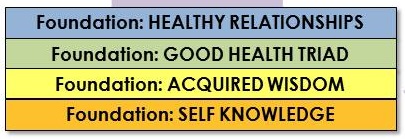
The Foundation is now made up of four sections, with the new addition of Healthy Relationships. This means that the four sections are Self Knowledge, Acquired Wisdom, Good Health Triad and Healthy Relationships. I realised through reflection and exploring what makes life fulfilling that I had omitted a significant aspect of all our lives, which is the relationships that we have. I will go into this in more detail later in this blog post.

Self Knowledge

I have put Self Knowledge at the bottom of the Foundation, as I believe self knowledge is the rock upon which we can build the foundation of our lives. If we do not know ourselves well then how can we know what we want out of life, what we value and what we believe. Self knowledge is the basis of what we think, say and do. If we do not have a good understanding of ourselves then we will be guessing what we want out of life and everything in it will be half-hearted and will not bring about fulfilment. We will also be living life either reacting to the events within it, not really having any direction or plan, or we will be living out other peoples plans for us, and our true selves become lost in a life wasted.

It has been a philosophical imperative since the days of Socrates to “Know Thyself.” It is also sage advice, as it will dictate what we get out of life, and whether you believe we only have one life or not, if we follow the path of others and do not explore what makes us who we are we will likely not spend our lives well, because we will not be forging our own paths through life.

Acquired Wisdom

Self knowledge will only get us so far in life. It will help crystallize what we want out of life and how we want to live, but we can still make mistakes along the way. Part of a life well lived is being wise about the choices we make and how we spend our time. The wisdom of others can help us here.

Whether you are a religious person or not our human history is filled with the words of wiser people than us. The wisdom of humanity comes from religious and philosophical writings, from scientists, from the native peoples of the world and from our own parents.

It is important not only to listen to the wise words of those around us, but also to become avid readers. Acquiring the wisdom of others and applying it to our lives can mean that not only do we not have to rely solely on trial and error, but also we spend the time we have exponentially better. It helps us live more deeply and to be able to look back at the end of life and say we lived well.

Good Health Triad

The Good Health Triad is three areas where we should aim to have good health in order to have good wellbeing. The first is the most obvious, it is good physical health. Going to the gym once in a while won’t be enough. We need to consistently exercise to our level in ways that are not detrimental to our health. For some gentle and often is better, especially if they are physically disabled. For some running marathons is good for them. Find your exercise routine at your level.

This also means a good diet. Not just eating everything that we are told is good for us, but rather figuring out the best diet for your body. This could be more vegetables than fruit to keep your diet more alkaline than acidic, it could mean spicy food or not, it could be dairy free. There are lots of options. This involves research, listening to your body and trying different types of food. Most diet advice is good, but don’t go for every fad diet that pops up in the media. Find your best diet and go to see a nutritionist if needs be.

The third element of the Good Health Triad is good energy health. As Chinese medicine discovered a long time ago, and Western medicine is slowly accepting, we have an energy system that allows Qi or Chi to flow along the meridians within our body. Much like our blood flows through our veins and nerve signals travel through our nervous system, our Chi flows through our meridian system. If our Chi does not flow freely or is unbalanced our health deteriorates.

Practicing Qigong or Tai Chi every day can help, as well as going for Acupuncture or Qigong Acupuncture, which is done using the practitioners own Chi instead of needles, will help to maintain good, healthy Chi. Ensuring we cover all three areas of this Good Health Triad will mean we live longer and feel better, so we are more able to achieve what we want to achieve, do what we want to do and live fulfilling lives.

Healthy Relationships

We all have relationships, with our family, our friends, our partner, our work colleagues, and so on. Some relationships are better than others, but I would argue that they should all be healthy relationships. What I mean by this is ideally we should not have any relationships in our lives that are detrimental to our wellbeing. Relationships that cause us stress, anxiety or self loathing need to be removed from our lives. Stress is something that can have such a negative impact on our health that people can die due to the consequences of stress on their bodies.

Those we have relationships with, in whatever area of our lives, should lift us up and make us feel connected. They should make us feel like we are part of something, a collective of good people. Our relationships should make us happy more than sad.

We should also try to cultivate our good relationships so that they grow and become stronger too. All relationships need maintaining through spending time with those people, finding out what is going on with them, being there for them when they need us and not only caring about ourselves.

The biggest barrier to healthy relationships in our current culture is mobile phones and tablets. People are spending more time on their devices than with each other, even if they are together they are looking at screens. If there is a momentary lull in the conversation there is an urge to pull out our mobile phones and scroll through our social media feeds.

Relationships are built on the little moments between other things, when we are waiting for a meeting to start or for a bus to arrive we can strike up a conversation, ask how someone’s day is going, etc. This is how we build strong, healthy relationships. We should also avoid things like gossip, which are corrosive to trust and cooperation.

Something to think about

What three changes will you make in line with this Foundation to improve your life and wellbeing in 2020?

Stepping Into The Unknown

“How can you know what you’re capable of if you don’t embrace the unkown?”
― Esmeralda Santiago, Conquistadora

In life there are many avenues to go down, many paths to take, or not as the case may be. Some of these paths lead to dead ends and some to wonderful opportunities. The challenge we have is that we never know beforehand, for certain, if making a particular choice will bring a positive outcome or not. Each time we are stepping into the unknown. We can, however, as the saying goes, learn from our mistakes and use our experience to weigh up the options and then make a decision. Some say we should go with our gut, with what feels right, but if this is not tempered with wisdom and experience, then we will only be following our instincts, which are primed for survival, not necessarily leading a fulfilling life.

The unknown could be a new job, a new relationship, trying a new hobby or something that changes lots of things in our lives, like moving to another town or city. We make these sorts of changes every day, but they still come with uncertainty and some anxiety. Each new change begins with a decision and leads to more decisions along the way. I would argue that no approach to making decisions is the best or the worst, as we each live individual lives and we are all individual people, but there are some things that can help when we are stepping into the unknown, which I will come onto in a moment.

However, first of all I would like to explore why we might feel the need to step into the unknown. It has long been part of the human spirit to push beyond our boundaries into uncharted territories. Human history is full of examples of men and women that have strived beyond the boundaries of their day to create new innovations and break records, whether this is manned powered flight or reaching the South Pole on foot.

For most of us such challenging goals are not things that we aim to do, partly because we are interested in other things and partly because we have commitments in our lives that need our attention and focus. That being said, we all have things that we are passionate about, things that we would happily do for free if time and circumstances permitted. This is the unknown territory that I want to talk about today, the venturing into the things that we are passionate about. Often, we don’t jump into our passions because we have responsibilities that we feel we must commit to or we lack the confidence to do so.

More often than not we do not follow our passions because we have had bad experiences trying new things in the past and we think that the same thing will happen again. There is an important principle connected to this that I have recently been trying to apply in my life, which is that the past does not equal the future. A lot of people, including myself, are held back by failure, because based on past experience we expect to fail again. The problem is that we see failure as a negative thing because of our past experiences. If we accept that we will fail sometimes then we can employ all of the resources that we have to make it work and to succeed.

We also live in a time when almost everything is instant. Whatever it is you want to buy, often there is an option to have it delivered the same day. We can do our banking on our mobile phones, we can send an email to someone and they will receive it a few seconds later, no matter where in the world they are, as long as they have an internet connection. Innovation has made our lives a lot more convenient, but not easier. This is because we expect everything to be instant, but many of the important things in life take time and effort. For example, relationships take time and effort to become strong and durable through the ups and downs of life. It is the little moments of asking how someone’s day is going and caring about the answer, of engaging in small talk in the moments between doing other things. These things help to build strong, healthy relationships.

Too often we are spending time with people without spending time with them. I’ve seen couples at restaurants where they are both on their mobile phones and not looking at or communicating with the person they came to the restaurant with. It has become an accepted thing to do to scroll through our Facebook feed on our mobile phones, instead of making a connection with the person we are with. This has had a knock-on effect that means young people are finding it difficult to build relationships, because the social skills that are normally built up through trial and error as a child cannot be practiced if they are looking at a screen and not a person.

Failure also seems all the more magnified because if we expect things to be instantly successful, and if we fall at the first hurdle, we give up. We are becoming conditioned for insecurity when we should be conditioned to fail our way to success. I guarantee that every successful person who is famous for their success has failed more times than most other people have tried. It is not about how many times you get knocked down, it is about how many times you keep getting up and try again. Having this sort of mentality will enable us to stride forth into the unknown with the confidence to fail and try again.

For this to work, however, we need to have the right motivation. Wanting to be successful so that we can be rich is a motivation, but it will inevitably lead to an emptiness, because you cannot buy happiness. If, on the other hand, we want to be financially successful so that we can help more people live better lives, then fulfilment will be our reward. Motivation is key and it has to fit with our values and beliefs, this above all else is important, because to live a fulfilling life our thoughts, speech and actions should reflect what we value and what we believe.

But where do our beliefs and values come from? They are manifestations from the culture and community we grow up in, the examples our parents give us and how they raised us, as well as the education and experiences that we have had. Through all of this input we piece together what we believe and what we value. All of this then effects the decisions that we make on a day to day basis, but I believe that if we are to make wise decisions in life then we should be wisdom seekers, and I believe that wisdom can be found in any of the many religious scriptures and philosophical texts from around the world, amongst other places. If we have wise guidelines or principles to follow, then stepping into the unknown will seem less scary.

Something else that can help us in our ventures into the unknown is to have an attitude of asking ourselves “what if…?” What if we tried something new, what if we gave it a go, what if? Being open to the many positive possibilities that could result from trying something new means that we will more likely have a positive outcome. It is also a way of getting past the barrier of failure, a way to overcome our fear of criticism or looking like a fool; what if we succeeded, what if we achieved our dreams. This allows us to consider the possibility of actually succeeding, rather than becoming consumed by the thought of failure.

For me, this is a call to action, for us all to be a beacon of light, because we went first, we stepped into the unknown unsure what will happen, but with faith in the idea that there are benefits in both failure and success, and that our values and beliefs will guide us towards a better world. To strive for a world where everyone respects the inherent worth and dignity of every person. If we strive to be the light for those around us, then we will become beacons for good and we can dispel the bad in the world, bit by bit. It also means that others will be the light for us as well, this is what being part of a community and a fellowship is all about. If we can achieve this, then we can walk into the unknown and bravely accept what is before us on our path.

I would like to end with a poem entitled, Our Deepest Fear by Marianne Williamson, which speaks to what I have been discussing today. It mentions God in the poem, but if your beliefs that do not include God, then please think of the word God in the context of your own beliefs.

Our Deepest Fear
By Marianne Williamson

Our deepest fear is not that we are inadequate.
Our deepest fear is that we are powerful beyond measure.
It is our light, not our darkness
That most frightens us.

We ask ourselves
Who am I to be brilliant, gorgeous, talented, fabulous?
Actually, who are you not to be?
You are a child of God.

Your playing small
Does not serve the world.
There’s nothing enlightened about shrinking
So that other people won’t feel insecure around you.

We are all meant to shine,
As children do.
We were born to make manifest
The glory of God that is within us.

It’s not just in some of us;
It’s in everyone.

And as we let our own light shine,
We unconsciously give other people permission to do the same.
As we’re liberated from our own fear,
Our presence automatically liberates others.

How To Achieve Your Dreams

Cherish your visions and your dreams as they are the children of your soul, the blueprints of your ultimate achievements.

Napoleon Hill

Imagine swimming through jellyfish and shark infested water for 53 hours without stopping. Imagine the training necessary in order to prepare to swim such a distance. There is a stretch of water between Cuba and Florida that is 111 miles that no one, since it became a goal in the 1950s, has been able to swim across. Diana Nyad is a marathon swimmer who had a dream of swimming this stretch of treacherous water. She has a team of around 30 people, shark experts, nutritionists, navigators, etc and they had tried 4 time before. She almost died on one attempt due to being stung by a Box Jellyfish.

In 2013 Diana Nyad at the age of 64, on her 5th attempt, made it across this stretch of water. The only person that I am aware of to have ever done so. Her mantra on this attempt was “Find a way.” She said in a TED Talk entitled “Never, ever give up“, where she talks about this dream and achieving it, that she is in the prime of her life at 64 years old, and I believe her. When she staggered up onto the beach in Florida after more than two days of constant swimming, she had three messages. Number 1, you should never, ever give up. Number 2, you are never too old to chase your dreams. Number 3, it looks like a solitary sport, but it’s a team.

Now, we are not all going to be endurance swimmers, or even want to be. The message is not about specifically what Diana did, it is about how she did it. She had a dream and rather than let the pursuit of that dream fall into apathy she studied everything she needed to know, she trained consistently, and she never, ever gave up. No matter what she found a way. We all have dreams, for some of us it is a hazy inkling of an idea, for some of us it is crystal clear, but for all of us the dream will not achieve itself. It takes drive and passion and consistent effort, and above all else the willingness to fail trying until we succeed. It is about failing our way to success.

In my opinion, life should always be a striving to live life well, to find fulfilment, joy and happiness, and to bring these things into other people’s lives as well. Life, like Diana said about marathon swimming, sometimes can appear like a solitary sport, but it takes a team. Our dreams are individual, but to achieve them it takes a community of friends, family and colleagues.

So, firstly we need to figure out what our dream is, something that is individual to us. Secondly, we need to research how we can achieve this dream. Thirdly, we need to create a plan to get from where we are to where we want to get to. Fourthly, we need act on that plan everyday, even if the steps are small. Fifthly, we need to look for and accept help from those around us, life is always a community effort. And lastly, never, ever give up.

Something to think about:

What dreams have you heard that others have that resonate with you? What do you value in life? What makes you happy? What pursuit could be your dream? Think about these questions and figure out what your dream is and how you can work towards it. #LiveDeeply my friend.

Making The Most Of 2019

“There is a plan and a purpose, a value to every life, no matter what its location, age, gender or disability.”

– Sharron Angle

Why new year resolutions are hard

At the first month of every year the same phrases are banded around, “new year, new you,” “make 2019 your year,” etc. It is also the time when we set new year resolutions that we rarely keep past the end of January. I think this is because we set resolutions that are picked from the collection of universal resolutions that are suggested by our culture. The key, I think, is not to find a resolution that we want to do, though this is important, but to figure out why we want to do it. Why do we want to lose the weight or give up smoking. What is our motivation?

Resolutions are typically hard to keep up, which is why we tend to give up on them a few weeks in. We will give up on anything that is hard unless there is a compelling reason to continue. This reason has to be either a serious one that affects our health or well-being if we don’t, or it is in alignment with our ‘why’, our reason for being.

Finding your purpose

The beginning of a new year is always a good time to take stock of our lives, look back at where we have been and decide on where we are going, but more important, I believe, is to figure out our why. This is a key component of living a fulfilling life. I recommend that you have a look at something called Ikigai, pronounced ikee-guy. This is a Japanese method of figuring out your priorities and motivations, to find your purpose for being.

It works by asking you to put things from your life into a Venn diagram with four categories and four cross-over areas.

Finding Your Reason For Being

I found it beneficial to start with What You Love, then What You Are Good At, then What You Can Be Paid For and finally What The World Needs. Then to fill in the things that fit both categories in the cross-over areas called Passion, Profession, Vocation and Mission. This order worked for me, but you can do it in any order you wish. The aim of Ikigai is to figure out what your passion, profession, vocation and mission are, and they should be based on deep self knowledge. Ikigai is achieved when all of these are aligned with each other in your life. It is the sweet spot of purpose and being.

Once you have found your Ikigai you will have your mission, your profession, your vocation and your passion. Whatever order you decide to complete you Ikigai Venn diagram in, I believe that our mission should be the driving force behind all areas of our lives, it is essentially our Why. Your profession is important because it is necessary to work, so you can pay your bills, but it also affords the biggest opportunity to bring your mission to life, because we spend most of our time each day working.

If you are going to set a goal for 2019, if you have not already, I would work through the process of figuring out your Ikigai and find one big change that you want to make, something embedded in your Ikigai. If you do, it will bring into view the metaphorical mountain that you are going to climb. The summit is your destination, your life’s purpose will show you a big achievement that you want to complete. Once you figure this out you will be at your base camp looking up at your mountain.

Finding a mountain to climb

Next, plot your path to the summit. Like all good mountain climbers, reverse engineer your journey from the summit back to the base camp and then get started. It is time to take the metaphorical mountain that you have been putting off or have not been aware of. Once you have a big 2019 goal don’t let yourself get in the way. Build rituals and habits that support your climb and jettison your unhelpful habits. And don’t forget to use your Ikigai Venn diagram as your compass, because every decision, your thoughts, speech and actions, should come from your Ikigai diagram.

This might all seem like a big undertaking, but remember, small steps count too, as long as you are going forwards. Draw on the support you have around you and find someone that you trust to share your big 2019 goal with, so they can be your accountability partner to keep you on track. Many believe that you only get one life, but even if you believe in reincarnation, it is best to make the most of this human life. I wish you good Ikigai my friends, so that you can live blessed lives in order to be a blessing to others.

Something to reflect on:

Purpose in life should be an equal balance of following our heart and making the world a better place than it was the day you were born into it.

Bring on 2019

“Everything can be taken from a man but one thing: the last of the human freedoms—to choose one’s attitude in any given set of circumstances, to choose one’s own way.” 

– Viktor E. Frankl, Man’s Search For Meaning

Bad experiences 

Many of us, if we think back to our childhood, our teens or our early adulthood, we can think of bad experiences that we have had, like bullying, breaking an arm or leg, parent’s separating or big disappointments. I sincerely hope these experiences for you were not too traumatic, but I feel safe in saying that no one grows up without some of, what we could consider to be, bad experiences. Often these bad experiences involve being embarrassed, upset, humiliated or injured.

All of the bad experiences we have get carried around by us as we grow, mostly unconsciously, metaphorically speaking. They even have an impact on our day to day decisions and on our relationships. They become part of the prism through which we see the world.

Fear of the past becoming the future

These bad experiences can become underlying fears or anxieties that shape our behaviour, sometimes in unusual ways. We often gravitate towards  what we know, even if it is bad for us, because it is familiar, it is not the unknown, which we can be the most afraid of. In evolutionary terms we have a deep, ingrained suspicion of the unknown. Historically, this has kept our species alive. To be suspicious of a shadow could mean that humans avoided being eaten by wild animals. Today, we are often suspicious of other people’s motives when they are nice to us or of experiences that are alien to what we have experienced before. 

However, this suspicion becomes a present fear when it comes from a bad experience we have had in the past, and if we allow it to remain unresolved in our minds the fear can grow and become a barrier to our happiness and success. The fear manifests as anxiety, and the more extreme the bad experience the greater the anxiety usually, especially if there is an unknown element to the situation that we are anxious about.

Attitude is everything

Something that has helped me overcome my anxieties is to figure out the unhelpful belief that is creating the anxiety. Often this is unconscious and some work is needed to figure this out. Writing a journal about your anxiety can help. Once we have the unhelpful belief we can then find a belief that will act as an antidote, something we can use to replace the unhelpful belief.

An important way to think about all of this is that often we let our bad experiences in the past control our present and our future. We let the drive to avoid experiencing the same bad situation dictate our decision making and the things we say and do. We let our past control our future because we, whether unconsciously or not, believe that our past will be repeated. But I am here to tell you that your past does not equal your future. We have more control than we think about what our futures will be like, because our future is largely a result of our decisions, actions and behaviours of our present.

It is true that our present is a result of our past, and we cannot control or change the exact present moment, because of this, but we all have control over how we respond to the present and what our future will be like. In any situation the one thing we can always control, if we practice enough, is our attitude. Even in the Nazi concentration camps, in the most dire of situations, there were inmates who would go around making sure everyone else had food, water and whatever minor comforts where available. As evidenced in Viktor Frankl’s book Man’s Search For Meaning, which documents his experiences in such a camp.

Taking on a newyear

So, if 2018 was not a particularly good year for you it does not mean that 2019 will be the same. The same is true if you had a good 2018. We cannot control everything that will happen in our lives, but if we firstly control our attitude to the events in our present and our past experiences, we can live positively and make positive decisions in each moment to make our future’s as awesome as they could be.

If we develop positive beliefs that we use to replace negative beliefs we can build our resilience to the difficulties in life, so we can rise above them and begin to fly. It is not about how many times we get knocked down by life, but rather the act of getting up every single time and taking on whatever lies before us on our path.

In 2019, build up your resilience, grow your relationships, build up your health, and seek opportunities. The opportunities are always there, but we have to have a positive mindset in order to see them and then take advantage of them. The world needs the things that only you can bring into it. You are needed to make the world a better place. I wish you a happy new year and an awesome 2019 and beyond.

Something to reflect on

Normally at this time of year we set new year resolutions, which we often do not continue with beyond January. However, I suggest you endeavour to have a positive attitude whatever the circumstances, however difficult this may be.