5 Books to help you get your life on track

“Books are the training weights of the mind.”

-Epictetus


Books, it has been said, are windows into the soul and the doorways into dreams, but they also have the function by which we broaden our minds, sharpening our intellect and help ourselves live better lives. They are signposts on the path to happiness, success and fulfilment, the ingredients of a life well lived. These are 5 books that I believe will lead to a life well lived. They span the categories of health, self-improvement and spirituality. All three of these categories relate to the Foundation in my Fullfilment Framework, which is an evolving framework which I believe will lead to living a fulfilled life. (You can click on the titles of the books to take you to Amazon should you wish to buy a copy, though there are many other excellent online outlets where you could buy the books).


1. Start With Why, How Great Leaders Inspire Everyone To Take Action by Simon Sinek


“There are many ways to motivate people to do things, but loyalty comes from the ability to inspire people. Only when the WHY is clear and when people believe what you believe can a true loyal relationship develop.”


I am going to begin with Start With Why, an excellent book for figuring out your own ‘Why’, whether as an individual or as a company. Our ‘Why’ is our purpose, our reason for being, it is the thing that is behind every decision we make and every action we take, it is an essential part of our mind, body and soul. Our ‘Why’ is formed by the time we are in our early 20s, but many of us do not know what it is, or we do but we do not understand it well enough to utilise it in making a fulfilled life for ourselves. It is only now in my mid-thirties that I have figured out my ‘Why’, which is to help others be fulfilled in their lives. My Why is the motivation I use when at work, at church, with friends or with family, it is also the reason I have begun writing this blog.

This book takes us through the world that does not start with Why and the consequences of it. It then goes on to talk about the biology of our human brains and how the concept of Why is in harmony with our biology. It then goes on to discuss the successes various famous people and companies have had because they know their ‘Why’. The book is an excellent introduction to the concept of having a Why and it will help you figure out what your Why is, so you can align your life with it.


2. The Motivation Manifesto by Brendon Burchard


“We must ask: When will we be ready to ascend to another level of existence.”


This book is about focusing your life for success. It begins with ‘The Declaration of Personal Power.’ It is about reclaiming our sense of self and channeling our energy into self renewal and success in our lives. Section One in the book looks at our human nature and how we are affected by freedom, fear and motivation. We have conditioned responses to each of these, but if we were to take control of our responses then we can be free, courageous and generate our own motivation.

Section Two goes through a list of nine declaration on what we shall do, for example, “We Shall Reclaim Our Agenda” and “We Shall Defeat Our Demons.” These declaration empower us to be in the driving seat of our lives so that we can make our lives magnificent. This is something we can all do, every single one of us.


3. Healing Foods, Eat Your Way to a Healthier Life by Neal’s Yard Remedies


“The food we eat has an overreaching effect on our health and well-being, whether we are conscious of it or not.”


This book contains a wealth of knowledge about how food can be used to heal and to help us live a healthy life. It begins with different dietary patterns and diversity from around the world. It compares GM foods to food the way nature intended (organic) and it goes through the benefits of supplements. The main body if the book is an extensive look at the foods that heal. The food types are divided into Fruits, Vegetables, Nuts, Seeds and Sprouts, Medicinal Herbs, Culinary Herbs, Cereals and Grains, Pulses, Spices, Fats and Oils, Fermented Foods, Meats, Oily Fish and Other Foods. There is also a section with some wonderful Recipes That Heal and recipes set out into daily meals and types of foods. For a healthy body and a sense of well-being, our physical health is essential. Everything tat we eat and drink becomes our bodies, we are what we eat.


4. The Way of Qigong, The Art and Science of Chinese Energy Healing by Kenneth S. Cohen


“Qi is the Chinese word for “life energy.”… …Gong means “work” or “benefit acquired through perseverance and practice.” Thus, qigong means working with the life energy, learning how to control the flow and distribution of qi to improve the health and harmony of mind and body.”


Qigong is an ancient practice of generating and controlling the energy that flows through our bodies, which is a distinctly Eastern practice and a major part of Chinese medicine. In the Western model of medicine the focus is on treating the symptoms without trying to find the cause(s). I have experienced this first hand with my onset of Fibromyalgia. I went to see a variety of experts who could only see their specific section of the body and its functions, but having been treated by practitioners of Chinese medicine I can vouch for the fact that the focus is more on the whole body and fixing the cause of the illness, to bring the body back into balance.

This book firstly explains what Qigong is, its history and scientific evidence proving that it works. It then explains Qigong basics, ways of using Qigong to heal yourself and living a Qigong lifestyle. The book goes into a lot of depth, but explains everything in a way that makes sense and is easy to follow, with physical practices that are not very different from Tai Chi. In the West energy healing, or Qigong, is little known about, but it is slowly filtering into our culture in the same way that Martial Arts, Yoga and Tai Chi have done, it is only a matter of time.


5. Spiritual Renegade’s Guide to the Good Life by Lama Marut


“This book is for desperados. It’s for those who know life is short and who are tired of wasting day after day in low-level unhappiness as they wait for the next high-level version… …It’s a guide for those tired of trying to become well-adjusted to a perverse society and who are willing – even eager – to deviate from the norm.”


This book comes from a Buddhist standpoint, but it acknowledges the teachings of other world religions, and takes a common sense view of how to live a spiritual life, which, as every Prophet and Sage has taught, usually goes against the system. In our case it goes against the Capitalist culture we live in, which is designed to keep us unhappy, so we will keep buying things to keep the economy rolling on. Stepping off this hamster wheel and fighting the power by being content is the first step, because contentment is entry level happiness, the first step towards enlightenment, or perfect happiness.

What I like about this book is the short sections within each chapter which allow us to absorb the points made and practices suggested. There is also a Couch Potato Contemplation and an Action Plan at the end of each chapter. The Couch Potato Contemplation is something to reflect on from the chapter that you have just read, but rather than treating it like a serious meditation, it is something to just sit and think about while sat on the couch. The Action Plan is a behaviour to try and embody based on the teachings in the chapter we have just read, something simple but that challenges the status quo for the better. Each section also has a QR code that we can scan with our mobile phone, which takes us to YouTube Videos of Lama Marut giving teachings related to the section we have just read, to embed the learning and explore the ideas presented.


There is a Recommended Reading List on my blog site that has these books and many others under the categories:

  • Happiness, Health and Success
  • Theology and Philosophy
  • History and Science
  • Fiction


Resources


YouTube Channel of Dr John Bergman, who talks about how to achieve good health naturally without chemicals like medication.

YouTube Channel of Lama Marut, a Buddhist Lama who teaches deep Buddhist teachings in easy to understand lectures.

Website of Jim MacRitchie, a Qigong Acupuncturist who teaches Qigong classes (There are free Qigong resources on this website).

Website of Simon Sinek, discussing the concept of ‘Why’ and resources to use this concept to improve your life and that of others.

Mini Reflection: Success depends on necessity 

Quite often we know what we have to do to be successful. Most of the time we know how to do what we need to do as well, but we don’t do it. Something inside us, some doubting voice in our head says it is too difficult or it will end in failure, so we don’t take action and success remains illusive. Breaking through this mind barrier to take the action that will bring us success is not easy, but it is possible. What we need to do is make these actions a necessity. As Tony Robbins tells us, we have to turn our shoulds into musts. Success by necessity is how we can achieve success consistently. This is what I refer to in my Fullfilment Framework when I talk about raising your standards periodically. Raising your standards of what you expect of yourself, what your musts are. When you reach your current standards for yourself it is time to raise the bar and keep doing so. These standards need to be a necessity for success to manifest in your life.

– Fullfilment Project

Mini Reflection: Contentment and progress are not opposites

There is a temptation to discount the idea of contentment in favour of progress, as if they are somehow opposites. I would like to suggest that we need both of these things to feel fulfilled in our lives. The mistake that some make is believing that the acquiring of money and expensive things shows the world that they have progressed, but these shallow achievements will not bring happiness.

If the goal of progressing is to have more things and be more rich, then this will move us further away from contentment, because things and money do not last. Putting our hopes for happiness into these things takes control of our happiness and gives it to things which are out of our control. Things break and money is spent and gone as a result.

However, if our progress is rooted in our self development, in our ability to be better at the things we feel passionate about. If we acquire more knowledge and skills to do more and help more people, then our progress will be closely aligned with our contentment, as long as we are content with how we live our lives. The relationships, the opportunities and the necessities. If we can manage to be both content and to progress then we will live deeply and live well.
– Fullfilment Project

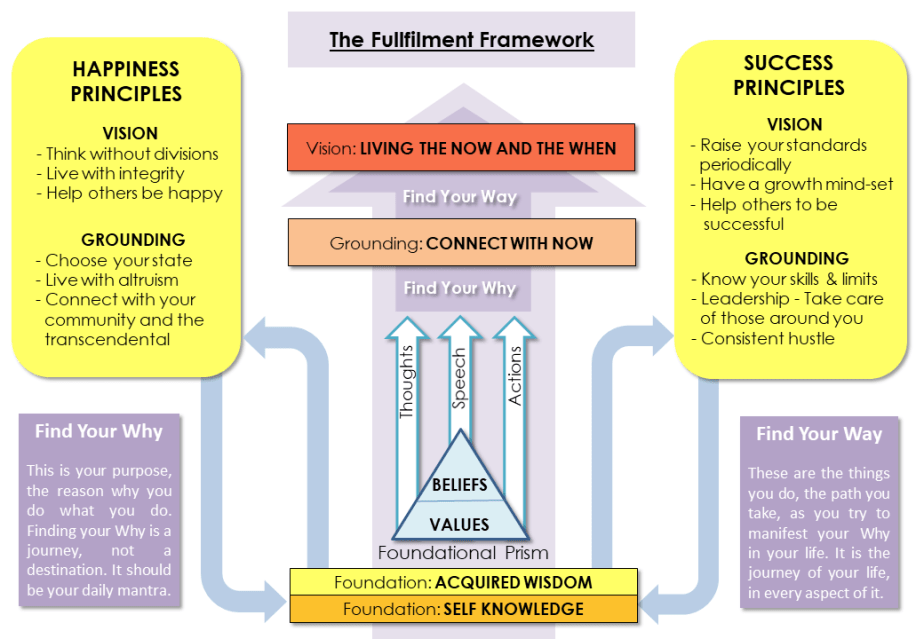
The Fullfilment Framework

This is a summary of the Fullfilment Framework, which is a framework aimed at helping you live a life full of happiness, success and, of course, fulfilment. This forms one of the pages on my blog, but I wanted to share the framework with the world more directly as well, so I am writing it as a blog post as well.

When talking about happiness, success or fulfilment the subject of setting goals is often centre stage, it is often seen as a pre-requisite of achieving these things. However, I believe that none of these three are things that can be ‘achieved’. I believe that they are a result of living well rather than a way of aiming to achieve happiness, success or fulfilment. I believe that fulfilment itself is dependent upon two pillars, the pillars of happiness and success, and each of these is dependent on how we live, rather than having these as the goals we set ourselves. For example, those who help others be happy are happy themselves as a result. Those who help others be successful become successful as a result, because they are trusted, respected and recommended by their peers. So, it makes sense to take actions every day that are in keeping with this philosophy. Many religious, philosophical and secular texts from around the world back this up, which I and many others consider to be wisdom. This is why I believe it is so important to actively acquire wisdom from such sources, on a daily or weekly basis.

I’m not saying that we should not set goals, of course we should, but the goals should be focused on the betterment of ourselves and others. For example, to live with integrity or to hustle (work hard) consistently. Setting the goal to be happy or to be successful is self-defeating, because these are states that we cannot go out and get, they are states of being, they are ways of living and to a large degree they are states of mind. For example, to be content with what we have is a catalyst for being happy in our lives. I believe that to be happy, to be successful and therefore to be fulfilled we have to break things down to key elements; our Foundation, our Why, our Way and our Happiness and Success Principles, which I will explain below.

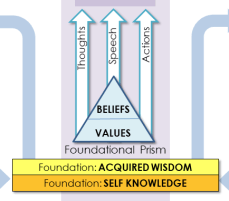
Foundation & Prism-Illustration of the Fullfilment Framework

It is important to have a deep knowledge of ourselves. To know thyself is an age-old command and one that will allow us to act in our best interests and live a good life. The combination of self-knowledge and the acquiring of wisdom culminates in what I call the Foundation of living a fulfilled life. This Foundation then allows us to discover and decide on what our beliefs and values are. This is who we are at our very core, and that which dictates what we think, say and do every day, based on our self-knowledge and acquired wisdom, or lack thereof. Our thoughts, speech and actions open or close doors, they create or obscure opportunities. Being the captain of our soul and the master of our fate, to paraphrase lines from the famous poem Invictus, means that we have a solid foundation, beliefs and values that we live by every day of our lives. Our beliefs and values are what I call our Foundational Prism, through which we see, understand and interact with the world.

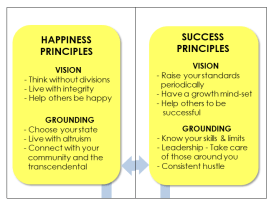
Principles-Illustration of the Fullfilment Framework

Our Foundation and Foundational Prism feed directly into the two pillars of happiness and success, and the principles I have associated with these pillars. The Happiness and Success Principles in the Fullfilment Framework are some of the things which I believe will result in happiness and success respectively. They are not a complete list, but I think they are likely to yield happiness and success. I have split them into actions focused on the present moment, which I refer to as Grounding and into actions focused on the present and the future, which I refer to as Vision. This is intended to be used as a way of being grounded in the present with the intention of living a good life moving forwards. The Vision is of the life we want to have had when we look back while breathing our last breath. It is living our legacy in the present moment.

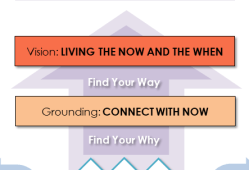
Why and Way-Illustration of the Fullfilment Framework

There is an important step that comes between the Foundation and the Grounding, and that is the finding of our Why. This is a concept popularised by Simon Sinek’s book Start With Why, which is about finding the reason why we individually do what you do, finding our reason for being. Yours or my Why is the star that guides us on our life long path.  Mine is to try and help others live a fulfilled life. Finding our Why can be hard, it takes a lot of soul searching and self-discovery. We have our Why formed by the time we get to our 20s, but many of us spend most of our lives not really identifying what it is. Finding our Why, however, is vital to living a happy, successful and fulfilled life. Once we know our Why the next step is to find what I call our Way. This is the thoughts, speech and actions we make every day to manifest our Why in our lives, and this is done through living the Happiness and Success Principles, and other acquired wisdom, as well as being true to ourselves. Living the Happiness and Success Principles, and other acquired wisdom, each day also feeds back into our self-knowledge, because every day of our life long adventure we learn something new about ourselves, and the cycle continues. All of this, I believe, will result in a fulfilling life.

This may seem like a lot to be able to do, but if you start small, by understanding yourself and reading, watching and listening to the wisdom of others every day, soon you will have your Foundation from which to build and to live your life well. This is not about being the best or the brightest, it is about finding what we were meant to be doing in this life, as well as the fact that a human life is a wonderful opportunity to make the lives of those around us better, to help them live fulfilled lives by helping them be happy and successful, to make the world better for the generations that will follow us, and for setting an example for them to continue in the same way. This is deep living, this is the path of fulfilment that we can all walk together.

Always strive to be inspired and inspiring.

#LiveDeeply    #FullfilmentFramework


The problem with To Do lists

If you are anything like me you frequently use To Do lists, but often it can seem like all we do is write lists of things that never get done. Sometimes we can create a massive long list, which seems overwhelming and as a result we distract ourselves by doing non-essential things like watching TV, scrolling through social media or playing video games.

The problem I think is that when we have the list written out we don’t know where to start, we have no system of prioritising the items on the list and we feel overwhelmed. I have struggled with this for years until I found a solution. I listened to lots of YouTube video where very productive people were talking about prioritising their To Do lists by the importance and the urgency of each item on the list. Now I use To Do lists very differently and have become more productive as a result.

Firstly, I write everything that I need to do as a list. Secondly, I categorise the items on the list by writing a number and a letter next to each item. Either a 1, 2 or 3  and an A, B or C. This is what these numbers and letters mean.

1 – Very important
2 – Important

3 – Not important

A – Complete as soon as possible
B – Complete within the next week

C – Complete in the next month

I can then prioritise the items by how soon they need doing and then their importance, so everything with 1A is complete first, then 2A and then 3A. I then move on to any item with B next to it and so on. What also helps is that when the items are prioritised I then add them to the calendar in my phone with reminders to get them done at certain times and days around other things like work, family and socialising.

There are also mobile apps that allow you to create To Do lists where the items can be moved around in order and categorised by colour, as well as adding items onto the app calendar. Some of these apps also sync the app calendar with the calendar on the mobile phone and email account. I recommend the To-Do Calendar Planner by isoTimer. This is only available on Android but is an excellent app.

Having these strategies in place means that your days are planned out and you will be more productive, and your To Do lists will work to your advantage rather than causing things to go undone.

How successful have you been with To To lists?

Starting the journey towards fulfilment

On the way to experiencing fulfilment we need a place to start. Every journey begins somewhere, but I don’t mean the day we were born or some moment of revelation. What I mean here is the creating of a foundation for our sense of self; the me, the I, the self. I believe that this Foundation has three parts to it.

The first part is a deep knowledge and understanding of ourselves. This comes from continuous  questions and answers about how we tick, how we see the world and what makes us feel the whole spectrum of emotions that we feel. It also means trying out new things and seeing how we respond to them. This can be done at any age but I recommend starting to do this in the first quarter of your lives. If you are further along your life journey like me, begin from where you are, as it is a continuous process. The art of fulfilment is in the act of living our lives well, and to do this we first need to know ourselves deeply.

The second part is the acquiring of wisdom. This should be a constant endeavour. Wisdom enriches our lives and guides us along our life long journey. Reading, watching or listening to wisdom every day will give us the ability to make wise choices, to behave nobly and to help others to live their lives well. Wisdom is never self serving, it is always focused on the greater good. It is the constant mixing of this self knowledge and acquiring of wisdom that builds the Foundation from which we experience and interact with the world.

The third part of this Foundation is what I call our Foundational Prism,  the prism of our values and beliefs that we view the world through. This prism affects what we think, say and do in every moment and is a major key to living a life well, and living a life well is how we can experience fulfilment. This Foundation is a kind of alchemy, a mixture of self knowledge, acquired wisdom, our values and beliefs. Fulfilment is not something we find, it is a biproduct of living our lives well, starting with our Foundation. This is deep living.

What is stopping you from getting to know yourself deeply?

Know where you are starting from

Sometimes we feel paralysed by life and we feel that we should be doing something greater, something better, but we are unsure what this is. Fear of the future and the regret of the past paralyses us. It is important to pay attention to both the future and the past, but we have to do this in the right way.

When we are fearful of the future or regretful of the past our mind is rarely in the present, we are fully focused on the fear and the regret. If we are not present in the moment then we are preventing ourselves from being happy or successful in the present. We cannot act in the future or the past, but we can act in the present, so to get out of this paralysis we have to focus on what is happening now.

I used to spend a lot of my time thinking about what the future may bring, what my life might be like without knowing what I wanted to do with my life. I was so focused on the future I was missing the present. This is something that many of us do. We either don’t have a clear idea of what we want to achieve or we do have an idea but we aren’t sure what we need to do to reach this achievement, because we haven’t researched what we think we want. To figure out what we want to achieve with our career or our health or our relationships, we need to research our plans and start from where we are. This process has three stages to it: Grounding, Reflection and Decisive Action.

Grounding.

We need to move our focus and ground ourselves in the present. Asking ourselves what we are happy with and what we are unhappy with, what we have control over and what we don’t. This is our base camp and the end goal will be the summit of a theoretical mountain. Knowing ourselves deeply is always the best place to start. If we know ourselves then we will make decisions in our best interests.

Reflection

Next we need to reflect on our past through the prism of our present. We should reflect on our experience, our skills, our strengths, our interests, our values and our beliefs. Understanding how all of these things make up who we are in this present moment is very important.

This will help us to realise two things. What our overarching purpose is in our lives and from this what we want to see manifest in our lives. Our purpose is our why, why we do what we do and the way we do it. My ‘Why’ is “Finding purpose is a path we all walk together, through helping each other find happiness and success,” which is why I write this blog. Your ‘Why’ will help you find what you want to manifest in your life.

When we find our ‘Why’ and what we want to manifest in our life, next we should research it and find out all of its aspects before reverse engineering the steps from where we are now to where we want to be.

These first two stages will not happen over night, becoming grounded in the present involves developing new mental habits, which takes practice and dedication. However, it does help to think of this as creating new habits which will replace old ones, rather than trying to remove the old habits. This is a matter of where we put your focus.

Decisive Action

When we have grounded ourselves in our present circumstances and reflected on our skills and experience, our values and beliefs, then the next step is to set steps to achieve on the way to the goal. These will be metaphorical milestone on the climb up the mountain to achieve what we want to see happen in our lives.

An important step that many miss out is to research the goals we want to achieve in order to clarify what is involved and, importantly, if it is truly what we want to see happen. Some goals are set because something looks or sounds good or others are doing it and it is right for them. Just as we reflect deeply on ourselves, we have to put the same effort into analysing our goals. If the research is not done then we may achieve our intended goal but it may not produce the fulfilment we expect.

We each walk through our lives picking up experiences and memories, skills and understandings. Our sense of self is formed like a sculpture chipped out of rock over time, bearing the marks of these things. Each of our lives is a journey and our happiness and success are shaped by everything we experience and everything we think, say and do. Therefore, in order to live fulfilling lives our goals need to match who we are. Ground yourself in the present, reflect on your past and this will help you reach your desired goals in your future, the summit of that metaphorical mountain.

What is getting in the way of you finding the goals that match your true self?

Fear of others

We live in a more and more insular society where communication is often restricted to the sending and receiving of words and pictures on digital devices. It reminds me of the short story The Machine Stops by E. M. Forster, about a future humankind that lives underground individually in hexagonal room, each exactly the same as the other, all over the world. The machine controls the air temperature, the lighting, the access to food and water and provides a way to communicate with others around the world through screens. No one travels or even leaves their room, life is solitary, lived through a global machine. This is an extreme situation but it resonates, I think, with the way we often communicate, or don’t communicate with each other today.

I often sit in social situations, like a restaurant or a pub, and the majority of people that have clearly come to this place together are not talking to each other, or even looking at each other, they are silently checking their social media on their mobile phones for snippet of other people’s lives and to see who has liked or commented on the snippets of their own lives that they have shared. It seems ludicrous to me that people socialise with others, without socialising with them, without interacting with them, they are just people who know each other that are in the same area. The rise of mobile phone technology and social media has created a rift in our culture between people, created by the lack of social skills needed to navigate human relationships. The generations growing up with this technology are failing to learn the social communication skills of holding a conversation with someone, sharing their thoughts and feelings with someone and are more likely to turn to Facebook than a person when they suffer from mental difficulties like depression or anxiety.

This is the problem, unseen by many, which has two parts to it.  Firstly, the more we use social media to communicate with each other the less able we are to have face to face interactions. The trial and error needed to learn these social skills while growing up happens less because there are less opportunities, due to the time spent on social media. These social skills are needed to have healthy, positive relationships with family and friends, romantic partners and colleagues at work. So many people become daunted by the idea of striking up a conversation with a stranger or an acquaintance, because they have not had the practice while growing up. Secondly, the very nature of social media means that we accumulate social media friends which agree with the things we believe in or do what we do, and it becomes very easy to remove a connection to someone by unfriending them; instantly cutting ties with a person with a click of a button, if their way of being clashes with ours. As a result we rarely engage with people we disagree with, so the skills needed to debate with others or to find our own values and beliefs become lost, because these things come from interacting with people we disagree with.

This all creates a situation where we are less likely to engage with people who are different from us, so we begin to fear people who are different. This might manifest in the belief that our town/city, country, religion, lack of religion, politics, language, culture, skin colour, home, car, family, friends are better than those of other people who are different. This manifests in the dislike of ‘foreigners,’ or people fro a different town or city within our own country, without the realisation that we are foreigners in the eyes of others too. In any culture, whether it is a country or a business, difference is an advantage. Life flourishes in the places where a multitude of species coexist. Creativity flourishes in the same type of environment, where difference is abundant. The ability to accept others who are different from us and to interact with them using an open mind and an open heart is certainly an advantage. When we become so caught up in our own ideologies we become tribalistic, we become extremist, we become intolerant, we become an us, as opposed to a them. In the Bible Jesus said “Love your enemies,” to me this means that if we love our enemies then we will have no enemies. Love is the antidote to fear. When you hear reporters or politicians referring to people from other places in terms of a them, reframe the situation in your mind and think of them as one of us. Our tribe is called mankind and we are in this together. There is only a ‘them’ if we choose to use this term to refer to other people. We are in control of how we see the world and each other. Let us disagree, debate and share our ideas together as a collective, so we can change each other for the better.

Question:

What beliefs or experiences in your life cause you to fear others?

The goal is not everything 

There is a growing trend in our culture today that allows us to obtain almost anything instantly. If we want to watch a film we put on Netflix, if we order something it can be delivered the same day, if we are hungry we can go to a fast food place and get food in minutes. This expectation of receiving things straight away is spreading to the world of work and of personal success, because for many it has become a natural part of our thinking, we habitually assume this applies to all things.

Part of the problem is the development of mobile technology, specifically the use of apps on mobile phones. We can now talk to anyone in the world, find a date, find a friend, buy things and manage our money instantly. Those who have grown up with this techology are succumbing to an instant gratification mindset.

If we use the analogy of a mountain to description the goals we set ourselves, professionally and personally, then the summit would be the goal and base camp would be where we are beginning from. In our current culture of instant gratification we often focus on the summit forgetting entirely that there is a mountain between where we are and where we want to get to. This has a sad side effect, which is that when we only focus on the goal we will inevitably feel like we are failing until we get there, and if we feel it should be a goal we reach soon then the instant gratification mindset compounds the problem.

What we need to do is twofold. Firstly changing our focus from the goal, and nothing else, to a focus on the process that will get us where we want to go. The goal then becomes where we set our compass to and the process becomes our preparation,  whether we work as a team or go it alone, the map that we use and the targets we set along the way. To continue with the analogy of the mountain, we can set camps that we aim to get to after we leave the base camp. These are the stages of climbing the mountain. There can be as many target camps as you like and reaching each one will be a success.

Secondly we need to cultivate patience. Some goals take a long time to get to, and that is OK. You cannot climb a mountain in a day. Sometimes there is a lot of preparation that needs to be done before getting to the base camp. Sometimes set backs occur and alternative roots need to be taken. Patience is also a skill that needs practice, which ironically can take a while to master.

So, if we change from focusing entirely on the goal to the process we do to get to the goal, with targets to achieve along the way then our success will be measured by the progress we are making not reaching of the goal in the end. If we feel successful we are more likely to work harder, feel happier and be more creative. This mindset of working towards our goals one step at a time can be cultivated in ourselves, but what really needs to happen is that our work places create a culture where progress towards goals is favoured over the achieving of goals over everything else. If this is achieved colleagues will feel encouraged to work harder and feel safe enough to try and fail and try again. This is how innovation happens.

What are your views on prioritising progress towards a goal over prioritising achieving the goal over everything else?

Don’t let where you’ve come from ruin where you are

There are many of us that have gone through mentally challenging times in our lives, and the memory of these times can be carried with us during each day. These experiences can cause anxiety and stress to permeate the various parts of our lives, causing our past to corrupt our present.

But it doesn’t have to be like that, we don’t have to let where we have come from ruin where we are now. So many people act as if they are still in a bad situation which they have been delivered from, still going on and on about it, talking about how other people couldn’t possibly understand the trauma and the tyrrany they went through. Some experiences that people have gone through will need specialist support allow them to move on and move forward and can be hard to do. What I am talking about is the other bad situations that don’t required specialist support, they just need the person to move on.

The problem is that people will treat you differently depending on how you present yourself, and if you are nothing but negative you might not be invited to that event or hired for that job or asked out on a date, because you are living as if you were still in a past situation. This is one of the ways that people let their past ruin their present.

It is better to put on a fresh attitude, to drop the issues of the past and be positive about the here and now. If you spend your time focused on the past you will miss opportunity after opportunity in the present. Our attitude to our circumstances is the barometer of how others view us, either positively or negatively. What we ideally need to try and do is to be positive about our present circumstances and to leave the past in the past. This can be hard to do sometimes depending on the severity of the circumstances we have been in.

I do think that some people like to have a moan, as a way of getting attention. This is the wrong kind of attention, in terms of building positive relationships. Our relationships are the framework of our lives, they interlink our family life with our friendships with our work life with our hobbies, etc etc. It is our human connections that largely encourage the happiness in our lives, along with how we view these relationships. If those we care about and those we meet for the first time only see the negativity we are emitting then they may well not want to spend time with us or connect with us. Choosing to moan about the negative can be detrimental to our relationships,  which is in turn bad for us.

We are only human, as the saying goes when we refer to our frailties, but we also must take responsibility for how we think, speak and act. If there is an option of being positive or being negative, and there often is a choice if we take a look, then being positive will always be the better option. The more we make the choice to be positive the more it will become a habit, and the old mental pathways connected to our previous negative circumstances get replaced with better mental pathways, better mental habits.

Have you ever felt a shift of positive change happen in your life when you left bad circumstances in the past and focused on the positive circumstances in the present?

Standing by your principles 

The recent political debacle in the UK has highlighted to me the need to stand by your principles, and to spend time working out what your principles are, because they are the framework for every decision you make and every action you take. You could say that your principles define you, so you need to firstly define your principles, but is it as easy as knowing what your principles are?

During political elections like the one we have just had, principles play a very important role. When we decide who to vote for, we usually look for people who have similar views to us on important matters like education, the health service, housing etc, and we look for a political leader that we feel will stick with these principles when making big decisions about the big things that effect our lives. However, we see very often that political leaders do not always do what they say they are going to do, which leads to a lack of trust and cynicism sets in. Consistently living by your principles builds trust and respect from others. So if we want to work well with others we firstly need good principles and then we need to stick by them in the hard times and the good.

What is it though that makes principles good? The thing that I think is a large indicator is the effect it has on others. For example, if we believe that money will solve all of our problems, then we may well sacrifice relationships to get more money, hurting others in the process. If we believe that we should be completely honest all of the time then, for example, telling someone that they are fat will have a negative impact on the other persons self esteem. Money and honesty are not bad things in and of themselves, but the application of them should be for the greater good for both of ourselves and others, which should form part of the principles we hold.

Even though, I believe that fundamentally our principles should come from our own views on the world and everything in it, we should be open to the principles of others. It is only when we actually listen to the view points and principles of others that we can shape and sculpt our own. We all begin with the view points and principles of our parents and our peer groups, but this should be the beginning of our life long quest to shape and sculpt our own principles. This being the case then we have to live in two states. The first is being open to listen to others and learning from them, so we can reflect on our own principles to see if they still hold water. The second is to stand by our principles in every situation. This will mean we make good decisions and we build trust and respect in the relationships we have throughout our lives.

Two of my important principles are:

  1. Kindness should be part of every action and every word.
  2. Generosity that is received should be shared with those who need it.

What are your principles?

Bringing a new focus to this blog

After much consideration I have reshaped the focus of this blog. I have come to realise that happiness and success are in fact the pillars which support fulfilment in one’s life. The goal of life is fulfilment, which is impossible without understanding how to achieve both of these pillars. This is the manifesto for my new blog, which I have renamed The Fullfilment Project, the aim of which is to help people live a full life.

Manifesto

The Fullfilment Project is about inspiring every individual to find fulfilment in their lives. I believe every human being deserves to live a fulfilled life, which stands on two pillars, that of happiness and success. These are two vital intertwined states of being. You may be beaten down by life and circumstances, you may be living a blessed life, either way I aim to inspire you to be a better version of yourself today than you were yesterday, and as a result to find fulfilment.

I will post weekly content aimed at inspiring you to be the best version of yourself that you can be, a self that is happy, successful and fulfilled. I will focus on personal development, setting goals, daily hustle and cooperation with others.

I am on a journey studying the best ways to find fulfilment in life, so that I can share my findings and help as many people as I can to achieve their dreams and feel fulfilled, because I have a vision of a world where everyone cooperates with each other to find happiness and success, and therefore find fulfilment.

If we know the way to find fulfilment then we have a responsibility to guide others to find it and when others know the way we have to be humble enough to follow them. Happiness, success and fulfilment can be found in cooperation with others, because when we help others find these things we find them ourselves. This is our fulfilment manifesto.

How to plan your career

When it comes to a career it can seem like navigating without a map or a compass, when these are in fact the exact things we need. The map shows us where we want to go and how to get there, while the compass provides the bearing to keep us on course. Some of us may have a working compass but no real idea of what we want our career end goal to be, and so we settle for a job that does not inspire or excite us, it just pays the bills.

What we need to do is find out what we were born to do, what we excel at and what we love doing. If we can find the right career then it will not feel like work.

I believe that there are four stages to finding the career you were born to do. I call the stages Foundation, Grounding, Vision and Actions. The Foundation is the Values you have, the behaviours and beliefs that shape who you are, it is your culture and your upbringing. Your values should form the foundation of your life, so exploring what your values are and having them in your mind will give you a compass to navigate through your life. It is important to check your bearings at regular intervals to see if you are still on course.

The Grounding, as I call it, is taking a good look at where you are now, in the present. What are your skills, experience and achievements? What makes you feel positive emotions and what makes feel negative emotions? It is an audit of your life and yourself, it is where you begin your endeavour towards your ideal career. This is the starting point on your map for success.

With the Foundation and the Grounding done you should have a better idea of where you want your career to go. Start with broad things like customer service face to face or working independently at home and then zone in on what role you really want to be doing. This is a big decision and listening to your gut can really help. The part of your brain that makes decisions,  called the Limbic brain, does not have the capacity for language and this is why we feel it rather than think it when we make ‘gut’ decisions. Listen to this and let it guide you. Once you have figured out your dream career this becomes your destination on the map to success. This becomes your Vision.

So how do you get from where you are now to where you want to be? Just thinking about what you should do here is not enough. You need a plan, but without Actions to back it up it will never happen. This is the forth stage. The best way I have found is to firstly list the actions you need to take. This could be training, shadowing someone, getting advice or applying for a position that starts you on your way to the career you want. This is essentially a To Do list, but as you may well know To Do lists often become lists of things we don’t get done.

To get past this there are some steps you can take. For each action write down why you should do it, followed by how you should do it and then, the crucial part, add a time frame for getting it done. A time frame puts pressure on yourself to get it done, and you can decide on the level of pressure by adding realistic timescales. Knowing why you should do the action also speaks directly to the decision making part of the brain, which thinks in terms of why rather than how and what, as Simon Sinek has taught us in his book ‘Start With Why.’

The reason why you do each action should be guided by both your values and your vision. This will keep you on course on your map for success. Once this framework is set up you will need to keep moving forwards, achieving the actions and following your values and vision, but the thing that is crucial is the application of consistent actions, every day, every week and every month. It may take years to get to where you want to be, but with patience and persistence I believe you can get there. You can have the career you want by following your compass and your map to success. Good luck.

Foundation: Values

Grounding: Skills, achievements and experience

Vision: The dream job/career

Actions: What, Why, How, Timescale

#career #findyourwhy #values #vision

How can we build a legacy?

Have you ever thought about what legacy you are leaving behind you? When I think of legacy my natural instinct is to think of big businesses and powerful movements that change the world, nothing that I would associate with myself. However, I am beginning to think of legacy in broader terms. I have come to realise that every person’s legacy will be unique to them, and it can be both positive and negative.

It is the long lasting affect we have on the world, which out lives us. It has to therefore be about other people, we cannot create a legacy if we only focus on ourselves, this is how people die regretting the impact they could have had in the world. We have an innate feeling that we want to be remembered, that if people remember us after we die then our lives will have had meaning.

I think this innate feeling is slightly skewed. The way to find meaning is to find purpose, and the best way to find purpose is to help others realise their dreams, even if this is just being supportive or being available to listen when people need us to. Often it means being a good friend or colleague. It is less about being remembered and more about the affect you have on the lives of those around you.

I hope my legacy will be the positive change I make in other people’s lives and the positive change they will make in other people’s lives, and so on and so on.

Finding your Why

You may have heard this banded about quite a bit recently with people on YouTube offering ways to find your Why. The motivational coaching space seems some what saturated with this since the book Start With Why was written by Simon Sinek and his TED Talk on the subject went viral on the Internet. But here’s the thing, finding your why is essential in order to find both happiness and success. It is your reason for being,  your reason for getting up in the morning. It is the reason why you feel so amazing when you do things that you love, and it should guide everything that you do in your life.

But how do you find your why? You start by find the things that bring you joy, the activities and life events that have a tremendously positive impact on your life, and then finding what links them. It took me until I was 35 years old to find my Why. It is now my philosophy for everything.

“Finding happiness and success is a path we walk together.”

If we collaborate rather than dictate then we find our happiness and success together, inspiring and supporting each other. This is why I write this blog every week, because I want to help others find both happiness and success. I do believe that we can all find both of these and that they are inseparable. This is my Why now go and find yours.

The relationship between values/beliefs and trust

“Value, by definition, is the transference of trust… …You have to earn trust by communicating and demonstrating that you share the same values and beliefs.”

– Simon Sinek

Our values and beliefs are the reasons why we say what we say and do what we do, our behaviours and decisions are the product of these values and beliefs. As human beings we are drawn towards others who “…share the same values and beliefs.” This is how we should communicate with each other, telling the world what we stand for and what we believe.

It can be as simple as saying please and thank you, which shows that we believe manners are important. And when we meet people who believe the same thing a connection is made. This is why we join groups and wear certain clothes, to fit in with a specific group.

Problems can occur when we try too hard to join a specific group that we want to be part of, but we are not being our authentic selves, the values and beliefs of the group don’t align with ours. If what we communicate through our actions and words is not authentically us, people will often pick up on this and trust cannot develop. Authenticity matters, even though it has become a popular buzz word. Knowing why who hold certain values and beliefs will influence how you behave, it brings a self confidence and is broadcast out to the world.

The same is true in business, because every client, customer and colleague is a human being, who will trust we if they share the same values and beliefs, but they have to come from us first. Find your authentic self, pitch your metaphorical tent and those who believe what you believe will be drawn to you and trust can build, but your focus needs to be on the greater outcome, on something bigger than yourself, on a cause, even if this is just excellent customer service or being a kind person.

Vision & Mission: The catalysts for greatness 

For a company, a team or an individual colleague to do well there needs to be a foundation of Values. Without this foundation there is no direction, and as Simon Sinek has taught us, there is no Why. There also needs to be consistency across the Behaviours of the company, team and colleague as well, this is How the Why is achieved. If the Values and the Behaviours are right then the Results will match and success will be the outcome.

However, just having the right Values to inspire the right Behaviours is not enough to attain greatness. This involves how we get from the Values to the Behaviours, having a clear and consistent path to follow. In order to attain greatness there are two other pieces to this picture, things which are the bridge from the Values to the Behaviours. These are the Vision and the Mission. Both should be clear and outcome orientated.

The Vision is the extension of Why we do what we do, it is the overall goal that shoots for the stars, it is an ideal outcome, an ideal worth working hard for. For example, the Vision of the Royal National Lifeguard Institution is “To end preventable loss of life at sea.” This is a clear and noble goal, as all Visions should be.

The Mission is more about What we are going to do and How we are going reach the Vision. It is the second part of the bridge between Values and Behaviours. It is a kind of action plan in the form of a statement. For example, this is the Mission statement of Disney, “We create happiness by providing the finest in entertainment for people of all ages, everywhere.” This might sound like what Disney do, which it is, but it also tells us How Disney does it.

In order for the Vision and the Mission to firstly be created and secondly to become part of the culture of a company or team and the mindset of an individual colleague, we also need passionate leaders who inspire others to believe in the overall Vision and Mission. Then each individual within the team or company will make it their reason for coming to work, their reason to strive for greatness.

This is the job of Line Managers at every level, to coach their team, so that they may oporate at their full potential, in a way that helps their colleagues find joy in their contribution. This is teamwork at its best, and it begins with Values and Vision and continues with Mission and Behaviours. Let us all be the leaders which inspire greatness in others, so that we may achieve greatness together.

Kindness and success 

Some people will say that nice guys finish last, but I would like to politely disagree. To use a racing metaphor, if it is a sprint the nice person may well finish last, but life and/or a career are not a sprint, they are marathons. Kindness, if mixed with competence and cooperation, will quite often win you the career race, and the life long race. It depends on what you value.

Opportunities are given to those who are trusted, and nothing erodes trust more than back-stabbing and gossip, two behaviours that those who want to be first can often display. Living a meaningful life involves building and maintaining relationships. In relationships we are running metaphorical marathons. I would argue that kindness is an essential ingredient in a life full of both happiness and success. This is the race worth running.

The science of achievement and the art of fulfilment 

Happiness and success can be thought of in terms of units. I believe that both happiness and success work a bit like compound interest, if you don’t cash in on the interest of the happiness and success units invested, but instead take what you’ve learned and double down on what brought the happiness and/or success, then the net result increases more and more.

However, it can be very difficult to find out what makes each of us happy and how we individually find success. This is because we are all individuals. Now we know this intellectually, but we often still go chasing after things that appear to bring these desired results for other people. These things are often external, temporary and ineffective in bringing long term happiness and success. I often put happiness and success together, and I do this on purpose, because I believe that they are so interconnected that it is very difficult to have one without the other.

When we gain material success we rarely find long term happiness, because of the nature of material things. If we can figure out what actually makes us happy, things that bring us joy and contentment, it then becomes clear what type of success will then increase and sustain this happiness for us. This is because our goals for success will be on our terms, they will be what success means to us.

Tony Robbins calls this the Science of Achievement and Art of Fulfilment. If you get both of these right, then you will be happy and you will find success by following your own path, guided by the wisdom and examples of others, rather than following the paths of others guided by someone else’s goals that will not necessarily bring the happiness and success you are looking for. Socrates said “Know thyself,” Tony Robbins added to this “Be thyself.” This is the route to both happiness and success.

Win win strategies 

A win win strategy, as you may well know, is a situation between two people when you win and so do they. In many situations people aim for themselves to win and they don’t necessarily think about the outcome for the other person. This may be a sales pitch, a marketing opportunity or a situation between friends. My belief is that in business and in life when we aim for a win win we often end up winning twice.

If we help someone else while helping achieving a positive outcome for ourselves, then we build a relationship that can include trust and respect, which often pays dividends further down the road. With any relationship it is the positive contributions to that relationship from both sides that makes it strong and long lasting. If we want this sort of personal relationship or one with business accossiates and/or clients then aiming for a win win is an intelligent thing to do.

Motivation: can versus can’t 

Our subconscious believes what we tell it and if we tell ourselves what we can’t do more often than what we can do our whole self image can become very negative. On the other hand, if we choose to tell ourselves more often the things that we can do, this has a positive effect on how we see ourselves.

Every thought we have either creates new pathways in the brain or reinforces old ones, so that they become strong habits. Simply focusing on what we can do can be very motivating. If a problem pops up in our lives taking a moment to look at our options to see a way through will help. Try starting sentences with “I can…” rather than I can’t and I think you will develop more motivation and more confidence over time. Give it a try, I know you can.

Mental obsticles and their antidotes 

We all have mental obsticles, thoughts that pop up again and again which seem to sabotage our plans. Often these are minor things that prove to be an inconvenience and nothing more. Sometimes the mental obsticles can be very debilitating. However, there is something we can do about the debilitating mental obsticles, if we can identify them then we can find antidotes for them.

There are three areas I have found where these mental obsticles can appear, they relate to your health, your sense of self and your professional life. For me these were anxiety, anger and procrastination respectively. My job at the time of discovering this was very stressful, which caused great anxiety that had a negative impact on my health. I felt angry at the situation, at my difficulty in finding a different job and at those around me associated with the situation, which was very uncharacteristic of me and something I did not like at all. I also habitually procrastinated when I should have been up-skilling myself to move forward professionally.

My answer was to find three mental antidotes and use them as a mantra when any of the mental obsticles popped up in my thinking. I decided that courage would overcome anxiety, compassion for myself and others would overcome anger and fortitude would overcome procrastination. These were my key words, courage, compassion and fortitude, this is my mantra. It did not fix things immediately, because I needed to rewire my thoughts and make new pathways in my brain, and I still have some work to do on this, but it can help when the mental obsticles popped up in the moment by saying or thinking them.

I recommend you find your mental obsticles (one that is effecting your health, one your sense of self and one your professional life) and then find their antidotes, this will be your healing mantra. Repetition of the mantra is the key. Every morning, every night and any time one or more of the mental obsticles pops up. Instead of being sucked in by the negative mental obsticles, repeat the mantra over and over out loud or, if you prefer, in your head and no one else needs to know.

Something to remember however, is that even though it will help in the moment when it is needed, the mantra is not a quick fix, it is only an aid on the journey to self mastery. You have to put in the time again and again to achieve this.

Taking responsibility

Taking responsibility for the things you have control of in your life can bring immense rewards, the most important of which is that you will move away from feeling like you are a victim in areas or situations in your life. When we feel that our lives are mainly subject to forces outside of our control we feel like victims. A similar mindset allows us to blame these outside forces, or even other people, when things don’t go our way.

Outside forces and people will have their influence over us at times, when it rains and we are standing outside we will get wet, but the degree to which we stand there is the degree to which we get wet. At all times we can decide to take acton to improve things or we can decide to view a situation in a positive light and look for the opportunities. This boils down to taking responsibility for what we do, what we say and most importantly what we think. We cannot control everything but we can control how we respond to the events and situations in our lives.

A word of warning however, do not mistake taking responsibility for blaming yourself. If you made a mistake it can be easy to beat yourself up about it. Whatever we do it will never be perfect. Our lives will always be a work in progress. Embrace this and treat life as a great adventure with every mistake being an opportunity to learn and every challenge an opportunity to either succeed or learn how to.

This is taking responsibility for your life, the fruit of which will be a greater feeling of control in your life and greater opportunities. You will be able to see more opportunities, because you will be looking for them and others will see that you take responsibility, that you are accountable for your actions, and they will give you opportunities. The greatest payoff however will be that you will be happier while you have more control over your life, because you have control of yourself. This is the most important mastery you can achieve.

Doing the right thing

Sometimes being successful means doing the thing that you know is right in a culture or environment that is encouraging you to do otherwise, because personal success must align with your values and beliefs. This can be incredibly hard to do. It does help to try and cultivate inside yourself a moral compass. The more you think about your moral compass, the more vivid your focus on it, the easier it is to use it when a situation is pushing you the other way. Your values and beliefs are what guide your moral compass, they are your North star.

Know thyself before leading others 

Gaining a deep understanding of yourself brings with it a feeling of being comfortable in one’s own skin, and this brings an inner confidence that is emitted out to everyone around you. It is about knowing what you value and what you believe. Your values and beliefs are your centre of gravity, so to speak, they are the compass and bearing of every decision you make. However, this is only a starting point of building yourself up as someone people look to for advice, collaboration and leadership.

You will need to prove yourself too, as someone who can be relied upon, who can be trusted and can lead others. This also has to be consistent, good leaders help those around them consistently, which builds trust. Without trust no organisation or team will succeed or work well together.

Knowing yourself is only the beginning, it is the foundation from which to build your new happier and successful self, and a place to begin as a leader. Good leaders inspire others to follow them through what they do, what they say, and how they treat those around them. If you look after those around you well consistently then are already a leader.

Sometimes it is what you don’t do that matters 

In one of my previous jobs I inadvertently had a very positive effect on a colleague by not doing something. While chatting for a few minutes one day at work they made an unkind comment about a Director of the company. I didn’t agree with what they said or join in talking about the Director, I just didn’t respond and changed the topic of conversation.

After the brief chat I forgot about it and got on with my day. Months later on a works social night out the same colleague told me that this same conversation, that I had forgotten about, had a profound effect on them. My decision not to join in making comments caused my colleague to rethink how they talk about other people, it has encouraged them to be more kind and to participate less in negative gossip. Sometimes what you don’t do is as important as what you do.

At any time you can be seen by others as a role model, so we should try to live up to this in everything we do and don’t do in our lives.

The path to success 

We need to see the success we want, to see it and then walk the path towards it. Success is the destination and the path, because every step on the path is a success in itself. This may seem like an obvious thing to say, but many of us can see the success we want, the destination, but are blind to the path we need to go down to get there. We focus on the future we want and not the present.

This causes two problems. Firstly it makes the present seem worse because we compare it to the better future we want. Secondly not focusing on the presents blocks many of the steps, tasks and opportunities in front of us that can help us get to the success we want. We have to know the success we want and also be focused on what we need to do today and every day to get there. Remember to celebrate every step you make towards your goals.

Success is the destination and the path, because every step on the path is a success in itself.

Gossip kills trust

When we hear someone gossiping, whether we laugh along or even join in with the gossip, the trust we have for the person gossiping begins to erode. This is because we fear that they do the same about us behind our back.

Gossip kills trust and without trust it is less likely that others will cooperate with us. Both success and happiness are built on cooperation. Happiness is largely a result of the relationships we have with other people and relationships are built on trust too. Success is not something we can achieve completely alone, long term success certainly can’t be achieved this way. Let us create and maintain positive relationships and therefore a good life.

I’m not saying that you have to get on your high horse and tell others not to gossip, but not participating in gossip yourself will undoubtedly improve your relationships and therefore your happiness and success. Other people will start to notice that you don’t engage in gossip and they will trust you more. The greater the trust the greater the cooperation and the greater your happiness and success will be.

Read something amazing every day

I believe that success is closely linked to absorbing knowledge from the world around us. This often takes the form of unconsciously assimilating messages and information from the culture in which we live. This is a passive way of absorbing knowledge.

It is important to be aware of what is going on around us, but I think that if we are to become successful, or even happy, in our lives then we need to be more active about learning new things that are relevant to success in general and in the specific area that we want to succeed in. Knowledge and understanding is power.

I have a recommended reading list on my blog site of books I think would help you find both happiness and success. It is not an exhaustive list, but these are books that I have read and have benefited from the wisdom in their pages.

Exploring happiness and success 

Meaning in life invariably stems from the values we have accumulated from our past experience. And finding meaning is a key component in finding happiness, because without meaning it would be difficult to see the point of doing anything. Yet in our current society success and usefulness are prized over value and if we are to find our own happiness we need to start moving away from the tide of expectations imposed by society and walk our own path.

You may be wondering why I am saying such things given that this blog is in part about finding success, but the success that society preaches is not what I am talking about in this blog. I am not talking about success based on society’s narrow definition of it, I am talking about personal success based on the foundation of personal values and the cultivation of personal happiness. It seems to me that you cannot find personal success without finding this foundation first.