Go Ahead And Lead

We think of leaders as big, charismatic characters who lead from the front, who announce their vision and point in the direction they are going in. They inspire us to follow them.

This is not what I mean when I say lead, though to be visionary is certainly needed. To me, leadership is taking care of those around you. It is servant leadership. This type of leadership does not require vision, it requires empathy, compassion, and above all, courage.

It means that you become the solver of other people’s problem and check in with those in your circle, making human connections and taking care of people. Not in big ways but in small uplifting comments or in time spent engaged with someone, and so on. This to me is leadership.

So go ahead and lead.

Why Should We Read?

The first step on my Pathway To Fulfilment is to Acquire Wisdom. It is essential, I feel, to have a grounding in wisdom, because on a journey to living a fulfilling life the more wisdom we begin with the less time we spend making mistakes and going down blind alleys.

The traditional way of acquiring said wisdom is to read, to read lots and read broadly. This is still an effective way to do it, and I will explain why in a moment, but the same information can be obtained through conversations with well informed people, exploring websites or watching YouTube videos. Many universities have lectures on any subject you could want to study free on YouTube.

The advantage I have found in reading books is that often someone has poured their life experience into the book they have written and this is invaluable. Also, a book does not require batteries and can easily be carried around and shared with others.

When you have acquired a number of books you will end up with your own personal library and simply looking at the books you have read will remind you of snippets of wisdom without needing to read the books again. Though reading some books again after you have lived a little bit of life will bring a new perspective to the ideas and words in them.

So, read frequently and broadly, but also take advantage of the masses of resources available on the world wide web. I have a list of books that I recommend on the Resources page, please do have a look.

What Is Normal?

When we look at a bottle of shampoo it will often say that it is for Normal Hair. In our culture we have an idea of what normal is, it is what the majority of people we know do or say, or in the case of shampoo, the type of hair that the majority of people have. I would like to suggest that normal is simply what is most popular, it is not a trait by which people should be judged.

In marketing, companies will often aim their interruptions at the majority in the hopes that everyone will pay for their product or service. There is a fundamental problem with that. Either the product or service is designed for a particular kind of person, in which case it is not for everyone, or it is aimed at everyone and therefore no one, because we are not all the same.

In culture, we often want to be ‘normal’ and to fit in, but when we try to act or think in ways that are the most popular then we are not being ourselves. We are performing a role to be accepted, but everyone ends up doing the dance of normality and losing themselves in the process.

What we should do, in my opinion, is to figure out what our values are, what we believe and, importantly, what our ethics are. This will determine which people we will enjoy spending our time with. We can identify our ‘tribe’ and we will then genuinely fit in and thrive. The goal with this is to belong rather than to be accepted, and these are two very different things.

The Art Of Interaction

We don’t often think of how we interact as something to work on or improve. We learn how to communicate with each other during our childhood years and that’s that. However, if we are to make a real difference in the world then we need to master how we interact with each other.

I first came across the concept of the ‘art of interaction’ in Seth Godin’s book Linchpin, where he describes every interaction with a colleague or customer as practicing the art of interaction. It is an integral part of becoming a linchpin within your organisation, someone who is indispensable.

It is also good to practice how to interact with others on a general basis in order to develop good relationships and to uplift others. Treating it as an ‘art’ also means that how you interact with others can be unique to you. It is an art not a science. It is also one of the strings to your bow that are needed in order to have self mastery.

Finding Your Purpose

Purpose is a word loaded with expectations. There is a lot of pressure on those wanting to develop themselves, to find their unique purpose for being born.

My view on finding your purpose is that by the time you are in your 20s you will have a reason behind everything that you do. For some it is to leave things better than they found them. For others it is to generate joy in others. Everyone has a think that makes them tick. This is your purpose.

For me it is helping others to live well, to ultimately have a fulfilling life. It is not one thing that you do, it is the reason behind everything that you do.

Because It’s Free

Often in life things are offered to us for free. It might be a marketing strategy to give out cans of a new drink to get people to try it and hopefully to start buying it. It might be your friends offering you a bar of chocolate as a kind gesture. Whatever it is, what we often do is get excited and accept it without question, because it’s free.

If we had to pay for it, we would likely ask more questions about whether it was good for us and whether it would create any value for us. So, why is it different when something is free? I think there is a sense that we have somehow won something or we are grateful for the kindness of others.

When we are offered something for free we could ask, does it serve me? Would I normally pay for it? Does it align with my values? Does it align with my goals?

If you are offered a free chocolate bar and you have made the decision to stop eating chocolate, due to you trying to eat healthier, you shouldn’t take it, because it does not align with your goal and it does not serve you. This applies to anything we are offered for free.

Just because something is free does not mean that it has value.

Divisions Create Conflict

There are many divisions in our lives and this week, more than most, we turn our attention to them. On Thursday it will be 11th November, the date the First World War ended and peace was declared. On Sunday churches around the country will be holding Remembrance Services.

World Wars, and armed conflict of any kind are horrific in their nature and take a toll on humanity. We also have smaller more personal conflicts in our own lives which are born out of division. Any time there is an Us and a Them there is a division and there is some form of conflict in every division.

During this time of Remembrance let us strive to heal the divisions in our lives by removing the need for a Them and including everyone as Us. When we see people as human first we are better able to use empathy and resolve issues.

When Nelson Mandela came out of prison where he spent 27 years of his life he realised that if he continued to hate those he incarcerated him he would never be free. He later led his country, as President, to forgive and heal after the atrocities of Apartheid. He was a remarkable man, but we can each try to heal the divisions in our lives and use examples like Nelson Mandela as a beacon of hope, hope that it can be done.

Create Value Not To Win

On 16th July 1945 the first nuclear bomb was tested and one of its creators looked on in horror, regretting what he had done. Robert Oppenheimer said later that a quote from the Bhagavad Gita ran through his mind while he witness the nuclear explosion before him, “Now I am become Death, the destroyer of worlds.”

This quote is often misunderstood, but it highlights the way Robert Oppenheimer was feeling. Presumably, he had not imagined the power of the nuclear bomb and the destruction its use would unfurl on the world while creating it. But once something like this is done it is hard for it to be undone.

In 2006 Aza Raskin invented the infinite scroll that meant social media platforms could be used without hitting a ‘next’ button, new content simply appears when you scroll down. He later said “One of my lessons from infinite scroll: that optimizing something for ease-of-use does not mean best for the user or humanity.” 

The amount of time that people now spend on social media, rather than doing other important things like interacting with the people they are with or doing the work they are avoiding has grown a lot due to this feature. Again, presumably Aza Raskin did not think about the impact this feature would have on the world.

It is not necessarily fair to compare these two inventions in terms of their impact, but the common denominator is that the inventors regret their inventions. The lesson, I think, is that the things we create have a direct impact on the world, so they should be there to serve humanity not to hinder it. When we create anything or do anything we must first ask ourselves if it will serve to bring people together and make the world better, and also if it aligns with our values.

When we create or act for a larger organisation we can often find ourselves serving a goal to beat the competition or to make money rather than making people’s live better. And as we see from the example of Aza Raskin, making things easier does not necessarily make things better.

Embrace Your Struggles

In life we have many struggles, both small and large. There are also struggles that for some are small but for others the same struggle seems insurmountable. This is because, quite clearly, we all see things differently.

There is a way of seeing struggles that is helpful, and that is to see them as opportunities to find and develop strengths. For example, if you were struggling with confrontation you could see this as an opportunity to learn conversational skills that de-escalate situations and turn them around.

Within every struggle there is an opportunity, even if it is to build your resilience to the hardships of life; to bounce back and keep moving forward each and every time.

The Obstacle Is The Path

Today is referred to as Bonfire Night in the UK to remember the plot to blow up parliament by radical men who wanted to create change in their country. They saw the parliament as an obstacle to the country they wanted to have.

There is a Zen proverb which states “The obstacle is the path.” Guy Faulks and his men, who tried to blow up parliament, may have agreed with this proverb, but taking lives and destroying property is never the right path

What I think the proverb means is that when we face difficulties in our lives, such as writer’s block, overwhelming workloads, or social anxiety then we should lean into the difficulty. Freezing or running from our difficulties will only give them strength.

Make the decision to move towards difficulty and seek support from those around you, as well as upskilling yourself by reading books or accessing online resources. You will grow in confidence and the difficulty that was magnified by your mind becomes something you can break down into small chunks and you can find a way forward. Go, go and be your best self and you will get to the other side.

Means To An End

It is often said that a particular action or actions are a means to an end, usually meaning that the means are unpleasant or undesirable but they will lead to the end result that is wanted.

The problem with this well warn approach is that it is seen by many as an excuse for poor behaviour. There is also the assumption that the means by which we reach the end don’t really matter.

I would argue that the means are more important. We all need something to aim towards, otherwise we can go around in circles and not get anywhere. However, how we act will dictate all of our relationships. If we take take take from those around us, because it is a means to an end, then the relationships we have will break down and trust drops off.

What I am advocating for is what you might call morally right behaviour. It could also be called ‘being a nice person.’ Rather than seeing people as commodities to exploit, see them as human beings.

I am also advocating for you to do work that matters, work that lift others up and makes positive change in the world. It requires an infinite mindset not a finite one. It requires means with excellence.

Being Together

Yesterday we went to a Halloween party as a family. The children played musical statues and musical chairs and everyone ate well, danced and had a great time. It was good to be with other people.

There is something special about coming together for a shared celebration and just having a good time. This is something that left a hole in our lives when such things were banned during the several pandemic lockdowns over last year and this year.

We thrive when we are part of a ‘tribe’ and we celebrate together. The shared experience solidifies relationships and helps us to feel as if we belong. To be happy, successful and ultimately fulfilled in life we need to belong and spend time with those in our tribe, our community.

Spending Time

In the UK between the last Sunday in March and the last Sunday in October Greenwich Mean Time goes forward one hour to take advantage of there being more light in the evening than in the morning during the Summer. Which means the clocks went back one hour today. The aim is to give the like of farmers more time to do their work during the Summer.

This moving of time and the hours of the day are agreed upon to allow us to all work to the same timescale. It is a practical use of the time that we have each day, by dividing it into portions that can be allocated and measured. This is without getting into the physics of relative Spacetime.

This brings up the point of how we allocate our time during each day. Many of us will spend a lot of our time on social media or watchng TV or a streaming service like Netflix, which could be seen as a good use of our time or not. A better question would be, is the quality of how we spend time good?

If you spend most of a weekend binge watching a series on Netflix the hours spent on that is high in quantity but I would argue that it is low in quality. Spending the weekend with friends, you could argue, is higher in quality. It depends on what you value, which is different for each of us.

Doing an audit of how we spend our time and thinking about the benefits of each thing we do can mean we move the arch of our lives towards a more meaningful existence.

Communicating With Others

Recently, Facebook, Instagram and WhatsApp stopped working and for many their world suddenly stopped, as they are all owned and operated by Facebook. To be fair it was a shock.

We think of the availability of these apps as a certainty, as if they will always be there, like the air or the sky, but they are just mobile and computer applications and technology does not always work.

There is an argument that we crave other people ‘liking’ or ‘sharing’ one of our posts or someone ‘follows’ us, as if our self worth is tied to it. I think it has more to do with the hit of dopamine we get when we get acknowledgement via a like, share or follow, and how addictive this is.

Many of us use these apps to communicate with others, but often we use social media apps as entertainment or to just sustain our attention, so we can switch off and not have to think.

The problem is that when we get absorbed into the infinite scroll we check out of reality for a while. All sorts could be going on around us but we would have no idea. This is the power of social media.

Communicating with each other is supposed to he done face to face with eye contact and hand shakes and pats on the back. When we spend a lot of time with our eyes down and our attention on a mobile phone we avoid the opportunities to develop the skill of socialising. The ability to make friends and influence people is a skill that is becoming more scarce due to the lack of practice.

I saw the Facebook, Instagram and WhatsApp outage as a blessing to unplug and socialise the old fashioned way. It also highlighted our dependency on technology and social media in particular. We need to rebalance ourselves and reduce screen time and increase actual facetime.

Building Trust

Technology is supposed to make our lives easier, and often it does. The difficulty comes when technology promises to make your life easier and then it does not deliver. This is kills trust.

I have a pre-payment electicity meter, which is a Smart Meter that is not so smart. I can top it up easily enough on the company’s website using my debit card and the promise is that it will reflect on my Smart Meter in my home within 60 minutes. It never does.

When you search for guidance on how to top up the meter manually, you find a video on the company’s website where a man gives instructions on how to manually top up the meter by entering a twenty digit number, one digit at a time.

Each number requires you to press the button repeatedly; eight times for a number seven and once for a zero, twenty times. The man even suggests, in his mannerisms and words, that this is a common problem.

The point I am making is not to have a moan about this poor service. My point is that the company appears to find it easier, and possibly cheaper, to make a video explaining how to manually top up the meter rather than fixing the problem to allow the meters to top up automatically once they are topped up online. This may benefit the company in the short term but trust is lost with their customers, which may be more costly in the long term.

This is a business relationship between a business and a customer, but the same can be said for personal relationships. A quick fix in the short term will not build a strong relationship. For example, you cannot buy trust, you must trust others and act in ways that allow others to trust you, this takes time and consistency.

As another example, if you said that you gave £10 to a homeless person this morning you might get a vague well done. If you said that you gave up your weekend to help paint a community centre then this will be much more respected. The point is that time spent helping others has more meaning and value than money spent, which is quickly done.

The very definition of money is that you are giving an IOU for someone else to provide goods and service in the future, it states this clearly on all bank notes. In effect you are passing the buck.

The fact that it takes time and energy to build trust is true in all human relationships.

Re-Centre Yourself

Often in life we feel stressed or confused or just out of our comfort zone. In these moments we need to recentre ourselves.

In life we are on one long journey or many short journeys, depending on how you want to think about it. When we get into a primal state of stress or anxiety we need to stop, re-centre ourselves and look at what is ahead of us to decide our next step.

Re-Centre

If you use Google Maps on a mobile phone there is a feature that allows you to tap a symbol on the screen and the app uses the GPS on your mobile phone to bring the map to your exact location. Stopping and re-centring is very much like this, it is being mindful of your present, and moving away from thoughts about what has happened and what may happen.

We live most of our lives thinking about either the past or the future, and these thoughts are more often negative rather than positive. Being mindful and present will solve a lot of our problems and will usually reduce our anxiety.

Opt Out Of Negativity

Google Maps also has a feature where you can choose to avoid motorways or toll road, etc. In life we can also choose what we focus on. We can choose to begin with a new more positive belief about our capabilities or how the world works and opt out of the negative thinking. We can choose to believe that the universe is working for us rather than against us. These beliefs can fundamentally change our world view.

Change Your Beliefs

I heard an example recently of a successful entrepreneur that was out with some movers and shakers and felt that they didn’t belong there. This man was a believer in God and his life coach asked him why God would put him in the wrong place on a Friday night. This man suddenly realised that, to him, this would mean that he belongs everywhere he is. This is a fundamental shift in his world view. He changed a limiting belief to an empowering belief, because he realised that the limiting belief was untrue, more importantly he realised that the opposite was true.

It is almost always the case that our limiting beliefs are untrue. If we look at them and consider what the opposite belief would be and look for evidence of this belief, then we empower ourselves to move forward with confidence.

Don’t Quit, Adjust

When a plane sets off from an airport and the wind starts to push it off course the pilot doesn’t turn the plane around and land, so they can try it again. They adjust their altitude and direction to bring the plane back on course. Often in life we quit new ventures before we get very far because we have come across adversity. Here are some of the reasons why and how to keep moving forward.

Perfectionism

Often we feel that new ventures need to be perfect before we begin. Whatever it is that you want to do, the conditions will never be perfect. Sometimes the conditions are a serious hindrance and waiting is the right thing to do, but most of the time the conditions are fair but not ideal.

Hiding behind wanting things to be perfect is a way of avoiding getting started, because we fear failure. The problem is that every success requires failure, and if we build it into our process and we learn from it, failure can be the reason we succeed. So, whatever it is just start, take the plane into the sky and start your journey.

Fixed Mindset

When we come up against adversity, those with a fixed mindset will either keep pushing forward until they crash and burn or they just quit. A fixed mindset is built around believing that you are clever or beautiful or creative or anything permanent. A growth mindset is built around believing that you are hard working or a good problem solver. A growth mindset looks at a problem as an opportunity, a fixed mindset sees a problem as a barrier.

In basketball, when coming up to the basket, defenders will inevitably try to stop you, but once a player has placed both hands on the ball they have to shoot or pass. If a shot is not possible they will pivot, keeping one foot still, and look for another way to get the ball into the basket, they look for and find an opening to another player. When life throws up barriers, see them as an opportunity to find another way and pivot.

Have A Goal

An example that Simon Sinek gave illustrates this well. If you were asked to walk in a straight line and after a few steps I put a chair in front of you then you would likely stop in your tracks. However, if I asked you to walk to the corner of the room and after a few step I put a chair in front of you then you would likely walk around the chair and keep going.

The point is that when we have a clear goal the method we use to get there can be flexible and adversity causes us to rethink our strategy rather than stopping all together. The strategy we use should never be fixed, it should be flexible, and the goal should be fixed.

Be Curious

George de Mestral, a Swiss engineer, was out hunting in the Jura mountains in the 1940s and he wondered why cockle-burs were sticking to his trousers and his dogs fur. He became curious and took one home to look at under a microscope. He discovered that the cockle-burs had tiny hooks that grabbed hold of the loops in the fabric of his trousers.

He had a light bulb moment and Velcro was the invention that followed. Velcro is taken for granted these days and is used in clothing, bags, tents, travel cots, and the list goes on. All because a man was curious. He could have been angry or frustrated or just found it funny and left it there. When we have a curious mind we make connections, we make inventions and we change the world.

Collaborating With Colleagues

If you work in a role that means you attend meetings, then there may be times when you lead a project or need to get colleagues on board. Take the example of starting a project. There will be a temptation to decide how it will work, what the vision is for the project and who will take on which role, etc. Sometimes it is your role to decide this. Sometimes it is not. However, this advice will work either way. It may also be useful if you are pitching an idea to colleagues too.

Plan Together

A good way to get your colleagues invested in the project is to involve them in the planning of it from the very start. Some things will be decided by circumstances outside the project, but there will be things that can be discussed and planned together.

Highlight Strengths

Many of your colleagues will have skills and experience that will benefit the project. Highlighting these strengths will make your colleagues feel respected and valued. You could start a Skills Bank where colleagues share their skills and experience and it all get collated and shared amongst the team, so each will know who to go to for specific advice. This could simply be a Word document made available on a shared drive, by email or uploaded to Microsoft Teams.

Listen Before You Speak

If you explain the project and tell everyone what you think, your colleagues will be less likely to contribute. However, if you hold off from giving your opinion and wait to hear everyone else, then they will feel heard and you get the benefit of their opinion before you give yours.

Empowering Yourself

The idea of karma is something that often divides people, though many in the western world don’t spend the time to consider its implications, as they are more familiar with the monotheistic religions. I personally do believe in karma and I was thinking about it recently and I had a couple of insights that are relevant for everybody.

My understanding of karma is twofold, my present circumstances are a result of my past actions and my response to my current circumstances will result in my future circumstances.

If you find yourself in a good situation, you could think to yourself ‘I earned this.’ If you find yourself in a bad situation, you could think to yourself ‘I earned this.’ Owning your current situation based on your past actions is powerful. Thinking this way about bad situations could be seen as a negative thinking pattern, but not if you apply the second insight.

After considering your current situation, ask yourself ‘what do I do now to make things better?’ This will mean that you respond to the situation rather than reacting to it. You are asking yourself to put together a plan of action, you are empowering yourself to own whatever situation you find yourself in and move forward. This opportunity is always available, no matter what your present circumstances are.

Finding Your Passion

There is a lot of talk, particularly from motivational coaches, around finding your passion. Some will give the advice that you should do what you love. This is advice I am inclined to disagree with because there is a danger that you will turn what you love into work that you hate to do. There are two other ways to think about this.

Find Your Why

Simon Sinek explained this very well in his book Start With Why. The idea is that once you have figured out the ‘Why’ behind all that you do, the DNA of your decision making and how you treat others, then you can apply this to ‘How’ you live or work and ‘What’ you do, based on your ‘Why.’ This will allow you to be more passionate about what you do because it will be aligned with who you are.

Be Passionate About What You Do

Seth Godin suggests that if we choose to be passionate about the work we are already doing we are empowered by the act of choosing and it is better than expecting the work we do to give us passion. We will be doing what we choose to do, not what we have to do. The narrative changes.

We can then put our energy into making a difference and creating things that were not there before we decided to do them, and we will also be more fulfilled than we would by trying to do what we love.

I feel that both of these approaches are valid and some mixture of the two will certainly be better than doing what you love.

Be Unmistakably You

Doing something for the first time is scary, more so for some and less so for others, but it is still scary. So what we often do is settle for copying how it has been done before. We feel safe on this already trodden ground. But doing the same thing as others have done, or are doing, is rarely of significant use of our time; it does not often improve the lives of others, or ourselves.

Steve Jobs and Steve Wozniak took the idea of using a mouse and being able to move things around on a computer screen and put an Apple personal computer that almost anyone can use into people’s homes, where before in order to use a computer you had to learn to code or use the keyboard to navigate through endless DOS menus by picking option 4, then option 23, and so on.

This changed the world. It is not that Steve Jobs and Steve Wozniak were special people, it was that they pushed their thinking until they got to the boundary of what was deemed as possible and stepped beyond it, because it is beyond this boundary that things of use are created. If we do things as they have always been done we never find a better of doing them. I am not saying that you need to be a Steve Jobs and Steve Wozniak, what I am saying is that what they decided to do was a choice, a choice that we all have.

We often fear the embarrassment and the risk of going first, but those we hold up as exceptional did something new, whether it be Steve Jobs or Steve Wozniak or the painter Jackson Pollack or the author Harper Lee, who wrote To Kill A Mockingbird, they had not done what they did before they did it. They were unmistakably themselves, and what I am inviting you to do is to be unmistakably yourself. Not similar to those you wish to fit in with or different from the people around you that you disapprove of. It is to be unmistakably you.

How To Live A Good Life

I have been thinking recently about how we often hide from taking responsibility for our own journey through life. This story illustrates what can happen if you don’t take ownership. It is a made up tale, but it has a good point.

In a valley there was a town that was starting to be flooded. A van pulled up in front of a man’s house and offered to take him to safety, as they were evacuating the area. He said, “No, God will save me.” When the water level rose up to the first floor of this man’s house a boat came by to take him to safety and again he said, “No, God will save me.” When the water level had reached the rooftop a helicopter came to take the man to safety but again he said “No, God will save me.” The man drowned and when he went up to Heaven he got quite cross with God and asked him why he did not save him. Of course God said, “ I sent you a van, I sent you a boat and I sent you a helicopter.

The moral of the story is that we need to take responsibility for our own journey through life, to be our own rescuer. We also need to be our own cheer leader and take that which scares us as a sign that perhaps it is the direction that we should move in; to do the thing that rhymes with our true selves. To do the work of figuring out what our calling is and go all in on bringing it to life. This is the life long work of living a good life.

Finding Contentment

“Be thankful for what you have; you’ll end up having more. If you concentrate on what you don’t have, you will never, ever have enough”
― Oprah Winfrey

When thinking about contentment and what to talk about in this blog post I thought about what makes me content. I thought about my wife and daughters, the books that I read, how I feel when I am painting pictures, and then I started thinking about things that make me laugh, things that make me smile. Contentment, as a subject, is a big subject to tackle in something as short as a blog post, but I thought that it was also an important subject to talk about too, especially after the stresses and changes, the grief and the trauma that we have had to deal with over the past 18 months.

So, what then can be the solution to the age-old problem of how to be content? If we are all different people then how can there be one answer to this problem? Many different people have tried to come up with an answer, each with a different perspective on the issue, often driven by their theological or philosophical beliefs. Some we know to be powerful spiritual figures such as the Buddha and Jesus, others were, and are, just philosophers trying to answer the question of how to be content. The rest of us, generally, just try to make the best of things. With all of the difficulties we each face in our lives it is hard to find the time to philosophise about the ways and means of finding contentment. For the majority of us we spend our days working hard to have money to pay the bills and the rent, or mortgage, hoping to have a little left over at the end of the month to treat ourselves, and the ones we love.

Yet, somewhere in the busyness that is our lives we do find some time to set aside to enjoy ourselves, whether it be spending time with the kids, going for a drink with friends, a walk in the woods or just staying in to watch something on the TV, we all do somehow manage to find time to enjoy ourselves a little. This time spent relaxing and enjoying ourselves is greatly necessary for us to go on functioning in the jobs that we do and the responsibilities that we have, we need to laugh and play and get back to the things which make us who we individually are. But is this contentment or is it just making the best of things?

I would say that we can find moments of contentment in these periods of relaxation and enjoyment. We have all, I think, or at least I hope, had moments when we’ve paused and thought ‘my life is good right now, the good things outweigh the bad things and I am happy.’ An attitude of enjoying the small thing in life can be a useful attitude to have, as it helps us deal with the big problems we all face. The old saying ‘The best things in life are free’ is in a similar vein, and is good advice, often given by parents, or grandparents, to children who want things that are expensive and well advertised on the TV.

That being said, contentment can seem a complicated or difficult state of mind to achieve. But perhaps it isn’t contentment that is complicated but ourselves. Perhaps it is our own complications that can make it so difficult for us to achieve contentment, consistently. We have many thoughts running through our minds each day, as well as many emotions, either flaring up, such as anger, or lingering, such as sadness. There is a constant flow of both thoughts and emotions, almost like a river, which swells and runs dry over and over. With such turbulent minds it is no wonder that we find it difficult to settle and be content.

People also deal with things differently. In any situation there are those who are totally emotionally involved, and as a result their emotions jump up and down with the ups and downs of life. Others do not engage their emotions very much at all, and so are quite detached from any ups and downs that life throws at them. We all know people that fit either of these types of behaviour, and we know people who are both negative about life and those who are positive. I can be beneficial to think about how positive or negative we are to life’s us and downs. 

How we feel about our lives is often caused by our reactions to the events within it. Our reactions to the events of life are the responses that our brains throw up almost without us thinking about it, they are habits that we have formed over our whole lifetime. For example, if we disagree with something do we get angry very quickly and say the first thing that comes to mind, while we are angry, or do we take time to create a considered argument to explain how and why we disagree. If something bad happens to us do we react emotionally, getting angry or upset about our favourite cup getting broken or missing the bus to work, or do we think that the cup was only a thing and can be replaced and even though we missed our bus there will be another one along soon?

Things are only good or bad depending on how we see them. Roger Walsh M.D., Ph.D. put it well when he wrote “We do not see things only as they are, but also as we are.” If you think about that for a moment it is actually quite profound. This is only a quotation, but if you think about it in a wider context you could say that everything we see, or even experience, is coloured by the way we are at the time, how we are feeling, if we are tired, if we are in a rush or taking our time. This might be an obvious point that I am making but it is something we often forget when we are reacting to things that happen to us, because we are reacting. But if we remember that what we are experiencing from moment to moment is affected by how we are in those moments then we have a better chance of dealing well with the ups and downs of life, and I would say a better chance of being content as well. This is consciously choosing to be in a beautiful state, not an angry state or a stressed state, but a beautiful one.

Talking of beautiful states, the Euros 2020 final was a big moment in my home country’s footballing history, where England made it to the final of the Euros, something many football fans thought would never happen. Prior to the result of the match, the mood of the nation had been lifted, whether you enjoy football or not, the positivity has been infectious and we have been living in a happier state, generally, until of course we lost in penalties again. But we must remember that both Italy, who we faced in the final, and England have had a really difficult time during the pandemic and the joy we felt in both of our nations up to the final, and more so for Italy now, mark a new chapter in our national stories, it is a great contrast to the suffering we have had. The deeper the turmoil the higher the joy and the better we can choose to live; this is also true even when our football team does not win. And with the Olympics starting in Tokyo I hope each nations spirits will be lifts as they follow their athletes who are competing.

In order to be more content it is perhaps better to act instead of react, by which I mean taking control of the moments before we react so that we can make better decisions in what we say and what we do, in response to any situation. There is a Buddhist Mindfulness practice called the Three Minute Breathing Space to be used when we feel angry or stressed about something. The practice consists of stopping what you are doing and taking some slow and deep breathes for three minutes, or less if you like. It is a quick time out from the stresses of life, which can help enormously if you live particularly stressful lives. Practices like this can reduce stress and give us the presence of mind to avoid reacting to situations without thinking about what we intend to say or do in response to them.

We all have ways that help us de-stress, ways that we have developed through out our lives, hobbies that we have chosen to do, activities that are part of our daily routine, which are enjoyable and fun. But, these things are rarely structured activities as part of a path to find contentment, they are the things that make life enjoyable and fun, when it can be. There is nothing wrong with making the best out of life and enjoying it as much as possible. In many ways I would say that this is a road to contentment itself, but for those that want a more structured approach to finding contentment there is religion or a spiritual path. Here are some words on contentment from the some of the great religions of the world.

The Buddha said: ‘Contentment is the highest wealth.’ (Dhp.204), meaning that when we are content we do not need to get anything, go anywhere or be anything to be happy because we already are, and thus, contentment is more valuable than any possession or accomplishment. The Buddha describes the monk’s contentment like this: ‘He is satisfied with a robe to cover his body and alms food to satisfy his stomach and having accepted no more than is sufficient he goes his way, just as a bird flies here and there taking with it no more than its wings.’(D.I,71).

In the Bible, in the book of Timothy 6:verse 6-8 it says:

“Now there is great gain in godliness with contentment, for we brought nothing into the world, and we cannot take anything out of the world. But if we have food and clothing, with these we will be content.”

In Yoga, in the Hindu tradition, there are the Niyamas, ten ethical guidelines, which are the foundation of skillful living, or living in a morally good way. The second Niyama is called Santosha, or Contentment, and the expectation is this:

Nurture contentment, seeking joy and serenity in life. Be happy, smile and uplift others. Live in constant gratitude for your health, your friends and your belongings, Don’t complain about what you don’t possess. Identify with the eternal You, rather than mind, body or emotions. Keep the mountaintop view that life is an opportunity for spiritual progress. Live in the eternal now.

This is all good advice, and it makes it clear to me that on the road to contentment a spiritual path can be beneficial, because we are given advice on how to live in order to be content. There is a direct relationship between the directions given and the attainment of contentment, as many who have followed spiritual paths have stated in the past.

But what about those of us who are making the best of things, those of us that have busy lives spent doing what we can to provide for our families and ourselves, and follow our own spiritual paths when we can. Life can be difficult, and keeping a calm perspective on things when life doesn’t always go to plan is not an easy thing to do. I recommend using the wisdom of the many religions of the world, and the wisdom of those around us, our friends and family as well, they are our helpers, they sustain us as we sustain them. Our paths through life are also greatly helped by the enjoyment of life itself, our pleasure in the small things, and not wanting more than the world has allowed us to have. I believe it is a blessing to be alive at all, everything else is a bonus.
Developing The Pathway To Fulfilment

My intention is to create a process by which you can start to live well. To me living well means to live in a way that brings about happiness and success, which in turn brings about fulfilment in our lives. This is not a life hack or magical cure for what ails you. It is a deeply personal journey of self-discovery, of life balancing and of purpose finding. This is an evolving process, until I feel a clear and actionable ‘Pathway’ is created, so it can be shared and used effectively.

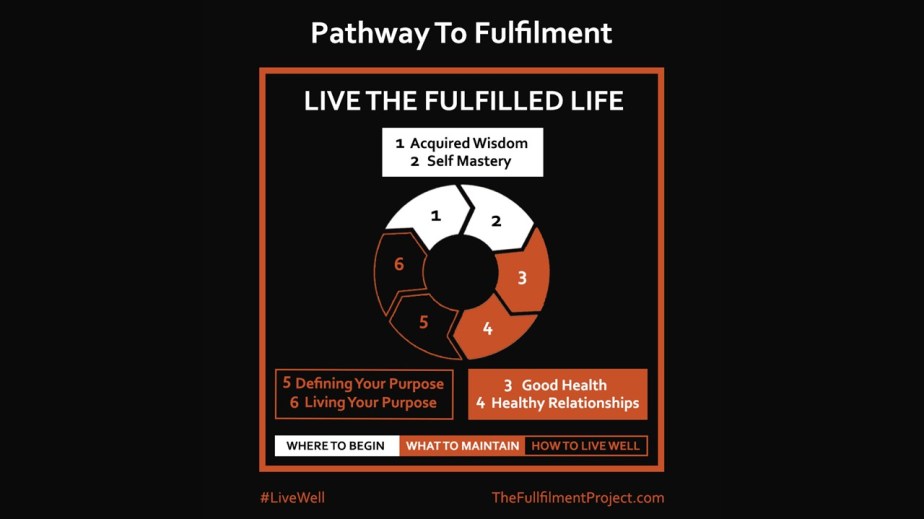
I have reflected on the first two steps to the existing Pathway and have moved Acquired Wisdom to Step 1, as I feel that wisdom gives us a strong foundation from which to build. I have replaced Self Knowledge with Self Mastery and moved it to Step 2, as self knowledge is a useful mental exercise, whereas self mastery is an actionable way of being, which is built on both wisdom and self knowledge. This, I feel, is a more effective part of the journey, as self mastery is required in order to have a life well lived. The six steps  are now Acquired Wisdom, Self Mastery, Good Health, Healthy Relationships, Defining Your Purpose and Living Your Purpose.

The six steps of the Pathway To Fulfilment are divided into Where To Begin, What To Maintain and How To Live Well. Now that I have an outline of a process that I believe will bring about fulfilment in ones life, I aim to add in the detail of the activities and actions you will follow within each step of the journey towards fulfilment and a life well lived. Watch this space and the Facebook Group Community for up and coming updates.

WHERE TO BEGIN

Step 1: Acquired Wisdom

We acquire the wisdom of others from a variety of sources, spiritual and secular. Wisdom challenges us and enlightens us. Often this is achieved by extensive reading, but, with the internet, a lot of this same wisdom can also be obtained through videos, audio books and pod-casts, however you learn best. This wisdom will feed into what you already know about yourself, it will influence how you see yourself and how you choose to live; helping towards self mastery.

There is a lot of wisdom out there to acquire, and it can sometimes be hard to distinguish wisdom from well sounding ignorance, so to simplify things for you I have broken down the wisdom I have found into ten Principles Of A Life Well Lived that will help you navigate the world skilfully. They are what I consider to be the essential wisdom to acquire. I will delve into each principle and explore how it will enhance your life. I have divided the principles into those that relate to Self and those that relate to Others. The principles related to Self are Growth, Equanimity, Fortitude, Seeking and Self Competition, and those related to Others are Stewardship, Servant-hood, Reciprocity, Joy Making and Connection. I will be sharing more detail on these moving forward.

Step 2: Self Mastery

The process of self mastery begins with getting to know yourself more substantially than you may have before; figuring out what really makes you tick, what you believe and don’t believe, what you think is true and false, what you think is ethical and not ethical, etc. It includes figuring out your beliefs and your ethics. Also, what happiness and success look like to you, personally, because our happiness and success are relative to our values, which are very personal to each of us. Our happiness and our success will not bring about fulfilment if they are not aligned with our values.  Self mastery begins with broad and deep self-knowledge and then in order to gain and maintain mastery of yourself you will need to cultivate both body and mind, the tools for which will come from the ten Principles Of A Life Well Lived.

This will primarily be mastery of your thoughts, which is the same whether you are embarking on self-development or a journey of faith. Our mind and body are in a sort of synergy, which means our thoughts effect the chemistry our brains create in our bodies, which in turn creates sickness or wellness. Wellness, being the optimal state to be in. Also, that if we fine tune our body through exercise, through practices such as Yoga, and if we cultivate strong Qi (Chi) in our energy system, through practices like Tai Chi and Qigong, our physical well-being will flourish and allow our mental mastery and well-being to develop too. Self Mastery is both physical and mental, which leads me to Step 3: Good Health.

WHAT TO MAINTAIN

Step 3: Good Health

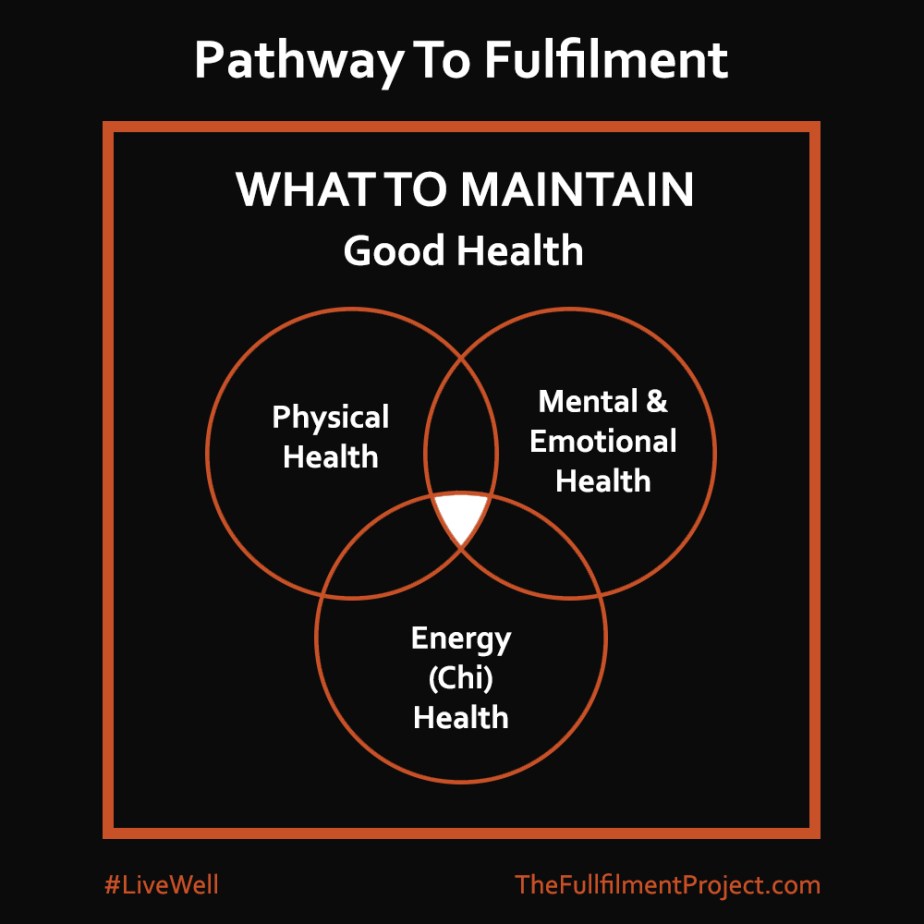
Your health should be of great concern, because good health is essential for your well-being and having an active, fulfilling life. I have included the usual physical health and mental and emotional health, and I have also included energy health; all of which could be thought of as a triad of good health. Good physical health includes diet and exercise. Good mental and emotional health includes mastering your emotions and balancing your thoughts. Good energy health includes mastering the Qi (Chi) that flows through your energy system, like blood through your bloodstream, as detailed in Traditional Chinese Medicine. To have good health you need to work on all three of these areas.

Step 4: Healthy Relationships

In this step you look at your relationships, and identify those relationships that are good for you and those that are not, and those that are a mixture of the two, that need work to become good. You should continuously work towards all of your relationships being healthy ones; meaning that they bring you happiness rather than stress, they uplift you rather than bring you down, and they are aligned with your values and ethics. These relationships are in circles of community, which are relationships with your self, your partner, your family, your friends, your colleagues and your acquaintances, and they are all interconnected.

HOW TO LIVE WELL

Step 5: Defining Your Purpose

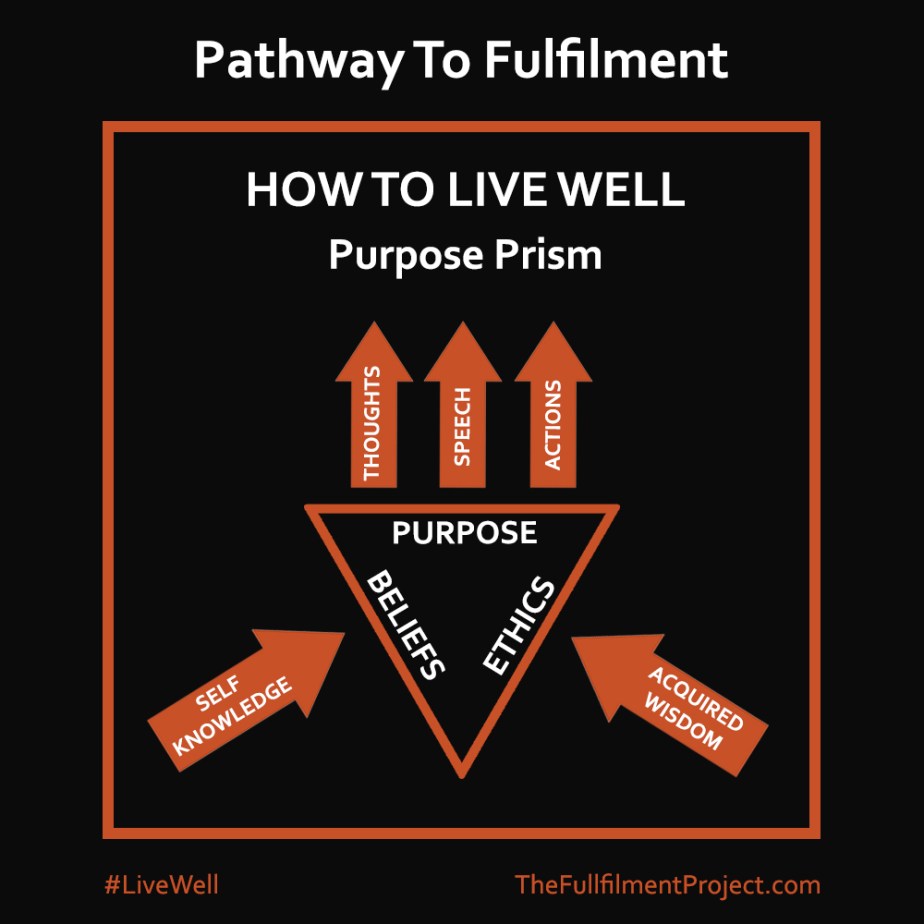
After working your way through this journey so far, you will have a solid foundation for how to start living your life better. From this new understanding of yourself, your defined beliefs and ethics form part of what I call your Purpose Prism, the third piece of this prism being your purpose. You will go through a process of building on your beliefs and your ethics, weaving in Acquired Wisdom and Principles Of A Life Well Lived, and all you have learned from steps 2, 3 and 4 and define your personal purpose. This prism is the filter through which you will see and experience the world, and it will influence your thoughts, speech and actions, making them wiser in nature. Your purpose comes from a vision of a better world that you want to help create.

Step 6: Living Your Purpose

You will then be set to start applying your beliefs, ethics and purpose to your life, to find your best way to live them out in your thoughts, speech and actions; to act on your vision of a better world through everything that you do. This is living your life on purpose. All of this work will mean that both happiness and success become personal, and therefore fulfilling, all three of which are bi-products of a life well lived. When the garden of our lives is tended to properly, these things blossom, but if we focus on achieving them without tending to the important things in our lives then these things will not blossom. Your happiness, success and fulfilment along your journey then feed back into your acquired wisdom, self mastery, health, relationships and your beliefs, ethics and purpose, and on it goes, because this journey is a life long endeavour. Follow the Path To Fulfilment and live well my friends.

The Skill of Optimism

“While you can’t control your experiences, you can control your explanations.”
― Martin E.P. Seligman

Much is often said of the optimism of youth and that such a person is optimistic and another person is pessimistic, as if they are both something we have as innate abilities, like being funny or courageous or creative. Much of what we see as personality traits are in fact based on learnable, practicable skills. It all depends on knowing the underlying behaviours and thinking patterns that bring about said optimism or pessimism.

In his book Learned Optimism, How to Change Your Mind and Your Life, Martin E. P. Seligman, Ph.D lays out his evidence for the theory that optimism can be learned and that pessimism left unchecked can make us feel helpless, which is the essence of depression; depression is essentially prolonged helplessness. The root cause of both pessimism and optimism is how we explain bad experiences and good experiences to ourselves, how we explain failure and success.

I will let Martin E. P. Seligman explain this is their own words. “The optimists and the pessimists: I have been studying them for the past twenty-five years. The defining characteristic of pessimists is that they tend to believe bad events will last a long time, will undermine everything they do, and are their own fault. The optimists, who are confronted with the same hard knocks of this world, think about misfortune in the opposite way. They tend to believe defeat is just a temporary setback, that its causes are confined to this one case. The optimists believe defeat is not their fault: Circumstances, bad luck, or other people brought it about. Such people are unfazed by defeat. Confronted by a bad situation, they perceive it as a challenge and try harder.”

So, how do you explain misfortune to yourself, do you say things like “why does this always happen to me?” The emphasis on the always will make it seem like the misfortune will happen again and again and that it all your fault. The language we use to explain misfortune to ourselves matters, because seeing misfortune as permanent, pervasive and our fault makes us feel helpless, with no way to make things better. If we begin to train our thinking to explain misfortune as temporary, specific and caused by factors outside of ourselves then we build our skill of optimism.

Optimists, according to Martin E. P. Seligman’s research, also see success as permanent, pervasive and created by themselves, and pessimists see success in the opposite way. A simple flip of how we explain misfortune and success changes everything, and we go from pessimistic to optimistic. However, the way we explain the events in our lives has been developed and somewhat hard wired into our brains from childhood. It is not a quick process to changes our thinking, but it is possible through repetition.

It helps to monitor how we explain the events in our lives and keeping a journal to document our explanatory style (pessimistic or optimistic) and to create language that develops optimistic thinking can change it over time. This is positive, it means that your success and failure are in your hands. It means that you can develop bulletproof optimism that will lead to a happier and more joyful life full of successes and, ultimately, a more fulfilling life. So, take back control over your life through your explanations of what happens in it and make it a life well lived.