Beliefs Are More Important Than Goals

I’m currently reading the book Atomic Habits by James Clear. I’m only part way through the book but the book makes a good argument why goals do not help with continuous improvement but systems do. The standout idea so far is the way in which we think of habits: “Changing our habits is challenging for two reasons: (1) we try to change the wrong thing and (2) we try to change our habits in the wrong way.”

When changing our habits we can look at outcomes, processes or identity. “Outcomes are about what you get. Processes are about what you do. Identity is about what you believe.” The most effective way is to see yourself as the kind of person you make the desired improvement or is doing the desired productivity or activity, to believe it. A great example in the book is this:

“Imagine two people resisting a cigarette. When offered a smoke, the first person says, “No thanks. I’m trying to quit.” It sounds like a reasonable response, but this person still believes they are a smoker who is trying to be something else. They are hoping their behavior will change while carrying around the same beliefs.

The second person declines by saying, “No thanks. I’m not a smoker.” It’s a small difference, but this statement signals a shift in identity. Smoking was part of their former life, not their current one. They no longer identify as someone who smokes.”

I guess it is all about mindset. Believe you are the kind of person who will achieve the goals that you want to achieve and your behaviour will reflect that belief. The results will then follow.

The Gift Is In The Giving

I was given a medallion with an embossed image of St Christopher carrying a child across a river by my father recently. He has carried it around with him for many years and the shiny outer brassy layer of metal has worn away in places revealing the shinier silvery metal underneath. It is well worn and well used.

I don’t believe that it will give me luck or protection, but it feels like a legacy, a gift that I should carry around with me throughout my life, which I will. The importance is in the giving and the belief of my father that it will help me. The gift is in the giving and its intention, and that is why I will honour the gift and keep it with me.

Living In Alignment

When we are born our body and mind understand our nature as human beings, what we need to sustain us and how to live as a human being. Not intellectually, but instinctively. Then we become aware of our culture and our minds shift to operating in alignment with the culture in which we live.

This could be the culture in our family, in our friendship group or in the society in which we live. When our minds are overridden by cultural expectations that do not match what our bodies instinctively know to be correct, our levels of stress go up and our bodies get sick.

This might seem unrealistic but we have all worked in a workplace where the culture does not feel right, it feels outside what we expect to be the norms we want to live by. This friction causes stress. Many of us don’t fully understand or are aware of our beliefs and values, specifically, and we live lives based on the people and environment around us.

If we were to go deep and really understand what our beliefs and values are and we lived in alignment with them, then our energy, enthusiasm and fulfilment would grow exponentially. Living in alignment with who we really are is the first step towards living a fulfilled life.

Building Calm Confidence

I saw footage online of a Park Ranger standing in front of a wild male elephant who was clearly angry and looked ready to charge. The Park Ranger only had a thin stick to defend himself with. He raised his arms openly either side of him and stood still and calm. He gave nothing for the elephant to react to, and seeing no danger the elephant went away.

To me this is the essence of calm confidence. It is confidence in yourself regardless of what you are faced with. It comes from testing yourself, knowing your limits and having a deep understanding of your values, your beliefs and your ethics. It also comes from developing a level of skill that allows you to handle whatever comes your way. It is not boastful confidence or aggressive confidence, it has a stillness that cannot be shaken. This is calm confidence.

Possibility Blindness

We are largely defined by the environment we live in. The opportunities we have in most western countries are very different to those in third world countries. Our opportunities, or lack of them, will have a direct impact on how we see life.

We are also shaped by the people we spend our time with. Our parents have a significant effect on how we see ourselves and what we are capable of. We learn from a young age views of how easy or difficult it is to make money, how easy or difficult relationships are, and what our self worth is to us, etc.

When we let the views and beliefs of others become ours, we become blind to the possibilities available to us. To see an opportunity we must first think that it is possible. If you are living your life small, then it is likely that you have some limiting beliefs acquired from others. If that is the case, it is time to rewrite your beliefs and become an opportunity seeker. To believe in the possibilities life has to offer. Don’t let the views and beliefs of others give you possibility blindness. Open you eyes and begin to believe that you can, it is possible, but first you must believe that it is.

Questioning Our Beliefs

Beliefs are conclusions that we assume to be the truth. We often say that beliefs come from faith, but a belief unquestioned becomes a closed door. When we say we belong to a particular religion we are often identifying with a belief system which has institutionalised beliefs into a specific way of seeing the world.

Though the guidance from religions can be beneficial, if they go unexplored and unquestioned this is not a spiritual journey, it is a spiritual roundabout. Beliefs are important, particularly religious ones, because they deal with the nature of reality. However, I feel these beliefs should not go unquestioned. If beliefs are seen as a working model of how the world works, we can then repeatedly test it to see if it produces joy, happiness and fulfilment. These are the measure of a life well lived.

Don’t Always Set Goals

In life we need to set goals, progress is an essential aspect of living a fulfilling life. If we had no progress we would feel a sense of stagnation and a lack of motivation. Goals are important, but sometimes they are a reflection of who we think we should be. There are goals that we think we need to achieve in order to be a success, after which we will be happy.

Success does not automatically equal happiness. If the success is in something that does not align with our fundamental values, for example, then it can never really be happiness inducing. What we need to understand is what happiness and success look like for us, based on our values, beliefs and ethics.

Sometimes we also set goals in order to feel like we are working towards success, but in fact we are avoiding figuring out what we really want. Doing the work of figure out who we are and what we want out of life can seem too difficult, so we take someone else’s model of success, or the model that is currently seen as popular, and tell ourselves it is what we want. In a way it is a form of procrastination.

So, set goals, but do the hard work of figuring out what you really want out of life first.

What Should We Unlearn?

Our reality is largely what we are told that it is, from the explanations and examples of our parents to the education we receive to the religion or lack of religion that we follow. Our starting point for understanding our place in the world, or the universe, is received from other people.

It is only later in life, as our childhood becomes adulthood that we really start to question the foundations of understanding that we have been taught. Some understandings, particularly religious ones, it seems, can last a lifetime without being questioned.

There are many understandings of things, both religious and non-religious, that create divisions, which are further worsened by seeing a them and an us. More and more I am starting to believe that there are no divisions or categories or labels except the ones we create to understand the world and the universe, to give us a framework from which to go about our daily lives.

Don’t get me wrong, without such things we would not have science or medicine or a great many other things, but there is much, I think, that we have to unlearn about how we see each other and our place in the grand scheme of things.

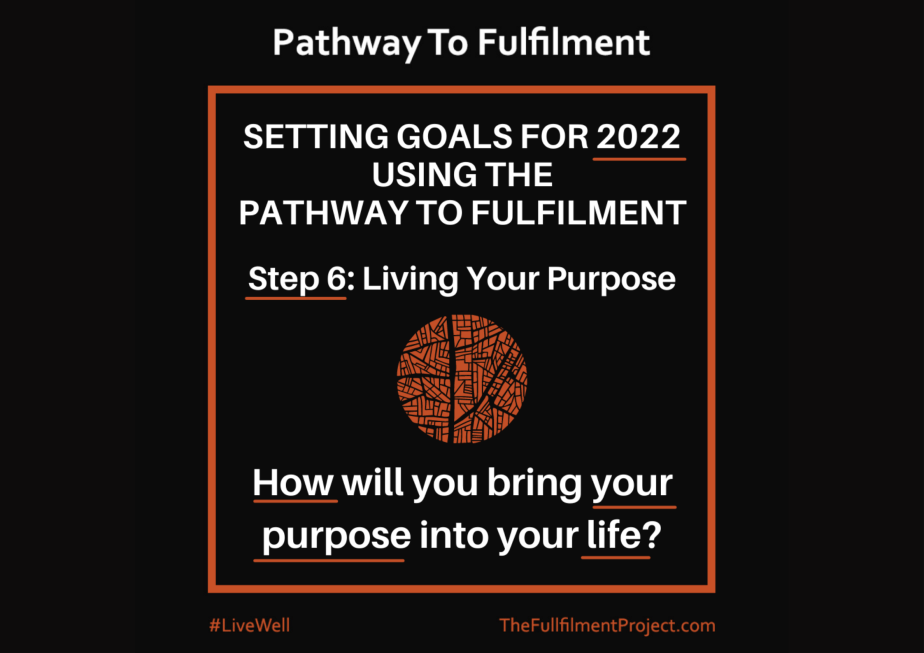
2022 Goals: Living Your Purpose

It is one thing to figure out what your Purpose is, but it is another to act on it. To live by your Purpose takes courage and determination, because it can put you at odds with people in your life and can require you to make some difficult choices.

Step 6 in the Pathway To Fulfilment is Living Your Purpose. Once you have gone through Acquiring Wisdom, Self Mastery and Defining Your Purpose, if you do not live your Purpose it will have all been just a theoretical exercise. In order to live well and have a fulfilling life, you have to live by your Purpose, once you have defined it.

So, what will you do this year to live by your Purpose?

I appreciate that you may not yet have defined your Purpose, but you can work on it this year. While this important work is being undertaken you could figure out your principles, beliefs, values and ethics and live by them. These will be guides to how you live your day to day life.

Once you have defined your Purpose, however, you will be ready to set your sights on your north star and make big decisions on how you want to live your life over the next months and years.

Trying Something New

Where do our beliefs and values come from? They are manifestations from the culture and community we grow up in, the examples our parents give us and how they raised us, as well as the experiences that we have had. Through all of this input we piece together what we believe and what we value.

All of this then affects the decisions that we make on a day to day basis, but I believe that if we are to make wise decisions in life then we should seek out wisdom as well, which can be found in any of the many religious scriptures and philosophical texts from around the world. If we have wise guidelines or principles to follow then stepping into the unknown will seem less scary.

Something else that can help us in our ventures into the unknown is to have an attitude of asking ourselves “what if…?” What if we tried something new, what if we gave it a go, what if? Being open to the many positive possibilities that could result in trying something new means that we will more likely have a positive outcome.

It is also a way of getting past the barrier of failure, a way to overcome our fear of criticism or looking like a fool; what if we succeeded, what if we achieved our dreams. This allows us to consider the possibility of actually succeeding, rather than becoming consumed by the thought of failure.

Re-Centre Yourself

Often in life we feel stressed or confused or just out of our comfort zone. In these moments we need to recentre ourselves.

In life we are on one long journey or many short journeys, depending on how you want to think about it. When we get into a primal state of stress or anxiety we need to stop, re-centre ourselves and look at what is ahead of us to decide our next step.

Re-Centre

If you use Google Maps on a mobile phone there is a feature that allows you to tap a symbol on the screen and the app uses the GPS on your mobile phone to bring the map to your exact location. Stopping and re-centring is very much like this, it is being mindful of your present, and moving away from thoughts about what has happened and what may happen.

We live most of our lives thinking about either the past or the future, and these thoughts are more often negative rather than positive. Being mindful and present will solve a lot of our problems and will usually reduce our anxiety.

Opt Out Of Negativity

Google Maps also has a feature where you can choose to avoid motorways or toll road, etc. In life we can also choose what we focus on. We can choose to begin with a new more positive belief about our capabilities or how the world works and opt out of the negative thinking. We can choose to believe that the universe is working for us rather than against us. These beliefs can fundamentally change our world view.

Change Your Beliefs

I heard an example recently of a successful entrepreneur that was out with some movers and shakers and felt that they didn’t belong there. This man was a believer in God and his life coach asked him why God would put him in the wrong place on a Friday night. This man suddenly realised that, to him, this would mean that he belongs everywhere he is. This is a fundamental shift in his world view. He changed a limiting belief to an empowering belief, because he realised that the limiting belief was untrue, more importantly he realised that the opposite was true.

It is almost always the case that our limiting beliefs are untrue. If we look at them and consider what the opposite belief would be and look for evidence of this belief, then we empower ourselves to move forward with confidence.

Integrity Matters

There are two types of integrity. The first means that you do what you say you will do, to yourself and to others. This could be seen as just being reliable, but if it is done as a matter of principle, then, for me, it falls into integrity, rather than reliability.

The second is living by your values and beliefs. This is being kind, even to those who treat you badly. It is finishing what you started, because you always do. It is a path less travelled, but an honourable path to walk down. In a social media filtered, fake it til you make it culture, living by your values and beliefs is unusual, but essential.

The Power Of Imagination

We suffer more in our imagination than we do in reality. This happens to many of us more often than we would like. We look into the future, or the future we think will happen, and we lean towards the worst case scenario. Our brains are wired to do this as a survival mechanism, but it is, I would say, the main cause of stress in people’s lives.

The way to avoid this is to pay attention to our thoughts and find the beliefs at the root of the thoughts and examine them. Most often they will be untrue and if the belief is untrue then some form of the opposite must be true. What then would this look like? If this new belief is true then what actions should then be taken?

Following this process will move you from a disempowering state to an empowering one. If you do this over and over you will change your belief system and the future will look less scary. You will then be able to imagine the future that you do want and how you might act, what you might do and how you might feel.

Your brain does not know the difference between your imagination and reality, so the future you imagine is more likely to come true, because your beliefs dictate your thoughts which influence your actions which cause your results, which reinforce your beliefs, and on it goes. Your future is yours to create.

The Missing Piece Of A Life Well Lived

“People who truly understand what is meant by self-reliance know they must live their lives by ethics rather than rules.”

Wayne Dyer

Our Beliefs

We all have our own beliefs, things that we believe to be true. It might be that all children are precious or that the environment needs to be protected or that money is the route of all evil. You may agree with some of these beliefs but maybe not all of them. Our beliefs are part of what makes us who we are, and also what links us to other people; we gravitate towards others who believe in what we believe. This is human nature.

Our Actions

Our actions in life are often directly related to our beliefs. If you believe that being kind is important then you will often be kind to others, for example. However, often our actions are triggered by our emotions and are reactions to the immediate situation we are in. Our character plays a part too, but our actions are not always aligned with our beliefs. We might believe that we should take care of the environment but find it hard to give up on our big fancy car that guzzles fuel.

The Missing Piece

There is often a missing piece between beliefs and actions, and that is ethics. Ethics are moral principles we hold as important, which extend our beliefs into a code to live by. If we have a strong ethical code then our actions will more robustly align with our beliefs. It takes effort to put together an ethical code for ourselves. First we must clearly define our beliefs through self-exploration, by asking ourselves deep questions about what we believe and then putting our beliefs down on paper.

Then once our beliefs are clearly defined we need to reflect on what the ethical extensions are for each belief. For example, if you were to believe that it is important to be kind then the ethic of that would be something like to treat others as they wish to be treated, sometimes called the platinum rule. Your actions would then reflect this ethic and the route belief more consistently.

In order to live well, we need to live intentionally, with purpose. This is the importance of figuring out your Why, your overriding purpose for your life, but this is built on top of your beliefs and your ethics, which is all built on deep self-knowledge. It is to know yourself intimately and have the courage to live by your beliefs, your ethics and your Why. A life well lived is a courageous one aligned with who you are and how you can help those around you to live their best life. Fulfilment in life comes from living well, so join in the fulfilment revolution and figure out your beliefs and your ethics and have the courage to live by them.

Something To Think About

What are your beliefs and their corresponding ethics, and how will you bring these into your life?

Knowing Yourself

Often it can be easy to become the things that those around us want us to be. With peer pressure, the pressure from modern culture to dress a certain way or act a certain way and the expectations of our parents all add to who we think we should be. However, this is not always who we actually are. If the version of ourselves that we present to the world is different from how we are in our own head, or in private, then something is wrong.


The problem is that if we live to other people’s expectations then we are never going to feel fulfilled, because all that we do will be for the benefit of others. To live life as your authentic self takes courage, because you will be judged by someone, maybe many, in your life. But if you do it, if you live as you with conviction then my friends you can become your best selves. Your achievements will then feel worth it.


When the way you live your life is aligned with your values and beliefs then your heart will feel full, contentment will permeate your thoughts and your levels of stress will be reduced. The thing to do is to get to know yourself, deeply.


Your Values


Your values are simply the things in life that you value. I know obvious right? What I mean is the things that you have strong feelings about. The things that stand out as important to you. Is it your family, your friends, is it justice or charity? Is it creativity or making money? None of these are good or bad, but they get to the essence of who you are.

I value creativity, stewardship, kindness and leadership very highly. I value my family highly too. I also value equality and respect for others. Figuring out what values are important to you will fill in part of the picture of who you authentically are.


Your Beliefs 


Beliefs are about how you think the world works and how you think people should behave. Beliefs include religious ideas as well as human ideas. It might be that God’s grace is real. It might be that karma is real. It might be that we should try to lift other up and not put them down. It might be that the winner takes it all and the loser dismissed.


There is a morality to figuring out our beliefs. They define what is right and wrong in your eyes. Figuring out what you believe about all sorts of things is really important. To question the beliefs that are given to you by others and decide if you too believe them, deep down in your heart, is very important too. We are all individuals and living life by someone else’s beliefs can be detrimental to us.

What Is Your Vocation

We all have jobs, generally speaking, but they are often not things that we have chosen because we deeply believe in the work we are doing. Often the job we have is simply a way of exchanging our time and energy for money to live on. If the work is in contrast to our values or beliefs then this can be a stressful situation. Some places of work are also focused on how much productivity they can squeeze out of us rather than helping us to reach our full potential.

Some of you will have things that you do outside of work, things that you have chosen to do. Things that you are passionate about. Things you are literally doing for free, because you love it. One thing I do is preaching in a Unitarian church. You might be a Scout leader, a volunteer in a charity shop, a volunteer in a food bank, a writer or a blogger. These are signs of the things that you could flourish at if you were doing it as you actual job. Your vocation can become your job if you have the courage to take a chance and go for it.

All of this is about figuring out who you are, how you work, what you deeply care about and living your best life, because you know your self. This is life’s mission, a personal journey such as this avoids a life that will feel wasted at it’s end, because you will be living on your terms, in your way, and not living your life through the expectations and peer pressure of others.

Go forth and discover your wonderful self and live according to your values and beliefs. Be courageous and live true to who you are.

5 Actions To Make 2020 The Best Year Yet

“Don’t mistake activity with achievement.”

― John Wooden

Figuring Out Your Beliefs and Values

This might seem a little too hippy for you to think about doing, but our beliefs and values are the prism through which we experience and act in the world. They are the reasons we do what we do and how we do it. If we believe it is wrong to steal we won’t, if we believe it is right to be generous then we will be.

Our beliefs are what we believe to be right and how we believe the world, and the universe, works. It is not just religious beliefs, which do also matter, but also beliefs about right and wrong, our morals and how people should behave. We also have beliefs about ourselves and how we allow ourselves to be treated. If we believe we are not worthy of respect, we will let people walk all over us, but if we believe we are worthy of respect, then we will expect it, or perhaps demand it.

Figuring out our values and beliefs sets the parameters for our lives. It gives us tools to navigate the world, to make good choices and will impact how our coming year and the rest of our lives will work out. If we don’t clearly define our beliefs and values we are kind of hitting and hoping with how we live our lives, which is certainly not a recipe for a successful, happy and fulfilling life.

Reviewing Your Priorities

Once we have our values and beliefs clarified we can set our priorities for the year ahead and look at how we are spending our time. If we look at our day or week we can see what percentage of our time we spend working, with friends, with family, engaging in hobbies, keeping fit, attending our place of worship, working on our goals etc.

Often we get stressed out because our life is out of balance. We sometimes spend too much time working or doing things for other people and not enough time for ourselves. Conversely, it is also not good to spend too much time doing personal activities and neglecting our loved ones or our jobs.

Finding a balance is a personal thing and therefore reviewing all the areas in our lives and thinking about what we care about is important. It may take a bit of time but it will mean your level of happiness, satisfaction and fulfilment in life will grow exponentially.

Removing The Bad Relationships

We all have relationships with other people, that is obvious, but the quality of those relationships matters. If someone in your life brings you down, makes you feel small, disrespects you on a regular basis or is just not good for you then you have two options.

The first option is to try and mend the relationship, to confront them on how they are treating you and stand up for your own wellbeing. All relationships should be built on equality and respect. They should include kindness, encouragement and generosity, if they do not then odds are they are having a detrimental effect on your wellbeing.

The second option is to cut them out of your life. If they are having a significantly negative impact on your life and confronting them on it either did not work or is not an option then they are not worth having in your life. Your life is wonderful opportunity to reach your full potential, to experience joy, success and fulfilment. No one has the right to get in the way of this and it your responsibility to manage your relationships, no one can do it for you.

Cultivating The Positive Relationships

On the flip side, we all have relationships in our lives that are very positive. People who give us love, encouragement, support and their time. These are the people we should be building our relationships. It can be easy to take these people for granted and assume that they will always be our friends and partner without any effort to cultivate these relationships.

However, if we do not spend time with these people, ask after their wellbeing, support them when they need us, and be a good friend or partner then we will grow apart and friends become acquaintances and partners move out of our lives.

it is also important to maintain and cultivate our relationships with workmates. These are people we spend a significant amount of time with and in order for the companies we work for, the team we work with and for us to thrive we need to build strong relationships with trust, loyalty and collaboration. All of these come from spending time with each other, face to face. Human being are social animals and we only trust people we know. We cannot do this over social media or by video conferencing, etc.

Reverse Engineer Your Dreams

We all have something we want to achieve, something big that lingers in the back of our minds, but seems too big to be able to get done. We usually tell ourselves that we will get around to working on this goal but life always get in the way. The reason we are not working towards this goal, whatever it might be, is that we are not prioritising it, we are not allocating time for it.

This might be because we have a mega busy lifestyle or it might be because the goal seems too big and we don’t think we will ever achieve, so we never start it. The first reason can be solved by breaking the goal into very small chunks and find time to slot these in during our day. For example, if you take public transport this is a perfect opportunity to read up on the goal in question or write assignments, notes, plans, etc.

The second reason is a lack of self belief. Depending on how deep this is you might just need encouragement from others or you might need something like Cognitive Behaviour Therapy if the issue is based on underlying bad experiences. If the latter is true there is no harm in seeking professional help to improve your well-being and quality of life, it can really help and is private.

Also, for the first reason asking someone who has a positive impact on your life to be an accountability partner can really help. Someone who knows your goal and who can check in with you on a regular basis to see how you are getting on and to give you encouragement and tips.

All of this is good, but you also don’t want the journey to your goal to take too long, so you need to speed up the process. To do this I recommend finding someone that you admire that has achieved the goal that you are seeking to achieve and study how they got there. Then you can reverse engineer the steps they took and take the same steps.

Some of the steps might not be applicable to you, or be things that are not available to you, but it will give you a road map. It will take some creative thinking and persistence. Once you have a plan it is important to set daily, weekly and monthly goals. Have a check list for time-frames like 3 months, 6 months, 1 year and 5 years. Take a course, read books, listen to podcasts, whatever it takes, you can do it. Have faith in yourself and go for it. We regret what we do not do more that the things that we do.

When you are at the end of your life in a nursing home don’t let this goal be a regret you wish you had tried to achieve. Good luck my friends, you can do great things with effort and persistence.

Something to think about

The limits we have in our lives are often created by ourselves, based on what we think the world expects of us. These limits are flexible barriers that can be changed or even removed. You are in charge of your reality.