To have a purpose is to have a goal to work towards. It is essentially something we ‘do’. To be mindful it is less about ‘doing’ and more about ‘being’. In a sense ‘doing’ is a more Western approach to life and ‘being’ is a more Eastern approach to life. Depending on where your cultural reference points are you might feel that these are polar opposites.
In fact they are intertwined. You cannot ‘do’ well unless you are present in the moment and you cannot ‘be’ in the moment without a purpose for doing so. They feed each other like Yin and Yang. To separate them would end up causing confusion and frustration and you would not be able to ‘do’ or ‘be’ particularly well.
To be purposeful mindfully or be mindful on purpose are not easy things to do, but once we recognise the interconnected nature of the two elements we can work towards it.
What we often lack is meaning and purpose in life. With so many choices that we can make and so many interests and the interests of others pulling us in different directions we can make bad choices with big consequences. The benefit of spirituality is that it gives us structure, boundaries and of course both purpose and meaning, without formalised rules to follow. Without a guide that comes from a spiritual tradition we look for structure, purpose and meaning wherever we can find it.
This is why people join groups, whether it be a gang, supporting a football team or a religion. In any group that we join in order to feel like we belong, the rules and ethics are subscribed, they are the things we adopt in order to be accepted into the group. By and large there is no problem with this, as this is the way social beings live. We accept the laws in the country we live in because we want to live there. Others will accept the teachings of a religion in order to worship in a particular religious building. I advocate for joining a church or mosque, synagogue or temple because the usual end result is that good morals and ethics become central to life.
However, formalised religion is not for everyone. Some wish to choose the rules and practices that they live by, which is a good way to live, as long as you have the ability to decipher what is wisdom and what is propaganda. There are many self proclaimed teachers of truth out there in the wonderful world of the internet.
Anyone can start a YouTube channel and start sharing their thoughts. Some reach a level of popularity and fame that suggests that they may know what they are talking about, people like Russel Brand and Jordan Peterson, who incidentally divide opinion due to their strong views. The rule of thumb when it comes to taking on the teachings of others is to ask yourself if following their advice is making you happier and more fulfilled. If it works then keep listening. if it doesn’t move on.
I’ve been thinking a lot about Purpose recently and I’m sure I’ve discussed it on this blog before. I may have already covered the points mentioned here, but, as it is with human beings, we forget profound truths because we return to our default behaviours and mental patterns and the wisdom does not stick.
What occurred to me this morning is that life does not give you purpose, you have to figure out what your purpose for living is and apply it to your life. Last night I was feeling a little lost, so I picked up my copy of Man’s Search For Meaning by Viktor E. Frankl, an astounding book that I recommend you read. I dipped into it and found this quote from the section ‘The Meaning Of Life’ that really struck me, “Ultimately, man should not ask what the meaning of life is, but rather he must recognize that it is he who is asked.”
Then the obvious truth became clear, that there can never be one meaning of life, because we are all different people. What you find meaning in cannot be the same as what I find meaning in, though there will be some overlap. The thing to do is to figure out what gives your life meaning and to live that and do that, whatever it may be.
I recently watched an interview with Jay Shetty where he talked about his formula for finding your Purpose.
Your Passion
+
Your Strengths
+
Compassion
=
Your Purpose
This seems like a good balance of ideas in order to find Purpose. Your Purpose does have to include what you are passionate about, but if you focus on things that are not your strengths, then you won’t get very far. The inclusion of compassion ensures the Purpose you have is not a selfish one. We thrive more if we are focused on helping others, it is how we are wired.
Purpose is a word loaded with expectations. There is a lot of pressure on those wanting to develop themselves, to find their unique purpose for being born.
My view on finding your purpose is that by the time you are in your 20s you will have a reason behind everything that you do. For some it is to leave things better than they found them. For others it is to generate joy in others. Everyone has a think that makes them tick. This is your purpose.
For me it is helping others to live well, to ultimately have a fulfilling life. It is not one thing that you do, it is the reason behind everything that you do.
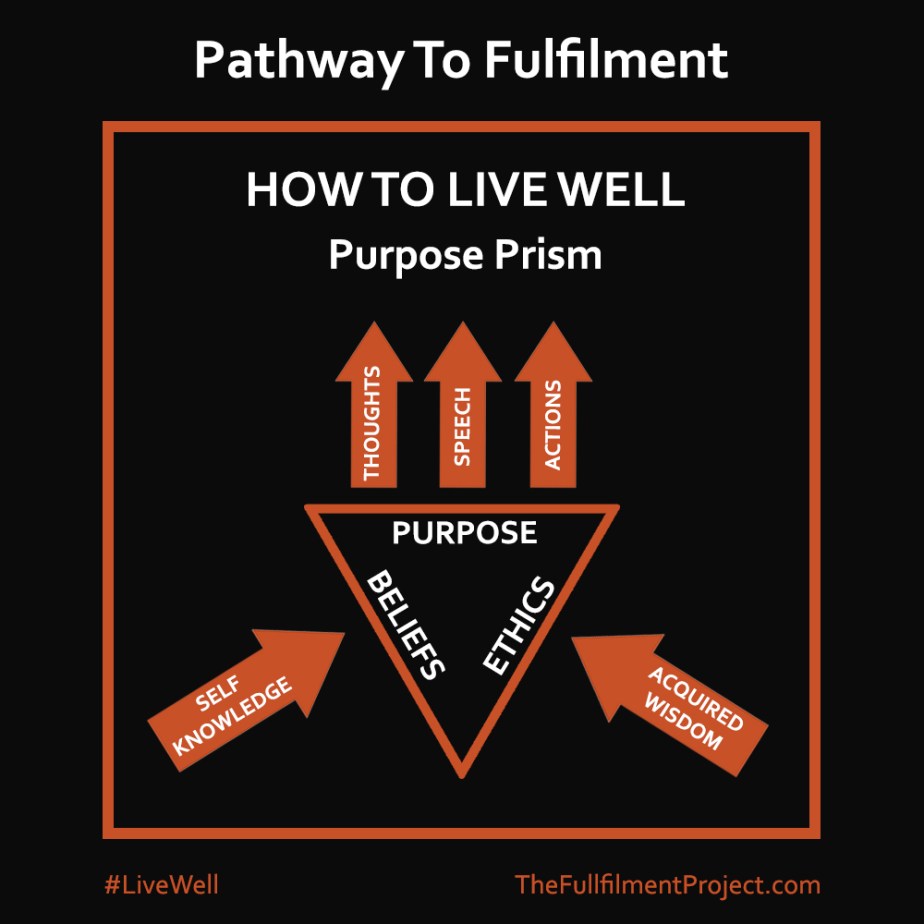
The Pathway To Fulfilment has the steps that it does because the end result are thoughts, speech and actions that are aligned with your purpose that you will define. They come from your Purpose Prism, which includes your beliefs, your ethics and your purpose.
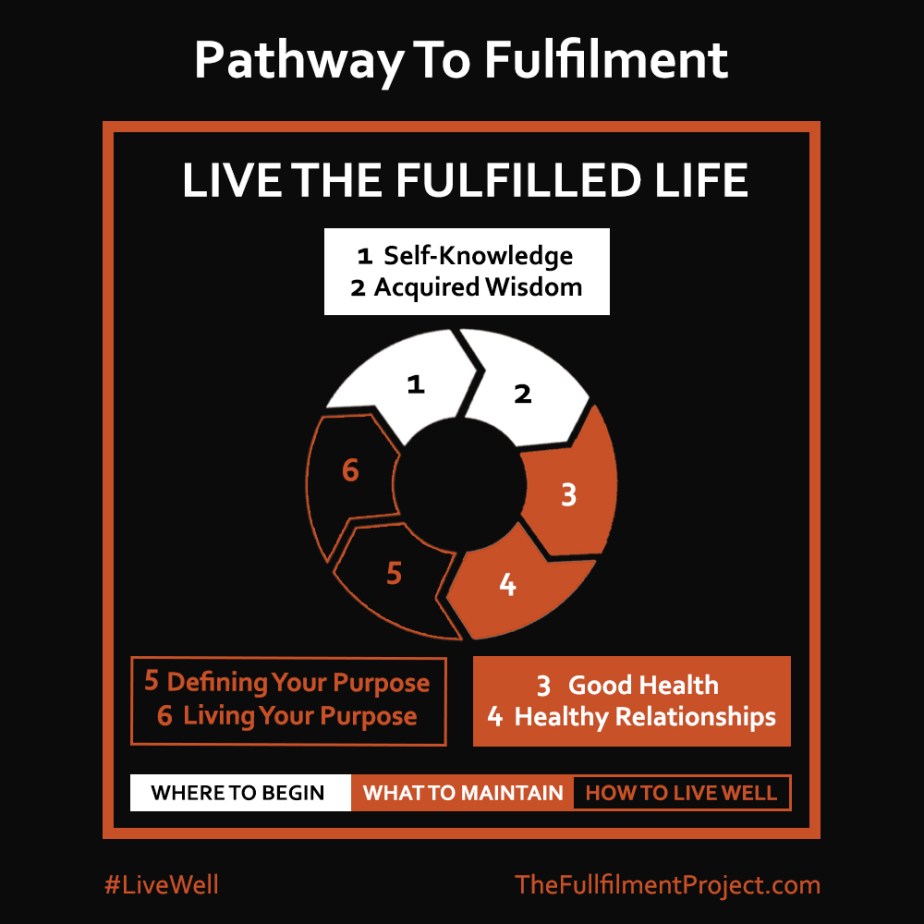
You will have gained deep Self-Knowledge (Step 1), which is when you will define your beliefs and ethics, and you will have Acquired Wisdom (Step 2). A purpose can then be defined aligned with these elements from Step 1 and Step 2 that together will make your thoughts, speech and actions full of altruism and wisdom.
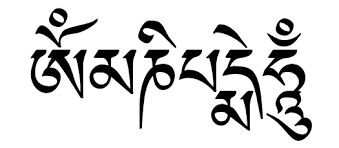
Om Mani Padme Hum
In regards to altruism and wisdom, there is a Buddhist mantra, Om Mani Padme Hum, which explains how, in Buddhist understanding, one reaches enlightenment. Om is made up of through sounds A – U – M. These represent thoughts, speech and actions, and once we are enlightened these are pure. Mani means Jewel, which represents altruism. Padme means Lotus, which represents wisdom. Hum is unity of both infinite altruism and infinite wisdom, both of which are needed to become enlightened, in Buddhist understanding.
The reason I am asking you to begin with self-knowledge, then to acquire wisdom, and to figure out your beliefs and your ethics, is so that your purpose will be imbued with both altruism and wisdom, and that your purpose becomes your unity, your Hum. Your thoughts, speech and actions dictate how your life will be, because whether your life is good or bad, enjoyable or not is firstly based on your thoughts, of how you see the world, and secondly the impact that your speech and actions have on those around you.
How We Walk Through The World
If we walk lightly through the world, trying to live in balance and to help others, then we will live a more fulfilling life. Also, in order for us to find a purpose in life, we need to know ourselves really well, to have gone deep into the parts of our minds that we often shy away from, but also to develop a wise understanding of how the world works and how we can have a positive impact on it.
This is why Defining Your Purpose and Living Your Purpose are Steps 5 and 6. There is work you must do with yourself before a purpose can become clear. This work will not always be easy, but it is necessary, and I will be putting together a guide to help you along this Pathway to Fulfilment. It will take time to put together, as I want the pathway to be simple and the steps to be clearly defined, which means there is a lot to distill down into a clear and effective pathway. The outline of the pathway is set out below.
Something To Think About…
Think about how you currently live your life, how you treat others and how you earn a living. Are these ways that make you feel good? If not, what changes could you make?


 The Fullfilment Project