Find The Quiet In The Storm

Find the quiet in the storm,
Find the path in the chaos.
The quiet is the mountain,
The path is the light.
Find the balance between the two.

We all live through challenging, noisy times and chaotic times, too. Not necessarily every day, but it happens to us all. To try and control the storm or the chaos would be a fools errand really as the world can not be controlled. The only thing we can realistically control is ourselves; our minds and the paths we choose to follow.

To find quiet in our minds amongst the storm around us, to find it despite the storm is a skill that can be practised and mastered. To practise meditation is to lift the mental weights that build the capability to be quiet and calm when all around you is not.

Similarly, the paths we choose in life define us, but there are so many paths, so many choices to make each day. To choose a path and to stick with it is also a skill. To follow a path amongst the chaos is not easy, but it is possible. The trick is to see the light that illuminates your chosen path and to follow it, no matter what.

These two things, the stillness in your mind and the path you follow, are different things, both with their own importance. The challenge is to balance them both. Too much stillness, and you don’t get anywhere. Only follow the path, and you can get lost along the way. This is the challenge of living a wise and intentional life.

Beliefs Are More Important Than Goals

I’m currently reading the book Atomic Habits by James Clear. I’m only part way through the book but the book makes a good argument why goals do not help with continuous improvement but systems do. The standout idea so far is the way in which we think of habits: “Changing our habits is challenging for two reasons: (1) we try to change the wrong thing and (2) we try to change our habits in the wrong way.”

When changing our habits we can look at outcomes, processes or identity. “Outcomes are about what you get. Processes are about what you do. Identity is about what you believe.” The most effective way is to see yourself as the kind of person you make the desired improvement or is doing the desired productivity or activity, to believe it. A great example in the book is this:

“Imagine two people resisting a cigarette. When offered a smoke, the first person says, “No thanks. I’m trying to quit.” It sounds like a reasonable response, but this person still believes they are a smoker who is trying to be something else. They are hoping their behavior will change while carrying around the same beliefs.

The second person declines by saying, “No thanks. I’m not a smoker.” It’s a small difference, but this statement signals a shift in identity. Smoking was part of their former life, not their current one. They no longer identify as someone who smokes.”

I guess it is all about mindset. Believe you are the kind of person who will achieve the goals that you want to achieve and your behaviour will reflect that belief. The results will then follow.

Making A Better Tomorrow

Life is a series of moments. Some are good and some are bad. This is pretty obvious. However, we often don’t think in this way about the time we spend and the experiences we have. Sometimes we think a bad situation is permanent and will always be like that. Sometimes we think a good situation will not last.

It is true that all thing shall pass. That is to say that everything is temporary and part of a process. When a bad thing happens we can’t wish it away or try to change what happened. What we do have power over, however, is what we choose to do about the situation we are in.

If we see where we are and what is happening as a process we can plan and set goals and work towards a better situation. If you don’t like you job or your relationship or your home life change it. Either work on making it better or make a change. A new job might be better than staying where you are. An honest conversation with your manager might improve your working environment. There are always things you can do to make this moment a step towards and better tomorrow.

Getting Things Done

Sometimes I have what they call fibro fog where it can be difficult to collect thoughts and think things through as easily as I normally would, which means ways that I might normally get things done don’t work. Essentially, relying on my memory falls down when the fibro fog appears.

This led me to thinking about how we each deal with things differently. Some of us are planners and need a bullet point plan before starting and some of us jump right in and figure it out along the way. There is no one right way of doing it because we each have different personalities and different challenges to face.

My advice would be to find a way that works for you by trying out different approaches to getting things done, both in your personal and professional lives. I intend to develop a fall back plan that relies on checklists and priorities that give me structure when the fibro fog appears.

I feel this approach suits me well overall as well, so I’ll give it a try and adjust as needed moving forward. I suggest you pick an approach and try it too. You can always adjust it or change it if it doesn’t work, but make sure you try it for a good few weeks before deciding if it works for you or not.

How To Be Successful

We hear a lot about motivation and striving for success, but often we chase the wrong goals because they look good on someone else. So we either gain success and feel empty or we fail because we can’t get motivated.

We get excited and get more done when we are enjoying something or it aligns with what we care about. It is hard to get motivated about something that we don’t care about, but very easy to get a lot done with very little motivation when we are passionate about the thing we are doing.

Success comes when we figure out what we care about, what we are passionate about, and we put our energy into succeeding in that area. We don’t need better motivation, we need clearer values and beliefs, because these will highlight the things we care about. Then we can be successful and feel fulfilled by the success.

Don’t Always Set Goals

In life we need to set goals, progress is an essential aspect of living a fulfilling life. If we had no progress we would feel a sense of stagnation and a lack of motivation. Goals are important, but sometimes they are a reflection of who we think we should be. There are goals that we think we need to achieve in order to be a success, after which we will be happy.

Success does not automatically equal happiness. If the success is in something that does not align with our fundamental values, for example, then it can never really be happiness inducing. What we need to understand is what happiness and success look like for us, based on our values, beliefs and ethics.

Sometimes we also set goals in order to feel like we are working towards success, but in fact we are avoiding figuring out what we really want. Doing the work of figure out who we are and what we want out of life can seem too difficult, so we take someone else’s model of success, or the model that is currently seen as popular, and tell ourselves it is what we want. In a way it is a form of procrastination.

So, set goals, but do the hard work of figuring out what you really want out of life first.

Don’t Focus On Your Strengths

We hear a lot of motivational speakers talk about focusing on your strengths, whether it be your top 5 or your best strength. However, anyone who has become successful at anything had to develop and become good at what they currently do.

Strengths are certainly useful, but they do not provide long term success, because there is no long turm objective, other than to become better at what you are already good at. It is smarter to have a vision or purpose for your life, a reason why you get up in the morning, and centre your development around that.

It could be to help people to read or to make a difference in people’s lives or to run your own company or many other things. Your strengths will often help with these things, but only if they align with your vision, purpose or reason. It is more likely that you will need to develop in areas that you are not strong in currently and with work these then become your strengths. The goal is to live your best life, which will require developing in areas that are not your current strengths.

Setting Goals For 2022

Over the past few days I have briefly covered the 6 Steps of the Pathway To Fulfilment to help you consider what goals you want to set for yourself this year.

As I have said, often it is better to build in new daily habits and aim to keep them consistently and to link these to your overall purpose in your life, if you want to make long term, positive change in your life. Goals are important too though, because they give us something to work towards and deadlines to hold ourselves accountable.

Whatever goals or daily habits you choose to undertake this year, commit, go all in and make this year an amazing and transformational year.

Because It’s Free

Often in life things are offered to us for free. It might be a marketing strategy to give out cans of a new drink to get people to try it and hopefully to start buying it. It might be your friends offering you a bar of chocolate as a kind gesture. Whatever it is, what we often do is get excited and accept it without question, because it’s free.

If we had to pay for it, we would likely ask more questions about whether it was good for us and whether it would create any value for us. So, why is it different when something is free? I think there is a sense that we have somehow won something or we are grateful for the kindness of others.

When we are offered something for free we could ask, does it serve me? Would I normally pay for it? Does it align with my values? Does it align with my goals?

If you are offered a free chocolate bar and you have made the decision to stop eating chocolate, due to you trying to eat healthier, you shouldn’t take it, because it does not align with your goal and it does not serve you. This applies to anything we are offered for free.

Just because something is free does not mean that it has value.

Don’t Quit, Adjust

When a plane sets off from an airport and the wind starts to push it off course the pilot doesn’t turn the plane around and land, so they can try it again. They adjust their altitude and direction to bring the plane back on course. Often in life we quit new ventures before we get very far because we have come across adversity. Here are some of the reasons why and how to keep moving forward.

Perfectionism

Often we feel that new ventures need to be perfect before we begin. Whatever it is that you want to do, the conditions will never be perfect. Sometimes the conditions are a serious hindrance and waiting is the right thing to do, but most of the time the conditions are fair but not ideal.

Hiding behind wanting things to be perfect is a way of avoiding getting started, because we fear failure. The problem is that every success requires failure, and if we build it into our process and we learn from it, failure can be the reason we succeed. So, whatever it is just start, take the plane into the sky and start your journey.

Fixed Mindset

When we come up against adversity, those with a fixed mindset will either keep pushing forward until they crash and burn or they just quit. A fixed mindset is built around believing that you are clever or beautiful or creative or anything permanent. A growth mindset is built around believing that you are hard working or a good problem solver. A growth mindset looks at a problem as an opportunity, a fixed mindset sees a problem as a barrier.

In basketball, when coming up to the basket, defenders will inevitably try to stop you, but once a player has placed both hands on the ball they have to shoot or pass. If a shot is not possible they will pivot, keeping one foot still, and look for another way to get the ball into the basket, they look for and find an opening to another player. When life throws up barriers, see them as an opportunity to find another way and pivot.

Have A Goal

An example that Simon Sinek gave illustrates this well. If you were asked to walk in a straight line and after a few steps I put a chair in front of you then you would likely stop in your tracks. However, if I asked you to walk to the corner of the room and after a few step I put a chair in front of you then you would likely walk around the chair and keep going.

The point is that when we have a clear goal the method we use to get there can be flexible and adversity causes us to rethink our strategy rather than stopping all together. The strategy we use should never be fixed, it should be flexible, and the goal should be fixed.

New Beginnings: It Takes Courage

“Fear wins or freedom wins. And so let us ask ourselves, will my life be about aversion or ascension?” 

Brendon Burchard

In our lives you could argue that every moment is a new beginning, in which we always have a choice in how we respond to the circumstances we find ourselves in. Perhaps a choice of either Fear or Freedom, often a difficult choice to make when the harsh realities of life seem set against us. This is the question that connects the two opening chapters of the book The Motivation Manifesto by Brendon Burchard.

The first chapter is entitled On Freedom and the second is entitled On Fear. The opening words in the third chapter, On Motivation, sum up the opening message of this book. “The dominant motives of Humankind involve either freedom or fear; there are no other pathways in our psychology. One demands engagement with our true self and ambitions, and inevitably leads to independence, growth, happiness, and transcendence. The other causes us to skirt around challenges, avoiding struggle as much as possible – despite struggle often being the very thing required for growth.” [The Motivation Manifesto by Brendon Burchard, page 51]

Whether you agree with this or not, it does bring up the question of how we ourselves respond to the events within our lives. Do we respond with the confidence to tackle the challenges in our lives or do we avoid conflict and therefore forfeit the potential rewards that lie on the other side of these challenges, if we were to tackle them rather than run from them?

We each have our own ways of making decisions, of dealing with the demands that beset our lives. So, what is your default setting, so to speak, when you are faced with a challenge? Most of us are not aware of the how and the why of our decision-making process. It is not until we start to question ourselves, and start to observe ourselves that we get a sense of whether we fall prey to fear or if we embrace freedom.

It has been said that every moment is full of potential and all around us there are metaphorical doors opening to new possibilities, but most of the time we choose not to take opportunities when they appear in our lives. We are too busy, we don’t want to deviate from what we are used to or we are just uncertain of what the outcome might be. When we do take opportunities that come our way, things can go wrong for us, but wonderful things can also happen too.

You may be thinking that it is all well and good suggesting that we take more opportunities when they come our way, but how do we know which opportunities will bring positive results and which will bring negative results? Unfortunately, we don’t really know what the results will be until we walk through the doors of opportunity and see what happens. It is like the act of being brave, you have to do something that scares you, even though you may be terrified, and the bravery comes afterwards. The more opportunities we take the more experience we get and we start to realise which might be good opportunities and which might not be.

We can think about our experiences in similar situations and make a judgement call. It is the difference between intelligence and wisdom, you could say. Intelligence is knowing lots of things, but wisdom is intelligence plus experience. It is the culmination of trying and failing over and over until we don’t fail as often, because we have learned from our experiences and applied some intelligence to our decision making. This is why elders are so respected in so many cultures, because they have the experience that gives them wisdom. I for one would someday like to be an elderly person who has made lots of mistakes, but has not been afraid to keep trying.

I think that as we get older we can develop an instinct for good opportunities, perhaps it is a little bit of wisdom. We can look at an opportunity and have a good or a bad feeling about it, and I think this can guide our decision making. I definitely feel that my good opportunity radar is beginning to work fairly well. I sometimes get the feeling that I should do something and I have tried to trust in this feeling and go with it and see what happens. Don’t get me wrong, it is scary trusting in these feelings, but in my experience trusting in my good opportunity radar has brought good things into my life.

This might be the divine in the world at work, guiding me, I don’t know. I like to think of these situations are karmic sign posts pointing to good things, as the Buddhist in me believes in karma. You may well see these kinds of situations in your own lives in a different way, depending on your own beliefs and experience. You may think that it is God guiding you or that there is no divine hand guiding you or anyone else. Whatever your theological beliefs I do believe that when we begin to trust our feelings about whether we should try something new, or take a chance, then we invite more positive outcomes and experiences into our lives.

Every moment is full of potential, there are doors of opportunity all around us, but it is up to us to walk through these metaphorical doors and try something new, whether this is a new job, a new relationship, rekindling an old relationship, a chance to learn something new or a chance to try something you have never done before, we will always grow as individuals. The outcome might not always be a positive one, but every mistake is an opportunity to learn in itself, even this can lead to making better decisions in the future and therefore a better future, as we become wiser with every mistake we make and every challenge we try to overcome. Go forth, try new things and keep going, and if you fall, fall forwards, pick your self up and try again.

Something To Think About

What opportunities are thee in your life that you are fearful of taking? How would it feel if you give it a try and it works out well for you?
How To Achieve Your Dreams

Cherish your visions and your dreams as they are the children of your soul, the blueprints of your ultimate achievements.

Napoleon Hill

Imagine swimming through jellyfish and shark infested water for 53 hours without stopping. Imagine the training necessary in order to prepare to swim such a distance. There is a stretch of water between Cuba and Florida that is 111 miles that no one, since it became a goal in the 1950s, has been able to swim across. Diana Nyad is a marathon swimmer who had a dream of swimming this stretch of treacherous water. She has a team of around 30 people, shark experts, nutritionists, navigators, etc and they had tried 4 time before. She almost died on one attempt due to being stung by a Box Jellyfish.

In 2013 Diana Nyad at the age of 64, on her 5th attempt, made it across this stretch of water. The only person that I am aware of to have ever done so. Her mantra on this attempt was “Find a way.” She said in a TED Talk entitled “Never, ever give up“, where she talks about this dream and achieving it, that she is in the prime of her life at 64 years old, and I believe her. When she staggered up onto the beach in Florida after more than two days of constant swimming, she had three messages. Number 1, you should never, ever give up. Number 2, you are never too old to chase your dreams. Number 3, it looks like a solitary sport, but it’s a team.

Now, we are not all going to be endurance swimmers, or even want to be. The message is not about specifically what Diana did, it is about how she did it. She had a dream and rather than let the pursuit of that dream fall into apathy she studied everything she needed to know, she trained consistently, and she never, ever gave up. No matter what she found a way. We all have dreams, for some of us it is a hazy inkling of an idea, for some of us it is crystal clear, but for all of us the dream will not achieve itself. It takes drive and passion and consistent effort, and above all else the willingness to fail trying until we succeed. It is about failing our way to success.

In my opinion, life should always be a striving to live life well, to find fulfilment, joy and happiness, and to bring these things into other people’s lives as well. Life, like Diana said about marathon swimming, sometimes can appear like a solitary sport, but it takes a team. Our dreams are individual, but to achieve them it takes a community of friends, family and colleagues.

So, firstly we need to figure out what our dream is, something that is individual to us. Secondly, we need to research how we can achieve this dream. Thirdly, we need to create a plan to get from where we are to where we want to get to. Fourthly, we need act on that plan everyday, even if the steps are small. Fifthly, we need to look for and accept help from those around us, life is always a community effort. And lastly, never, ever give up.

Something to think about:

What dreams have you heard that others have that resonate with you? What do you value in life? What makes you happy? What pursuit could be your dream? Think about these questions and figure out what your dream is and how you can work towards it. #LiveDeeply my friend.

Making The Most Of 2019

“There is a plan and a purpose, a value to every life, no matter what its location, age, gender or disability.”

– Sharron Angle

Why new year resolutions are hard

At the first month of every year the same phrases are banded around, “new year, new you,” “make 2019 your year,” etc. It is also the time when we set new year resolutions that we rarely keep past the end of January. I think this is because we set resolutions that are picked from the collection of universal resolutions that are suggested by our culture. The key, I think, is not to find a resolution that we want to do, though this is important, but to figure out why we want to do it. Why do we want to lose the weight or give up smoking. What is our motivation?

Resolutions are typically hard to keep up, which is why we tend to give up on them a few weeks in. We will give up on anything that is hard unless there is a compelling reason to continue. This reason has to be either a serious one that affects our health or well-being if we don’t, or it is in alignment with our ‘why’, our reason for being.

Finding your purpose

The beginning of a new year is always a good time to take stock of our lives, look back at where we have been and decide on where we are going, but more important, I believe, is to figure out our why. This is a key component of living a fulfilling life. I recommend that you have a look at something called Ikigai, pronounced ikee-guy. This is a Japanese method of figuring out your priorities and motivations, to find your purpose for being.

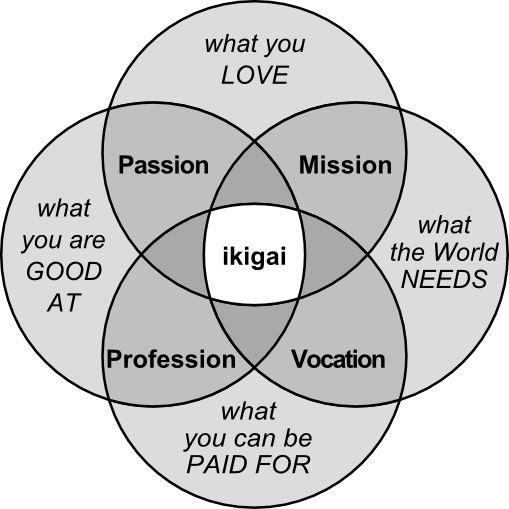
It works by asking you to put things from your life into a Venn diagram with four categories and four cross-over areas.

Finding Your Reason For Being

I found it beneficial to start with What You Love, then What You Are Good At, then What You Can Be Paid For and finally What The World Needs. Then to fill in the things that fit both categories in the cross-over areas called Passion, Profession, Vocation and Mission. This order worked for me, but you can do it in any order you wish. The aim of Ikigai is to figure out what your passion, profession, vocation and mission are, and they should be based on deep self knowledge. Ikigai is achieved when all of these are aligned with each other in your life. It is the sweet spot of purpose and being.

Once you have found your Ikigai you will have your mission, your profession, your vocation and your passion. Whatever order you decide to complete you Ikigai Venn diagram in, I believe that our mission should be the driving force behind all areas of our lives, it is essentially our Why. Your profession is important because it is necessary to work, so you can pay your bills, but it also affords the biggest opportunity to bring your mission to life, because we spend most of our time each day working.

If you are going to set a goal for 2019, if you have not already, I would work through the process of figuring out your Ikigai and find one big change that you want to make, something embedded in your Ikigai. If you do, it will bring into view the metaphorical mountain that you are going to climb. The summit is your destination, your life’s purpose will show you a big achievement that you want to complete. Once you figure this out you will be at your base camp looking up at your mountain.

Finding a mountain to climb

Next, plot your path to the summit. Like all good mountain climbers, reverse engineer your journey from the summit back to the base camp and then get started. It is time to take the metaphorical mountain that you have been putting off or have not been aware of. Once you have a big 2019 goal don’t let yourself get in the way. Build rituals and habits that support your climb and jettison your unhelpful habits. And don’t forget to use your Ikigai Venn diagram as your compass, because every decision, your thoughts, speech and actions, should come from your Ikigai diagram.

This might all seem like a big undertaking, but remember, small steps count too, as long as you are going forwards. Draw on the support you have around you and find someone that you trust to share your big 2019 goal with, so they can be your accountability partner to keep you on track. Many believe that you only get one life, but even if you believe in reincarnation, it is best to make the most of this human life. I wish you good Ikigai my friends, so that you can live blessed lives in order to be a blessing to others.

Something to reflect on:

Purpose in life should be an equal balance of following our heart and making the world a better place than it was the day you were born into it.

Bring on 2019

“Everything can be taken from a man but one thing: the last of the human freedoms—to choose one’s attitude in any given set of circumstances, to choose one’s own way.” 

– Viktor E. Frankl, Man’s Search For Meaning

Bad experiences 

Many of us, if we think back to our childhood, our teens or our early adulthood, we can think of bad experiences that we have had, like bullying, breaking an arm or leg, parent’s separating or big disappointments. I sincerely hope these experiences for you were not too traumatic, but I feel safe in saying that no one grows up without some of, what we could consider to be, bad experiences. Often these bad experiences involve being embarrassed, upset, humiliated or injured.

All of the bad experiences we have get carried around by us as we grow, mostly unconsciously, metaphorically speaking. They even have an impact on our day to day decisions and on our relationships. They become part of the prism through which we see the world.

Fear of the past becoming the future

These bad experiences can become underlying fears or anxieties that shape our behaviour, sometimes in unusual ways. We often gravitate towards  what we know, even if it is bad for us, because it is familiar, it is not the unknown, which we can be the most afraid of. In evolutionary terms we have a deep, ingrained suspicion of the unknown. Historically, this has kept our species alive. To be suspicious of a shadow could mean that humans avoided being eaten by wild animals. Today, we are often suspicious of other people’s motives when they are nice to us or of experiences that are alien to what we have experienced before. 

However, this suspicion becomes a present fear when it comes from a bad experience we have had in the past, and if we allow it to remain unresolved in our minds the fear can grow and become a barrier to our happiness and success. The fear manifests as anxiety, and the more extreme the bad experience the greater the anxiety usually, especially if there is an unknown element to the situation that we are anxious about.

Attitude is everything

Something that has helped me overcome my anxieties is to figure out the unhelpful belief that is creating the anxiety. Often this is unconscious and some work is needed to figure this out. Writing a journal about your anxiety can help. Once we have the unhelpful belief we can then find a belief that will act as an antidote, something we can use to replace the unhelpful belief.

An important way to think about all of this is that often we let our bad experiences in the past control our present and our future. We let the drive to avoid experiencing the same bad situation dictate our decision making and the things we say and do. We let our past control our future because we, whether unconsciously or not, believe that our past will be repeated. But I am here to tell you that your past does not equal your future. We have more control than we think about what our futures will be like, because our future is largely a result of our decisions, actions and behaviours of our present.

It is true that our present is a result of our past, and we cannot control or change the exact present moment, because of this, but we all have control over how we respond to the present and what our future will be like. In any situation the one thing we can always control, if we practice enough, is our attitude. Even in the Nazi concentration camps, in the most dire of situations, there were inmates who would go around making sure everyone else had food, water and whatever minor comforts where available. As evidenced in Viktor Frankl’s book Man’s Search For Meaning, which documents his experiences in such a camp.

Taking on a newyear

So, if 2018 was not a particularly good year for you it does not mean that 2019 will be the same. The same is true if you had a good 2018. We cannot control everything that will happen in our lives, but if we firstly control our attitude to the events in our present and our past experiences, we can live positively and make positive decisions in each moment to make our future’s as awesome as they could be.

If we develop positive beliefs that we use to replace negative beliefs we can build our resilience to the difficulties in life, so we can rise above them and begin to fly. It is not about how many times we get knocked down by life, but rather the act of getting up every single time and taking on whatever lies before us on our path.

In 2019, build up your resilience, grow your relationships, build up your health, and seek opportunities. The opportunities are always there, but we have to have a positive mindset in order to see them and then take advantage of them. The world needs the things that only you can bring into it. You are needed to make the world a better place. I wish you a happy new year and an awesome 2019 and beyond.

Something to reflect on

Normally at this time of year we set new year resolutions, which we often do not continue with beyond January. However, I suggest you endeavour to have a positive attitude whatever the circumstances, however difficult this may be.

What are we looking for?

“Don’t Look For Anything,

Just Learn to Look”

– Sadhguru


In his blog post on 30/04/18 Sadhguru reflects on the difference between looking to find a conclusion in life and the art of just looking. It is true that in our culture we are very focused on outcomes, achieving goals and reaching success, but in our path of life the important things like happiness and love, and even success, should not be end goals, not really. Real happiness, love or success are experiences felt in the moment, within ourselves, and they are very personal.


Looking in the wrong place

If you take any of these three things you can say that they are different for each individual person, because they are manifestations from our individual interactions with the people and the world around us, and when our circumstances and our relationships with other people and the world are in alignment with our values and beliefs then happiness, love and success manifest in our lives. The point here is that we spend too much time in search of attaining these things, as if they are out there in the world, as if we could possess them, if only we can live the right life, buy the right things and do the right actions. Happiness, joy, love, pleasure, satisfaction, success and many other human goals are all things that we experience within ourselves, we can never find them by looking for them out there in the world.


“The ability to look without motive

is missing in the world today.

Everyone is a psychological creature,

wanting to assign meaning to everything.”

– Sadhguru


Just looking

Many sages talk about being mindful, of being fully conscious of the moment we are in and not being distracted by our regrets of the past or worries about the future. The point that Sadhguru is making in his blog post referenced above is that our capacity to experience life in it’s fullest form is dependent on whether or not we focus on just looking so that we understand what we are looking at more deeply, it is curiosity for curiosity’s sake. He says “Spirituality is not about looking for God, truth or the ultimate. It is about enhancing your perception, your very faculty of seeing.” In this way you could say that the path to enlightenment, or just happiness or success, is in fact the path itself. All of these positive experiences that I have been talking about can be experienced instantly if we have the right mindset and if we look at the world and ourselves without expectation of a goal.


Something to reflect on:

How do you try to manifest happiness, love and success in your life? Are you seeing them as goals or as experiences in the moment?

Mastering Your Time

“Until we can manage time, we can manage nothing else.”

– Peter Drucker


Why we should master our time

If we do not master our time then we will continually miss opportunities to move closer to success in the areas of life that we care about and our lives will be what happens when we are busy making plans. Time will not stop moving forwards, we cannot control the passage of time, only how we choose to live as time passes by. Therefore, mastering time management is one of the most important skills to have and is a skill that can be learned, with practice and good strategies.


When it comes to mastering your time there are two well used items that are very rarely used to their full potential, these are the calendar and the to-do list. There is a smart way to use them and then there is the way that most people employ, which works against optimal time management. Usually we add things to our calendar as they pop up in our lives so we don’t forget to do or attend them, which on the surface is useful, but success is built on excellent time management, for which we need to be more strategic.


Mastering our calendar

Let’s look at how we can effectively use the calendar. To best use a calendar we need to block out everything that we want to do in blocks of time, both essential and non essential things, so we have some structure to cut down on the amount of time that we waste not working on the things we want to be successful at. For this I suggest using an electronic calendar like Google Calendar, or one of the many other very good alternatives, that allow you to add in items by the minute and allow you to add reminders. Many of these calendars will also allow you to colour code items, for those of you that are visual thinkers like me. These should be events and activities that take up a chunk of time, both recurring things that happen every day or every week like going to work and one off events like weddings. These are not to be confused with tasks, for these we will need to use the to-do list, which I will come onto soon.


Firstly, we block out the things we have to do like our job, family commitments, appointments and the like, important things that have to be prioritised first. I call these the Everyday Essentials. Secondly, we block out the things that are important to us, things that we are passionate about, like meditation, going to the gym, being creative, religious worship and the things we want to become successful at; for me that is this blog. I call these Passion Essentials. Thirdly, we block out the things that are not essential, things like meeting up with friends for a drink or going to watch a movie. I call these the Non-Essentials.


This process of blocking out time should ideally extend to planning out the whole year with everything we know we will be doing, like the hours we will be working and family holidays, as well as one off events we know about. Then as the year progress we will be able to add in more things as they come up, usually over the future month or two. In this way we will know what we will be doing the following day, week and month, which will reduce any time that we would otherwise be wasting figuring out what we are going to do during the day ahead. There will undoubtedly be gaps in the calendar, which is a good thing, because it gives time to fit in unexpected events as well as allowing us to utilise the to-do list to include the tasks we need to complete over the following days and weeks.


Mastering the to-do list

The problem with to-do lists is that they often seem like a long list of things that we do not end up doing because we do not know where to begin, so we do nothing. What we need to do to get the best out of the to-do list is to prioritise the items on the list by importance and how soon they need to be completed. This could be to respond to an email or to work on an assignment or go to a meeting.


First we write out the items that need to be completed and then prioritise the items on the list by writing next to each of them a number to show the importance and a letter to show how soon the item needs to be completed. Either a 1, 2 or 3  and an A, B or C. This is what these numbers and letters mean.

1 – Very important
2 – Important

3 – Not important

A – Complete as soon as possible
B – Complete within the next week

C – Complete in the next month


We can prioritise the items by how soon they need completing and then their importance, so everything with 1A is completed first, then 2A and then 3A. Then we move on to 1B, 2B and 3B and so on. Once we have prioritised the to-do list we can then add these tasks onto our calendar around the things that we have already blocked out.


There are mobile apps that allow you to create to-do lists where the items can be moved around in order and categorised by colour, as well as moving the to-do items onto the app calendar. Some of these apps sync the app calendar with the calendar on the mobile phone and email account, so they will be included in the calendar which we have already blocked out. I recommend the To-Do Calendar Planner by isoTimer, which will sync with the Google calendar linked to the Google account on the mobile phone, if you have a Google account. This app is only available on Android, but is an excellent app.


Final thoughts

Using a calendar to block out the events in our lives and a prioritised to-do list to organise the tasks we need to complete in this way will mean that we end up with less time wasted and more success in our lives. The level to which you plan out each of your days is up to you. You might prefer to leave big parts of your days with nothing in them or you might prefer to account for every minute of every day, the choice is yours, as it is your life. However, I do believe that some degree of structure will allow you to make the most of your days, and therefore your weeks, months and years. I sincerely hope that you have a long and fulfilling life, and that you achieve success in your chosen passion.

2017 goals achieved? How to set 2018 goals.

“A goal properly set is halfway reached.”

—Zig Ziglar


It has come to the end of 2017, have you achieved all that you wanted to this year? Did you set goals this time last year that went undone? We often set unrealistic goals or we set achievable goals but do not put into place the habits and targets we need to achieve them. I will set out 5 steps that will help you achieve your goals for 2018.


Step 1: Decide on what you goal is going to be.


The first step is an obvious but crucial one, to make a decision on what you want to achieve and then deciding to act on this. This decision, however, needs to be made in the full conviction that you will achieve it. No half measures, no self doubt. Decision with conviction is the first and vital step to making positive change in your life.


Step 2: Reverse engineer the path to the goal.


Without a plan, or a map, to get you from where you are today to where you will be when you have achieved your goal, you can waste time doing unnecessary things by getting caught up in activities or strategies that do not help progress you towards your goal. This is wasted energy and time and this can have a negative impact on your motivation to continue, because you might begin to question whether it is worth it after all. So, start from having the goal achieved and work back through the steps that you would need to take to get there. Ask yourself what are the key actions that you will need to take. Ask what is the key knowledge and experience that you will need to have. Ask what key support you will need from mentors, family members and friends. We all need support sometimes, we cannot do everything alone. Ask what costs there will be and how you will finance the achieving of this goal. Finally, ask what habits you will need to have in order to work towards this goal. This will all give you a road map from where you are now to where you will be when you have achieved the goal.

Top Tip:

A short cut to achieving a goal is to find someone who is a high performer in the area you want to achieve in that has reached this goal themselves and find out the steps that they took to get there.


Step 3: Set daily, weekly and monthly targets.


Once you have reverse engineered the necessary steps, knowledge and experience to achieve your goal you will need to set up regular targets to get you to your goal. These should include daily goals which build on the habits that you will need to have, for example, if your goal is to loose weight a daily target could be to complete a simple exercise routine before you start your day that takes 15 minutes. If this is done every day the impact over a year will be massive. Then set weekly targets, for example, you could create a diet plan that includes mainly healthy foods 6 days out of the week with 1 day as your cheat day when you can eat want you want as a rewards for being consistent the rest of the week. Then set a target for a set number of months. If the goal will take 1 year then set a target for every 3 months. This will allow you to keep on track and all of the little successes each day, week or month will keep you be motivated as well.


Step 4: Set reminders to check in on progress at the start of each month.


Setting a reminder in your calendar to check in on your progress, whether it is a paper one or a digital one on your mobile phone or computer, is very important. This allows you to assess where you are doing well and where you might need to improve or make changes on your journey to achieve your goal. I would suggest the 1st of every month would be a good time to do this. As we move through life we become more knowledgeable and experience bring with it wisdom that can help move you closer to your goal sooner. Reflecting on your progress on a regular basis will also help you stay motivated to keep going, because you can see how far you have come already and how well you are doing. This self-reflection should involve comparing what you have done so far to the targets you have set yourself and whether you have achieved them, and then making some notes on what has gone well and what changes you might need to make.


Step 5: Make yourself accountable to the targets and the goal.


This is a strategy that can really help you stay on track to achieve your goal. Find yourself someone who will hold you accountable on the progress towards your goal. It is best if this person is someone that you trust and you have a good relationship with, but not someone who will not be supportive or who will not push when you need to be pushed. Usually, it is a good idea to pick a relative or a friend who will support you and motivate you when you are struggling to keep going. This will be your Accountability Buddy.  Sharing with them your plan to achieve the goal and the daily, weekly and monthly targets you have set yourself is needed here, so they can keep tabs on how you are doing. I would suggest setting up times when you can get together or talk over the phone to reflect on how you are doing. I would suggest using the monthly reminder to reflect on your progress as a good time to do this. Once you have sat down yourself to self-reflect then share this with your Accountability Buddy and discuss what went well and how you could do better.


Final Thoughts


Setting goals can be a tricky business because we are often pressured by outside forces to make changes in our lives. This could be pressure from family and friends, from messages through the media on how we should live or act, and it could be pressures from our place of work. When we set goals they should reflect our inner drives, our reason for being. In short they should come from our ‘Why’. Finding out what our Why is will be the single most important thing you can do. We all have a Why, but many of us are not sure what it is.

Your Why is the motivation behind everything that you do, it is as I say, your reason for being. Mine is to help others find fulfilment in their lives. For others it might be to be an amazing sports person or to be the best parent they can be. If you are unsure how to figure out what your Why is then I recommend you read the book Start With Why by Simon Sinek, or watch his TED Talk “How Great Leaders Inspire Action” which summarises the main points of the book, this will bring clarity to your Why. There is a companion book called Find Your Why, which I have yet to read but this may help you find further clarity. You could also visit the website www.startwithwhy.com. Start with your Why and set your goals in line with it, that way you won’t achieve your goal and then find that it does not fulfill you as you thought it might when the goal was set. Checking out my Fullfilment Framework found on the menu of this blog site can also help on your journey to finding your Why and your Way, two essential components to living a fulfilled life.