Spirit Of Generosity

Christmas is a time of giving, as the saying goes. It is a time when we spend a lot of money on presents for our loved ones. We also spend our time with then too. I would argue that it is more meaningful and more of a gift to spend time with others. We can always get more money, but time is a non-renewable resource. Who we choose to spend our time with is meaningful and has a significant impact on our lives.

This generous spirit is not something we should limit to the Christmas period. Ideally, it should be a way of life. If we live our lives with a generous spirit then we will make those around us happier, whether they are family, friends, or colleagues, or people we are meeting for the first time. The wider we extend who we are generous to the happier our lives will be.

To help others without expecting anything in return is planting trees under whose shade we will not sit. The fruits of the trees will benefit those we will never meet. It is also true that one generous act encourages another and the wave of generosity goes out into the world making it better one small act of generosity at a time. Even a smile is a gift that can lift someone’s spirits. So go and be generous every day and see how your life changes and how you change the lives of others.

You Can’t Step Into The Same River Twice

I recently visited a church that was my spiritual home for many years before I moved away from the area. The church was the same with the same minister, but the congregation had grown and was filled with new people.

At first, it felt uncomfortable as it felt so different because I didn’t know most of the people attending, but the vibe and the spirit of the place were the same. It made me think about the idea of not being able to step in the same river twice because the water constantly changes as it flows downstream.

However, the name and location of the river remain the same. I suppose you could say that all things, people and places are both different and the same each time we encounter them. They are the same river but the river is different.

We are also different each day and in each moment. The eyes through which we see the world at 15 years old are very different to the eyes we see through at 30 and 60 and 90 years old. To a large degree, we see the world how we are not how the world is. Becoming aware of this and recognising the changing state of things and of us can help us to navigate the world successfully.

Thrive to Serve, Serve to Thrive

When being asked what the meaning of life is, I have a tendency to say 42 with my tongue firmly in my cheek. However, it is something I think about quite a lot, and currently, I have settled on the meaning of life to be to thrive and help others to thrive.

I could go into the many reasons for this, including the evolution of our socially focused species and the effects of feel good hormones when we do good for others, but essential if we thrive we are more able to help others, to serve them. Also, if we focus on serving others, our own well-being is improved, helping us to thrive. And on it goes.

I do not mean to be someone else’s servant, I mean to have the mindset to help others, to serve what they need to be happy and successful. Conversely, we also need to be open to allowing others to help us. Allowing this is a gift to the person helping us because it allows them to reap the rewards that come from helping other people.

This cycle goes on and on and can spread through the world, causing us all to thrive together. So, if we work on thriving in mind, body, and chi, we can serve others when they need us to, and in serving others, we thrive even more.

Don’t Call It Mental Health

It seems that the idea of mental health permeates Western culture as a requirement of wellbeing and a keen focus for employers and self-help gurus alike. The problem with the term and idea of mental health is that it is innately something that you have or you don’t. To feel that we don’t have it makes us feel that our life and mental state is below par and, therefore, less worthy than those who have it. It can make us feel that we are not enough.

I agree with Simon Sinek that a better term is ‘mental fitness’. It better describes the gradient upon which mental wellness sits. It becomes a scale and a skill to improve. It opens up the idea of working towards mental wellbeing one step at a time, much like building up strength or stamina. It implies a journey and not a binary situation where you have it or not. It allows for bad days and good days and avoids the self degradation that befalls those who do not feel mentally well. This includes those who have experienced war, as a soldier and a civilian.

Face What Scares You

There is a Buddhist idea that comes from the Sanscrit word ‘maitri’, which means loving-kindness. Quite often, we are hard on ourselves, and we put ourselves down, or we are judgemental towards others. In each of these cases, we are thinking about ourselves or others based on opinions and beliefs that we have collected over the years. Opinions and beliefs that may not have any truth to them at all.

This is also true of the things that scare us. The reason we are scared of people or situations is because of our opinions and beliefs about them. It is as if we are running away from them without actually looking at them. When we apply loving-kindness to ourselves, we are looking at ourselves openly and with an embracing sensibility that diffuses negative thinking until what remains is only positive.

If we apply loving-kindness to the things that scare us, when we are curious, when we are interested in why these things scare us, then they lose their power. They lose their power simply because you have chosen not to run away, we have chose to face them. I am not saying that this will be easy, but it is worth it.

Choose a Better Response

I often see people swiping their arms at flies buzzing around them, which is usually accompanied by comments such as “damn fly” or “irritating fly.” I have increasingly been of the opinion that being annoyed by a fly is a choice.

This comes from the perspective that life and the world are not as they are but how we are. We interpret the events that go on around us based on the meaning we put on them. This is not to negate verifiable facts that exist independent of interpretation. What I mean is whether we see something as good or bad, intimidating or joyous.

If it is true that we put such meaning on the events that we experience, then we choose to see a fly as irritating. We can, if we choose to, say hi to the fly and thank them for their visit, for example. They can not harm us and will usually fly away shortly after they fly near to us. If we apply this idea to the rest of our lives, there are many situations where we can choose a better response rather than reacting with negative emotions.

The Power of Thoughts

Yesterday it was sunny and around 20 degrees Celsius, so I needed to put suncream on my 5 year old. As I was about to put it around her neck she said don’t tickle me and preceeded to wriggle around on the floor giggling as I tried to put on the suncream. I then had her sit up and take some slow breathes to allow me to try again. She let me put on the suncream and she didn’t feel like I was tickling her.

When she prepositioned in her head that it would tickle, that was her experience.  When she prepositioned in her head that it wouldn’t tickle it didn’t, as much.

A more extreme example can be found in Viktor Frankl’s book Man’s Search For Meaning. In the book, the author recounts his experiences in a Nazi concentration camp. He describes how some inmates would give up and others would move around helping others where they could, giving away their last piece of bread. The point being, one’s attitude or thoughts in any given situation can bring about very different states of mind.

Our thoughts become our emotions, and our emotions become our experiences, and our experiences, if repeated enough, become our reality; the world as we see it. Our thoughts are very powerful, and we have the power to choose them. So, we have a choice on how we see the world. Empower yourself by selecting your thoughts.

Beliefs Are More Important Than Goals

I’m currently reading the book Atomic Habits by James Clear. I’m only part way through the book but the book makes a good argument why goals do not help with continuous improvement but systems do. The standout idea so far is the way in which we think of habits: “Changing our habits is challenging for two reasons: (1) we try to change the wrong thing and (2) we try to change our habits in the wrong way.”

When changing our habits we can look at outcomes, processes or identity. “Outcomes are about what you get. Processes are about what you do. Identity is about what you believe.” The most effective way is to see yourself as the kind of person you make the desired improvement or is doing the desired productivity or activity, to believe it. A great example in the book is this:

“Imagine two people resisting a cigarette. When offered a smoke, the first person says, “No thanks. I’m trying to quit.” It sounds like a reasonable response, but this person still believes they are a smoker who is trying to be something else. They are hoping their behavior will change while carrying around the same beliefs.

The second person declines by saying, “No thanks. I’m not a smoker.” It’s a small difference, but this statement signals a shift in identity. Smoking was part of their former life, not their current one. They no longer identify as someone who smokes.”

I guess it is all about mindset. Believe you are the kind of person who will achieve the goals that you want to achieve and your behaviour will reflect that belief. The results will then follow.

Build The Life You Want

I recently watched an interview at Harvard with Oprah Winfrey and Arthur Brooks where they were discussing the book that they wrote together called Build The Life You Want. This book is on my to do list of books to read, but they covered the essentials of it in this interview. You can watch the video by following this link, but here are the essentials.

Happiness has three elements.

  • Enjoyment (not pleasure)
  • Meaning or purpose
  • Satisfaction

Enjoyment is pleasure plus people and memory. You must spend time with other people and make memories together to experience enjoyment. Also, you cannot keep satisfaction through acquiring things. There is an equation, however, for lasting satisfaction. Lasting satisfaction equals all the things you have divided by all the things you want. If you reduce the things that you want you increase lasting satisfaction.

Faith is believing that there is something larger than yourself. This could be God, nature, the universe, etc. The point is that you are not the centre of your universe.

As well as the elements of happiness that are mentioned above, there are institutions in your life that all need your attention to be happier. They are like a pension fund where you have to deposit in all of them to reap the rewards of feeling happier further down the road. These institutions are:

  • Family
  • Friends
  • Faith
  • Work that serves others

It is important not to think of happiness as a destination, but to aim for happierness. To be happier than you are now. It is a shift in state by ensuring that you focus on all four institutions.

When good things happen to you or bad things happen to you a good practice is to think, how can I use this in the service of others? This will mean that the bad things and the good things have purpose and you have control over what you do with what you get.

It is good to do small things with great love. Don’t always focus on having a big impact or making a big change. Doing small things with great love will, in the end, have more of an impact. After all greatness is determined by service to others.

Social media is the junk food of social life. There is no substitute for being in the same room as someone and being able to look them in the eye. This human to human interaction will give you more of the feel good hormones and will build stronger relationships. Interacting through screens is not the same.

Finally, your legacy is not some great thing that you leave behind, it is every life that you touch.

We Can Be Peacemakers

Much of the world is at war with other parts of the world, but also, much conflict is celebrated in the news and social media, when one celebrity is fighting with another or some situation is pitting one group of people against another. It makes good viewing, because people watch. Some conflicts are real and others are not. However, all forms of conflict seep into our lives through our exposure to them.

We can be mindful of what we let into our minds, what things we agree with because those around us do, what we watch on TV and whether we encourage or engage in divisive speech. We are not in a war zone, but we can be peacemakers. We can seek resolution and not conflict. We can become open hearted and not hard hearted. We can learn to assume good intentions from those we interact with. We can seek out our prejudices and judgemental thinking and remove them. We can meditate and pray and share what we have with those around us. In the end, from the cosmic perspective, we are all in this together.

We are on a planet hurtling through space around a star, one of billions in our galaxy in a universe that has billions of galaxies. We share our DNA with all other life on this planet. We share DNA with a banana, and a fruit fly, believe it or not, because we have the same origin as all other life on this planet. If you choose to, you can see all living things as our brothers and sisters, as many native peoples do. Otherwise we risk conflict and divisiveness, even if unintentional.

We are all brothers and sisters. One human family. The chasm between us and our enemies is but a step towards love and compassion. The space between enemies is decided by how we see them and how they see us. In reality there is no space.

What Change Do You Seek To Make?

Often in a capitalist culture we focus on one metric, the output. Any other effects of the work done are therefore treated as side effects. But really the impact of what we do, make or produce are all effects, there are no side effects. Creating mobile phones, for example. The company will focus on how many can be made in any given timeframe. The impact on the environment, the impact on the quality of life for those making the parts for the mobile phones and the impact on those who are using mobile phones are all effects. When we focus solely on the output we miss, or ignore, the other effects of what we do.

It is better, I think, to focus on creating value. This then brings quality into the equation. The quality of the impact on the environment, the quality of life for those making the product, the quality of life for those using the product, etc. The quality and the quantity must be balanced in order to create value. And quality can be quantified as can quantity, it is just easier to see the impact of quality in the long term and less so in the short term.

This then begs the question, what value do you seek to give? If you want people to collaborate you would focus on applications and tools to connect people effectively. If you want to focus on accessibility you would ensure those with disabilities could access the thing you are making. And on it goes. Being clear on what you intend to do, who it is for and why you are doing it allows for quality to matter, and once the quality is in place, the quantity will take care of itself.

But first ask yourself, what change do you seek to make?

Finding Steady Ground

For a while now I’ve felt a little lost, in the sense that I didn’t feel like I was living up to the purpose I had found for myself and I was just coasting. It felt as if I had a purpose but no motivation to work towards it. Having Fibromyalgia I feel exhausted most of the time, so taking the time to work on my purpose is hard. Though I do need some sort of steady ground to keep me centred and from which to build.

I have a Buddhist faith, although I would also class myself as Unitarian, and I haven’t meditated or prayed at my shrine for a long time and watching this interview with Shia LeBeouf shifted something in me. He is someone who has hurt people and this recently spilled out into the public eye, which brought him to rock bottom. However, he found a way forward through a Catholic faith, as well as doing the work with other groups to get sober and make amends for the hurt he caused to others.

I guess seeing his transformation through faith I have realised the importance a daily religious practice has on giving you structure and a steady ground on which to move through the world. It has to be a daily practice though. My approach of prayer on an ad hoc basis has not worked. This is part of the work of finding fulfilment, to have daily practices that nourish the soul and clear the mind. I will try again.

Humility In Action

There is a story about a samurai and a wise man that goes something like this. A samurai once stopped a village elder on the roadside and asked him to define heaven and hell. The wise man responded by saying, “you are too stupid to understand something like that.” The samurai flew into a rage, took out their sword and raised it above their head to bring down onto the wise man. The wise man then said calmly “that is hell.” The samurai stopped, lowered his sword and reflected on the wise man’s words. The wise man then said, “and that is heaven.” The samurai bowed in respect and continued with their journey.

It is said that for a samurai to use their sword they must make the decision to use it before they take it out, as they must draw blood once it has been taken out. The decision, therefore, is not changed once decided. I would like to argue that we should be humble enough to change our decision once it has been made, when there is new information that requires a better course of action. This takes humility, which is a skill we all need to practice. Sometimes someone wiser than us will show us a better way and we should listen, acknowledge them and act in accordance with this new found wisdom.

Questioning Our Beliefs

Beliefs are conclusions that we assume to be the truth. We often say that beliefs come from faith, but a belief unquestioned becomes a closed door. When we say we belong to a particular religion we are often identifying with a belief system which has institutionalised beliefs into a specific way of seeing the world.

Though the guidance from religions can be beneficial, if they go unexplored and unquestioned this is not a spiritual journey, it is a spiritual roundabout. Beliefs are important, particularly religious ones, because they deal with the nature of reality. However, I feel these beliefs should not go unquestioned. If beliefs are seen as a working model of how the world works, we can then repeatedly test it to see if it produces joy, happiness and fulfilment. These are the measure of a life well lived.

Don’t Always Set Goals

In life we need to set goals, progress is an essential aspect of living a fulfilling life. If we had no progress we would feel a sense of stagnation and a lack of motivation. Goals are important, but sometimes they are a reflection of who we think we should be. There are goals that we think we need to achieve in order to be a success, after which we will be happy.

Success does not automatically equal happiness. If the success is in something that does not align with our fundamental values, for example, then it can never really be happiness inducing. What we need to understand is what happiness and success look like for us, based on our values, beliefs and ethics.

Sometimes we also set goals in order to feel like we are working towards success, but in fact we are avoiding figuring out what we really want. Doing the work of figure out who we are and what we want out of life can seem too difficult, so we take someone else’s model of success, or the model that is currently seen as popular, and tell ourselves it is what we want. In a way it is a form of procrastination.

So, set goals, but do the hard work of figuring out what you really want out of life first.

To Read Is To Grow

Many people don’t read on a regular basis. They read social media posts or snippets of news stories on their mobile phones, but reading seems to be something fewer people do for pleasure these days. I may be wrong, but that’s how it seems to me.

Reading has many benefits in terms of keeping the brain active, but the benefits beyond this depend on what you read. If we are to improve ourselves, to become wiser, kinder and happier, then what we read matters more than how often we read.

There are self development books and their are spiritual books, which are also self development books. Books that reach deep into you and show you what not to be and how to be in order to be happy and fulfilled in life. The wiser the content of what you read the happier you feel the more you read it. We all need progress, to varying degrees, and reading good books is the best way I know how to do so. To read is to grow.

Check out my recommended books on the Resources page.

Appreciate Where You Are

They say that every season has its purpose. In nature, Autumn bring the falling of leaves which nourish the soil, that then feeds the tree from which the leaves fell. Summer provides lots of sunlight to help plant life to flourish, which helps all life to flourish.

You might feel like you are in a difficult situation that might be likened to the harshness of Winter, but difficulty can help us to develop resilience. If it was like the Summer all of the time then we may not appreciate what we have. Every year Winter shows us what the absence of Summer is like and we appreciate it all the more when it comes around again.

In life we have challenges and we have moments in the Sun. Each has its purpose and we can use them to our advantage, if our mindset is a growth mindset and we look for the opportunities rather than the difficulties.

Read It Yourself

In the 16th Century the Bible started to be translated into European languages from Latin. Previously, Catholic clergy were predominantly the ones who understood Latin and they told their loyal followers what the Bible said. They told their followers what the teachings of the Catholic Church were too.

Once the Bible was available to be read in the common people’s own language, people began to disagree with some of the teachings of the Church. The Reformation began, the understanding of God, Jesus and the Church was reformed into many different viewpoints.

Some say that this is for the better and some for the worse. It is not a debate I intend to start here, and this is not a comment on the teachings of the Catholic Church. My point is that, much like the teachings of the Church at the time, our culture has us believing a number of things that we take for granted; we receive signposts on how to live in a similar way, we are told them. We are told how to be happy, the value of money and what success looks like.

When you read into what actually makes you happy and successful it will likely not match the messages from our culture, because our culture is influenced by those who wish to sell us things. They have an interest in the stories we are told.

So, ask why when our culture tells us to do something. Ask what the purpose is of living how we are expected to live and you will be on the road to a more enlightened way of living, and you will be happier and more successful.

Who Should We Listen To

When we only listen to the news or social media or friends that agree with us then we are in what is referred to as an echo chambers. However, echo chambers can be used to our benefit, but it depends on who we listen to and this depends on what kind of life we want.

If we listen to the religious teachings of Jesus, the Buddha or Mohammed our lives will likely be happier. If we listen to the advice from Tony Robbins, Seth Godin and Simon Sinek our lives will likely be more successful. If we know what kind of life we want and we wilfully enter the appropriate echo chamber we can tune out the cultural noise that is the opposite of what we want, then this will be help.

However, if we have right wing ideas and we listen to the ramblings of Donald Trump, then we will likely go down into an echo chamber of extremism and violence. Echo chambers have their place, as long as we also make ourselves aware of opposing views too. When we completely close off alternative view then we can become extreme and potentially an extremist.

Dare Greatly

I would like to begin this blog post with a quote from the American president Theodore Roosevelt.

“It is not the critic who counts; not the man who points out how the strong man stumbles, or where the doer of deeds could have done them better. The credit belongs to the man who is actually in the arena, whose face is marred by dust and sweat and blood; who strives valiantly; who errs, who comes short again and again, because there is no effort without error and shortcoming; but who does actually strive to do the deeds; who knows great enthusiasms, the great devotions; who spends himself in a worthy cause; who at the best knows in the end the triumph of high achievement, and who at the worst, if he fails, at least fails while daring greatly, so that his place shall never be with those cold and timid souls who neither know victory nor defeat.”

I became aware of this quote when watching a talk by Brené Brown. Prior to the recent talk I watched, she did a TED Talk called The Power of Vulnerability, which I recommend you watch. The TED Talk went viral and inevitably the trolls of the internet began commenting with personal attacks rather than listening to the very wise content of the talk. Brené Brown stumbled on to this quote after reading the horrible comments about her.

Since then she has decided that if you are not in the arena getting your arse handed to you, if you are not putting your work out there, then she is not interested in your feedback. What I would like to advocate for you is that you do two things. Firstly, have the courage to dare greatly and secondly, to ignore feedback from those who are not daring greatly themselves.

Building A Better World

“Follow your dreams and use your natural-born talents and skills to make this a better world for tomorrow.”

– Paul Watson

This Summer saw the long awaited 2020 Tokyo Olympics, which was an unusual state of affairs, without the spectators. However, it gave a chance for the people of each country to see their Olympic champions battle it out for the highly held Olympic medals. After the way the 2020 Euros lifted the spirits of the nation, there was a hope that the Olympics could keep the national excitement going. In the end more people watched the Tokyo Olympics than did the Rio 2016 Olympics. Records were broken and Britain came a respectable forth in the medals table, which is all pretty positive. Positivity is in great need after the past 18 months and the uncertainty of coming out of the imposed social distancing guidelines, which has left us all feeling a little unsure how to interact with each other in the new normal.

The Olympics have long been held up as the bastion of sportsmanship, of unity in diversity and of excellence. Curious to see the principles behind the organising of the Olympics, I looked up the Vision of the International Olympic Committee, which is “Building A Better World Through Sport.” A worthy vision, and one which is shown in their Values of Excellence, Respect and Friendship. And this got me thinking about how we can make the world a better place after the COVID-19 pandemic put a pause on much of society’s habitual behaviours. During the pandemic the kindness of strangers and the capacity to care flourished amongst neighbours and strangers alike. The concept of Key Workers redefined for many of us who plays an important role in our society and who does not. There was initially talk about going back to normal after the pandemic, or rather a new normal, and it is this idea of a new normal that I want to focus on today.

If we can better choose how we can interact with each other, how we can live together and how we can connect with each other, then this seems like a good time to do it. We can take up the cause of the Olympics of ‘building a better world,’ but not just through sport, but through how we see each other and how we interact with each other. This thing called life is a shared journey from cradle to the grave, but we are capable of lifting each other up, so we may all live better lives.

To illustrate what I am talking about I would like to share a story I saw online recently about a Police Officer in America who pulled a young man over, as his driving licence had expired. The young man explained that he barely had enough money to pay the bills and his rent and could not afford to renew his licence, due to losing his job. He was also on his way to a job interview, in the hope to gain an income and eventually get his licence renewed. The Police Officer left his own car and drove the young man to the job interview and apologised to the Interviewers as he was the reason the young man was late for the interview. The young man got the job and was able to renew his licence in order to legally drive again. Sometimes kindness matters more than the letter of the law. It also matters more than the prejudices and stereotypes that we all have which prevent us from seeing others as equal to ourselves and therefore worthy of kindness.

It is also important to remember how connected we all are. The COVID-19 pandemic showed how our movement around the world can cause diseases to spread, but we can also share our behaviours, our ideas and our values. Kindness and generosity are also infectious. Mother Nature has provided a way to encourage us to be kind and generous. This is how we thrived as a species, by working together. If we are to be generous or kind to someone else without any expectation in return we get a hit of Oxytocin, which makes us feel good. The person we are generous or kind to gets a hit of Oxytocin as well, which means they will likely go and be generous or kind to someone else that day. Even a person just witnessing an act of generosity or kindness will give them a hit a Oxytocin and will encourage them to pay the generosity or kindness forward. We are hard wired to do this, because we are stronger together.

To further show how connected we all are on our planet, here is something from a TV series on Netflix called Connected that blew my mind. It is in the episode on Dust and how important certain dust can be. In Chad, North Africa, in what used to be Lake Mega-Chad, but is now part of the Sahara Desert, there are the remains of fish and other creatures, which once lived in the lake, before the area became a desert. The wind breaks up the skeletons into dust which is then carried by the wind up into the atmosphere and it makes its way all the way to the Amazon Rainforest, in South America, where the dust becomes part of the soil. What is amazing is that the rain in the rainforest washes away most of the nutrients that the plant life needs to grow and survive, but the dust all the way from the Sahara Desert in Chad, North Africa, replenishes it. Around 22,000 tons of phosphorus is deposited in the Amazon Rainforest every year from Lake Mega-Chad, which is about the amount the soil loses every year due to rainfall. Without this process happening, there would be no rainforest. We are truly, globally connected to every other ecosystem on the planet. This is why when we through things away, there is no away. We need to look after our planet as well as each other.

The environmental movement, which includes Greenpeace, sprung to life after a very special photograph was taken when “Apollo 8, the first manned mission to the moon, entered lunar orbit on Christmas Eve, Dec. 24, 1968. That evening, the astronauts-Commander Frank Borman, Command Module Pilot Jim Lovell, and Lunar Module Pilot William Anders-held a live broadcast from lunar orbit, in which they showed pictures of the Earth and moon as seen from their spacecraft. Said Lovell, “The vast loneliness is awe-inspiring and it makes you realize just what you have back there on Earth.” They ended the broadcast with the crew taking turns reading from the book of Genesis.”(1) As they orbited back around the moon toward the Earth the photo Earth Rise was taken as the view of the Earth in the distant blackness of space rose into view over the surface of the moon, which is seen in the foreground of the photo. The sense that if we do not take care of our planet their is no planet B reverberated through the cultures of the West and the rest of the world.

We have now reached a point where taking a trip up to where the Earth’s atmosphere meets outer space is becoming a reality for those who can pay for it. There has been much debate online about the recent endeavours of Billionaires like Sir Richard Branson to develop “rocket planes” that can take people up the edge of space. Sir Richard Branson was the first to have “…successfully reached the edge of space on board his Virgin Galactic rocket plane”(2) recently. The main argument against such endeavours has been why build a rocket plane to take people to the edge of space on tourist trips when there are millions who are homeless, starving and displaced due to war. There are also issues with global warming. It is an argument over priorities and values, over selfishness and selflessness. Tickets to take the Virgin Galactic up to the edge of space cost up to £180,000, again money that could be spent helping our fellow human beings. I guess the main ill feeling comes from the disproportionate distribution of wealth and the fact that there are billionaires in the world where much good can be done if this wealth was shared. If a tenth of the wealth held by the Billionaires of the world was spent on helping those in need, the quality of life for many would be improved. Access to water, electricity and education, for example.

But we are not all Billionaires, far from it. Most of us have enough to survive and a little bit more to save or spend on nice things. This begs the question what can we do to make the world better? If we are to go back to the Vision of the International Olympic Committee, “Building A Better World Through Sport,” we can think about what Vision we might have for our lives. If your Vision began with “Building A Better World Through…” what would come next for you? I would suggest you build a better world through kindness. Kindness to the environment and kindness to the people we interact with each day.

However, it is not always easy to be kind, especially if we are asked to be kind to those we really do not like. In the Bible Jesus asked us to Love our Enemies? You might not think in terms of ‘enemies,’ but you will have people you would rather avoid, people you dislike. How do we build the capacity to be kind to those people? A good place to start is to work on the prejudices and stereotypes we all have, on the barriers we have that create an us and a them, so we can start seeing each other as human first, and then we can increase our generosity and kindness on a daily basis. The more people we are generous and kind to the more people will do the same for others. And you will feel so good at the end of the day.

Reference:

1: https://www.nasa.gov/multimedia/imagegallery/image_feature_1249.html

2: https://www.bbc.co.uk/news/science-environment-57797297

Developing The Pathway To Fulfilment

My intention is to create a process by which you can start to live well. To me living well means to live in a way that brings about happiness and success, which in turn brings about fulfilment in our lives. This is not a life hack or magical cure for what ails you. It is a deeply personal journey of self-discovery, of life balancing and of purpose finding. This is an evolving process, until I feel a clear and actionable ‘Pathway’ is created, so it can be shared and used effectively.

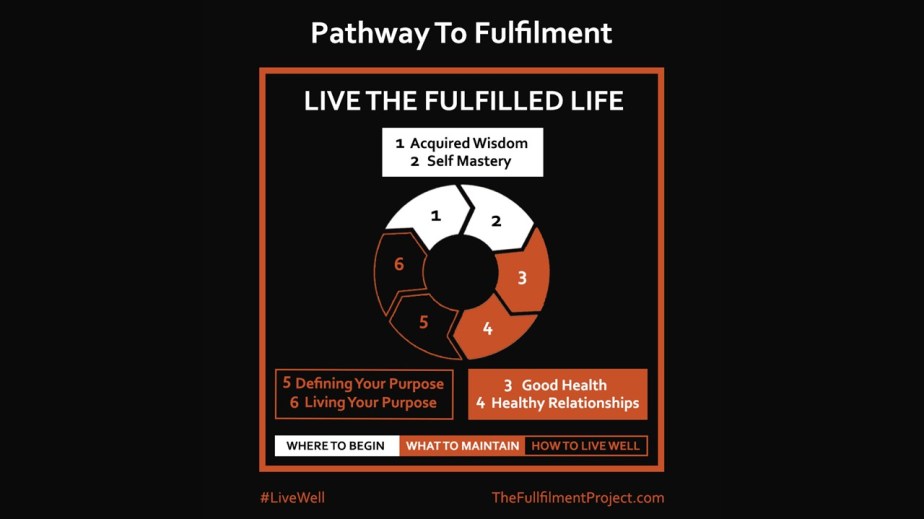
I have reflected on the first two steps to the existing Pathway and have moved Acquired Wisdom to Step 1, as I feel that wisdom gives us a strong foundation from which to build. I have replaced Self Knowledge with Self Mastery and moved it to Step 2, as self knowledge is a useful mental exercise, whereas self mastery is an actionable way of being, which is built on both wisdom and self knowledge. This, I feel, is a more effective part of the journey, as self mastery is required in order to have a life well lived. The six steps  are now Acquired Wisdom, Self Mastery, Good Health, Healthy Relationships, Defining Your Purpose and Living Your Purpose.

The six steps of the Pathway To Fulfilment are divided into Where To Begin, What To Maintain and How To Live Well. Now that I have an outline of a process that I believe will bring about fulfilment in ones life, I aim to add in the detail of the activities and actions you will follow within each step of the journey towards fulfilment and a life well lived. Watch this space and the Facebook Group Community for up and coming updates.

WHERE TO BEGIN

Step 1: Acquired Wisdom

We acquire the wisdom of others from a variety of sources, spiritual and secular. Wisdom challenges us and enlightens us. Often this is achieved by extensive reading, but, with the internet, a lot of this same wisdom can also be obtained through videos, audio books and pod-casts, however you learn best. This wisdom will feed into what you already know about yourself, it will influence how you see yourself and how you choose to live; helping towards self mastery.

There is a lot of wisdom out there to acquire, and it can sometimes be hard to distinguish wisdom from well sounding ignorance, so to simplify things for you I have broken down the wisdom I have found into ten Principles Of A Life Well Lived that will help you navigate the world skilfully. They are what I consider to be the essential wisdom to acquire. I will delve into each principle and explore how it will enhance your life. I have divided the principles into those that relate to Self and those that relate to Others. The principles related to Self are Growth, Equanimity, Fortitude, Seeking and Self Competition, and those related to Others are Stewardship, Servant-hood, Reciprocity, Joy Making and Connection. I will be sharing more detail on these moving forward.

Step 2: Self Mastery

The process of self mastery begins with getting to know yourself more substantially than you may have before; figuring out what really makes you tick, what you believe and don’t believe, what you think is true and false, what you think is ethical and not ethical, etc. It includes figuring out your beliefs and your ethics. Also, what happiness and success look like to you, personally, because our happiness and success are relative to our values, which are very personal to each of us. Our happiness and our success will not bring about fulfilment if they are not aligned with our values.  Self mastery begins with broad and deep self-knowledge and then in order to gain and maintain mastery of yourself you will need to cultivate both body and mind, the tools for which will come from the ten Principles Of A Life Well Lived.

This will primarily be mastery of your thoughts, which is the same whether you are embarking on self-development or a journey of faith. Our mind and body are in a sort of synergy, which means our thoughts effect the chemistry our brains create in our bodies, which in turn creates sickness or wellness. Wellness, being the optimal state to be in. Also, that if we fine tune our body through exercise, through practices such as Yoga, and if we cultivate strong Qi (Chi) in our energy system, through practices like Tai Chi and Qigong, our physical well-being will flourish and allow our mental mastery and well-being to develop too. Self Mastery is both physical and mental, which leads me to Step 3: Good Health.

WHAT TO MAINTAIN

Step 3: Good Health

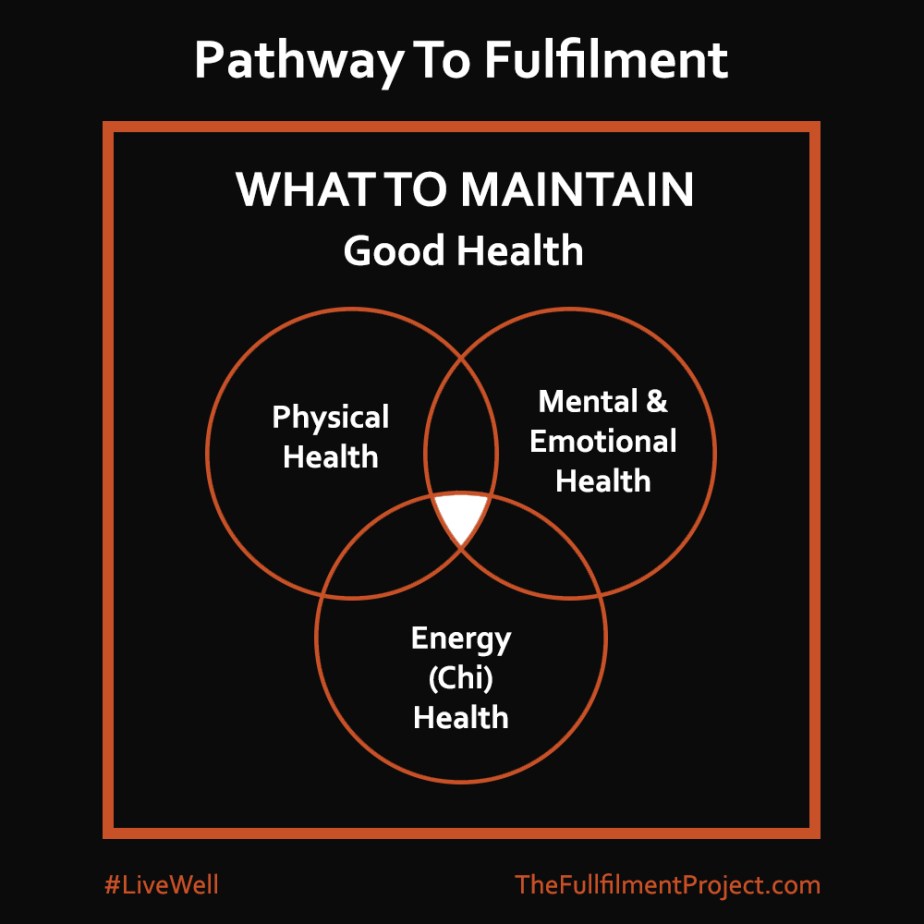
Your health should be of great concern, because good health is essential for your well-being and having an active, fulfilling life. I have included the usual physical health and mental and emotional health, and I have also included energy health; all of which could be thought of as a triad of good health. Good physical health includes diet and exercise. Good mental and emotional health includes mastering your emotions and balancing your thoughts. Good energy health includes mastering the Qi (Chi) that flows through your energy system, like blood through your bloodstream, as detailed in Traditional Chinese Medicine. To have good health you need to work on all three of these areas.

Step 4: Healthy Relationships

In this step you look at your relationships, and identify those relationships that are good for you and those that are not, and those that are a mixture of the two, that need work to become good. You should continuously work towards all of your relationships being healthy ones; meaning that they bring you happiness rather than stress, they uplift you rather than bring you down, and they are aligned with your values and ethics. These relationships are in circles of community, which are relationships with your self, your partner, your family, your friends, your colleagues and your acquaintances, and they are all interconnected.

HOW TO LIVE WELL

Step 5: Defining Your Purpose

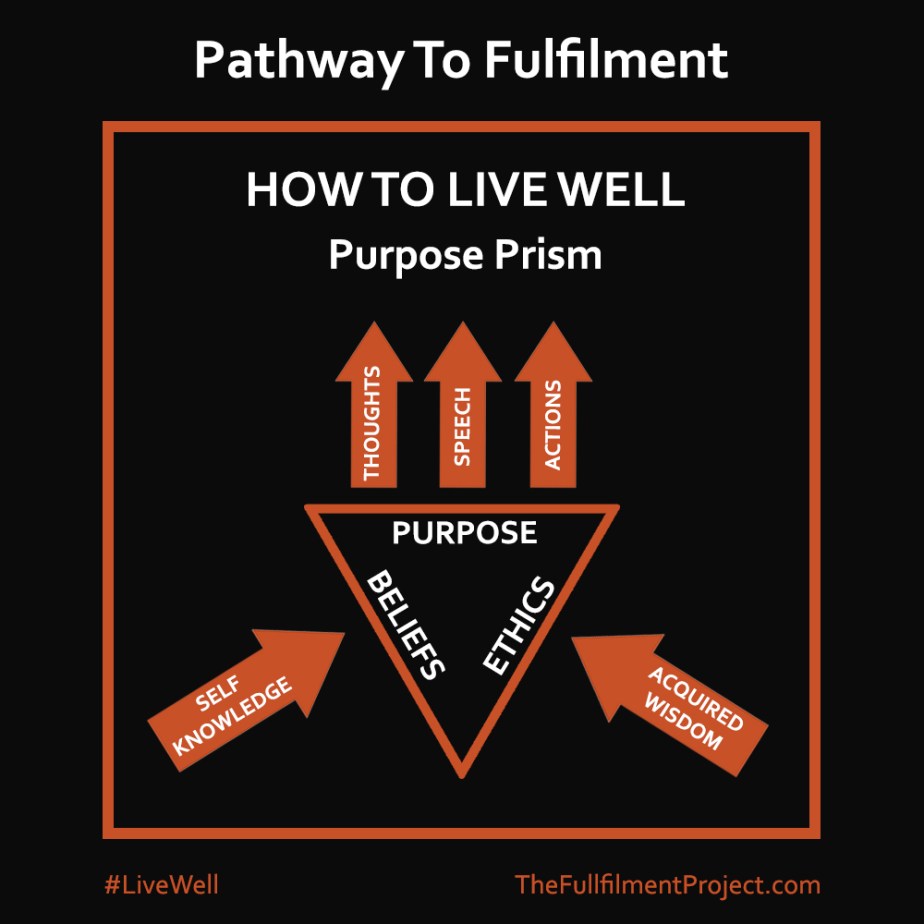
After working your way through this journey so far, you will have a solid foundation for how to start living your life better. From this new understanding of yourself, your defined beliefs and ethics form part of what I call your Purpose Prism, the third piece of this prism being your purpose. You will go through a process of building on your beliefs and your ethics, weaving in Acquired Wisdom and Principles Of A Life Well Lived, and all you have learned from steps 2, 3 and 4 and define your personal purpose. This prism is the filter through which you will see and experience the world, and it will influence your thoughts, speech and actions, making them wiser in nature. Your purpose comes from a vision of a better world that you want to help create.

Step 6: Living Your Purpose

You will then be set to start applying your beliefs, ethics and purpose to your life, to find your best way to live them out in your thoughts, speech and actions; to act on your vision of a better world through everything that you do. This is living your life on purpose. All of this work will mean that both happiness and success become personal, and therefore fulfilling, all three of which are bi-products of a life well lived. When the garden of our lives is tended to properly, these things blossom, but if we focus on achieving them without tending to the important things in our lives then these things will not blossom. Your happiness, success and fulfilment along your journey then feed back into your acquired wisdom, self mastery, health, relationships and your beliefs, ethics and purpose, and on it goes, because this journey is a life long endeavour. Follow the Path To Fulfilment and live well my friends.

Cultivating Wellbeing

Wellbeing is often thought of as an ambition to feel better and laugh more. This is like looking at a garden and focusing on the need to have flowers. This is upside down thinking. If we were to plant the seeds, cultivate the soil, water the ground and ensure there is good sunlight, then flowers will appear. If we cultivate our bodies, so we may feel physically well, cultivate our relationships, so we may feel connected to others, cultivate our thinking, so we may feel mentally well, and cultivate our purpose, so that we have a direct towards which we work, laughter, joy, love and a feeling of wellbeing will blossom all by themselves. Without this wellbeing will never blossom.

Craving Connection

“We are like islands in the sea, separate on the surface but connected in the deep.”
― William James

Connection

As you will have heard numerous times over the past year, these are unprecedented times where a virus has infiltrated our communities, causing much devastation and causing us to be separated from each other. With the success of the vaccination role-out in the UK we are beginning to ease out of the lockdown, and many have flocked to go shopping or to go for a freshly pulled pint, often queuing for a very long time to feel a bit more normal, and to restore a part of ourselves lost when isolated at home. Other countries, unfortunately, are still struggling to tackling this virus. I hope and pray that they get the support they need from the rest of the world. What we have longed for during this pandemic has been connection, connection with others where we share the same space and time together. We have craved the feeling of spending time around others. In the UK and other countries, as we move out of the lockdown we will be able to do this more and more, all being well.

I think we will see more and more that people will connect remotely through Zoom, or other software, moving forward, as necessity has highlighted the benefits of it. People have had job interviews and begin to work, without ever having met their new colleagues face to face. Doctors appointments have been done over the phone, or video call, when needed. Companies have started to build teams to work on projects regardless of where the team members are located. Many who follow world faiths are connecting via Zoom. Muslims who are fasting are breaking their fast each night with others via Zoom. Some who have been marginalised by religious groups are finding those in these religious groups are connecting with them during this lockdown. Remote connection has brought flexibility and opportunity where it was not their before. When a crisis affects us all, the best of us will always see others as human first.

However, we must reflect on what will be left behind if we are to take advantage of this new way of connecting. Human beings, for thousands of years have survived and thrived because we are inherently social creatures. We need hand shakes and hugs, eye contact and presence, we need to spend time in the company of those we care about. Without this vital physical connection depression and feelings of isolation will go up. Remotely gathering for worship or a quiz has been a Godsend in comparison to isolating ourselves at home and not seeing anyone other than those we live with. But once we can again gather in the real world, we should not exclude this for the wonders that technology provides.

Feeling Connected

That being said, it is also important to remember that we are all, always connected. We are all part of an interconnected web of life. We can be both individuals and drops of water in the same ocean, each with a place and each essential to the place of others. This is something to reflect on in this time where we are physically separated. We are still all connected, through belief in God, through the oneness of the universe, and through connecting to nature. Many of us have spent more time in our gardens or going for our daily exercise in nature, to connect to something greater than ourselves, and something unaffected by this pandemic. It is comforting to see that Spring is still rising as it has through the metronome of the seasons throughout the existence of our planet earth. To know that nature is still blossoming and new life is beginning all around us can bring some peace to us at this time.

The seasons that return time and time again each year affect each of us, but not always in the same way. For example, during the months of Winter a homeless person experiences this season very differently from those who have a home. When I was living in Liverpool some years ago, around November time, I was heading to our local mini supermarket and spotted a homeless person sat outside. It was a man who was sat against the outside bin crying. A lot of people were walking past him, avoiding eye contact. I decided to stop and have a conversation, and possibly cheer him up a bit. He told me that it was his birthday and he was 40 years old and there was no one he could share it with. He also told me that he was on a waiting list for a hostel, but he had to wait 12 weeks, just as Winter was beginning. I told him to stay where he was and went into the shop to buy him some food. I also went home and filled a bag with warm clothes and a woolly hat and gloves to get him through the cold months ahead until he could move to a hostel. Much like the Good Samaritan in the Bible reading we heard earlier, what I did was not extraordinary, it was simply a willingness to connect with another person in need and providing the help they needed; it is the ability to be compassionate and empathetic.

Prejudice and Peace

When we decide that there are some we do not want to engage with we are choosing not to connect with them. Many do this across cultural, political and religious lines, some across country or county lines, and some between the homeless ad the rest of us. The prejudices and assumptions we have about others divide us and prevent the possibility of connection, which may greatly enrich our lives. However, when we appreciate that we are because others are, that we all Inter-are, then we open the possibilities for collaboration and we cross pollinate ideas. The value of whole the human race is always greater than any one part of it.

And on that note, I would like to end with an extract from a book called Stillness Is The Key by Ryan Holiday. A small book full of wisdom.

“The less we are convinced of our exceptionalism, the greater ability we have to understand and contribute to our environment, the less blindly driven we are by our needs, the more clearly we can appreciate the needs of those around us, the more we can appreciate the larger ecosystem of which we are a part.

Peace is when we realize that victory and defeat are almost identical spots on one long spectrum. Peace is what allows us to take joy in the success of others and to let them take joy in our own. Peace is what motivates a person to be good, to treat every other living thing well, because they understand that it is a way to treat themselves well.”

Something to reflect on…

Our relationships are the glue that holds our lives together. They need our attention and care if we are to avoid loneliness.

Choosing Joy

“I don’t think of all the misery, but of the beauty that still remains.”
― Anne Frank

Recently I have been suffering with what appears to be Sinusitis and Labyrinthitis, which has caused sinus pain, painful ears, dizziness and Tinnitus for the past four months. I have been through several stages of dealing with this seemingly unending suffering. First I thought that it cannot last that long. Then it did and I became somewhat unhappy and a little depressed about it. Then I remembered the words from Man’s Search For Meaning by Viktor E Frankl, “Everything can be taken from a man but one thing: the last of the human freedoms – to choose one’s attitude in any given set of circumstances, to choose one’s own way.”

I began to seek out reasons to be joyful. I work in telephone customer services, so I speak to a lot of people. Some of which, as is normal in customer service, are unhappy and take it out on you. I began asking customers how their day was going and having really lovely conversations about the ups and downs of life living through a pandemic. I focused on how lucky I am to have a Wife and Daughter, to still have my parents, to wake up each morning. The pain, dizziness and noise in my ears remained constant, though subdued through medication periodically throughout the day, but my attitude to how I was physically feeling changed. I decided not to let how I was physically feeling determine how I was mentally feeling. This helped a lot, I began to feel that there is a way to master how we choose to feel each day, joy being the best feeling to aim for.

I then moved into a phase that was reflective. I reflected on how I miss silence and being pain free. I realised that the simple things in life are really important. The ability to sit and meditate without the constant buzzing of Tinnitus will be something that I will savoir once I recover from whatever is going on in my sinuses and ears. It is important to be grateful for everything that we have, as well as the tough experiences we have. The valleys we go through serve to highlight the euphoria of the mountains we climb. We all have, to varying degrees, the ability to choose how we want to feel, by choosing what we focus on. If we are unwell do we focus on how that is making us feel or do we focus on still having the ability to do the things we enjoy, even if the illness reduces these options. We all have the ability “…to choose one’s attitude in any given set of circumstances, to choose one’s own way.”

Setting Goals For 2021

“It must be borne in mind that the tragedy of life doesn’t lie in not reaching your goal. The tragedy lies in having no goals to reach.” — Benjamin E. Mays

Another year has begun, and like many people I have set myself goals for the coming year, things I intend to do to improve or enrich my life. I’m sure many of you have at least thought about making new years resolutions, it is something that seems to be a requirement of starting a new year. Often our goals are based on what we have done or not done in the previous year. 2020 has been a very different year for us all. Much of what we had planned at the beginning of the year had to be set aside as we navigated the challenges of living through a pandemic.

We have had to connect through screens to feel close to the people we love, our families, our friends, and many used Zoom to maintain team cohesion at work and fellowship in collective worship. The year 2020 will be a year that we will want to leave behind us. It has taken its toll on us in many ways. However, with the vaccine being rolled out we can look at the year ahead with more optimism. We can hold true to the very human notion that better things are coming our way. There is hope that we will return to a sense of normality. More than ever in our lives, the end of one year and the beginning of another brings with it a sense of both relief and hope. Hope for a better year to come. More than ever, this is also a good time to look at setting goals for what we want to achieve in the year ahead, Coronavirus permitting.

As we set these goals we could consider some of the top new years resolutions, like being more organised, quitting smoking or learning something new. These are all good resolutions to aim for. The general impetus is the improvement of ourselves and our habits, but underneath all of them, I think, is the drive to try and become happier; happier with ourselves and with our lives.

For as long as human beings could conceive of such things, people have been in search of this thing we call happiness, this illusive state that underlies the motives behind much of our thoughts and actions. Aristotle said that “Happiness is the meaning and the purpose of life, the whole aim and end of human existence.” However, it is often something that we experience only in fleeting moments, in brief periods of time that come and then go as we venture on into the future of our lives.

This is often the case because we are seeking happiness out there in the world. We often make the acquiring of things the way in which we try to find happiness. Whether it is a new car, a new TV, recognition for an achievement or becoming wealthier than we currently are, the failure is always going to be in the hope that the things and people in the world are going to match our expectations. Things rarely work out as we expect them to, life, as we have discovered over this passed year, is often not like that. If we look at the many religious and philosophical writings of the world we will find a recurring idea, that the root to happiness is to be found within ourselves rather than in the acquiring of worldly things.

In the Bible in the Gospels of Matthew, Mark and Luke it says “It is easier for a camel to go through the eye of a needle than for someone who is rich to enter the kingdom of God.” A parable I think many of us have frequently heard, and what Jesus means by the ‘Kingdom of God’ is heaven, a place or state where we would have complete and unending happiness. You may not believe that there is such a place or state as heaven, and you are well within your rights to do so. Beliefs are personal and personal beliefs should be respected. But if there was such a thing as unending happiness, it would be such a wonderful thing that most, if not all, of the world religions have this desire at their very heart. Indeed it is at the very heart of what it means to be human. Whether we call it heaven, moksha or nirvana the experience of it will be the same.

Just before the passage in the Bible about the camel and the eye of a needle, Jesus says “Truly I tell you, anyone who will not receive the kingdom of God like a little child will never enter it.” Here I think Jesus means that if we try to receive heaven with expectations then we will never receive it. In other words, if we seek happiness with expectations then we will not become happy, because, as I have said, life rarely conforms to our expectations of it. I say this because one of the main things that separates children from adults is that children begin from a place without expectations, they do things for the pure joy of doing them. They spin around on swings, climb trees, dance and run around because they enjoy doing so. They do not think about the end result of spinning around on a swing, they just do it. We can learn a lot from children; I think we loose a lot when we transition into adulthood.

In the Tao Te Ching, a text written around 500 BCE by Lao Tzu, a Chinese sage, teacher, and scribe, it says,

“Better to stop short than fill to the brim. Oversharpen the blade, and the edge will soon blunt. Amass a store of gold and jade, and no one can protect it. Claim wealth and titles, and disaster will follow. Retire when the work is done. This is the way of heaven.”

To be and to do, this is what is important, rather than to get and to have.

I have heard it said that we struggle to find happiness  because of the very act of seeking it. This might sound crazy, but what I mean is, that if we make the pursuit of happiness a demand, something that we feel we must do, then the pressure of this demand can make us unhappy. The desire to be happy becomes twisted into a demand that we think we have to achieve. What we need to do instead is to create the conditions for happiness in our lives. This could be found in enjoying activities for their own sake, much like children do. When we are engrossed in something we become one with the moment that we are in. There is no past or future, only the now, the moment we are in. When we are engaged in sporting activities, creative activities,  good conversations, listening to a fantastic piece of music, we are lost in the moment, we are centred and content. We have all experienced glimpses of this and once we have had a taste of it we generally want more, and I think this fuels our pursuit of happiness.

The problem with life is that with the fantastic moments also come the sad and painful moments, moments that can make us feel that we may find it difficult to find happiness again, so we immerse ourselves in the pursuit of happiness in the world, when the answer is not in our experiences in the world, but in our understanding of those experiences. Happiness is found in how we view the world and all the people and things within it. It involves our beliefs and our opinions, and it involves letting go of our prejudices and judgements.

There is something else which is important, especially in times such as these, and that is building resilience. Some people are generally more resilient to challenges in their lives, and some really struggle. I recently watched a TED Talk on The Three Secrets of Resilient People and I think they are good pieces of advice. The first is that resilient people now that challenges happen, that everything is not all a bunch of roses, they are realistic about the ups and downs of life. They also do not say to themselves, “why does this happen to me,” which would put them in the position of a victim, which takes away any control they think they have in the situation.

The second is that resilient people are careful where they choose to put their attention. They focus on what they can change and not what they cannot. We are hard wired through evolution to pay attention to the negative, to the things that could harm us, but we no longer have to worry about a sabre-toothed tiger being around the corner. In short, resilient people tune into the good things in life, they focus on being grateful every day. In fact studies show that if we think of three things to be grateful for each day over a period of months our tendency towards depression decreases and we become happier.

The third is that resilient people ask themselves, “is what I am thinking or doing helpful or harmful” and if it is harmful they they stop and change to something more helpful. They are kinder to themselves, and this puts them in the drivers seat of their lives. It gives them control over the decisions they make.

These three actions are things that we can all do, and we are all people who have and will have challenging times, especially at the moment. Following these three steps can make the challenges we face easier to bear and make us more proactive in our own happiness making.

This all being said, should we still make new years resolutions? Of course we should. Without setting goals we will never progress or achieve anything, but I would suggest we should firstly think about what it is we really want, what personal problems we are currently facing and how we might change our thinking or our actions to make them better. However, these goals should come from a desire rather than a demand, within a context of the changes we can make in our lives that will allow our goals to happen. This is creating the conditions for happiness to find us, rather than seeking the happiness we want.

Every living being has the right to be happy, but we should remember that it is OK to be happy with what we already have; we can be content with what we already have. So it can be helpful to think about what in our lives is just as we want it to be, what things don’t need changing, and whatever is left over can become things we aim to improve. Being aware of the good things in our lives first can make us more grateful, and therefore happier without trying to achieve happiness.

We could also set ourselves goals aimed at improving the lives of other people. This could be giving to charity or a food bank, it could be trying to make other people smile each day, whatever we can think of to help other people. Whether we did or didn’t achieve our goals last year let us strive to achieve our goals this year. Let us aim to make it a very good year for ourselves and all of those around us, because some of the best goals are those that enrich and improve the lives of other people.

2020 was a very challenging year, but we got through it. People came together and did extraordinary things in the service of others. The human spirit persevered. We take this energy through to a new year. Let us make it a wonderful year, for us all.
How To Make The Best Out Of Life

“One way to get the most out of life is to look upon it as an adventure.” William Feather

How do we make the best out of our lives? This is an age-old question that has seen many different suggested ways of achieving it. I believe that we find this question so hard to answer because we have grown up in a world that favours things more than relationships. If there is a scale of what makes people happy, I believe there would be relationships at the happy end and things somewhere towards the other end of the scale. I’m not saying that things can’t make us feel good; buying a new car, a new piece of clothing or a new mobile phone can make us feel good, but this is not happiness. This is a good feeling created because our bodies release dopamine, a hormone released by the brain.

Whenever we achieve something or we get something we want, our brain releases dopamine to make us feel good. This is partly how our ancestors survived, because finding food or a mate felt good, making us want to do it more and more, it is a survival mechanism. There are many other hormones that our brains release in different situations, causing us to be in different states, whether we are anxious or angry, sad or hungry, the state we are in can dictate how we behave and what we do or say. What state we are in matters, and I believe that we can, to some degree, affect what state we are in, by choosing what we focus on and how we respond to the circumstances that we find ourselves in.

If we let our circumstances dictate our lives, we will be like a ship without a rudder or a sale, and we may be thrown against the rocks by our circumstances. To illustrate this, I have an extreme example of how some, even under the most horrendous circumstances, can choose how they respond to these said circumstances. Viktor Frankl, a Jew, who survived being an Auschwitz concentration camp inmate, imprisoned by the Nazis during World War Two, years later wrote the book Man’s Search For Meaning, a reflection on his time in the concentration camp. Viktor Frankl’s experience and his training as a neurologist and psychiatrist gave him a unique perspective on finding meaning in the worst of circumstances.

In this book he wrote “We who lived in the concentration camps can remember the men who walked through the huts comforting others, giving away their last piece of bread. They may have been few in number, but they offer sufficient proof that everything can be taken from a man but one thing: the last of the human freedoms — to choose one’s attitude in any given set of circumstances, to choose one’s own way.” This is an extreme example, as I have said, but I believe what was said in the quote applies to any human experience. Some circumstances will undoubtedly make it very difficult to “choose one’s attitude,” but I believe that this is the key to making the most out of our lives and how we can lead a happy life rather than the opposite. I know from personal experience that this is not easy, but with practice it is possible.

Another example from history is that of Nelson Mandela, who is famous for memorising the poem Invictus, which was read to you earlier, and how the poem helped him stand when all he wanted to do was lie down, during his time in prison. On the first day he arrived at the prison on Robben Island, that would become his home for the majority of his 27 years in prison, he insisted that the guards address him as Mr Mandela, he would not respond to anything else. In the end, the guards gave in and did so. Nelson Mandela chose his attitude to the circumstances and demanded to be treated as an equal. 27 years later, as he was released from prison, becoming a free man, he realised that if he continued to hate those who imprisoned him, he would never be free. He decided to forgive, and in doing so he lead the whole country as its President to peace through forgiveness.

Choosing one’s attitude to the circumstances we find ourselves in is a powerful way to get the most out of life, it puts us in the driving seat of our lives. It allows us to respond to circumstances rather than react to them. One way to do this, that I have found helps me, is to focus on being grateful for as many things as possible. Grateful for having a family, for having a home, for the air I breath, for the relationships I have, for the challenges that test my patience, for opportunities that life sends my way. It is very hard to be angry and grateful, or sad and grateful.

If you are lucky enough to be born in the western world you have effectively won the lottery. There are countries where the citizens do not have access to the Internet or the government controls the media they have access to and people can be executed for things we take for granted in our day to day lives. These are extreme examples but they are true. A large percentage of the world’s population live on less than £1 a day. In comparison, many of us live a dream life. So, perspective can be a great motivator to become more grateful, and gratitude is a powerful force that can bring happiness to your life.

Sometimes life can seem to give us challenge after challenge to the point where we struggle to keep ourselves going. The impact of the Coronavirus pandemic have brought us many struggles, financial and social, many have lost loved ones or have felt the difficulties of isolation, as we keep our distance from each other in order to keep each other safe. Sometimes life can seem out to break us, but what can keep us strong is the relationships we have. Our strength often comes from other people, others pick us up when we are knocked down by life and we pick up others in the same way. We all live in a community of human connections. We may sometimes feel that we have to go on alone, to stand strong by ourselves, but just asking for a little help can change our whole perspective on what is happening.

Sometimes, when life becomes hard, we can feel that we are not making any progress, we might be making little steps forward towards our goals, but because they are little steps they don’t feel significant. However, baby steps still count, as long as we are moving forward. When life is hard we can end up focusing on the negative, which does two things, it can make us feel miserable and it can mean we miss opportunities that come into our lives. This is when we need to consciously focus on the positive and to create an opportunity mindset, which everyday looks for opportunities. You may believe in God, you may believe in Karma, you may believe in luck, but if we don’t see the opportunities that come into our lives then we will miss out. This reminds me of a story I once heard about a flood that left a man stranded on the roof of his house, surrounded by water. A man came past the house in a small boat to help people to safety, but the man refused the help and said, “God will save me.” Then a helicopter came to pick him up and again he refused saying “Gods will save me.” Soon the water level rose above the house and the man drowned. When he went up to heaven he asked God “Why did you not save me?” and God said “I tried, I sent you a boat and I sent you a helicopter.” Sometimes we need to open our eyes to get the most out of life.

Some say that religion can help you live a good life, which I believe is partly true, it depends on how you apply the teachings of the religion. Most religions have good teachings, but like in the Biblical reading, if the teachings are taken to heart, they do form a strong foundation for our lives. The teachings of the world religions invariably preach forgiveness, gratitude and love, they promote the necessity of community and that we should be generous in spirit, these are the ways in which we can make the most out of our lives. We all know this, but we do not always put it into practice. I am guilty of this myself, as we all are, but if we try every day to be better than we were the day before, then we can make our lives a wondrous experience, full of hope and joy, of friendship and love. We can create a community that includes as many people as we choose to include.

Our lives are not just our place of worship community, our job community, our family and friends community, we often live at the intersection of the relationships we have with others, but this is not a bad thing. The best in life exists on the boarders of two neighbouring places, just look at the edges of jungles and open land, or where fresh water meets the sea. Life thrives in these places, and it is the same in our own lives. Our relationships are in a way the framework of our lives. Our beliefs are our foundation and both are needed to be strong enough to withstand the storms of life. Let us all strive to be grateful and generous, joyful and respectful, loving and open to new opportunities, and focused on building positive relationships with those in our lives.

Making The Most Of Lockdown

“The oak fought the wind and was broken, the willow bent when it must and survived.”
― Robert Jordan

Challenging Times

It looks like it might be here again in England, full lockdown. We will find out this week, when Parliament debate it. At the start of this week panic buying began again, made worse by the sudden need to Christmas shop, just in case the lockdown continues into December. The fear and the loneliness. The uncertainty and the financial stress. These are challenging time.

Some might say that having a bit more time to ourselves could be used for self-development or devoted to a hobby or passion. It is not so easy if we are worrying if we can pay our bills or our rent or mortgage. However, sometimes deepening a spiritual practice or devoting time to an activity we love can heal the soul, just a little.

Can Escapism Help?

I am not saying that meditating more or finding a hobby will solve everything, but it can certainly help. These sort of things do bring a form of escapism, in some cases, and in others can bring meaning to the experiences we have, both good and bad. Much in religious literature, for example, is guidance on how to deal with suffering.

Mostly, we do not have the time to devote to such nourishing activities, because life has a way of becoming busy. We take on responsibilities in order to progress and our personal lives can be filled with family time and relationship time. Often time for personal activities is at the bottom of our priorities. The irony is often that more focus on doing what we care about or what we love brings more joy and meaning, and we become better and more productive at the other stuff in life.

Attitude Is Everything

Lockdown could be seen as forced imprisonment and restrictions, but on the flip side it can be seen as more available time, time being a resource that cannot be replaced. Even if your finances are becoming uncertain or insufficient, or you are separated from your loved ones, finding something creative or fun or spiritual can build some resilience and lift your spirits.

In life one of the few things we have control over is our attitude to our present circumstances. Something that Viktor Frankl writes about in their book Man’s Search For Meaning, which recounted their experiences as a prisoner in Nazi concentration camps. Some prisoners would give up where as others would go around making sure everyone was as comfortable and reassured as they could be. They chose a mission, to take care of those around them, and it got them through the horrors they were facing.

Our attitude to our circumstances is our first line of defense against despair and depression. If we chose to take care of those around us, whether friend, family, colleague or acquaintance, we choose to make our situation and theirs better. If we choose to use our time wisely, when a lockdown provides us with more of this finite resource, our life becomes fuller and nourishing. 

Conclusion

We can find a way forward, no matter the apparent bleakness before us. So paint, draw, dance, learn, share, sing, build, pray, meditate, contemplate the meaning of things, use your time constructively and this part of your life will be the beginning of better tomorrows.

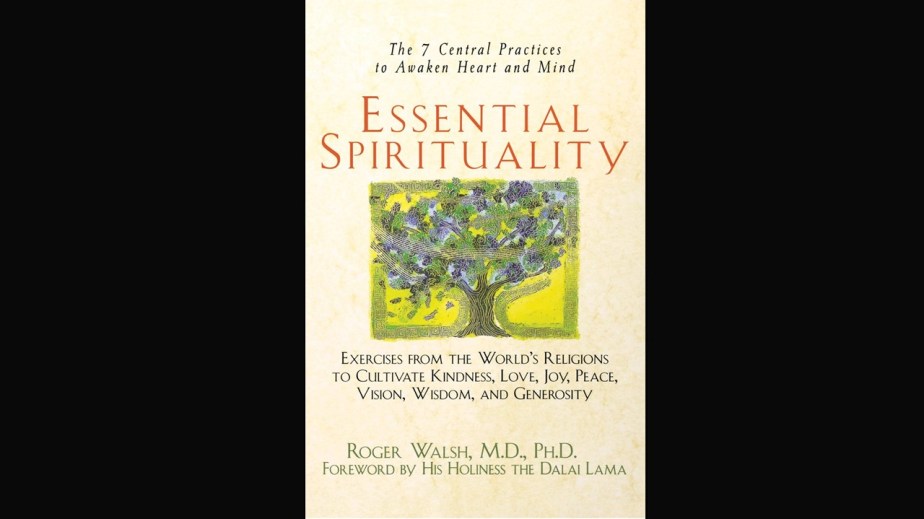
Book Recommendation: Essential Spirituality: The 7 Central Practices to Awaken Heart and Mind by Roger Walsh

“Our lives are rich with opportunities and our challenge is to live them to the full. All of us can be the creative artists of our lives.”
― Roger Walsh

Image Source: Amazon UK

Get The Book Here

Why Read This Book

This book covers seven practices that religions across the world include, practices that can help restore balance and create happiness in our lives. It is a book to read and then revisit to help you live a balanced and happy life.

Contents

  • Foreword by His Holiness the Dalai Lama
  • Introduction
  • 1.    Unveiling the Sacred
  • 2.    Discovering the Seven Practices
  • 3.    Using This Book
  • 4.    Spiritual Practices: What Do They Do and How Do They Do It?
  • The Seven Practices
  • Practice One: Transform Motivation: Reduce Craving and Find Your Soul’s Desire
  • 5.    The Secret of Happiness
  • 6.    Exercises to Reduce Craving
  • 7.    Find Your Soul’s Desire: Redirect Motivation
  • 8.    Exercises to Redirect Desires
  • 9.    The Higher Reaches of Desire
  • Practice Two: Cultivate Emotional Wisdom: Heal the Heart and Learn to Love
  • 10.    The Gift of Love
  • 11.    The Challenge of Difficult Emotions
  • 12.    Reducing Fear and Anger
  • 13.    Cultivate Love and Gratitude
  • 14.    The Higher Reaches of Love
  • Practice Three: Live Ethically: Feel Good by Doing Good
  • 15.    The Value of Virtue
  • 16.    What is an Ethical Life?
  • 17.    Exercises in Ethical Living
  • 18.    The Higher Reaches of Ethical Life
  • Practice Four: Rest in Peace: Concentrate and Calm the Mind
  • 19.    Your Meandering Mind
  • 20.    Develop a Peaceful Mind
  • 21.     The Higher Reaches of Concentration and Calm
  • Practice Five: Awaken Spiritual Vision: See Clearly and Recognize the Sacred In All Things
  • 22.    The Healing Power of Awareness
  • 23.    Exercises in Awareness
  • 24.    Seeing the Sacred in All Things
  • 25.    Exercises in Sacred Seeing
  • 26.    The Higher Reaches of Vision
  • Practice Six: Cultivate Spiritual Intelligence:  Awakening Wisdom and Understanding Life
  • 27.    What is Wisdom?
  • 28.    Awakening Wisdom
  • 29.    Exercises in Wisdom
  • 30.    The Higher Reaches of Wisdom
  • Practice Seven: Express Spirit in Action: Generosity and the Joy of Service
  • 31.    The Spirit of Service
  • 32.    Developing a Generous Heart
  • 33.    Exercises in Generosity and Service
  • 34.    The Higher Reaches of Generosity
  • 35.    Enjoy Your Self: Awakened Heart, Awakened Mind
  • Source Notes
  • Further Reading
  • Bibliography
  • Index

Summary

This book explores the different behaviours and ideas that cause us to be unhappy and to suffer, and practices to remedy them. There are seven practices, as the title of the book suggests, but there are also exercises within each chapter that are simple, but beneficial, for example “Exercise 9, Discover Your Future Self,” from the section entitled Exercises To Redirect Desires.

The author explores these subjects through the lens of the scriptures of our world religions and the writings of philosophers. It is practical, yet this book includes profound, deep wisdom. Whether you are religious or not, I recommend this book, it will apply some perspective to your life and help you find your path to a life well lived. The book is extensive, but you can dip into the section that relates to your current issues and find the guidance and exercises to help.

The Fullfilment Framework Remastered

I have reworked my Fullfilment Framework, so it has a better journey towards fulfilment. This is a brief summary of the journey, which I will expand on later on this blog. This summary can be found on the Pathway To Fulfilment page.

Where To Begin

The Fullfilment Framework is a pathway to fulfilment. It is a deeply personal journey of self-discovery, of life balancing and purpose finding. The structure of the Fullfilment Framework begins with getting to know yourself more substantially than you may have before; figuring out what really makes you tick, what you believe and don’t believe, what you think is true and false, what you think is ethical and not ethical. Also, what happiness and success look like to you, personally. It is broad and deep self-knowledge. This is your starting place, the first level of the Foundation of the Fullfilment Framework. Next, you look at the wisdom of others, from a variety of sources; wisdom that will challenge you and enlighten you, as wisdom should. This wisdom will feed into your self-knowledge, and influence how you see yourself and how you should live.

Next, you look at Principles of a Life Well Lived, which are divided into those that relate to Yourself and those that relate to Others. The principles are; Self: Growth, Equanimity, Fortitude, Seeking, Self-Competition, and Others: Stewardship, Servanthood, Reciprocity, Joy Making, Connection. These are very much connected to Acquired Wisdom, because they are wise principles that I believe will help you navigate the world skilfully and live your life well.

What To Maintain

Next, you look at your health, which has three areas of concern in this framework. We have physical health, we have mental and emotional health and we have energy health; all of which make the Good Health Triad. Good physical health includes diet and exercise. Good mental and emotional health includes mastering our emotions and balancing our thoughts. Good energy health includes mastering the Chi (Qi) that flows through our energy system, like nerve signals through our nervous system. To have good health we need to work on all three of these areas.

Next, you look at your relationships, and identify those relationships that are good for you and those that are not, and those that are a mixture of the two, that need work to become good. You work towards all of your relationships being healthy ones; meaning that they bring us happiness rather than stress, they uplift us rather than bringing us down. These relationships are in circles of community, and these circles are relationships with yourself, your family, your friends, your colleagues, your acquaintances, and all are connected.

How To Live Well

After working your way through this journey so far, you will have a solid foundation for how to start living your life better. From this new understanding of yourself, your defined beliefs and ethics form part of what I call your Foundational Prism, the third piece of this prism being your purpose. You will go through a process of building on your beliefs and your ethics, weaving in acquire wisdom and the principles of a life well lived, and define your personal purpose, which completes the Foundational Prism. This prism is the filter through which you will see and experience the world, and it will influence your thoughts, speech and actions, making them wiser in nature. Your purpose is a vision of a better world that you want to help create.

You will then be set to start applying your foundation, principles and purpose to your life, to find your best way to live them out in your thoughts, speech and actions, to act on your vision of a better world through everything that you do. This is living your life on purpose. All of this work will mean that both happiness and success become personal, and therefore fulfilling, all three of which are bi-products of a life well lived, and they feed back into your Foundation and your beliefs, ethics and purpose, and on it goes, because this journey is a life long endeavour. Follow the path to fulfilment and live well my friends.

Always strive to be inspired and inspiring.

#LiveWell