Build The Life You Want

I recently watched an interview at Harvard with Oprah Winfrey and Arthur Brooks where they were discussing the book that they wrote together called Build The Life You Want. This book is on my to do list of books to read, but they covered the essentials of it in this interview. You can watch the video by following this link, but here are the essentials.

Happiness has three elements.

  • Enjoyment (not pleasure)
  • Meaning or purpose
  • Satisfaction

Enjoyment is pleasure plus people and memory. You must spend time with other people and make memories together to experience enjoyment. Also, you cannot keep satisfaction through acquiring things. There is an equation, however, for lasting satisfaction. Lasting satisfaction equals all the things you have divided by all the things you want. If you reduce the things that you want you increase lasting satisfaction.

Faith is believing that there is something larger than yourself. This could be God, nature, the universe, etc. The point is that you are not the centre of your universe.

As well as the elements of happiness that are mentioned above, there are institutions in your life that all need your attention to be happier. They are like a pension fund where you have to deposit in all of them to reap the rewards of feeling happier further down the road. These institutions are:

  • Family
  • Friends
  • Faith
  • Work that serves others

It is important not to think of happiness as a destination, but to aim for happierness. To be happier than you are now. It is a shift in state by ensuring that you focus on all four institutions.

When good things happen to you or bad things happen to you a good practice is to think, how can I use this in the service of others? This will mean that the bad things and the good things have purpose and you have control over what you do with what you get.

It is good to do small things with great love. Don’t always focus on having a big impact or making a big change. Doing small things with great love will, in the end, have more of an impact. After all greatness is determined by service to others.

Social media is the junk food of social life. There is no substitute for being in the same room as someone and being able to look them in the eye. This human to human interaction will give you more of the feel good hormones and will build stronger relationships. Interacting through screens is not the same.

Finally, your legacy is not some great thing that you leave behind, it is every life that you touch.
Be Happier At Work

Often we wish we were doing something else for a job. Often we settle for something we are good at or something that was available as a way to earn money and pay our bills. We give our time and we get money. This rarely makes us feel fulfilled. Therefore we day dream of a better job but do nothing to get said job.

If we do end up getting said job, then it may not be what we thought it was. The grass is not always greener as they say. There is another way to think about it. You could think of the work you currently do as a craft. If you were to try to make your current job your craft, to take care and pay attention to align how you do your job with your values and what is important to you. Then your passion for your job will increase over time. Opportunities that you hadn’t seen will appear and you will spend time making a difference not exchanging your time for money.

Opportunities are always there, but we have to adjust our minds to see them and we have to do the work to create the conditions for the opportunities to appear. Remember, we see the world not as it is but as we are.

The Art Of Non-Action

Often in Western culture to be strong is to be tough, rigid and immovable. In Chinese culture, there is a concept called Wu Wei. It means ‘The art of non-action,’ it is embracing flow instead of effort to achieve a result. Essentially, it means being flexible, like water and being present in the moment, in a state of flow.

In Wu Wei if you strive for something you miss the point. A goal can be achieved through effortless action, through being so engaged with the task at hand that time passes and the work is done. It is to do and not to try.

When you are doing something you enjoy time passes by almost unnoticed and you go where the activity takes you. You do the thing you are doing without concentrated effort. Applying this to the rest of tour life is Wu Wei.

Work That Is Fulfilling

When we work we often feel that the point of it is to earn money in order to buy things. This should not be the purpose of working. Our culture has thrust upon us the need to be rich or appear as if we are by what we wear and what we do. This is a way of living that goes around and around and benefits the companies that sell us the things they say we need.

Of course we need money to pay our bills and live our lives, but I believe we should do work that we believe in, where possible. If we work in a job does not fulfil us or requires us to work in ways that counter our values and beliefs this has an impact on our wellbeing.

We can the question, what are we working for? What do we want to achieve? This is not intended to encourage you to suddenly leave your job, but to encourage you to figure what kind of job you would find fulfilling. It could be a change of role with the company you currently work in or a change completely. Asking the right questions will produce helpful answers.

Monday Blues

We often feel a sense of dread on Sundays, fearing what Monday might bring and we wish the week away, so we can enjoy the weekend, when it arrives. This push and pull that we self impose can cause us a lot of unnecessary stress. Our attitude to the working week largely comes from whether we are fulfilled by our job or not, but we are influenced by the cultural mindset that Mondays are bad and Friday evening and the weekend are good. We often think Thank God It’s Friday.

This way of looking at our working week is self defeating and can easily be avoided. As Viktor E. Frankl said in his book Man’s Search for Meaning, “Everything can be taken from a man but one thing: the last of the human freedoms—to choose one’s attitude in any given set of circumstances, to choose one’s own way.” We have control over our attitude and the things we tell ourselves about the work we do and how we spend our time. We can look on the bright side, as they say.

I suggest picking something positive about the work you do. Something related to helping people is good, because it brings a sense of fulfilment and purpose. It also helps to have compassion for the people we work with and work for. We all suffer to less and greater degrees and to reduce someone else’s suffering is a wonderful thing to do. This may be something you focus on as part of a spiritual path or a humane philosophy, either way it will make you happier to make other happier. Everyone wins, and you will begin to look forward to Mondays, because it will provide more opportunities to help others.

Opportunities In Life

I work as a complaint handler for a bank, which to many may be the last job they would ever wish to do, but I find great joy in doing it. The important question to ask ourselves is what opportunities are we looking for?

Opportunities to be rich, beautiful, happy or healthy. There are many things we seek for ourselves, but the most profound joy comes from seeking things for others.

With a complaint something has gone wrong, it may be the fault of the bank or the fault of someone else. The opportunity is to help reduce the customer’s suffering, to put right a wrong and rebuild the relationship between the customer and the bank.

I spoke to a customer recently who was so unwell and in pain that his Wife was talking on his behalf. His Wife was also suffering to see what her Husband was going through. During the call I managed to make the Wife and her Husband laugh and resolved the complaint successfully.

If you do your work with compassion and the intention to bring joy to other people’s lives, you will enjoy your work, and it will give your life purpose.

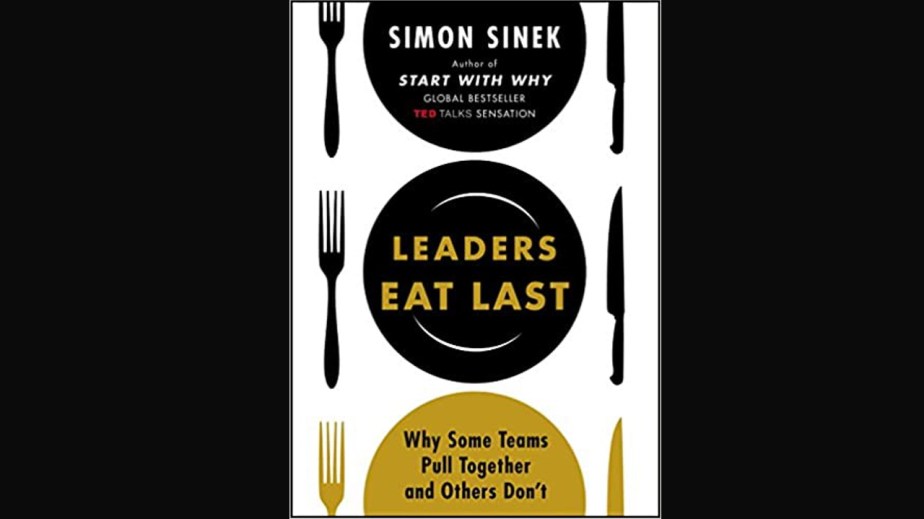
Recommended Book: Leaders Eat Last: Why Some Teams Pull Together and Others Don’t by Simon Sinek

“If your actions inspire others to dream more, learn more, do more and become more, you are a leader.”
― Simon Sinek

Image source: Amazon UK

Buy this book here

Why Read This Book

If you are in a leadership position, or are aspiring to be. this is an essential book to read. Also, if you want to help improve the culture of your workplace or to understand what it means to be a great leader,this is the book for you.

Contents

Part 1: Our need to feel safe

  • Protection from above
  • Employees are people too
  • Belonging
  • Yeah, but . . .

Part 2: Powerful forces

  • When enough is enough
  • E.D.S.O.
  • The big C
  • Why we have leaders

Part 3: Reality

  • The courage to do the right thing
  • Snowmobile in the desert

Part 4: How we got here

  • The boom before the bust
  • The boomers all grown up

Part 5: The abstract challenge

  • Abstraction kills
  • Modern abstraction
  • Managing the abstraction
  • Imbalance

Part 6: Destructive abundance

  • Leadership lesson 1: So goes the culture, so goes the company
  • Leadership lesson 2: So goes the leader, so goes the culture
  • Leadership lesson 3: Integrity matters
  • Leadership lesson 4: Friends matter
  • Leadership lesson 5: Lead the people, not the numbers

Part 7: A society of addicts

  • At the center of all our problems is us
  • At any expense
  • The abstract generation

Part 8: Becoming a leader

  • Step 12
  • Shared struggle
  • We need more leaders.
  • Appendix: A Practical Guide to Leading Millenials
  • Acknowledgements
  • Notes
  • Bibliography
  • Index

Summary

This book primarily explains why it is the role of leadership in organisations to take care of those in their charge, rather than just being in charge. The concept of the circle of safety within an organisation that means we are protected from outside dangers like the effects of the stock market or new innovations, and pandemics, which in turn creates more trust, cooperation and innovation. When we feel like we do not have to protect ourselves from our bosses, who might sack us if our numbers are not as high as they want them to be, then the organisation collectively works harder to protect the company from outside dangers.

The book also talks about how inhuman our decisions can become the further away we get from the people they effect. We have evolved to keep clear social links with around 150 people, so big organisations can mean the leaders at the top do not personally know those at the bottom, and the book talks about how leaders can resolve this by creating the right culture in their organisation. There are five leadership lessons, backed up by examples of both how it can go wrong and how it can go right. And the book ends with advice on becoming a leader and a new additional chapter on leading Millenials.