How We Treat Others

Before J K Rowling wrote Harry Potter, she was just another person sitting in a cafe working on a story. It is tempting to preach the idea that we should not judge a book by its cover, as the person we see as less than might become a billionaire. However, it is better to think that everyone has importance right here, right now.

It is better to avoid thinking of judging at all and instead to focus on treating each person you meet with dignity and respect. It does not matter if they are a billionaire or they are homeless and penniless. They are still human beings and still have value. The way in which we treat others says more about us than it does about those we interact with.

So, be the person who brightens up the day of others. Smile, say good morning, open doors for people, say thank you, put down your phone and speak to people face to face. Connect with others in meaningful ways.

The Benefits of Generosity

The other day I saw six or seven pigeons surrounding a slice of white bread that someone had left on the floor. They were all eating as much as they could as quickly as they could. Then one of them took a dislike to the pigeon next to it and started chasing it around. Perhaps it felt the other pigeon was eating its bit of bread, who knows, but for a good 30 seconds this pigeon chased the other around. Meanwhile, all of the other pigeons kept on eating. This reminded me of how our lizard brains can do us a disservice in contemporary life.

The lizard brain is in charge of fear, anger, revenge and reproduction. It is the early part of our brains that evolved which kept us safe from saber tooth tigers and from being kicked out of the tribe. It is why we survived as a species in our evolutionary early days. This served us well back then but it can ruin our lives today. It is largely the cause of stress, ill health and broken relationships. Even when we have a good life, objectively speaking, the lizard brain can take us away from the good things we have.

The whole time the pigeon was chasing the other pigeon it was missing out on the food that was lying on the floor ready to be eaten. There was more than enough food to go around, but fear that the other pigeon might eat their food turned to anger, which turned to revenge causing a pigeon chase around a car park.

If the pigeons were able to talk to each other and they had the capacity to have empathy, compassion or generosity, then they could have all happily shared the meal. The stress level would have been lower, and their relationships, pigeon to pigeon, would have been supportive, loving and generous. This is how we live good lives. We have good relationships, we are generous and we share what we have with those who need what we have.

The next time you see a homeless person on the street begging for money don’t automatically think, ‘why should I give them my money, they will only spend it on alcohol.’ Perhaps they haven’t eaten for two days and they need money for food, perhaps they need an extra £1 to pay for a hostel to have a comfy bed and shelter for the night.

They may have slept outside in the cold and rain for a week and are on death’s door and some change from us will save their life. And when you give them some change look them in the eye, smile at them and wish them well, because 95% of people that walked past them that day did not even acknowledge their existence. Be the 5% that cares and see their humanity.

Serving Others Better

One of the principles I try to live by is ‘own your journey’ and another is ‘serve others,’ and to me these are very much linked. If we have our own issues with our health, relationships, work, etc that we leave unresolved, because we don’t want to deal with them, we are not in a good position to serve others. Therefore, in order to serve others well we need to make sure we are in a good place.

The way we make sure we are in a good place is to take ownership of our problems and find solutions for them. Anyone who has reached advanced stages of a spiritual practice will be effective in serving others, because they have put in the work of resoling their problems. Whether you are spiritual or not, you still have to do the work.

Imagine having such peace of mind and clarity that you help to solve the problems of others effectively. If more people took ownership of their lives the world would be a better place. Let’s do the work and make it better together.

When They Go Low You Go High

This title comes from a saying that Past President Barack Obama and his Wife Michelle often said. It came across as a family motto, which is a very positive way to think about things. It essentially says that when others resort to lies, insults and immoral tactics to bring you down and make themselves look good you take the moral high ground.

However, going high, which is essentially acting like a good human being, is something that I would say should not be limited to scenarios where others have gone low. Being a good human being is always a good way to live. We can never be a good human being all day every day, as we have challenging times that cause us to waiver, but the intention is what matters. Think good and be good is my advice.

Lean In With Empathy

There are things in life we feel we are not equipped to deal with or to do, so we pull back and avoid these things. This often appears in our relationships. We pull back or we avoid topics of conversation or ways of being that scare us.

In my job I deal with complaints, so the person I talk to is usually upset, angry or both. I learned recently that I find it difficult to deal with people when they behave a certain way, so I don’t and I come across as cold and detail driven.

However, if i was to lean in with empathy, the conversation would be more productive and the other person would feel heard and respected. If you lean in with empathy in your lives the human connections you have will be much more rewarding.

Building A Better World

Today is Dr Suess Day and one of my favourite quotes from Dr Seuss books is “Don’t give up. I believe in you all. A person’s a person. No matter how small.” ― Dr. Seuss, “Horton Hears a Who!” I love all of his books, but this is one of my favourites.

We all have our highs and lows in life, our advantages and disadvantages. We are all fighting battles that others can’t see, some big and some small. The message that this quote gives me is firstly, believing in ourselves is necessary for progress to happen, it is is also necessary for others to believe in us too. You could be the person that causes someone to believe in themselves, to become their best self. There is power in believing in others.

Secondly, everyone has equal validity and worth. Therefore, kindness and respect should be a given with all interactions. If someone acts in a way that belittles or hurts others they should be held to account for their actions, but we should still respect their humanity. Never fall for thinking of others as less than human. This opens the door to inhuman treatment of fellow human beings.

Believe in others and they will believe in themselves. Treat all with kindness and respect. This is how we build a better world.

Spread Some Love

Today is Valentine’s Day, a day when expectations are high and romantic gestures are a plenty. It is also an opportunity to be kind to each other. My 2 year old brought home a Valentine’s card for us from nursery and it said on the front ‘Thumb Body Love’s You.’

She had dipped her thumb in red paint and made lots of red thumb prints on the front, which the nursery staff had turned into ladybirds. It was an opportunity for our 2 year old to learn the importance of kindness.

Valentine’s Day is certainly a day for couples, but many people are single and find this annual date difficult. Many people find every day difficult. So, single or attached, use this day to be kinder to one another, everyone deserves kindness in their lives.

Criticism Is Not Contribution

When we criticise in order to gain social points. When we insult someone to be funny. When we try to tear someone down so we can be lifted up, we are not contributing positively to the world. When people put themselves out there on social media, online or on TV, often the Trolls come out with horrible comments; this is not helpful.

We all know trolling online is not a nice thing to do, but often we enjoy poking fun at what people wear or what they do. It has become acceptable to be unkind about people behind their back, because that person is not in our social group.

If we are going to move forward positively as a society and a human race we need to cut out the behaviour that drags others down and focus on supporting each other in living a fulfilling life.

Monday Blues

We often feel a sense of dread on Sundays, fearing what Monday might bring and we wish the week away, so we can enjoy the weekend, when it arrives. This push and pull that we self impose can cause us a lot of unnecessary stress. Our attitude to the working week largely comes from whether we are fulfilled by our job or not, but we are influenced by the cultural mindset that Mondays are bad and Friday evening and the weekend are good. We often think Thank God It’s Friday.

This way of looking at our working week is self defeating and can easily be avoided. As Viktor E. Frankl said in his book Man’s Search for Meaning, “Everything can be taken from a man but one thing: the last of the human freedoms—to choose one’s attitude in any given set of circumstances, to choose one’s own way.” We have control over our attitude and the things we tell ourselves about the work we do and how we spend our time. We can look on the bright side, as they say.

I suggest picking something positive about the work you do. Something related to helping people is good, because it brings a sense of fulfilment and purpose. It also helps to have compassion for the people we work with and work for. We all suffer to less and greater degrees and to reduce someone else’s suffering is a wonderful thing to do. This may be something you focus on as part of a spiritual path or a humane philosophy, either way it will make you happier to make other happier. Everyone wins, and you will begin to look forward to Mondays, because it will provide more opportunities to help others.

Understanding Vulnerability

When we think of people being vulnerable we often think of young children, old people or those with a disability. However, we can all be vulnerable at some time or other, and it can be temporary, sporadic or permanent. Life events can make us vulnerable. We could lose a loved one, lose our job, have an unexpectedly large bill to pay, suddenly become severely unwell, have a sudden increase in caring responsibilities and the list goes on.

There is a stigma often associated with admitting our vulnerabilities and companies often have a one size fits all approach, which means vulnerabilities are to considered when supporting customers. People often assume others are not vulnerable without even considering the possibility. Vulnerability is something we should be considering and showing empathy towards.

Pre-COVID times a large percentage of UK adults had less than £300 in savings, which means they would have struggled if the boiler broke or their care needed significant repairs, and this has only got worse during the pandemic. Any of us could face a large bill for something unexpected. No one predicted the COVID-19 pandemic but it has left so many people vulnerable.

So, let’s be open about our vulnerabilities and show empathy towards others who may be struggling. Anyone you meet maybe struggling, so be kind, always.

Building A Better World

“Follow your dreams and use your natural-born talents and skills to make this a better world for tomorrow.”

– Paul Watson

This Summer saw the long awaited 2020 Tokyo Olympics, which was an unusual state of affairs, without the spectators. However, it gave a chance for the people of each country to see their Olympic champions battle it out for the highly held Olympic medals. After the way the 2020 Euros lifted the spirits of the nation, there was a hope that the Olympics could keep the national excitement going. In the end more people watched the Tokyo Olympics than did the Rio 2016 Olympics. Records were broken and Britain came a respectable forth in the medals table, which is all pretty positive. Positivity is in great need after the past 18 months and the uncertainty of coming out of the imposed social distancing guidelines, which has left us all feeling a little unsure how to interact with each other in the new normal.

The Olympics have long been held up as the bastion of sportsmanship, of unity in diversity and of excellence. Curious to see the principles behind the organising of the Olympics, I looked up the Vision of the International Olympic Committee, which is “Building A Better World Through Sport.” A worthy vision, and one which is shown in their Values of Excellence, Respect and Friendship. And this got me thinking about how we can make the world a better place after the COVID-19 pandemic put a pause on much of society’s habitual behaviours. During the pandemic the kindness of strangers and the capacity to care flourished amongst neighbours and strangers alike. The concept of Key Workers redefined for many of us who plays an important role in our society and who does not. There was initially talk about going back to normal after the pandemic, or rather a new normal, and it is this idea of a new normal that I want to focus on today.

If we can better choose how we can interact with each other, how we can live together and how we can connect with each other, then this seems like a good time to do it. We can take up the cause of the Olympics of ‘building a better world,’ but not just through sport, but through how we see each other and how we interact with each other. This thing called life is a shared journey from cradle to the grave, but we are capable of lifting each other up, so we may all live better lives.

To illustrate what I am talking about I would like to share a story I saw online recently about a Police Officer in America who pulled a young man over, as his driving licence had expired. The young man explained that he barely had enough money to pay the bills and his rent and could not afford to renew his licence, due to losing his job. He was also on his way to a job interview, in the hope to gain an income and eventually get his licence renewed. The Police Officer left his own car and drove the young man to the job interview and apologised to the Interviewers as he was the reason the young man was late for the interview. The young man got the job and was able to renew his licence in order to legally drive again. Sometimes kindness matters more than the letter of the law. It also matters more than the prejudices and stereotypes that we all have which prevent us from seeing others as equal to ourselves and therefore worthy of kindness.

It is also important to remember how connected we all are. The COVID-19 pandemic showed how our movement around the world can cause diseases to spread, but we can also share our behaviours, our ideas and our values. Kindness and generosity are also infectious. Mother Nature has provided a way to encourage us to be kind and generous. This is how we thrived as a species, by working together. If we are to be generous or kind to someone else without any expectation in return we get a hit of Oxytocin, which makes us feel good. The person we are generous or kind to gets a hit of Oxytocin as well, which means they will likely go and be generous or kind to someone else that day. Even a person just witnessing an act of generosity or kindness will give them a hit a Oxytocin and will encourage them to pay the generosity or kindness forward. We are hard wired to do this, because we are stronger together.

To further show how connected we all are on our planet, here is something from a TV series on Netflix called Connected that blew my mind. It is in the episode on Dust and how important certain dust can be. In Chad, North Africa, in what used to be Lake Mega-Chad, but is now part of the Sahara Desert, there are the remains of fish and other creatures, which once lived in the lake, before the area became a desert. The wind breaks up the skeletons into dust which is then carried by the wind up into the atmosphere and it makes its way all the way to the Amazon Rainforest, in South America, where the dust becomes part of the soil. What is amazing is that the rain in the rainforest washes away most of the nutrients that the plant life needs to grow and survive, but the dust all the way from the Sahara Desert in Chad, North Africa, replenishes it. Around 22,000 tons of phosphorus is deposited in the Amazon Rainforest every year from Lake Mega-Chad, which is about the amount the soil loses every year due to rainfall. Without this process happening, there would be no rainforest. We are truly, globally connected to every other ecosystem on the planet. This is why when we through things away, there is no away. We need to look after our planet as well as each other.

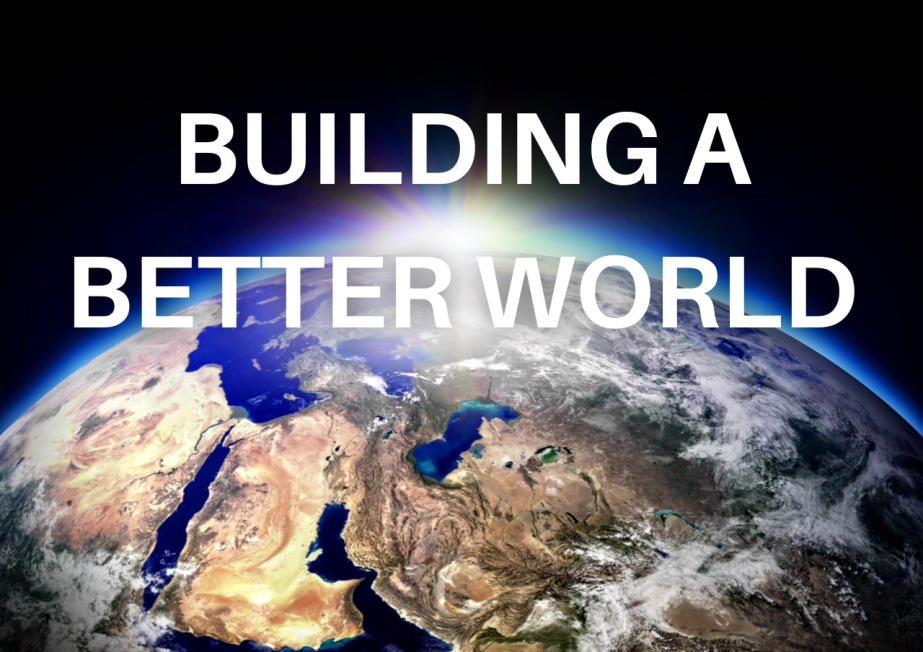
The environmental movement, which includes Greenpeace, sprung to life after a very special photograph was taken when “Apollo 8, the first manned mission to the moon, entered lunar orbit on Christmas Eve, Dec. 24, 1968. That evening, the astronauts-Commander Frank Borman, Command Module Pilot Jim Lovell, and Lunar Module Pilot William Anders-held a live broadcast from lunar orbit, in which they showed pictures of the Earth and moon as seen from their spacecraft. Said Lovell, “The vast loneliness is awe-inspiring and it makes you realize just what you have back there on Earth.” They ended the broadcast with the crew taking turns reading from the book of Genesis.”(1) As they orbited back around the moon toward the Earth the photo Earth Rise was taken as the view of the Earth in the distant blackness of space rose into view over the surface of the moon, which is seen in the foreground of the photo. The sense that if we do not take care of our planet their is no planet B reverberated through the cultures of the West and the rest of the world.

We have now reached a point where taking a trip up to where the Earth’s atmosphere meets outer space is becoming a reality for those who can pay for it. There has been much debate online about the recent endeavours of Billionaires like Sir Richard Branson to develop “rocket planes” that can take people up the edge of space. Sir Richard Branson was the first to have “…successfully reached the edge of space on board his Virgin Galactic rocket plane”(2) recently. The main argument against such endeavours has been why build a rocket plane to take people to the edge of space on tourist trips when there are millions who are homeless, starving and displaced due to war. There are also issues with global warming. It is an argument over priorities and values, over selfishness and selflessness. Tickets to take the Virgin Galactic up to the edge of space cost up to £180,000, again money that could be spent helping our fellow human beings. I guess the main ill feeling comes from the disproportionate distribution of wealth and the fact that there are billionaires in the world where much good can be done if this wealth was shared. If a tenth of the wealth held by the Billionaires of the world was spent on helping those in need, the quality of life for many would be improved. Access to water, electricity and education, for example.

But we are not all Billionaires, far from it. Most of us have enough to survive and a little bit more to save or spend on nice things. This begs the question what can we do to make the world better? If we are to go back to the Vision of the International Olympic Committee, “Building A Better World Through Sport,” we can think about what Vision we might have for our lives. If your Vision began with “Building A Better World Through…” what would come next for you? I would suggest you build a better world through kindness. Kindness to the environment and kindness to the people we interact with each day.

However, it is not always easy to be kind, especially if we are asked to be kind to those we really do not like. In the Bible Jesus asked us to Love our Enemies? You might not think in terms of ‘enemies,’ but you will have people you would rather avoid, people you dislike. How do we build the capacity to be kind to those people? A good place to start is to work on the prejudices and stereotypes we all have, on the barriers we have that create an us and a them, so we can start seeing each other as human first, and then we can increase our generosity and kindness on a daily basis. The more people we are generous and kind to the more people will do the same for others. And you will feel so good at the end of the day.

Reference:

1: https://www.nasa.gov/multimedia/imagegallery/image_feature_1249.html

2: https://www.bbc.co.uk/news/science-environment-57797297
Remedies To A Crisis

“Self-control is strength. Right thought is mastery. Calmness is power.” James Allen

Not Being In Control

We are going through a lot of anxiety across the world at the moment with the outbreak of the Coronavirus, there is much uncertainty around our health, whether we have the virus or if we will get it, whether we will lose our jobs, and when we have lost our jobs how we will pay the bills, whether our loved ones are safe, and how long this will all last. Some countries appear to be managing this crisis better than others, and these countries have been predominantly governed by women, whose natural instinct is often taken care of their people. Male leaders tend to be more head strong and want to appear to be strong.

These are generalisations, and not all male or female leaders fit these archetypes, but the global leadership styles that have kept some citizens safe and others not is quite telling. I think the degree to which people feel their leader(s) are taking care of them in a crisis is the degree to which we feel less or more anxious.

For example, some companies have said that they will guarantee that their staff will get paid, or at least 80% oft their salary, and that no one will be fired. Some smaller companies cannot afford to do this unfortunately, but those who are told that they will be taken care of will do all they can to keep their company going through this crisis, they will collectively protect their company because their leaders protected them.

On an individual level, it can be difficult to cope with the uncertainty, and the anxiety that arises from it, especially if we feel that we are not taken care of. Some express their anxiety through anger, we have seen an increase in domestic violence during this crisis. Some express this through trying to control unusual situations.

I heard a story from a friend of mine, who works on a shop, that an elderly man tried to attack her with a shovel, because she would not give him a refund for it, due to him not being able to provide a receipt. The shovel only cost £3, but I suspect he was trying to control the situation because he did not feel that he had control over other things due to this crisis.

In my experience, and through my research into how to live well, I think there are some crucial remedies to anxiety, especially when the anxiety is related to not feeling in control.

Self-Awareness

If we spend time being with our unpleasant emotions, as difficult as this is, if we can have the bravery to just be with them and not run away into distractions and intoxication then we can begin to see what things trigger our anxiety or our anger, or why we criticise and belittle others, then we can begin to develop deep self-awareness. The longer we spend being with ourselves in this way the more we are able to figure out our triggers for negative thoughts and behaviour and to find ways to handle these things better.

If we can figure out our triggers we can develop techniques to reduce our reactions to them, or if this is not possible, to find ways to avoid the triggers, for the sake of our own wellbeing. This is the life long process of self-improvement that will increase our quality of life and our wellbeing, because it will raise our happiness levels and improve our relationships.

Self-Control

If we can become more self-aware we can take responsibility for our own emotions and respond to situations rather than react to them. If we can begin to manage our emotions better we will have more control over what happens in our lives, because even though we cannot control being in the situations we find ourselves in necessarily, because we are already in them, we have a choice of how we act in the following moments.

If we have self-awareness and have developed self-control, then we have clearer thinking and can act out of compassion and altruism, and we can see further into the future of possibilities and determine our best course of action for a positive outcome. This type of mastery is mastery of the self, and it takes years to develop, but if we do not start then we will spend a lot of our lives reacting, often negatively, to each and every situation we find ourselves in and our happiness levels will plummet and our levels of anxiety will go up, because we will have less certainty.

When we let the uncertain nature of the world shake our sense of being we will always struggle. Self-awareness and self-control build a stoicism that will allow us to weather the storms of life and enjoy the fruits of it too.

Gratitude and Kindness

These are two of the most powerful antidotes to anxiety, in the moment. When we are grateful for the little things in life, then our bodies conspire to make us feel good with the hormones it produces. The same is true of being kind to others. To be grateful and to be kind makes us feel good and it reduces the hormones our bodies produce when we feel anxious.

Simply listing ten things we are grateful for every morning, making sure we smile at people and give them compliments, these are things we can all do, and if they become our daily habits then the crisis we are all in does not seem as bad. We develop the feeling that we are in this together and that we will get through this.

So, spend time with yourself, getting to know how you react and respond to difficult situations. Develop better strategies to manage yourself in these situations. Be more grateful for what you have and kinder to others around you. Do these things and this crisis will be easier to manage and you will be on your way to self mastery and a wonderful life.