How We Treat Others

Before J K Rowling wrote Harry Potter, she was just another person sitting in a cafe working on a story. It is tempting to preach the idea that we should not judge a book by its cover, as the person we see as less than might become a billionaire. However, it is better to think that everyone has importance right here, right now.

It is better to avoid thinking of judging at all and instead to focus on treating each person you meet with dignity and respect. It does not matter if they are a billionaire or they are homeless and penniless. They are still human beings and still have value. The way in which we treat others says more about us than it does about those we interact with.

So, be the person who brightens up the day of others. Smile, say good morning, open doors for people, say thank you, put down your phone and speak to people face to face. Connect with others in meaningful ways.

The Benefits of Generosity

The other day I saw six or seven pigeons surrounding a slice of white bread that someone had left on the floor. They were all eating as much as they could as quickly as they could. Then one of them took a dislike to the pigeon next to it and started chasing it around. Perhaps it felt the other pigeon was eating its bit of bread, who knows, but for a good 30 seconds this pigeon chased the other around. Meanwhile, all of the other pigeons kept on eating. This reminded me of how our lizard brains can do us a disservice in contemporary life.

The lizard brain is in charge of fear, anger, revenge and reproduction. It is the early part of our brains that evolved which kept us safe from saber tooth tigers and from being kicked out of the tribe. It is why we survived as a species in our evolutionary early days. This served us well back then but it can ruin our lives today. It is largely the cause of stress, ill health and broken relationships. Even when we have a good life, objectively speaking, the lizard brain can take us away from the good things we have.

The whole time the pigeon was chasing the other pigeon it was missing out on the food that was lying on the floor ready to be eaten. There was more than enough food to go around, but fear that the other pigeon might eat their food turned to anger, which turned to revenge causing a pigeon chase around a car park.

If the pigeons were able to talk to each other and they had the capacity to have empathy, compassion or generosity, then they could have all happily shared the meal. The stress level would have been lower, and their relationships, pigeon to pigeon, would have been supportive, loving and generous. This is how we live good lives. We have good relationships, we are generous and we share what we have with those who need what we have.

The next time you see a homeless person on the street begging for money don’t automatically think, ‘why should I give them my money, they will only spend it on alcohol.’ Perhaps they haven’t eaten for two days and they need money for food, perhaps they need an extra £1 to pay for a hostel to have a comfy bed and shelter for the night.

They may have slept outside in the cold and rain for a week and are on death’s door and some change from us will save their life. And when you give them some change look them in the eye, smile at them and wish them well, because 95% of people that walked past them that day did not even acknowledge their existence. Be the 5% that cares and see their humanity.

Serving Others Better

One of the principles I try to live by is ‘own your journey’ and another is ‘serve others,’ and to me these are very much linked. If we have our own issues with our health, relationships, work, etc that we leave unresolved, because we don’t want to deal with them, we are not in a good position to serve others. Therefore, in order to serve others well we need to make sure we are in a good place.

The way we make sure we are in a good place is to take ownership of our problems and find solutions for them. Anyone who has reached advanced stages of a spiritual practice will be effective in serving others, because they have put in the work of resoling their problems. Whether you are spiritual or not, you still have to do the work.

Imagine having such peace of mind and clarity that you help to solve the problems of others effectively. If more people took ownership of their lives the world would be a better place. Let’s do the work and make it better together.

Understanding Vulnerability

When we think of people being vulnerable we often think of young children, old people or those with a disability. However, we can all be vulnerable at some time or other, and it can be temporary, sporadic or permanent. Life events can make us vulnerable. We could lose a loved one, lose our job, have an unexpectedly large bill to pay, suddenly become severely unwell, have a sudden increase in caring responsibilities and the list goes on.

There is a stigma often associated with admitting our vulnerabilities and companies often have a one size fits all approach, which means vulnerabilities are to considered when supporting customers. People often assume others are not vulnerable without even considering the possibility. Vulnerability is something we should be considering and showing empathy towards.

Pre-COVID times a large percentage of UK adults had less than £300 in savings, which means they would have struggled if the boiler broke or their care needed significant repairs, and this has only got worse during the pandemic. Any of us could face a large bill for something unexpected. No one predicted the COVID-19 pandemic but it has left so many people vulnerable.

So, let’s be open about our vulnerabilities and show empathy towards others who may be struggling. Anyone you meet maybe struggling, so be kind, always.

Building A Better World

“Follow your dreams and use your natural-born talents and skills to make this a better world for tomorrow.”

– Paul Watson

This Summer saw the long awaited 2020 Tokyo Olympics, which was an unusual state of affairs, without the spectators. However, it gave a chance for the people of each country to see their Olympic champions battle it out for the highly held Olympic medals. After the way the 2020 Euros lifted the spirits of the nation, there was a hope that the Olympics could keep the national excitement going. In the end more people watched the Tokyo Olympics than did the Rio 2016 Olympics. Records were broken and Britain came a respectable forth in the medals table, which is all pretty positive. Positivity is in great need after the past 18 months and the uncertainty of coming out of the imposed social distancing guidelines, which has left us all feeling a little unsure how to interact with each other in the new normal.

The Olympics have long been held up as the bastion of sportsmanship, of unity in diversity and of excellence. Curious to see the principles behind the organising of the Olympics, I looked up the Vision of the International Olympic Committee, which is “Building A Better World Through Sport.” A worthy vision, and one which is shown in their Values of Excellence, Respect and Friendship. And this got me thinking about how we can make the world a better place after the COVID-19 pandemic put a pause on much of society’s habitual behaviours. During the pandemic the kindness of strangers and the capacity to care flourished amongst neighbours and strangers alike. The concept of Key Workers redefined for many of us who plays an important role in our society and who does not. There was initially talk about going back to normal after the pandemic, or rather a new normal, and it is this idea of a new normal that I want to focus on today.

If we can better choose how we can interact with each other, how we can live together and how we can connect with each other, then this seems like a good time to do it. We can take up the cause of the Olympics of ‘building a better world,’ but not just through sport, but through how we see each other and how we interact with each other. This thing called life is a shared journey from cradle to the grave, but we are capable of lifting each other up, so we may all live better lives.

To illustrate what I am talking about I would like to share a story I saw online recently about a Police Officer in America who pulled a young man over, as his driving licence had expired. The young man explained that he barely had enough money to pay the bills and his rent and could not afford to renew his licence, due to losing his job. He was also on his way to a job interview, in the hope to gain an income and eventually get his licence renewed. The Police Officer left his own car and drove the young man to the job interview and apologised to the Interviewers as he was the reason the young man was late for the interview. The young man got the job and was able to renew his licence in order to legally drive again. Sometimes kindness matters more than the letter of the law. It also matters more than the prejudices and stereotypes that we all have which prevent us from seeing others as equal to ourselves and therefore worthy of kindness.

It is also important to remember how connected we all are. The COVID-19 pandemic showed how our movement around the world can cause diseases to spread, but we can also share our behaviours, our ideas and our values. Kindness and generosity are also infectious. Mother Nature has provided a way to encourage us to be kind and generous. This is how we thrived as a species, by working together. If we are to be generous or kind to someone else without any expectation in return we get a hit of Oxytocin, which makes us feel good. The person we are generous or kind to gets a hit of Oxytocin as well, which means they will likely go and be generous or kind to someone else that day. Even a person just witnessing an act of generosity or kindness will give them a hit a Oxytocin and will encourage them to pay the generosity or kindness forward. We are hard wired to do this, because we are stronger together.

To further show how connected we all are on our planet, here is something from a TV series on Netflix called Connected that blew my mind. It is in the episode on Dust and how important certain dust can be. In Chad, North Africa, in what used to be Lake Mega-Chad, but is now part of the Sahara Desert, there are the remains of fish and other creatures, which once lived in the lake, before the area became a desert. The wind breaks up the skeletons into dust which is then carried by the wind up into the atmosphere and it makes its way all the way to the Amazon Rainforest, in South America, where the dust becomes part of the soil. What is amazing is that the rain in the rainforest washes away most of the nutrients that the plant life needs to grow and survive, but the dust all the way from the Sahara Desert in Chad, North Africa, replenishes it. Around 22,000 tons of phosphorus is deposited in the Amazon Rainforest every year from Lake Mega-Chad, which is about the amount the soil loses every year due to rainfall. Without this process happening, there would be no rainforest. We are truly, globally connected to every other ecosystem on the planet. This is why when we through things away, there is no away. We need to look after our planet as well as each other.

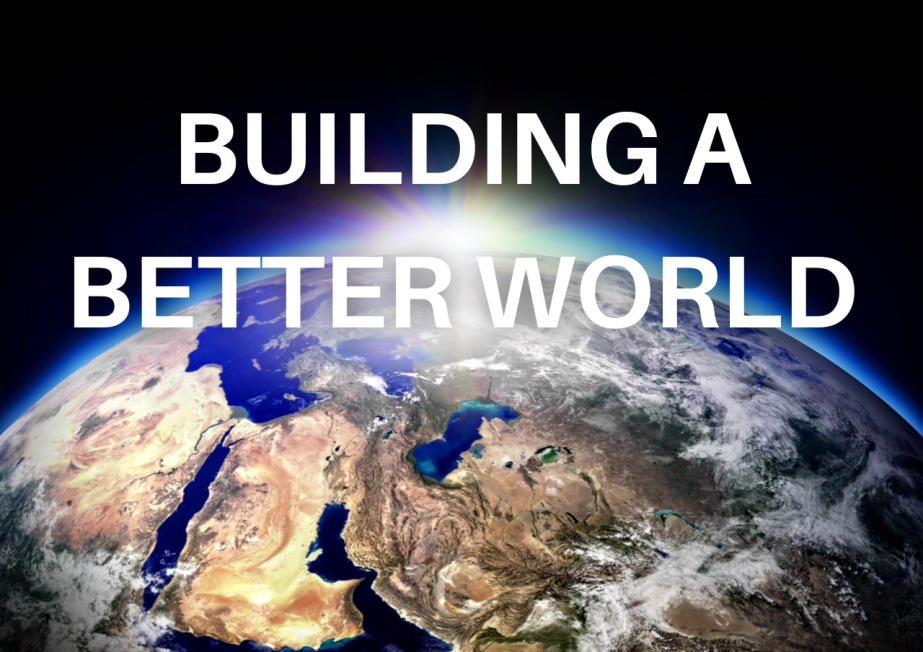
The environmental movement, which includes Greenpeace, sprung to life after a very special photograph was taken when “Apollo 8, the first manned mission to the moon, entered lunar orbit on Christmas Eve, Dec. 24, 1968. That evening, the astronauts-Commander Frank Borman, Command Module Pilot Jim Lovell, and Lunar Module Pilot William Anders-held a live broadcast from lunar orbit, in which they showed pictures of the Earth and moon as seen from their spacecraft. Said Lovell, “The vast loneliness is awe-inspiring and it makes you realize just what you have back there on Earth.” They ended the broadcast with the crew taking turns reading from the book of Genesis.”(1) As they orbited back around the moon toward the Earth the photo Earth Rise was taken as the view of the Earth in the distant blackness of space rose into view over the surface of the moon, which is seen in the foreground of the photo. The sense that if we do not take care of our planet their is no planet B reverberated through the cultures of the West and the rest of the world.

We have now reached a point where taking a trip up to where the Earth’s atmosphere meets outer space is becoming a reality for those who can pay for it. There has been much debate online about the recent endeavours of Billionaires like Sir Richard Branson to develop “rocket planes” that can take people up the edge of space. Sir Richard Branson was the first to have “…successfully reached the edge of space on board his Virgin Galactic rocket plane”(2) recently. The main argument against such endeavours has been why build a rocket plane to take people to the edge of space on tourist trips when there are millions who are homeless, starving and displaced due to war. There are also issues with global warming. It is an argument over priorities and values, over selfishness and selflessness. Tickets to take the Virgin Galactic up to the edge of space cost up to £180,000, again money that could be spent helping our fellow human beings. I guess the main ill feeling comes from the disproportionate distribution of wealth and the fact that there are billionaires in the world where much good can be done if this wealth was shared. If a tenth of the wealth held by the Billionaires of the world was spent on helping those in need, the quality of life for many would be improved. Access to water, electricity and education, for example.

But we are not all Billionaires, far from it. Most of us have enough to survive and a little bit more to save or spend on nice things. This begs the question what can we do to make the world better? If we are to go back to the Vision of the International Olympic Committee, “Building A Better World Through Sport,” we can think about what Vision we might have for our lives. If your Vision began with “Building A Better World Through…” what would come next for you? I would suggest you build a better world through kindness. Kindness to the environment and kindness to the people we interact with each day.

However, it is not always easy to be kind, especially if we are asked to be kind to those we really do not like. In the Bible Jesus asked us to Love our Enemies? You might not think in terms of ‘enemies,’ but you will have people you would rather avoid, people you dislike. How do we build the capacity to be kind to those people? A good place to start is to work on the prejudices and stereotypes we all have, on the barriers we have that create an us and a them, so we can start seeing each other as human first, and then we can increase our generosity and kindness on a daily basis. The more people we are generous and kind to the more people will do the same for others. And you will feel so good at the end of the day.

Reference:

1: https://www.nasa.gov/multimedia/imagegallery/image_feature_1249.html

2: https://www.bbc.co.uk/news/science-environment-57797297
Craving Connection

“We are like islands in the sea, separate on the surface but connected in the deep.”
― William James

Connection

As you will have heard numerous times over the past year, these are unprecedented times where a virus has infiltrated our communities, causing much devastation and causing us to be separated from each other. With the success of the vaccination role-out in the UK we are beginning to ease out of the lockdown, and many have flocked to go shopping or to go for a freshly pulled pint, often queuing for a very long time to feel a bit more normal, and to restore a part of ourselves lost when isolated at home. Other countries, unfortunately, are still struggling to tackling this virus. I hope and pray that they get the support they need from the rest of the world. What we have longed for during this pandemic has been connection, connection with others where we share the same space and time together. We have craved the feeling of spending time around others. In the UK and other countries, as we move out of the lockdown we will be able to do this more and more, all being well.

I think we will see more and more that people will connect remotely through Zoom, or other software, moving forward, as necessity has highlighted the benefits of it. People have had job interviews and begin to work, without ever having met their new colleagues face to face. Doctors appointments have been done over the phone, or video call, when needed. Companies have started to build teams to work on projects regardless of where the team members are located. Many who follow world faiths are connecting via Zoom. Muslims who are fasting are breaking their fast each night with others via Zoom. Some who have been marginalised by religious groups are finding those in these religious groups are connecting with them during this lockdown. Remote connection has brought flexibility and opportunity where it was not their before. When a crisis affects us all, the best of us will always see others as human first.

However, we must reflect on what will be left behind if we are to take advantage of this new way of connecting. Human beings, for thousands of years have survived and thrived because we are inherently social creatures. We need hand shakes and hugs, eye contact and presence, we need to spend time in the company of those we care about. Without this vital physical connection depression and feelings of isolation will go up. Remotely gathering for worship or a quiz has been a Godsend in comparison to isolating ourselves at home and not seeing anyone other than those we live with. But once we can again gather in the real world, we should not exclude this for the wonders that technology provides.

Feeling Connected

That being said, it is also important to remember that we are all, always connected. We are all part of an interconnected web of life. We can be both individuals and drops of water in the same ocean, each with a place and each essential to the place of others. This is something to reflect on in this time where we are physically separated. We are still all connected, through belief in God, through the oneness of the universe, and through connecting to nature. Many of us have spent more time in our gardens or going for our daily exercise in nature, to connect to something greater than ourselves, and something unaffected by this pandemic. It is comforting to see that Spring is still rising as it has through the metronome of the seasons throughout the existence of our planet earth. To know that nature is still blossoming and new life is beginning all around us can bring some peace to us at this time.

The seasons that return time and time again each year affect each of us, but not always in the same way. For example, during the months of Winter a homeless person experiences this season very differently from those who have a home. When I was living in Liverpool some years ago, around November time, I was heading to our local mini supermarket and spotted a homeless person sat outside. It was a man who was sat against the outside bin crying. A lot of people were walking past him, avoiding eye contact. I decided to stop and have a conversation, and possibly cheer him up a bit. He told me that it was his birthday and he was 40 years old and there was no one he could share it with. He also told me that he was on a waiting list for a hostel, but he had to wait 12 weeks, just as Winter was beginning. I told him to stay where he was and went into the shop to buy him some food. I also went home and filled a bag with warm clothes and a woolly hat and gloves to get him through the cold months ahead until he could move to a hostel. Much like the Good Samaritan in the Bible reading we heard earlier, what I did was not extraordinary, it was simply a willingness to connect with another person in need and providing the help they needed; it is the ability to be compassionate and empathetic.

Prejudice and Peace

When we decide that there are some we do not want to engage with we are choosing not to connect with them. Many do this across cultural, political and religious lines, some across country or county lines, and some between the homeless ad the rest of us. The prejudices and assumptions we have about others divide us and prevent the possibility of connection, which may greatly enrich our lives. However, when we appreciate that we are because others are, that we all Inter-are, then we open the possibilities for collaboration and we cross pollinate ideas. The value of whole the human race is always greater than any one part of it.

And on that note, I would like to end with an extract from a book called Stillness Is The Key by Ryan Holiday. A small book full of wisdom.

“The less we are convinced of our exceptionalism, the greater ability we have to understand and contribute to our environment, the less blindly driven we are by our needs, the more clearly we can appreciate the needs of those around us, the more we can appreciate the larger ecosystem of which we are a part.

Peace is when we realize that victory and defeat are almost identical spots on one long spectrum. Peace is what allows us to take joy in the success of others and to let them take joy in our own. Peace is what motivates a person to be good, to treat every other living thing well, because they understand that it is a way to treat themselves well.”

Something to reflect on…

Our relationships are the glue that holds our lives together. They need our attention and care if we are to avoid loneliness.