Choose Your Direction In Life

When you stand or sit still you are already moving. The Earth is spinning moving you in one direction, the Earth is orbiting the Sun moving you in another direction, our galaxy is rotating moving you in another direction and the universe is expanding moving you in yet another direction. We don’t feel any of this because the speed is constant in all of these directions, but we are always being moved. When we pick a direction to move in and we start to move then we are choosing our own direction.

In life we are often moved by the will of others or our circumstances, but in each situation we have a choice in how we respond. Be a victim or believe in yourself. Be pushed down by life or rise up. Choose how you move and no matter how the world moves you, you will be in charge of your life.

Everything We Do Is About Legacy

When we think of legacy, we think of having children or building a business or community organisation that will go on for generations, but I would argue that everything we do is about legacy.

Whenever we interact with someone, the impact, whether positive or negative, from our words and actions can be far-reaching. Like ripples across water, we can deeply wound or deeply enthuse those we interact with. Someone could be having a terrible day, but kind words or an actual of kindness can turn their day around and could be a catalyst for positive change.

Alternatively, if we are mean or unkind, we could change a person’s life trajectory down a dark path. Our words and actions have the power to impact the lives of others significantly.

Some years ago, I met a homeless man sitting outside a shop crying. I stopped to talk to him, and he told me that it was his 40th birthday and he was alone. It was November, and we were coming into a cold winter in the UK. He told me that he was on a waiting list for a hostel but had to wait 12 weeks. This meant he had to survive living on the streets through the winter before he could get a place to live.

I talked with him for a while, and as I lived nearby, I went home and packed a bag of warm clothes, including a woolly hat and gloves, and gave them to him. He was very grateful. I like to think that this small act of kindness got him through the winter and may have dissuaded thoughts of suicide during that difficult time. I also like to think that he has a better life now and is passing on the goodwill to others. I have no way of knowing, of course, but I hope. A small act of generosity from me could have had a big impact on him.

We don’t know the impact we have on those we interact with day to day. So, be kind, be generous, and be accepting of others, and together we can make the world a better place one interaction at a time, and if we make this a habit then this will change us for the better too.

The Rhyming of the Universe.

So many elements of the world and the universe work together like musical notes, like a symphony of sounds. Like the rhyming of poetry. Womb rhymes with tomb, bet rhymes with debt, and so on. Words that oppose each other yet are paired by their meaning. We give things words and meaning, we categorise and divide up the world so that we can make sense of the complexities of it all, but really, it is all one complex happening that we are each a part of.

We shy away from thinking about these complexities and prefer to think of ourselves in tribes and countries, races and genders. It is less scary to be part of a tribe and not to have to face the enormity of the universe. Division, however, invariably creates conflict. From the very first them and us, we are in conflict, even if just in our own heads.

Things like birth and death, work and play, happy and sad are not opposites in a finite sense. They are more like Yin and Yang, opposite sides of a circle. Ultimately, a circle only has one side. It is the balance of life, whether our individual lives or the interconnected web of all living things. The universe is not a collection of opposites, it is a symphony of sounds, a rhyming or words, it is one big happening.

Reducing The Suffering Of Others

Naturally in life we don’t want to see other people suffer. However, we often go about the world interacting with others from our own point of view. We think about things in terms of how they impact us. This can cause us to be reactive to life’s events, asking ‘Why have they done this to me?’, for example. A better question to ask is ‘Why did they do that?’ This moves the thinking from us to them and allows us to consider the reason the other person is behaving the way they are.

Hurt people hurt people. So if someone hurts you with their words or their actions it is an indication that they are suffering, and rather than becoming reactive and trying to hurt them back, we could be compassionate and empathetic. This diffuses the situation and creates a space to helps the other person to heal. We will heal a little too.

If we reframe how we see our interactions with others and move from ‘How can I make things better for me?’ to ‘How can I reduce their suffering?’, then your relationships will improve and life will become more fulfilling.

My New Life Manifesto

For a while now I’ve been dancing around ideas on self improvement and how to live well and not being fully committed or being the best version of myself. I think this is partly because fully owning my life feels like a big responsibility and can seem scary at times. It’s easier to stick with habits and go on autopilot through life. The trouble with that is that you can end up unhealthy, unhappy and underwhelmed by life. At 41 I felt it was time I really tried to cut the bullshit and take ownership of my life and my health.

I have Fibromyalgia, which can be a debilitating condition leaving me exhausted and in pain in my muscles and joints most of the time. Having the will and the energy to do anything can be a challenge. But knowing how to improve my fibro symptoms and not doing it is something I’m not prepared to do anymore. So, I have written a kind of life manifesto. I’ve tried writing this kind of thing before, but they have either been unhelpful or I just haven’t committed to them. As they say, I hope this time it will be different.

So, here it is. I am a very visual person so I have gone all graphic designy to make it appealing and accessible for me. I’ve used the word ‘better’ to express doing each thing in a wiser, more effective way than I have in the past. I’ve started at the top with my Why, my Purpose; to THRIVE SO THAT OTHERS MAY THRIVE.

MIND

I know that one’s attitude in any given situation is a choice, as expressed by Viktor E. Frankl in his great book Man’s Search For Meaning, and one’s attitude shapes everything we experience. Mindset has a similar impact and a growth mindset is better than a fixed mindset, the choice of mindset is for each of us to make. However, we also need actions, not just intentions. It is important to have good habits, things we do daily to improve our lives and the lives of others.

BODY

One of the things I have learned about physical illness is that diet plays a big role in causing and worsening any illness. This is a change that I have struggled to make, as I keep bouncing back to what I habitually eat. If I am going to be able to live my life and serve people, I need to make this change. Physical strength is something that many of us wish for, to be strong and look good. Having Fibromyalgia my muscles often feel weak and I am sometimes not able to do tasks which others may find easy. This is something I aim to change. Some of you may have a good understanding of what Chi is, others may have only heard it in reference to Tai Chi. Chi is the life energy that flows through all living things, in accordance with Traditional Chinese Medicine, and for us to be healthy we need our Chi to flow well, we need to have an abundance of it and for it to be balanced around the body. Better Chi means better flow, quantity and balance. Without this we get sick.

SPIRIT

I am a student of theology, not in the sense of getting a qualification, but in the sense of spending my time reading about and understanding the theology of different religions around the world. Three key themes that stand out to me that will help me fulfil my Purpose and live a good life are Connection, Wisdom and Altruism. The first includes connection to others and to the universe as a whole, and everything in between. If we are wise we will live well, this is a given, and to be altruistic means to lift others up, to help them to thrive.

I hope that this Life Manifesto helps me to thrive in order to help others to thrive too. I also hope that you find this inspirational and you write your own Life Manifesto, or feel free to steal mine. I wish for you a blessed and happy life my friend.

Give Your Life Purpose

I’ve been thinking a lot about Purpose recently and I’m sure I’ve discussed it on this blog before. I may have already covered the points mentioned here, but, as it is with human beings, we forget profound truths because we return to our default behaviours and mental patterns and the wisdom does not stick.

What occurred to me this morning is that life does not give you purpose, you have to figure out what your purpose for living is and apply it to your life. Last night I was feeling a little lost, so I picked up my copy of Man’s Search For Meaning by Viktor E. Frankl, an astounding book that I recommend you read. I dipped into it and found this quote from the section ‘The Meaning Of Life’ that really struck me, “Ultimately, man should not ask what the meaning of life is, but rather he must recognize that it is he who is asked.”

Then the obvious truth became clear, that there can never be one meaning of life, because we are all different people. What you find meaning in cannot be the same as what I find meaning in, though there will be some overlap. The thing to do is to figure out what gives your life meaning and to live that and do that, whatever it may be.

Look For Opportunities

Sometimes life can seem overwhelming and we unconsciously start thinking about things in terms of the worst case scenario. We say things like “I’ll never get it done” or “Its never going to work.” This type of thinking will reduce the chances of things going well and it may even become a self fulfilling prophecy.

We often tell ourselves that we are just being realistic, but we are actually being negative. We are more likely to succeed if we have a positive mindset that looks for ways around problems. If you think of water, it is fluid and flexible. It goes around and under obstacles. Yet water can wear away rock. Many rivers are there because water carved a path through the landscape while taking the path of least resistance.

We don’t have to fight to the last or keep doing the same thing because we have invested time into one approach. Life works best if you use creativity and humility to problem solve your way through it. And problem solving assumes that there is a solution. Change your mindset and you open up lots of new possibilities. Life is a series of opportunities, but you have to be looking for them to find them

You Are What You Think

What you focus on you feel. If the same thing is repeated it can become who you think you are. We can become who we fear we might be or become who we hope we will be.

If we think the worst will likely happen then our brains will look for evidence of this being true. If we think the best will happen then our brains will do the same. Thinking positive is clearly the better option.

There are a lot of positive things we can be grateful for. The Sun came up today, as it has every day of your life so far and for many many years before you arrived here in your life. If the Sun disappeared I have heard it said that in 18 hours all life on Earth would be gone.

The Sun is essential for life to exist on this planet, yet we rarely spare a thought for how fortunate we are that all life on Earth gets another day, and another day, and so on.

If you begin the day just being grateful for the Sun rising, you might find other things to be grateful for and you will likely have a good day, because your mind will look for evidence for it.

Living A Fulfilling Life

I am discovering through becoming more independent and confident in my job as a Complaint Handler that my health, happiness and success are all in my hands. This is to say that only I can achieve these things for myself, through good daily habits and believing in my own capabilities. Obvious I know, but not always easy to believe.

It begins with wisdom and self mastery, which leads into health and relationships, and ultimately purpose. These are all aspects of a life well lived, a life that in and of itself is a pathway that leads towards fulfilment. When we live well fulfilment is a natural state of being.

Become A Problem Solver

I heard an interesting turn of phrase recently. Someone I was listening to online said ‘When we think of Mother Nature we could think that we have a responsibility to mother nature.’ This got me thinking about our role in the interconnected web of life and our responsibilities as co-creators of life on Earth.

We are both parent and child, so to speak. Our individual existence is both of these things and there is some responsibility in both them. This got me thinking about the ownership we choose or don’t choose to take in our lives; whether we choose to make things better or not.

Whether we like it or not, we are stewards of this world, we are taking care of the world that belongs to our grandchildren, as the saying goes. When life is seen through this point of view, we become solution focused, we become problem solvers.

The Wisdom Of Suffering

No one likes to suffer, this is universal when it comes to the human condition. Suffering is a part of reality, in the sense that to be alive means, at some level, we suffer. We get hungry, we get cold, we don’t get what we want and we get what we don’t want. It could be either physical or emotional pain, or some might say psychological pain. Sometimes the situation we are in create unavoidable suffering. For these situations I hope you get the support you need.

However, generally speaking, how we interpret suffering will have an impact on our level of happiness. If it makes us feel helpless then we can fall into depression, if we are not careful. Though suffering can be a route to walk a spiritual path. Suffering can be a pathway to God or enlightenment, but we must be careful here. To use suffering to get closure to God or enlightenment does not work, you simply end up worshiping suffering.

Suffering can, however, be used as a tool to understand the human condition and how to live well. For example, certain situations would cause great suffering for us, but very little for others. This tells us that suffering is relative. It is relative because the amount to which it hurts us is linked to the amount we are attached to either our sense of Self, or Ego, or to things and experiences. When these are threatened or damaged the level of our suffering is often linked to our level of attachment. In this way we could ask how suffering can be a guide on the pathway to a life well lived.

Living Well

We often think of a good life as a full life, where we focus on the content of our lives. We cherish wealth and possessions and how other people see us. We cherish successes and we avoid failures. This is a busy life not a life well lived.

An apple tree does not have such objectives, its only objective is to thrive. It exists only to be an apple tree, but its branches provide homes for birds and its shade protection from the sun for all that rest under it. Its apples feed people and animals. Its presence in the world benefits those around it.

The context within which the apple tree lives is more important than the content of its achievements. It is connected to all life around it. If we are to thrive we need to focus on the context of our lives not the content of it. We need to try and thrive, as all life does.

Reaching Your Potential

As human beings we often think that knowledge is one of the most important factors in life. Much is thought of degrees, the school we went to and being a knowledgeable person. However, every piece of knowledge is a conclusion that we decide is fixed.

This creates a mentality of I am right and others are wrong. It also limits our human potential, because each conclusion becomes a dead end. This leads to stagnation in life. If we were to think of pieces of knowledge as an impermanent understanding then we are always open to learning new things and to the knowledge of others, which might prove us wrong.

In order to reach other full potential we must be open to new experiences and new knowledge. Growth leads to fulfilment.

Don’t Always Set Goals

In life we need to set goals, progress is an essential aspect of living a fulfilling life. If we had no progress we would feel a sense of stagnation and a lack of motivation. Goals are important, but sometimes they are a reflection of who we think we should be. There are goals that we think we need to achieve in order to be a success, after which we will be happy.

Success does not automatically equal happiness. If the success is in something that does not align with our fundamental values, for example, then it can never really be happiness inducing. What we need to understand is what happiness and success look like for us, based on our values, beliefs and ethics.

Sometimes we also set goals in order to feel like we are working towards success, but in fact we are avoiding figuring out what we really want. Doing the work of figure out who we are and what we want out of life can seem too difficult, so we take someone else’s model of success, or the model that is currently seen as popular, and tell ourselves it is what we want. In a way it is a form of procrastination.

So, set goals, but do the hard work of figuring out what you really want out of life first.

Your Lifelong Journey

The day before yesterday it snowed where I live and for a few hours everything was white. Then the snow turned to rain and washed away the snowy scene. The snow flakes were big and fluffy and fell through the air with a kind of grace.

Each snowflake was made from a drop of water that passed through streams of air, some of which began to freeze the water into crystals. As the drop of water passed through the atmosphere it began to freeze more and more and the water formed larger and larger crystals, its path through the ever changing atmosphere was unique, caused a unique crystal pattern to form. It is the path that the snowflake takes that determines its shape and size.

We are much like snow flakes. We all pass through the atmosphere of life, but we each have our own journey to take, growing as we travel. The experiences we have shape who we are and how we behave in the world. They say that every snowflake is unique and the same can be said of each human life. We each have experiences and memories, knowledge and wisdom, intentions and goals.

Your life is an unchartered journey through wonder and danger alike. You may wish to follow in the footsteps of those greater than you feel you are, but what you will learn and what you will do along the way is uniquely yours.

Sometimes, Just Pay It

A few months ago I went to the dentist as a tooth was bothering me a little, but not too much. They found an infection in the root of the tooth and I was told that removing the tooth would be the best course of action. The cost was £65.

I decided to leave it as it was, because it wasn’t really bothering me. Towards the end of last year I suddenly had nausea and pain in my stomach. It lasted most of the day until I vomited around 9pm.

The pain in my stomach was so severe I ended up at Accident & Emergency (UK) at around 10pm. There was a 10 hour wait to be seen. By this time I had figured out it was the infection in my tooth that had leaked out and gone into my stomach.

I left the A&E and went home. I got the earliest appointment and paid the £65 to have my tooth removed. The point of the story, as with many situations in life, sometimes you should just pay the money and avoid what may happen further down the way.

This applies to fixing problems when they are small, not when the have been left to become bigger. The action does not have to be paying money, it is whatever fixes the problem, as soon as it arises.

Meaning Matters

Thinking small is a product of how we talk to ourselves, which is often negative. Those who are successful in life have a very positive self-talk, they say all good things to themselves, which boosts their confidence and their thinking on what they are capable of.

So, when you feel that there is something you are not capable of, pay close attention to the thoughts you are having and the reasons you are giving for not being able to do whatever it is. Then, play around with thinking about whether the opposite is true, and if it is then change your thinking accordingly.

Our negative self-talk is almost always wrong and some form of the opposite is usually true. What let’s us get trapped in negative thinking about ourselves is often either bad experiences we have had in the past or how those we care about have treated us in the past.


The thing about these past experiences is that they do not tell you who you are. How you choose to view these experiences is who you are. Often we let the past control how we feel and act in the present, but this removes our ability to choose our present and future, because we let the meaning we have put on these experiences control our decision making.

If we change the meaning we change the script we tell ourselves and we change how we act in the present. The key is the meaning we put onto what we have done and what we do now. Meaning matters.

Just Surrender

Watching this YouTube video reminded me of a dark time in my life and how I got myself out of it. I don’t often talk about personal things on this blog, but I believe this may help some if you, so it’s worth sharing. I may have even shared details of this before.

I spent nine years working in a special needs school and enjoyed it for the first five or so, but we began to get children with more challenging behaviours and physical restraints became more and more necessary. I also developed Fibromyalgia during this time, so the physical restraints became challenging for me.

I began to worry about losing my job, which was our main source of income and I was working with young people who had already given me concussion. I began getting anxiety pain in my chest and feeling stuck in a difficult situation.

One day walking home from the bus stop at the end of a day in the special needs school, I had had enough and I looked up at the sky and said in my head, “universe, I surrender to you. I will take your signs and follow them out of this situation.” I cried and felt relieved.

I found another job which had an annual salary £3000 less than I was on, but I followed my gut and changed jobs. Two months in to my new job the company increased the salary to about what I was on in my previous job. A union had been working with the company for two years to get the salary increased and I arrived when it did.

The point I am making is that sometimes you need to surrender to the universe or God or whatever your beliefs call the oneness that we are all in and look for the opportunities it/he/she provides. It can have a profound effect on your life and wellbeing. Your journey will doubtless be different from mine, but shared experience is often shared wisdom.

What Game Are You Playing?

In life there are two types of ‘game’, the finite game and the infinite game. This is discussed by Simon Sinek in his book The Infinite Game, and he discusses it in this video. I have mentioned it on this blog before too.

The finite game is defined as having fixed rules, known players and the point is to win, which is the end of the game. Football for example. The infinite game is defined as having flexible rules, known and unknown players and the point is to stay in the game. Playing catch with your 3 year old for example.

A lot of day to day human activities are infinite; running a business, being in a relationship, customer service, being a parent, etc. However, often, especially in business, we talk about winning or being number 1 or the best at (fill in the blank), without realising that we are playing the wrong game.

There is no such thing as being number 1 at parenting, though many think they are. There is no such thing as being number 1 at customer service, though many companies claim that they are. You cannot win love or be the best at health. Somethings are just without a clear end.

Life is an infinite game. None of us will come out of it alive, but we want to keep living as long as we can. Within the many infinite games we play in our personal and professional lives there are also finite games too. There are also goals that we set which, once completed, stop as a goal and we find another one.

In life we are more likely to be successful if we play by the right rules for the different ‘games’ we play. In our relationships, we want to nourish them for the long term. When it comes to our health, we want to eat, drink and exercise for our long term health. And with anything that improves our wellbeing, if we are competing, we compete with ourselves.

Do Something

Often we wait for the right idea, the right job or the right partner before we trying something new. This waiting is a form of hiding, hiding from trying that new thing, because we fear failure or we fear making the wrong choice and wasting our lives.

If we don’t choose something we are wasting our lives. The regrets most elderly people have is the things they did not try. You have time to try and fail and try again. You will also either succeed or learn and then succeed. Failure is essential to success, because we can learn from it.

My advice is this, figure out what your values are, what your beliefs are and what your ethics are. Then go find a project to start, a challenge to take on, a problem to solve or a role to try that aligns with these and see what happens. If it aligns with your values, beliefs and ethics then you will thrive, you will feel empowered and you will feel fulfilled by the work you do.

But you must choose something and start.

Finding Your Purpose

Purpose is a word loaded with expectations. There is a lot of pressure on those wanting to develop themselves, to find their unique purpose for being born.

My view on finding your purpose is that by the time you are in your 20s you will have a reason behind everything that you do. For some it is to leave things better than they found them. For others it is to generate joy in others. Everyone has a think that makes them tick. This is your purpose.

For me it is helping others to live well, to ultimately have a fulfilling life. It is not one thing that you do, it is the reason behind everything that you do.

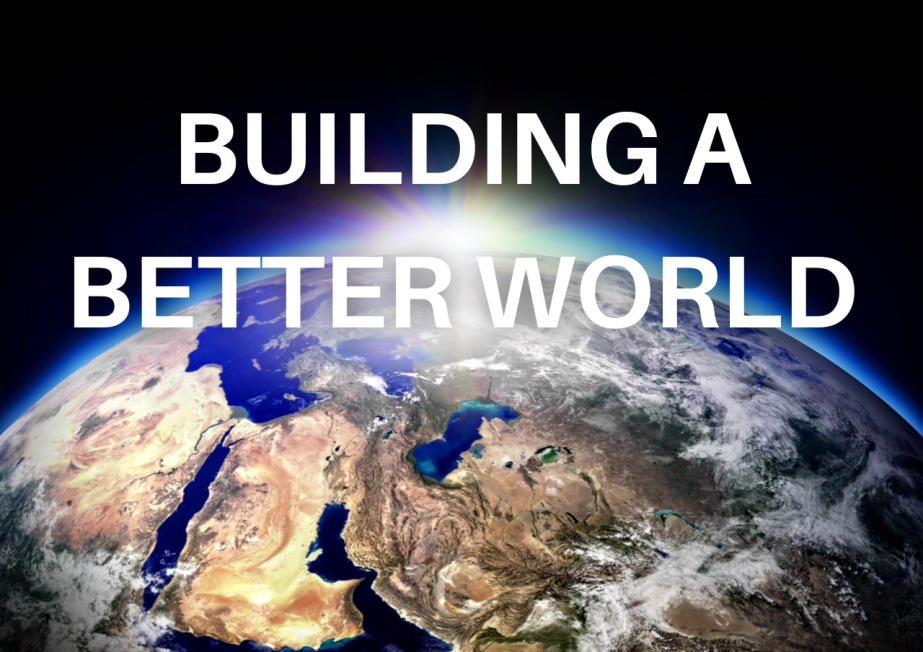
Building A Better World

“Follow your dreams and use your natural-born talents and skills to make this a better world for tomorrow.”

– Paul Watson

This Summer saw the long awaited 2020 Tokyo Olympics, which was an unusual state of affairs, without the spectators. However, it gave a chance for the people of each country to see their Olympic champions battle it out for the highly held Olympic medals. After the way the 2020 Euros lifted the spirits of the nation, there was a hope that the Olympics could keep the national excitement going. In the end more people watched the Tokyo Olympics than did the Rio 2016 Olympics. Records were broken and Britain came a respectable forth in the medals table, which is all pretty positive. Positivity is in great need after the past 18 months and the uncertainty of coming out of the imposed social distancing guidelines, which has left us all feeling a little unsure how to interact with each other in the new normal.

The Olympics have long been held up as the bastion of sportsmanship, of unity in diversity and of excellence. Curious to see the principles behind the organising of the Olympics, I looked up the Vision of the International Olympic Committee, which is “Building A Better World Through Sport.” A worthy vision, and one which is shown in their Values of Excellence, Respect and Friendship. And this got me thinking about how we can make the world a better place after the COVID-19 pandemic put a pause on much of society’s habitual behaviours. During the pandemic the kindness of strangers and the capacity to care flourished amongst neighbours and strangers alike. The concept of Key Workers redefined for many of us who plays an important role in our society and who does not. There was initially talk about going back to normal after the pandemic, or rather a new normal, and it is this idea of a new normal that I want to focus on today.

If we can better choose how we can interact with each other, how we can live together and how we can connect with each other, then this seems like a good time to do it. We can take up the cause of the Olympics of ‘building a better world,’ but not just through sport, but through how we see each other and how we interact with each other. This thing called life is a shared journey from cradle to the grave, but we are capable of lifting each other up, so we may all live better lives.

To illustrate what I am talking about I would like to share a story I saw online recently about a Police Officer in America who pulled a young man over, as his driving licence had expired. The young man explained that he barely had enough money to pay the bills and his rent and could not afford to renew his licence, due to losing his job. He was also on his way to a job interview, in the hope to gain an income and eventually get his licence renewed. The Police Officer left his own car and drove the young man to the job interview and apologised to the Interviewers as he was the reason the young man was late for the interview. The young man got the job and was able to renew his licence in order to legally drive again. Sometimes kindness matters more than the letter of the law. It also matters more than the prejudices and stereotypes that we all have which prevent us from seeing others as equal to ourselves and therefore worthy of kindness.

It is also important to remember how connected we all are. The COVID-19 pandemic showed how our movement around the world can cause diseases to spread, but we can also share our behaviours, our ideas and our values. Kindness and generosity are also infectious. Mother Nature has provided a way to encourage us to be kind and generous. This is how we thrived as a species, by working together. If we are to be generous or kind to someone else without any expectation in return we get a hit of Oxytocin, which makes us feel good. The person we are generous or kind to gets a hit of Oxytocin as well, which means they will likely go and be generous or kind to someone else that day. Even a person just witnessing an act of generosity or kindness will give them a hit a Oxytocin and will encourage them to pay the generosity or kindness forward. We are hard wired to do this, because we are stronger together.

To further show how connected we all are on our planet, here is something from a TV series on Netflix called Connected that blew my mind. It is in the episode on Dust and how important certain dust can be. In Chad, North Africa, in what used to be Lake Mega-Chad, but is now part of the Sahara Desert, there are the remains of fish and other creatures, which once lived in the lake, before the area became a desert. The wind breaks up the skeletons into dust which is then carried by the wind up into the atmosphere and it makes its way all the way to the Amazon Rainforest, in South America, where the dust becomes part of the soil. What is amazing is that the rain in the rainforest washes away most of the nutrients that the plant life needs to grow and survive, but the dust all the way from the Sahara Desert in Chad, North Africa, replenishes it. Around 22,000 tons of phosphorus is deposited in the Amazon Rainforest every year from Lake Mega-Chad, which is about the amount the soil loses every year due to rainfall. Without this process happening, there would be no rainforest. We are truly, globally connected to every other ecosystem on the planet. This is why when we through things away, there is no away. We need to look after our planet as well as each other.

The environmental movement, which includes Greenpeace, sprung to life after a very special photograph was taken when “Apollo 8, the first manned mission to the moon, entered lunar orbit on Christmas Eve, Dec. 24, 1968. That evening, the astronauts-Commander Frank Borman, Command Module Pilot Jim Lovell, and Lunar Module Pilot William Anders-held a live broadcast from lunar orbit, in which they showed pictures of the Earth and moon as seen from their spacecraft. Said Lovell, “The vast loneliness is awe-inspiring and it makes you realize just what you have back there on Earth.” They ended the broadcast with the crew taking turns reading from the book of Genesis.”(1) As they orbited back around the moon toward the Earth the photo Earth Rise was taken as the view of the Earth in the distant blackness of space rose into view over the surface of the moon, which is seen in the foreground of the photo. The sense that if we do not take care of our planet their is no planet B reverberated through the cultures of the West and the rest of the world.

We have now reached a point where taking a trip up to where the Earth’s atmosphere meets outer space is becoming a reality for those who can pay for it. There has been much debate online about the recent endeavours of Billionaires like Sir Richard Branson to develop “rocket planes” that can take people up the edge of space. Sir Richard Branson was the first to have “…successfully reached the edge of space on board his Virgin Galactic rocket plane”(2) recently. The main argument against such endeavours has been why build a rocket plane to take people to the edge of space on tourist trips when there are millions who are homeless, starving and displaced due to war. There are also issues with global warming. It is an argument over priorities and values, over selfishness and selflessness. Tickets to take the Virgin Galactic up to the edge of space cost up to £180,000, again money that could be spent helping our fellow human beings. I guess the main ill feeling comes from the disproportionate distribution of wealth and the fact that there are billionaires in the world where much good can be done if this wealth was shared. If a tenth of the wealth held by the Billionaires of the world was spent on helping those in need, the quality of life for many would be improved. Access to water, electricity and education, for example.

But we are not all Billionaires, far from it. Most of us have enough to survive and a little bit more to save or spend on nice things. This begs the question what can we do to make the world better? If we are to go back to the Vision of the International Olympic Committee, “Building A Better World Through Sport,” we can think about what Vision we might have for our lives. If your Vision began with “Building A Better World Through…” what would come next for you? I would suggest you build a better world through kindness. Kindness to the environment and kindness to the people we interact with each day.

However, it is not always easy to be kind, especially if we are asked to be kind to those we really do not like. In the Bible Jesus asked us to Love our Enemies? You might not think in terms of ‘enemies,’ but you will have people you would rather avoid, people you dislike. How do we build the capacity to be kind to those people? A good place to start is to work on the prejudices and stereotypes we all have, on the barriers we have that create an us and a them, so we can start seeing each other as human first, and then we can increase our generosity and kindness on a daily basis. The more people we are generous and kind to the more people will do the same for others. And you will feel so good at the end of the day.

Reference:

1: https://www.nasa.gov/multimedia/imagegallery/image_feature_1249.html

2: https://www.bbc.co.uk/news/science-environment-57797297

Developing The Pathway To Fulfilment

My intention is to create a process by which you can start to live well. To me living well means to live in a way that brings about happiness and success, which in turn brings about fulfilment in our lives. This is not a life hack or magical cure for what ails you. It is a deeply personal journey of self-discovery, of life balancing and of purpose finding. This is an evolving process, until I feel a clear and actionable ‘Pathway’ is created, so it can be shared and used effectively.

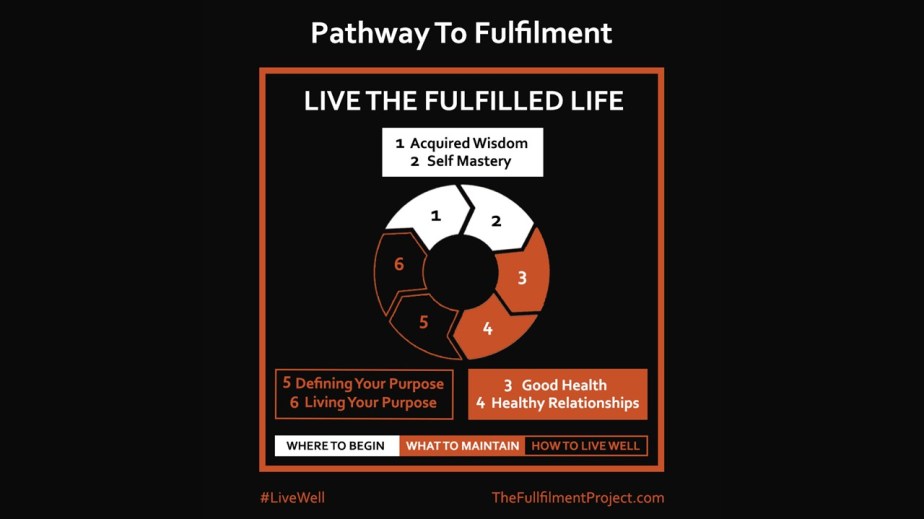
I have reflected on the first two steps to the existing Pathway and have moved Acquired Wisdom to Step 1, as I feel that wisdom gives us a strong foundation from which to build. I have replaced Self Knowledge with Self Mastery and moved it to Step 2, as self knowledge is a useful mental exercise, whereas self mastery is an actionable way of being, which is built on both wisdom and self knowledge. This, I feel, is a more effective part of the journey, as self mastery is required in order to have a life well lived. The six steps  are now Acquired Wisdom, Self Mastery, Good Health, Healthy Relationships, Defining Your Purpose and Living Your Purpose.

The six steps of the Pathway To Fulfilment are divided into Where To Begin, What To Maintain and How To Live Well. Now that I have an outline of a process that I believe will bring about fulfilment in ones life, I aim to add in the detail of the activities and actions you will follow within each step of the journey towards fulfilment and a life well lived. Watch this space and the Facebook Group Community for up and coming updates.

WHERE TO BEGIN

Step 1: Acquired Wisdom

We acquire the wisdom of others from a variety of sources, spiritual and secular. Wisdom challenges us and enlightens us. Often this is achieved by extensive reading, but, with the internet, a lot of this same wisdom can also be obtained through videos, audio books and pod-casts, however you learn best. This wisdom will feed into what you already know about yourself, it will influence how you see yourself and how you choose to live; helping towards self mastery.

There is a lot of wisdom out there to acquire, and it can sometimes be hard to distinguish wisdom from well sounding ignorance, so to simplify things for you I have broken down the wisdom I have found into ten Principles Of A Life Well Lived that will help you navigate the world skilfully. They are what I consider to be the essential wisdom to acquire. I will delve into each principle and explore how it will enhance your life. I have divided the principles into those that relate to Self and those that relate to Others. The principles related to Self are Growth, Equanimity, Fortitude, Seeking and Self Competition, and those related to Others are Stewardship, Servant-hood, Reciprocity, Joy Making and Connection. I will be sharing more detail on these moving forward.

Step 2: Self Mastery

The process of self mastery begins with getting to know yourself more substantially than you may have before; figuring out what really makes you tick, what you believe and don’t believe, what you think is true and false, what you think is ethical and not ethical, etc. It includes figuring out your beliefs and your ethics. Also, what happiness and success look like to you, personally, because our happiness and success are relative to our values, which are very personal to each of us. Our happiness and our success will not bring about fulfilment if they are not aligned with our values.  Self mastery begins with broad and deep self-knowledge and then in order to gain and maintain mastery of yourself you will need to cultivate both body and mind, the tools for which will come from the ten Principles Of A Life Well Lived.

This will primarily be mastery of your thoughts, which is the same whether you are embarking on self-development or a journey of faith. Our mind and body are in a sort of synergy, which means our thoughts effect the chemistry our brains create in our bodies, which in turn creates sickness or wellness. Wellness, being the optimal state to be in. Also, that if we fine tune our body through exercise, through practices such as Yoga, and if we cultivate strong Qi (Chi) in our energy system, through practices like Tai Chi and Qigong, our physical well-being will flourish and allow our mental mastery and well-being to develop too. Self Mastery is both physical and mental, which leads me to Step 3: Good Health.

WHAT TO MAINTAIN

Step 3: Good Health

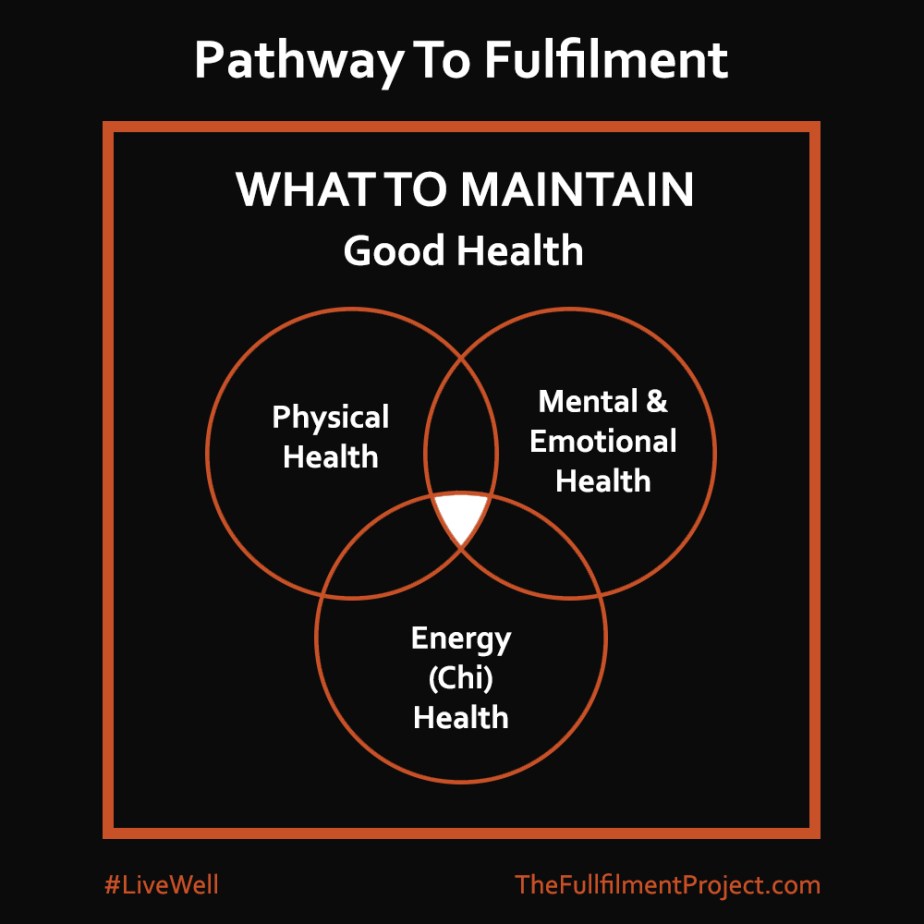
Your health should be of great concern, because good health is essential for your well-being and having an active, fulfilling life. I have included the usual physical health and mental and emotional health, and I have also included energy health; all of which could be thought of as a triad of good health. Good physical health includes diet and exercise. Good mental and emotional health includes mastering your emotions and balancing your thoughts. Good energy health includes mastering the Qi (Chi) that flows through your energy system, like blood through your bloodstream, as detailed in Traditional Chinese Medicine. To have good health you need to work on all three of these areas.

Step 4: Healthy Relationships

In this step you look at your relationships, and identify those relationships that are good for you and those that are not, and those that are a mixture of the two, that need work to become good. You should continuously work towards all of your relationships being healthy ones; meaning that they bring you happiness rather than stress, they uplift you rather than bring you down, and they are aligned with your values and ethics. These relationships are in circles of community, which are relationships with your self, your partner, your family, your friends, your colleagues and your acquaintances, and they are all interconnected.

HOW TO LIVE WELL

Step 5: Defining Your Purpose

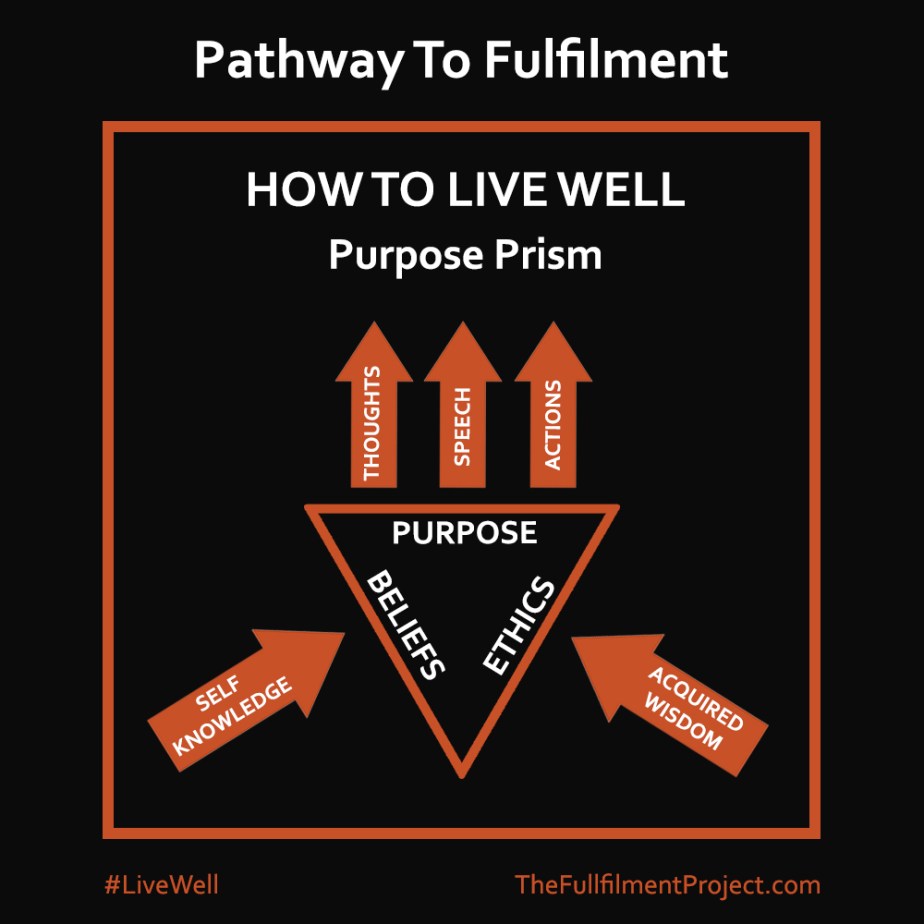
After working your way through this journey so far, you will have a solid foundation for how to start living your life better. From this new understanding of yourself, your defined beliefs and ethics form part of what I call your Purpose Prism, the third piece of this prism being your purpose. You will go through a process of building on your beliefs and your ethics, weaving in Acquired Wisdom and Principles Of A Life Well Lived, and all you have learned from steps 2, 3 and 4 and define your personal purpose. This prism is the filter through which you will see and experience the world, and it will influence your thoughts, speech and actions, making them wiser in nature. Your purpose comes from a vision of a better world that you want to help create.

Step 6: Living Your Purpose

You will then be set to start applying your beliefs, ethics and purpose to your life, to find your best way to live them out in your thoughts, speech and actions; to act on your vision of a better world through everything that you do. This is living your life on purpose. All of this work will mean that both happiness and success become personal, and therefore fulfilling, all three of which are bi-products of a life well lived. When the garden of our lives is tended to properly, these things blossom, but if we focus on achieving them without tending to the important things in our lives then these things will not blossom. Your happiness, success and fulfilment along your journey then feed back into your acquired wisdom, self mastery, health, relationships and your beliefs, ethics and purpose, and on it goes, because this journey is a life long endeavour. Follow the Path To Fulfilment and live well my friends.

Our Life Long Journey-What Path Should We Follow?

“Your life is a journey. Your attitude is the guide.”
PJ Ferguson

Caught In a Pandemic

Today we are globally in difficult times with the Coronavirus pandemic, but different countries are handling it differently; some better than others, as these are unprecedented events. America seems to be falling into division and chaos, and in the UK there seems to be confusing advice on what we can and cannot do, leading to anxiety in some and other taking advantage and not following sensible advice to keep us. Other countries have done better and worse, depending on your point of view. It can seem that the future is uncertain and full of difficulty, but we cannot necessarily tell what the future will hold, as it has yet to happen.

Whatever our future holds, let us follow the wise words of those who came before us, who led with compassion and love, those who shone a light of hope in difficult times, like the prophets of our many religions and people like Martin Luther King and Nelson Mandela; leaders who helped us move towards a better way of living. Let us always have hope for the best, and as we make our way into the future, many things will come and go, and we will move past this pandemic, hopefully learning collectively and individually how to live a more balanced life. As we have slowed down and been confined indoors it has been an opportunity to pause and reflect on how we want to live. As many have said, when things go back to normal, it will be a new normal. It is up to us how this new normal will look for us, how our beliefs and ideas about life will influence our lives moving forward.

Our Journeys

As we move forward, we will all have different experiences and different journeys that we each take everyday. Before the Pandemic, there were both every day and religious journeys that we would take, those that work had a journey that they took to get to their job each day; whether by car, bus or train. Many are now working from home, including myself. Others who don’t work will have things that they did and places that they went to regularly, which have also changed.

Whatever we do with each day there are habits that we form, and familiar routines that we go through, as we go to familiar places. These journeys always seem to take less time and are comforting in some way, perhaps due to their familiarity, and the fact that they form part of the fabric of our lives and are connected sometimes to our habits and routines, like walking the dog or going to the pub on a Friday night. These journeys can be down the road, or to another town or city, or even to another country. Whatever the journey, and whatever the destination, there is always a reason for the journey, a purpose for going.

The Events In Life

Many of us have significant events that happen to us on the many journeys that we take, occasionally it is an event which we feel we are lucky to walk away from, a car crash, an illness, a decision which might of ended badly if we had made a different choice, all of these can be life changing, they can make us reassess our lives and our priorities. Sometimes these events are something a little less extreme, like meeting someone and falling in love, having a baby, getting the job you wanted, or just coming to a realisation that causes a change in direction in our lives. Everyday any of these things can happen, life is changing all the time, and our interactions with others are often what cause these changes.

We Go Through Life Together

The journey that we each take through life is one that we share with our friends, and our family, and the things that we do are witnessed by our children. Even though we spend our efforts passing on wisdom and knowledge that we have discovered in the course of our lives, we also pass on examples of how to behave through our actions, we are role models for our children and the actions that we take, and the path through life that we choose, can be copied. The path we take can become the path that our children take, so it would be best to live in a way that we want our children to live, to live up to the wise lesson that we try to instill in them.

We are never alone in the life we lead, there are always people with which we interact; people at work, people on the bus, people in a congregation, friends and family. We live very interconnected lives, and in doing so we learn from each other everyday, we always know more than we did the day before, we are always learning through our experiences, our education, our everyday interactions.

Putting Things Into Perspective

In a way this is how mankind has evolved over the centuries, our interactions have manifested in a collaboration of ideas and knowledge, that has given us the development of human beings from early man to our current level of intelligence and development. This trend will continue, and the paths that we all take will inform the wider community, and the human race as a whole. We are all part of a greater society, and our actions are like drops of water in a lake, the ripples spread out along the water’s surface, eventually having a far-reaching effect on the rest of our world.

We are all parts of a whole and we all have individual lives to lead as well. It is a paradox of sorts. We all want to do what is best for ourselves, yet we also want to do what is best for others too. So how then should we live our lives? What paths should we take on our journey from birth to death? That is something we all have to work out for ourselves, though I do advise looking into the teachings of the many prophets, spiritual leaders, and wise sages that have contributed to the pool of spiritual knowledge that can be found in any of the holy texts and scriptures that every culture has.

Every culture has this knowledge because each of them have had someone who has understood it and documented it, and because this knowledge is not restricted to any one culture, it is a universal wisdom which is part of the universe, and is there to be discovered by anyone who has the ability to see it and understand it. So, think about what path you want to make through life, and how you want to live, then take that first step and keep walking.

Something to think about…

Sometimes life gives us a challenge that can be an opportunity. What challenges do you have currently that could be an opportunity?

Poem: Having Purpose

Striving and failing, repeatedly.
The defeated fall below their imposed par;
partly theirs, partly someone else's.
We often strive without direction, without purpose
on the treadmill of life, running and staying.
People, teams, businesses; we mistake rewards for purpose,
the spoils with the destination.
When we have no destination and no map or compass to speak of
we fail in our pursuits. Our purpose defines our destination
and our reason for going there. It is the means by which we transform
the world for the better. It is how we uplift others
and help them become their best selves.
To help others find fulfilment is to fulfil what it means to be human.

Self Knowledge: Doing What You Love

There are many ways to ‘find yourself,’ not least the well worn concepts of going to spend time in an ashram or travelling the world, but often we discover at the end of these spiritual or physical journeys that we find ourselves back where we started. It is not the places we go to that cause us to find ourselves, but the experiences we have, the searching we undergo and the inward reflections that we have.

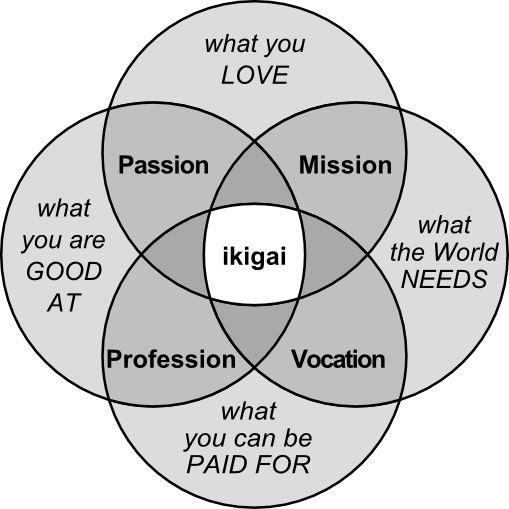
In truth, we can find ourselves right where we are. We do, however, need guidance, ironically the kind that you might in fact find in an ashram. If we do not have our own Guru, we can find wisdom in the writings of others, and processes like Ikigai, a Japanese method to find balance and purpose in life. As I have discussed in my last blog post, recommending a book on the subject of Ikigai, there are four areas to focus on in your life that interact in a Venn diagram layout that creates a centre, which is your Ikigai.

The top area of focus is What You Love, which is an enticing prospect, as doing what you love sounds like great advice, except, those who have rushed out and just done what they loved have often ended up as struggling artists or writers, with no financial plan, or steady income, but are prolific in their work, in the thing they love.

It is not that you should not do what you love, but it should be tempered with the other three areas of the Ikigai Venn diagram; What You Are Good At, What The World Needs and What You Can Get Paid For. Life is a complex meandering journey through strife and happiness, and just doing what you love will not always mean you will automatically live a fulfilling life. It needs to be balanced. Figuring out what you love is important, but the other aspects of Ikigai matter too.

For example, looking at what you can get paid for is important, because money allows you to do things and have things in life, money can be viewed as units of freedom, the more money you have the more freedom you have to do and have things. However, if you only think of yourself, in terms of what you love and what you can get paid for, this can mean others suffer so you can achieve personal goals. The amount of money we have does not equate to how happy we are, because we also need to have good, healthy relationships with other people too in order to be happy in life.

Figuring out what you love is a starting point, as is figuring out what the world needs, or what you are good at, or what you can get paid for. Trying to figure out what you were put on Earth to do is not straight forward, I recommend picking one of the areas of the Ikigai Venn diagram and start figuring out what that means to you and move around all four areas, and when you have a semblance of an answer for each area, then your Ikigai starts to take form and you are on your way to a fulfilling life.

This is, however, a life long pursuit; figuring out our life’s purpose can take a lifetime, and it will be different at different point in our life. So, don’t worry so much about having it all figured out. Start figuring it out and be open to the many, many possibilities that life has for us to explore and start exploring.

Book Recommendation: Man’s Search For Meaning by Viktor E Frankl

Image Source: amazon.co.uk

Buy the book here

Why Read This Book


This book is an insider’s view of the Nazi concentration camps from a Psychiatrist who lived in them as a Jewish prisoner. A view that came to see meaning even in the greatest of suffering. It is a book that reflects the idea that we can choose our attitude in any given circumstances. It is an empowering read that includes Viktor E Frankl’s Logotherapy, which is a structured way to find meaning in one’s life. For someone who wants to reach their full potential this is a must read.

Contents

  • Preface by Gordon W. Allport
  • Preface to the 1992 Edition
  • PART ONE
  • Experiences in a Concentration Camp
  • PART TWO
  • Logotherapy in a Nutshell
  • POSTSCRIPT 1984
  • The Case for a Tragic Optimism
  • About the Author

Summary

As is evident from the contents list this book if primarily about two things, the experiences that Viktor Frankl had while he was a prisoner of Nazi concentration camps, which included harrowing accounts as well as moments of joy. Also, how these experiences and what he witnessed brought him to the realisation that the underlying drive of human beings is to find meaning in life, and that meaning can change depending on the momentary circumstances we find ourselves in and that this meaning can only be realised by the individual themselves. This then lead him to use his training as a Psychiatrist to develop his Logotherapy, which is explained in clear detail in the second part of the book. This book is difficult to read at times, but the challenges of reading Part One bring context and depth to the Logotherapy explanation in Part Two, so I would recommend reading the whole book if you can.

5 Actions To Make 2020 The Best Year Yet

“Don’t mistake activity with achievement.”

― John Wooden

Figuring Out Your Beliefs and Values

This might seem a little too hippy for you to think about doing, but our beliefs and values are the prism through which we experience and act in the world. They are the reasons we do what we do and how we do it. If we believe it is wrong to steal we won’t, if we believe it is right to be generous then we will be.

Our beliefs are what we believe to be right and how we believe the world, and the universe, works. It is not just religious beliefs, which do also matter, but also beliefs about right and wrong, our morals and how people should behave. We also have beliefs about ourselves and how we allow ourselves to be treated. If we believe we are not worthy of respect, we will let people walk all over us, but if we believe we are worthy of respect, then we will expect it, or perhaps demand it.

Figuring out our values and beliefs sets the parameters for our lives. It gives us tools to navigate the world, to make good choices and will impact how our coming year and the rest of our lives will work out. If we don’t clearly define our beliefs and values we are kind of hitting and hoping with how we live our lives, which is certainly not a recipe for a successful, happy and fulfilling life.

Reviewing Your Priorities

Once we have our values and beliefs clarified we can set our priorities for the year ahead and look at how we are spending our time. If we look at our day or week we can see what percentage of our time we spend working, with friends, with family, engaging in hobbies, keeping fit, attending our place of worship, working on our goals etc.

Often we get stressed out because our life is out of balance. We sometimes spend too much time working or doing things for other people and not enough time for ourselves. Conversely, it is also not good to spend too much time doing personal activities and neglecting our loved ones or our jobs.

Finding a balance is a personal thing and therefore reviewing all the areas in our lives and thinking about what we care about is important. It may take a bit of time but it will mean your level of happiness, satisfaction and fulfilment in life will grow exponentially.

Removing The Bad Relationships

We all have relationships with other people, that is obvious, but the quality of those relationships matters. If someone in your life brings you down, makes you feel small, disrespects you on a regular basis or is just not good for you then you have two options.

The first option is to try and mend the relationship, to confront them on how they are treating you and stand up for your own wellbeing. All relationships should be built on equality and respect. They should include kindness, encouragement and generosity, if they do not then odds are they are having a detrimental effect on your wellbeing.

The second option is to cut them out of your life. If they are having a significantly negative impact on your life and confronting them on it either did not work or is not an option then they are not worth having in your life. Your life is wonderful opportunity to reach your full potential, to experience joy, success and fulfilment. No one has the right to get in the way of this and it your responsibility to manage your relationships, no one can do it for you.

Cultivating The Positive Relationships

On the flip side, we all have relationships in our lives that are very positive. People who give us love, encouragement, support and their time. These are the people we should be building our relationships. It can be easy to take these people for granted and assume that they will always be our friends and partner without any effort to cultivate these relationships.

However, if we do not spend time with these people, ask after their wellbeing, support them when they need us, and be a good friend or partner then we will grow apart and friends become acquaintances and partners move out of our lives.

it is also important to maintain and cultivate our relationships with workmates. These are people we spend a significant amount of time with and in order for the companies we work for, the team we work with and for us to thrive we need to build strong relationships with trust, loyalty and collaboration. All of these come from spending time with each other, face to face. Human being are social animals and we only trust people we know. We cannot do this over social media or by video conferencing, etc.

Reverse Engineer Your Dreams

We all have something we want to achieve, something big that lingers in the back of our minds, but seems too big to be able to get done. We usually tell ourselves that we will get around to working on this goal but life always get in the way. The reason we are not working towards this goal, whatever it might be, is that we are not prioritising it, we are not allocating time for it.

This might be because we have a mega busy lifestyle or it might be because the goal seems too big and we don’t think we will ever achieve, so we never start it. The first reason can be solved by breaking the goal into very small chunks and find time to slot these in during our day. For example, if you take public transport this is a perfect opportunity to read up on the goal in question or write assignments, notes, plans, etc.

The second reason is a lack of self belief. Depending on how deep this is you might just need encouragement from others or you might need something like Cognitive Behaviour Therapy if the issue is based on underlying bad experiences. If the latter is true there is no harm in seeking professional help to improve your well-being and quality of life, it can really help and is private.

Also, for the first reason asking someone who has a positive impact on your life to be an accountability partner can really help. Someone who knows your goal and who can check in with you on a regular basis to see how you are getting on and to give you encouragement and tips.

All of this is good, but you also don’t want the journey to your goal to take too long, so you need to speed up the process. To do this I recommend finding someone that you admire that has achieved the goal that you are seeking to achieve and study how they got there. Then you can reverse engineer the steps they took and take the same steps.

Some of the steps might not be applicable to you, or be things that are not available to you, but it will give you a road map. It will take some creative thinking and persistence. Once you have a plan it is important to set daily, weekly and monthly goals. Have a check list for time-frames like 3 months, 6 months, 1 year and 5 years. Take a course, read books, listen to podcasts, whatever it takes, you can do it. Have faith in yourself and go for it. We regret what we do not do more that the things that we do.

When you are at the end of your life in a nursing home don’t let this goal be a regret you wish you had tried to achieve. Good luck my friends, you can do great things with effort and persistence.

Something to think about

The limits we have in our lives are often created by ourselves, based on what we think the world expects of us. These limits are flexible barriers that can be changed or even removed. You are in charge of your reality.
Poem: Life’s Covenant

Infinite is our space and time.
Infinite is our consciousness.
Life blooms and fades, ebbing and flowing
from and back to the great eternity.
The Brahman, the Tao, the Emptiness,
the Universe, the Ubuntu.
Our divisions are all of our own creation;
Red versus Blue,
White versus Black,
Me versus You,
Us versus Them.
We were born of the flourishing planet
that we ride through the cosmos,
built from the elements of our eternal universe.
We exchange breath and energy and food,
our survival is a dance of coexistence,
our thriving comes from our collective
respect, cooperation and love.
We are intertwined and inseparable.
This is the truth under all other truths; we are one.
To create division seems to be a violation
of the very covenant of life itself.
Let us see others as ourselves and rise together
to our greatest happiness, joy and potential.