Your Lifelong Journey

The day before yesterday it snowed where I live and for a few hours everything was white. Then the snow turned to rain and washed away the snowy scene. The snow flakes were big and fluffy and fell through the air with a kind of grace.

Each snowflake was made from a drop of water that passed through streams of air, some of which began to freeze the water into crystals. As the drop of water passed through the atmosphere it began to freeze more and more and the water formed larger and larger crystals, its path through the ever changing atmosphere was unique, caused a unique crystal pattern to form. It is the path that the snowflake takes that determines its shape and size.

We are much like snow flakes. We all pass through the atmosphere of life, but we each have our own journey to take, growing as we travel. The experiences we have shape who we are and how we behave in the world. They say that every snowflake is unique and the same can be said of each human life. We each have experiences and memories, knowledge and wisdom, intentions and goals.

Your life is an unchartered journey through wonder and danger alike. You may wish to follow in the footsteps of those greater than you feel you are, but what you will learn and what you will do along the way is uniquely yours.

The Fullfilment Framework Remastered

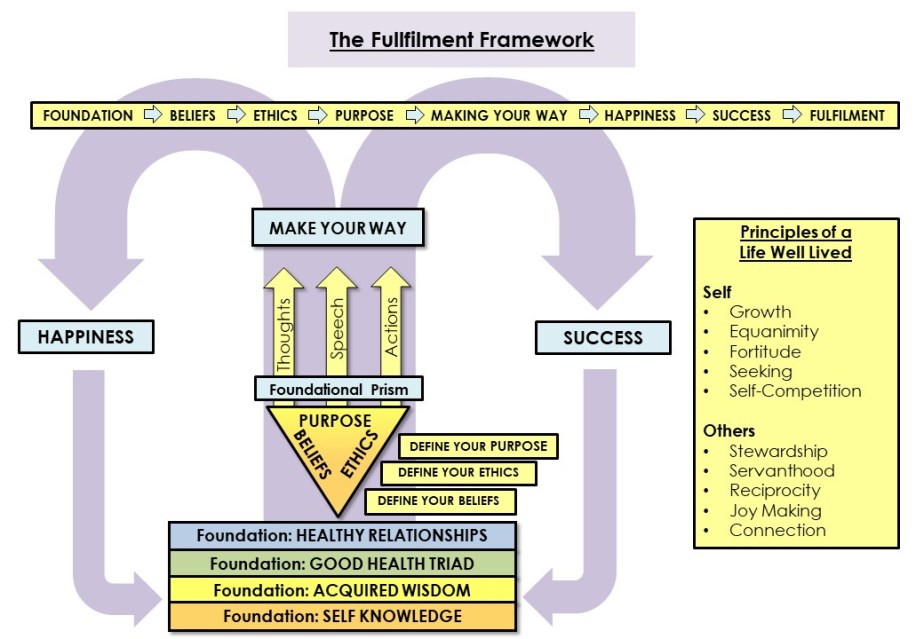
I have reworked my Fullfilment Framework, so it has a better journey towards fulfilment. This is a brief summary of the journey, which I will expand on later on this blog. This summary can be found on the Pathway To Fulfilment page.

Where To Begin

The Fullfilment Framework is a pathway to fulfilment. It is a deeply personal journey of self-discovery, of life balancing and purpose finding. The structure of the Fullfilment Framework begins with getting to know yourself more substantially than you may have before; figuring out what really makes you tick, what you believe and don’t believe, what you think is true and false, what you think is ethical and not ethical. Also, what happiness and success look like to you, personally. It is broad and deep self-knowledge. This is your starting place, the first level of the Foundation of the Fullfilment Framework. Next, you look at the wisdom of others, from a variety of sources; wisdom that will challenge you and enlighten you, as wisdom should. This wisdom will feed into your self-knowledge, and influence how you see yourself and how you should live.

Next, you look at Principles of a Life Well Lived, which are divided into those that relate to Yourself and those that relate to Others. The principles are; Self: Growth, Equanimity, Fortitude, Seeking, Self-Competition, and Others: Stewardship, Servanthood, Reciprocity, Joy Making, Connection. These are very much connected to Acquired Wisdom, because they are wise principles that I believe will help you navigate the world skilfully and live your life well.

What To Maintain

Next, you look at your health, which has three areas of concern in this framework. We have physical health, we have mental and emotional health and we have energy health; all of which make the Good Health Triad. Good physical health includes diet and exercise. Good mental and emotional health includes mastering our emotions and balancing our thoughts. Good energy health includes mastering the Chi (Qi) that flows through our energy system, like nerve signals through our nervous system. To have good health we need to work on all three of these areas.

Next, you look at your relationships, and identify those relationships that are good for you and those that are not, and those that are a mixture of the two, that need work to become good. You work towards all of your relationships being healthy ones; meaning that they bring us happiness rather than stress, they uplift us rather than bringing us down. These relationships are in circles of community, and these circles are relationships with yourself, your family, your friends, your colleagues, your acquaintances, and all are connected.

How To Live Well

After working your way through this journey so far, you will have a solid foundation for how to start living your life better. From this new understanding of yourself, your defined beliefs and ethics form part of what I call your Foundational Prism, the third piece of this prism being your purpose. You will go through a process of building on your beliefs and your ethics, weaving in acquire wisdom and the principles of a life well lived, and define your personal purpose, which completes the Foundational Prism. This prism is the filter through which you will see and experience the world, and it will influence your thoughts, speech and actions, making them wiser in nature. Your purpose is a vision of a better world that you want to help create.

You will then be set to start applying your foundation, principles and purpose to your life, to find your best way to live them out in your thoughts, speech and actions, to act on your vision of a better world through everything that you do. This is living your life on purpose. All of this work will mean that both happiness and success become personal, and therefore fulfilling, all three of which are bi-products of a life well lived, and they feed back into your Foundation and your beliefs, ethics and purpose, and on it goes, because this journey is a life long endeavour. Follow the path to fulfilment and live well my friends.

Always strive to be inspired and inspiring.

#LiveWell

6 Principles to finding happiness 

Many of us, throughout our lives, strive to find happiness; something which can often seem illusive. I think the reason we can find it so difficult to achieve it consistently, is that it our happiness is very individual to us on a surface level, but true happiness is something different.

I want to explain what I mean by happiness. Happiness, according to the English dictionary is “The state of being happy.”  Simple enough, but I would add that it is the state of being happy ‘consistently.’ True happiness is not fleeting, it is a constant state created by wisdom and frequent practice of wise actions, which allow us to experience a consistent state of happiness. It is a result of how we live our lives each and every day. Happiness is similar to success, in that they are both a bi-product of living a life well.

In order to live our lives well we can cultivate wisdom by studying the best of human philosophy, theology and science, and try to understand ourselves more deeply on a daily basis. The wisdom of the present and past also extend to what I call the principles of happiness. These are the attitudes and behaviours which are necessary if we are to be happy consistently. Let’s go through the six principles for finding true happiness.

The first, and most important happiness principle is something that Tony Robbins calls ‘choosing your state.’ Tony Robbins is an American author, entrepreneur, philanthropist and life coach. Our state is the emotional and psychological state that we are in. If we let the experiences we have and the people in our lives dictate our state, then we lose control of our sense of self. Actively choosing how we feel about the circumstances we are in is not only empowering, it is also a path to happiness, and fulfilment. If we have a choice why would we ever choose to be demoralised, upset, jealous, angry or frustrated? This is not easy, but it is possible with practice.

Viktor E. Frankl knew this more than most, he was a Psychiatrist and a survivor of a Nazi concentration camp, and he witnessed first-hand the horrors the inmates were subjected to and the effect of this on their psyche. In his book Man’s Search For Meaning, he talked about his experiences in the camp and he said:

“We who lived in concentration camps can remember the men who walked through the huts comforting others, giving away their last piece of bread. They may have been few in number, but they offer sufficient proof that everything can be taken from a man but one thing: the last of the human freedoms — to choose one’s attitude in any given set of circumstances, to choose one’s own way.”

This is part of the path to experiencing true happiness, to choose one’s own way. There are some practices which help us to achieve this. These practices are contentment and gratitude, both of which are necessary for us to choose the state we are in.

The next happiness principle is humility, the antidote to having a large ego. When we focus on ourselves selfishly at the cost of others this often brings suffering, because of two things. Firstly, selfish actions that seem to promise happiness rarely result in actual happiness. Secondly, if we act in a way that is selfish, we can damage the relationships we have, and this brings negativity into our lives.

The next happiness principle is having no boundaries. This refers to boundaries that are often imposed by others and those we learn. When we see an us and a them, divisions along the lines of race, religious, country, gender, sexuality, education, class or politics, we create conflict in our lives. At every division there is a conflict, but if we try we can see ourselves as one, as one community, one humanity, one universe, then we will have less conflict in our lives. The more unity we have in our mental attitudes, the more connection we will have, which takes us onto the next principle; connection.

If we are going to have more positive human connections then we have to do some daily practices. We must have compassion for others, to motivate us to see them as beautiful amazing people that we want to help and love. This applies to animals and all of nature as well. We must practice empathy, putting ourselves in the shoes of others, so we can better understand where they are coming from. This allows for better understanding and connection. We also must practice forgiveness, both for ourselves and for others. Carrying around hate and distrust is a heavy burden to carry.

Cultivating a connection to the greater oneness of the universe or God or Tao or Bradman, whichever connects with your beliefs. Duly meditation or prayer will allow us to make such a connection.

The next happiness principle is integrity. This connects directly to our values and beliefs and committing to living by them, no matter what temptations or difficulties there are in our lives. This can be very difficult, but I believe that integrity is very important to our happiness, because if we are not true to ourselves we can feel uncomfortable in our own skin and negativity can seep into our sense of self and corrupt our happiness. The final happiness principle is the act of helping others find happiness, this is very important.

The Dalai Lama said “If you make others happy, you’ll be happy. If you make others unhappy, you’ll be miserable.” We have evolved to be social creatures that protect those we care about. If we extend this to all people and all beings we can be very happy indeed.
Walk Your Own Path

When I was twenty I received a shaving razor from a well known company free in the post, which was a savvy move on their part, as I’m still buying razor blades for it fifteen years later. This razor worked very well and has never given me any cause to think about buying one from another company. However, a few years ago I was doing my usual big shop in a local supermarket when I saw a fancy looking razor that had been reduced to half price. It was made by a rival company, it was white and it vibrated the blade of the razor to give a closer shave. Intrigued and encouraged by the low price, I bought it and gave it a try. It was no way near as good as the razor I had been using for years. The lesson here is not to be drawn in by low prices and the promises of better features that don’t actually improve your life, because they only superficially appear to do so.

It is very easy in our current society to be convinced to buy consumerist products simply by being told they are better than the last thing we were told to buy or to behave in a certain way that is deemed cool or popular because so many others are doing the same. If we are not careful we can start to sleepwalk through life, living based on borrowed thoughts and feelings, on assimilated beliefs, and we end up not following our own path. In this situation I believe rebelling and walking our own path will lead to a happier and more fulfilling life. This, however, is not easy to do. Firstly it takes courage to swim against the stream, and secondly you have to find your own path before you can walk down it. This means lots of mistakes and walks down unfamiliar paths. Walking your own path takes courage but also persistence and self compassion. Mistakes will be made, so go easy on yourself.