Finding Your Passion

There is a lot of talk, particularly from motivational coaches, around finding your passion. Some will give the advice that you should do what you love. This is advice I am inclined to disagree with because there is a danger that you will turn what you love into work that you hate to do. There are two other ways to think about this.

Find Your Why

Simon Sinek explained this very well in his book Start With Why. The idea is that once you have figured out the ‘Why’ behind all that you do, the DNA of your decision making and how you treat others, then you can apply this to ‘How’ you live or work and ‘What’ you do, based on your ‘Why.’ This will allow you to be more passionate about what you do because it will be aligned with who you are.

Be Passionate About What You Do

Seth Godin suggests that if we choose to be passionate about the work we are already doing we are empowered by the act of choosing and it is better than expecting the work we do to give us passion. We will be doing what we choose to do, not what we have to do. The narrative changes.

We can then put our energy into making a difference and creating things that were not there before we decided to do them, and we will also be more fulfilled than we would by trying to do what we love.

I feel that both of these approaches are valid and some mixture of the two will certainly be better than doing what you love.

Be A Hero Not A Superhero

I came across this note I made in my journal some time ago and felt it may resonate with some of you.

I was having a dream that felt like it was happening, but I also knew it was a dream. I was part of a team of superheroes trying to stop bad guys doing something bad, I can’t remember what. I clearly remember a lady I used to work with, who has just had her second child with her husband, appearing in a corridor as I was about to go into ‘battle’.

She said “do you have any milk I could borrow.” I stopped and calmly said, “of course, it’s in the fridge down the corridor on the right.” I then joined the other superheroes to save the world or something. The revelation for me is that when I calmly gave my previous colleague what they needed, this was me being who I am, someone who helps others, not a superhero. This is enough for me.

Also, to help others in simple ways can sometimes make us a hero without intending to be one.

Be Unmistakably You

Doing something for the first time is scary, more so for some and less so for others, but it is still scary. So what we often do is settle for copying how it has been done before. We feel safe on this already trodden ground. But doing the same thing as others have done, or are doing, is rarely of significant use of our time; it does not often improve the lives of others, or ourselves.

Steve Jobs and Steve Wozniak took the idea of using a mouse and being able to move things around on a computer screen and put an Apple personal computer that almost anyone can use into people’s homes, where before in order to use a computer you had to learn to code or use the keyboard to navigate through endless DOS menus by picking option 4, then option 23, and so on.

This changed the world. It is not that Steve Jobs and Steve Wozniak were special people, it was that they pushed their thinking until they got to the boundary of what was deemed as possible and stepped beyond it, because it is beyond this boundary that things of use are created. If we do things as they have always been done we never find a better of doing them. I am not saying that you need to be a Steve Jobs and Steve Wozniak, what I am saying is that what they decided to do was a choice, a choice that we all have.

We often fear the embarrassment and the risk of going first, but those we hold up as exceptional did something new, whether it be Steve Jobs or Steve Wozniak or the painter Jackson Pollack or the author Harper Lee, who wrote To Kill A Mockingbird, they had not done what they did before they did it. They were unmistakably themselves, and what I am inviting you to do is to be unmistakably yourself. Not similar to those you wish to fit in with or different from the people around you that you disapprove of. It is to be unmistakably you.

How To Live A Good Life

I have been thinking recently about how we often hide from taking responsibility for our own journey through life. This story illustrates what can happen if you don’t take ownership. It is a made up tale, but it has a good point.

In a valley there was a town that was starting to be flooded. A van pulled up in front of a man’s house and offered to take him to safety, as they were evacuating the area. He said, “No, God will save me.” When the water level rose up to the first floor of this man’s house a boat came by to take him to safety and again he said, “No, God will save me.” When the water level had reached the rooftop a helicopter came to take the man to safety but again he said “No, God will save me.” The man drowned and when he went up to Heaven he got quite cross with God and asked him why he did not save him. Of course God said, “ I sent you a van, I sent you a boat and I sent you a helicopter.

The moral of the story is that we need to take responsibility for our own journey through life, to be our own rescuer. We also need to be our own cheer leader and take that which scares us as a sign that perhaps it is the direction that we should move in; to do the thing that rhymes with our true selves. To do the work of figuring out what our calling is and go all in on bringing it to life. This is the life long work of living a good life.

The Power Of Imagination

We suffer more in our imagination than we do in reality. This happens to many of us more often than we would like. We look into the future, or the future we think will happen, and we lean towards the worst case scenario. Our brains are wired to do this as a survival mechanism, but it is, I would say, the main cause of stress in people’s lives.

The way to avoid this is to pay attention to our thoughts and find the beliefs at the root of the thoughts and examine them. Most often they will be untrue and if the belief is untrue then some form of the opposite must be true. What then would this look like? If this new belief is true then what actions should then be taken?

Following this process will move you from a disempowering state to an empowering one. If you do this over and over you will change your belief system and the future will look less scary. You will then be able to imagine the future that you do want and how you might act, what you might do and how you might feel.

Your brain does not know the difference between your imagination and reality, so the future you imagine is more likely to come true, because your beliefs dictate your thoughts which influence your actions which cause your results, which reinforce your beliefs, and on it goes. Your future is yours to create.

Dare Greatly

I would like to begin this blog post with a quote from the American president Theodore Roosevelt.

“It is not the critic who counts; not the man who points out how the strong man stumbles, or where the doer of deeds could have done them better. The credit belongs to the man who is actually in the arena, whose face is marred by dust and sweat and blood; who strives valiantly; who errs, who comes short again and again, because there is no effort without error and shortcoming; but who does actually strive to do the deeds; who knows great enthusiasms, the great devotions; who spends himself in a worthy cause; who at the best knows in the end the triumph of high achievement, and who at the worst, if he fails, at least fails while daring greatly, so that his place shall never be with those cold and timid souls who neither know victory nor defeat.”

I became aware of this quote when watching a talk by Brené Brown. Prior to the recent talk I watched, she did a TED Talk called The Power of Vulnerability, which I recommend you watch. The TED Talk went viral and inevitably the trolls of the internet began commenting with personal attacks rather than listening to the very wise content of the talk. Brené Brown stumbled on to this quote after reading the horrible comments about her.

Since then she has decided that if you are not in the arena getting your arse handed to you, if you are not putting your work out there, then she is not interested in your feedback. What I would like to advocate for you is that you do two things. Firstly, have the courage to dare greatly and secondly, to ignore feedback from those who are not daring greatly themselves.

The Dangers of Seeking Reassurance

I have been think lately about why we seek reassurance before we step into doing new things or things that have creative risk and something happened to me this week which illustrates my thoughts on this. I work in a contact centre in a business park and walk for 15 minutes to catch the bus home. Now there are two buses with the same number which stop at my bus stop, one of the buses ends part way along the route and the other goes to where I live.

One bus came by so I waved it down to check if it was my bus, but it was the other bus that I needed, which promptly arrived and overtook the bus I had waved down and drove on by. While sitting at the bus stop waiting 40 minutes for the right bus to come by again I was thinking about why we seek reassurance and I realised that what I had done is outsource responsibility for knowing which was the right bus to the bus driver of the wrong bus.

If I’d have taken ownership of finding out which was the right bus, I could have checked the details on the bus stop timetable and compared them to the details on the front of the bus and could have been at home eating my dinner at the time the next correct bus arrived at the bus stop.

This to me illustrates the consequences we pay for seeking unnecessary reassurance that the thing we want to do is the right thing to do. Not taking responsibility for things in our lives, because we are worried about failing or choosing the wrong path is always the wrong path. We miss opportunities and we are left waiting for others to help us, or save us in some cases. No one is coming to save you, you have to save yourself and those around you will support you on this journey.

No one will give you the perfect answer as to what you should do either, because they are judging it based on what they would do, and they are not you. We need to make a choice and go try it, whatever it is. If it doesn’t work and we fall on our faces, we have learned something. The trick is to know that you will always pick yourself up and try again. A bird does not avoid landing on a tree branch because it is worried that the branch may break, if they did they would never land on a tree branch. A bird’s faith is not in the branch not breaking, it’s faith is in the ability of it’s own wings.

5 Rules On How To Build Trust

Trust is one of those things that can be hard to actively create with other people. We have all built trust with those we spend a lot of our time with, whether they are family, friends or colleagues. The longer we spend with people the more opportunity there is to build trust, so we often trust our friends and family more than we do our colleagues. However, trust is vitally important if we are to work and live together well.

Here are a few rules to follow in order to build trust with others.

Firstly, trust must be shared and we must go first. Always doing what you say you are going to do does not make you trustworthy, it just means that you are reliable. We must give people a certain level of responsibility over something important to us and leave them to do it. The more you do this the more the person feels trusted. They will then trust you with something and on it goes.

Secondly, if someone trusts you to do something or to keep something secret, you must do so, every time. This is the second part of the human covenant that is trust. It must go both ways. Over time the process builds strong trust.

Thirdly, gossip is a trust killer. When someone gossips to you about someone else it does two things; you know that they will share other people’s personal lives and their secrets behind their back to gain attention and that they will likely do it behind your back too. If you gossip you will not be trusted.

Fourthly, the giving of trust should not be given regardless of whether the trust is honoured. Sometimes you can trust someone over and over and the person proves themselves untrustworthy. At some point you need to draw a line in the sand and withdraw your trust. When trusting someone begins to effect your wellbeing it is time to withdraw that trust.

Fifthly, all people should not be trusted equally. The nature of human relationships is that each is unique. This involves differing levels of trust with different people. This is normal, and you should not feel that everyone should always be trusted. Trust is an aspect of a relationship and rules one to four should be applied in each relationship.

Rhyming With Who You Are

When we put ideas or thoughts out there into the world inevitably we get feedback from other people. Some think your ideas or thoughts are great, others will think they are not. Often we pin our self worth to what other people think of our ideas and thoughts. This is a mistake, it is giving away our power to others in the hope that they will validate our existence.

Social media is an extreme version of this. Every day people share their lives with followers and ‘friends’ hoping to get a like or a share as validation. What comes back is essentially feedback. If we listen to all of it, then we can become lost in the variety of ways in which other people think we should live. It becomes just noise, like the feedback when a microphone gets too close to the speaker it is linked to.

What we need to do is to provide our own feedback, and follow what is in our hearts. Our ideas and thoughts should rhyme with who we are. Then we will live a life that rhymes with who we are, and this will be a life well lived.

Mastering Your Work

While we work we are often asked by our Manager to complete a Personal Development Plan. This is often limited to office based work, but applies to any field of employment. This can be seen as another task to do or it is seen as a tick box exercise. The PDP is in fact a huge opportunity.

It is an opportunity to actively develop yourself, to take ownership of your career and progress to the level or role that gives you the most fulfilment.

In my opinion your PDP should begin with the values of the company you work for as well as your own values. This is because it is important that these values are compatible. You should include how you learn, how you work and what your skills and experience are. This will give you a good foundation to build your PDP from.

Set short goals, usually weekly, mid-term goals, usually quarterly and long term goals, usually yearly. I would also review your progress against these goals on a regular basis. I will be trying daily reviews at the end of my shift to highlight what went well, what I could have done better, what I learned and what actions I will take from the learning.

I feel that daily reviews will speed up my development and make sure it does not plateau at a low level. Try it yourself and see how you go. If it is too frequent, try weekly reviews. You will not regret it.

Building Self Credibility

Often, without meaning to, we make promises and break them, both to others and to ourselves. It could be that we say we will start going to the gym or that we say we will do a friend a favour, but then don’t.

When we break promises, no matter how small, we lose credibility with ourselves. We start to believe that we are unreliable and slowly our actions follow our thinking and we do.

If, however, we decide to go to the gym and we do it or we decide to get up when the alarm goes off, instead of hitting snooze, and we do it or we do the friend a favour when we say we will, then we will build credibility with ourselves and people will see that we mean what we say, that we are reliable and trustworthy. It is a matter of integrity, because integrity is a verb.

What Can Our Struggles Teach Us?

When going through difficult times, it is important to be grateful for everything that we have, which includes our tough experiences. The valleys we go through serve to highlight the euphoria of reaching the summit of the mountains we climb.

We all have, to varying degrees, the ability to choose how we want to feel, by choosing what we focus on. For example, if we are unwell, do we focus on how that is making us feel or do we focus on still having the ability to do the things we enjoy, even if the illness reduces these options. We all have the ability “…to choose one’s attitude in any given set of circumstances, to choose one’s own way.” (From Man’s Search For Meaning by Viktor E Frankl).

On the flip side the valleys will teach us lessons that the mountain peaks never can. Every struggle is an opportunity wrapped in unpleasantness. Every struggle is an opportunity to learn. I try to be in a state of flow, of effortless action, as often as I can. When I find myself in a negative state of mind or I fail at something and I come out of flow, I now ask myself three questions.

  1. What can I learn from this situation?
  2. Where are the opportunities?
  3. What should I do?

These questions help me re-centre and I then actively bring my mind back to flow. They are also fundamentally proactive, which means negative thinking patterns do not get a chance to sidetrack my mindset. Give these questions a go or come up with your own, you will not regret it.

We Are Connected

It is amazing how connected we all are on our planet. To illustrate this here is something from a TV series on Netflix called Connected that blew my mind. It is in the episode on Dust and how important certain dust can be.

In Chad, North Africa, in what used to be Lake Mega-Chad, but is now part of the Sahara Desert, there are the remains of fish and other creatures, which once lived in the lake, before the area became a desert. The wind breaks up the skeletons into dust which is then carried by the wind up into the atmosphere and it makes its way all the way to the Amazon Rainforest, in South America, where the dust becomes part of the soil.

What is amazing is that the rain in the rainforest washes away most of the nutrients that the plant life needs to grow and survive, but the dust all the way from the Sahara Desert in Chad, North Africa, replenishes it. Around 22,000 tons of phosphorus is deposited in the Amazon Rainforest every year from Lake Mega-Chad, which is about the amount the soil loses every year due to rainfall.

Without this process happening, there would be no rainforest. We are truly, globally connected to every other ecosystem on the planet. This is why when we throw things away, there is no away. We need to look after our planet as well as each other.

Taking Ownership of Your Journey

I’d like to tell you a story (author unknown). One day there was a great flood and a whole town was being evacuated. A van pulled up at a man’s house and the driver shout for him to get in as everyone was being evacuated. The man said, “No thank you God will save me.” Not wanting to risk staying, the van driver drove off to safety.

The water began to rise and was up to the man’s first floor window. A man in a boat came by and offer to take this man to safety, but again the man said “No thank you God will save me.” When the water rose up to the roof a helicopter came to rescue the man, who was then standing on his roof. Again the man said, “No thank you God will save me.”

The water continued to rise and the man drowned. When the man got to heaven he asked God why did you not save me? God said, “I sent a van, I sent a boat and I sent a helicopter.”

The moral of the story is that we have to take accountability and ownership of our own rescue and our own lives. We cannot expect others to do everything for us, even God for that matter, if you believe in him. If we are waiting for others to fix everything, we will miss so many opportunities that can lead us to great joy, fulfilment and success.

So, be humble and take offers of help when they are offered to you and take ownership of your life and your life will be exponentially better.

Cultivating Wellbeing

Wellbeing is often thought of as an ambition to feel better and laugh more. This is like looking at a garden and focusing on the need to have flowers. This is upside down thinking. If we were to plant the seeds, cultivate the soil, water the ground and ensure there is good sunlight, then flowers will appear. If we cultivate our bodies, so we may feel physically well, cultivate our relationships, so we may feel connected to others, cultivate our thinking, so we may feel mentally well, and cultivate our purpose, so that we have a direct towards which we work, laughter, joy, love and a feeling of wellbeing will blossom all by themselves. Without this wellbeing will never blossom.

The Skill of Optimism

“While you can’t control your experiences, you can control your explanations.”
― Martin E.P. Seligman

Much is often said of the optimism of youth and that such a person is optimistic and another person is pessimistic, as if they are both something we have as innate abilities, like being funny or courageous or creative. Much of what we see as personality traits are in fact based on learnable, practicable skills. It all depends on knowing the underlying behaviours and thinking patterns that bring about said optimism or pessimism.

In his book Learned Optimism, How to Change Your Mind and Your Life, Martin E. P. Seligman, Ph.D lays out his evidence for the theory that optimism can be learned and that pessimism left unchecked can make us feel helpless, which is the essence of depression; depression is essentially prolonged helplessness. The root cause of both pessimism and optimism is how we explain bad experiences and good experiences to ourselves, how we explain failure and success.

I will let Martin E. P. Seligman explain this is their own words. “The optimists and the pessimists: I have been studying them for the past twenty-five years. The defining characteristic of pessimists is that they tend to believe bad events will last a long time, will undermine everything they do, and are their own fault. The optimists, who are confronted with the same hard knocks of this world, think about misfortune in the opposite way. They tend to believe defeat is just a temporary setback, that its causes are confined to this one case. The optimists believe defeat is not their fault: Circumstances, bad luck, or other people brought it about. Such people are unfazed by defeat. Confronted by a bad situation, they perceive it as a challenge and try harder.”

So, how do you explain misfortune to yourself, do you say things like “why does this always happen to me?” The emphasis on the always will make it seem like the misfortune will happen again and again and that it all your fault. The language we use to explain misfortune to ourselves matters, because seeing misfortune as permanent, pervasive and our fault makes us feel helpless, with no way to make things better. If we begin to train our thinking to explain misfortune as temporary, specific and caused by factors outside of ourselves then we build our skill of optimism.

Optimists, according to Martin E. P. Seligman’s research, also see success as permanent, pervasive and created by themselves, and pessimists see success in the opposite way. A simple flip of how we explain misfortune and success changes everything, and we go from pessimistic to optimistic. However, the way we explain the events in our lives has been developed and somewhat hard wired into our brains from childhood. It is not a quick process to changes our thinking, but it is possible through repetition.

It helps to monitor how we explain the events in our lives and keeping a journal to document our explanatory style (pessimistic or optimistic) and to create language that develops optimistic thinking can change it over time. This is positive, it means that your success and failure are in your hands. It means that you can develop bulletproof optimism that will lead to a happier and more joyful life full of successes and, ultimately, a more fulfilling life. So, take back control over your life through your explanations of what happens in it and make it a life well lived.

How To Make The Best Out Of Life

“One way to get the most out of life is to look upon it as an adventure.” William Feather

How do we make the best out of our lives? This is an age-old question that has seen many different suggested ways of achieving it. I believe that we find this question so hard to answer because we have grown up in a world that favours things more than relationships. If there is a scale of what makes people happy, I believe there would be relationships at the happy end and things somewhere towards the other end of the scale. I’m not saying that things can’t make us feel good; buying a new car, a new piece of clothing or a new mobile phone can make us feel good, but this is not happiness. This is a good feeling created because our bodies release dopamine, a hormone released by the brain.

Whenever we achieve something or we get something we want, our brain releases dopamine to make us feel good. This is partly how our ancestors survived, because finding food or a mate felt good, making us want to do it more and more, it is a survival mechanism. There are many other hormones that our brains release in different situations, causing us to be in different states, whether we are anxious or angry, sad or hungry, the state we are in can dictate how we behave and what we do or say. What state we are in matters, and I believe that we can, to some degree, affect what state we are in, by choosing what we focus on and how we respond to the circumstances that we find ourselves in.

If we let our circumstances dictate our lives, we will be like a ship without a rudder or a sale, and we may be thrown against the rocks by our circumstances. To illustrate this, I have an extreme example of how some, even under the most horrendous circumstances, can choose how they respond to these said circumstances. Viktor Frankl, a Jew, who survived being an Auschwitz concentration camp inmate, imprisoned by the Nazis during World War Two, years later wrote the book Man’s Search For Meaning, a reflection on his time in the concentration camp. Viktor Frankl’s experience and his training as a neurologist and psychiatrist gave him a unique perspective on finding meaning in the worst of circumstances.

In this book he wrote “We who lived in the concentration camps can remember the men who walked through the huts comforting others, giving away their last piece of bread. They may have been few in number, but they offer sufficient proof that everything can be taken from a man but one thing: the last of the human freedoms — to choose one’s attitude in any given set of circumstances, to choose one’s own way.” This is an extreme example, as I have said, but I believe what was said in the quote applies to any human experience. Some circumstances will undoubtedly make it very difficult to “choose one’s attitude,” but I believe that this is the key to making the most out of our lives and how we can lead a happy life rather than the opposite. I know from personal experience that this is not easy, but with practice it is possible.

Another example from history is that of Nelson Mandela, who is famous for memorising the poem Invictus, which was read to you earlier, and how the poem helped him stand when all he wanted to do was lie down, during his time in prison. On the first day he arrived at the prison on Robben Island, that would become his home for the majority of his 27 years in prison, he insisted that the guards address him as Mr Mandela, he would not respond to anything else. In the end, the guards gave in and did so. Nelson Mandela chose his attitude to the circumstances and demanded to be treated as an equal. 27 years later, as he was released from prison, becoming a free man, he realised that if he continued to hate those who imprisoned him, he would never be free. He decided to forgive, and in doing so he lead the whole country as its President to peace through forgiveness.

Choosing one’s attitude to the circumstances we find ourselves in is a powerful way to get the most out of life, it puts us in the driving seat of our lives. It allows us to respond to circumstances rather than react to them. One way to do this, that I have found helps me, is to focus on being grateful for as many things as possible. Grateful for having a family, for having a home, for the air I breath, for the relationships I have, for the challenges that test my patience, for opportunities that life sends my way. It is very hard to be angry and grateful, or sad and grateful.

If you are lucky enough to be born in the western world you have effectively won the lottery. There are countries where the citizens do not have access to the Internet or the government controls the media they have access to and people can be executed for things we take for granted in our day to day lives. These are extreme examples but they are true. A large percentage of the world’s population live on less than £1 a day. In comparison, many of us live a dream life. So, perspective can be a great motivator to become more grateful, and gratitude is a powerful force that can bring happiness to your life.

Sometimes life can seem to give us challenge after challenge to the point where we struggle to keep ourselves going. The impact of the Coronavirus pandemic have brought us many struggles, financial and social, many have lost loved ones or have felt the difficulties of isolation, as we keep our distance from each other in order to keep each other safe. Sometimes life can seem out to break us, but what can keep us strong is the relationships we have. Our strength often comes from other people, others pick us up when we are knocked down by life and we pick up others in the same way. We all live in a community of human connections. We may sometimes feel that we have to go on alone, to stand strong by ourselves, but just asking for a little help can change our whole perspective on what is happening.

Sometimes, when life becomes hard, we can feel that we are not making any progress, we might be making little steps forward towards our goals, but because they are little steps they don’t feel significant. However, baby steps still count, as long as we are moving forward. When life is hard we can end up focusing on the negative, which does two things, it can make us feel miserable and it can mean we miss opportunities that come into our lives. This is when we need to consciously focus on the positive and to create an opportunity mindset, which everyday looks for opportunities. You may believe in God, you may believe in Karma, you may believe in luck, but if we don’t see the opportunities that come into our lives then we will miss out. This reminds me of a story I once heard about a flood that left a man stranded on the roof of his house, surrounded by water. A man came past the house in a small boat to help people to safety, but the man refused the help and said, “God will save me.” Then a helicopter came to pick him up and again he refused saying “Gods will save me.” Soon the water level rose above the house and the man drowned. When he went up to heaven he asked God “Why did you not save me?” and God said “I tried, I sent you a boat and I sent you a helicopter.” Sometimes we need to open our eyes to get the most out of life.

Some say that religion can help you live a good life, which I believe is partly true, it depends on how you apply the teachings of the religion. Most religions have good teachings, but like in the Biblical reading, if the teachings are taken to heart, they do form a strong foundation for our lives. The teachings of the world religions invariably preach forgiveness, gratitude and love, they promote the necessity of community and that we should be generous in spirit, these are the ways in which we can make the most out of our lives. We all know this, but we do not always put it into practice. I am guilty of this myself, as we all are, but if we try every day to be better than we were the day before, then we can make our lives a wondrous experience, full of hope and joy, of friendship and love. We can create a community that includes as many people as we choose to include.

Our lives are not just our place of worship community, our job community, our family and friends community, we often live at the intersection of the relationships we have with others, but this is not a bad thing. The best in life exists on the boarders of two neighbouring places, just look at the edges of jungles and open land, or where fresh water meets the sea. Life thrives in these places, and it is the same in our own lives. Our relationships are in a way the framework of our lives. Our beliefs are our foundation and both are needed to be strong enough to withstand the storms of life. Let us all strive to be grateful and generous, joyful and respectful, loving and open to new opportunities, and focused on building positive relationships with those in our lives.
How To Live Your Purpose

“If you have a strong purpose in life, you don’t have to be pushed. Your passion will drive you there.”
Roy T. Bennett

Starting With Your Why

The work of Simon Sinek has popularised the idea of having a Why with his book Start With Why: How Great Leaders Inspire Everyone To Take Action and his TED Talk How Great Leader Inspire Action. However, how can you use your Why to figure out what you should be doing in your life, your purpose?

As Simon Sinek rightly tells us, your Why is your origin story, it is the reason behind why you do the things you do. It is how you were raised, the early experiences you had and the decisions you made leading up to adulthood. In essence it is who we are. It is not always clear how to define your Why, but with self-reflection and self-observation you can find it.

Take me for example, I have a desire to figure out how to live life well and to share this with others. I have led worship in Unitarian churches for several years and worked in customer service and special needs education and started this blog without knowing my Why. It took the discovery of Simon Sinek’s book and some focused self-reflection to realise that my Why is to help others to live well, to find fulfilment. In all the areas of my life that I have mentioned I felt at home when helping others.

You might feel comfortable being a leader, being creative, working in a team or working alone. Whatever you do that makes you feel happy or content, these are clues as to your Why, because you feel good doing these things. Your Why is what defines you as a person. If you need guidance on finding your Why I recommend you read Simon Sinek’s book Find Your Why: A Practical Guide for Discovering Purpose for You and Your

Turning Your Why Into Your Purpose

Once you have defined your Why, you will be able to use it as a compass to direct you towards the things you should be doing. Ideally, your job should be aligned with your Why. In other words your work should make you feel happy, successful and fulfilled.

This is largely effected by the environment you work in, the leader(s) you have and the people you work with. But, if you know your Why then you can choose work that is aligned with it. Work that you can really get your teeth into and make a difference in the world.

At the moment, with the difficulties caused by the Coronavirus pandemic, we have to do the work that is available. As needs must we must go. However, if you are interviewing for a job it is a good opportunity to interview them at the same time.

Choosing The Right Work

A good question to ask interviewers is how they reward performance. If they reward good performance with bonuses, money incentives, for hitting the numbers they set, then the company values your output over you. If they reward good performance in a way that values you as an employee then the environment you would work in will be more fulfilling and you will feel looked after.

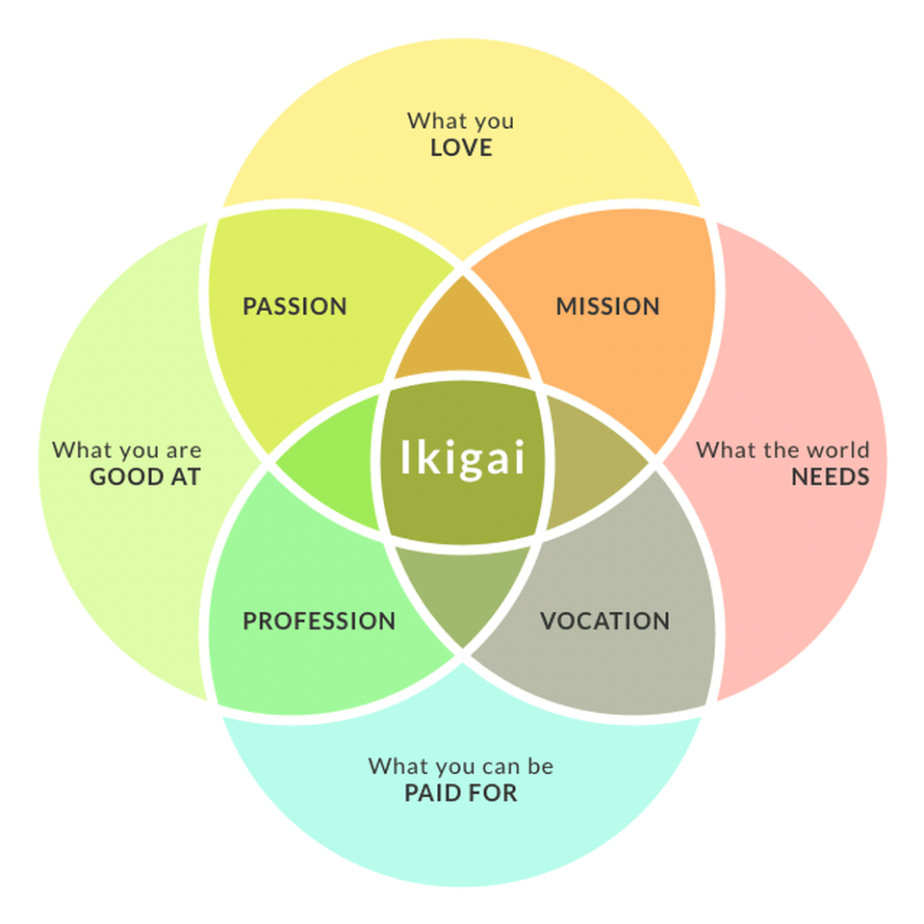
You should also look to work in roles that fit your Why, that align with who you are. The work we do in the world matters. If we are not doing what we are meant to be doing, then resentment and unfulfilment sets in. I recommend using the Ikigai method, where you look at What You Love, What You Are Good At, What You Can Get Paid For and What The World Needs. This will then reveal your Passion, Profession, Vocation and Mission. Knowing your Why will help you fill in these categories and find your Ikigai, your Purpose in life.

Conclusion

When we start with defining our Why we can start to figure out why we do what we do and then what we want to be doing in our life. Once we know our Why we can narrow down what we are meant to be doing, what our Purpose is. And when we live out our purpose, our work feels like a privilege.

Launching The Pathway To Fulfilment

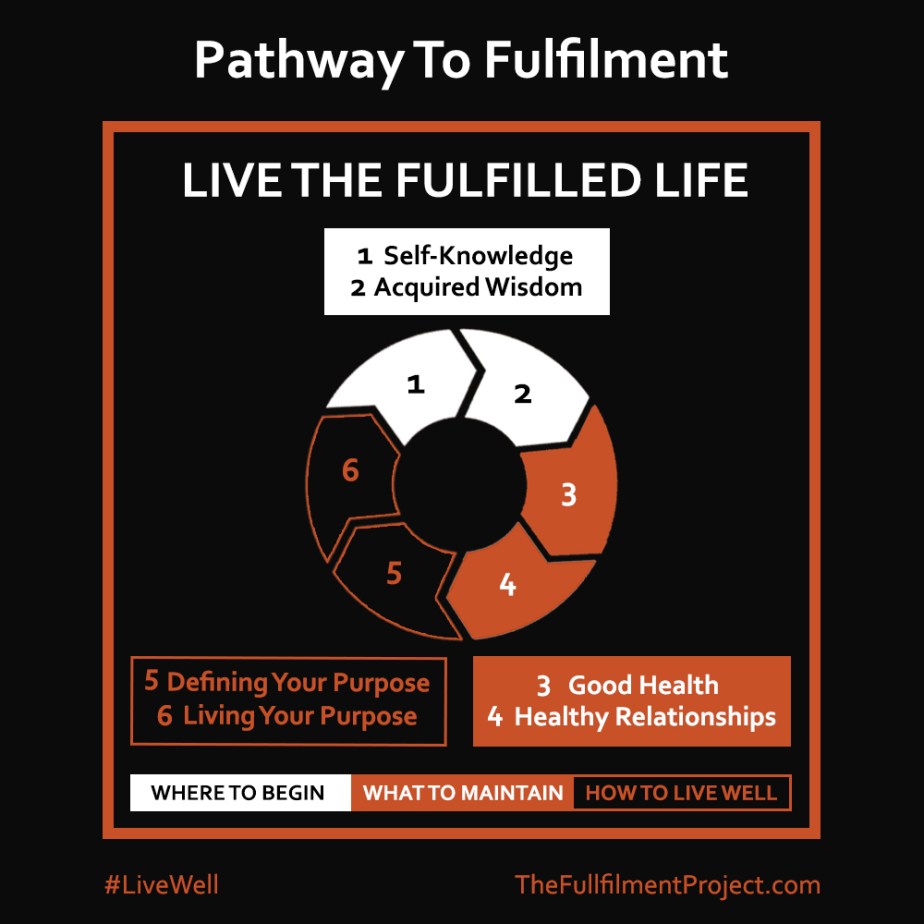
I have done some work on what I have so far called the Fullfilment Framework and renamed it the Pathway To Fulfilment, a more linear and simpler journey. My intention is to create a process by which people can start to live well, and therefore have fulfilment. This is not a life hack or magical cure for what ails you. It is a deeply personal journey of self-discovery, of life balancing and purpose finding. There are four steps of this process which are foundational to a life well lived, they are Self-Knowledge, Acquired Wisdom, Good Health and Healthy Relationships.

The Principles Of A Life Well Lived have been folded into the Acquired Wisdom. I have separated these foundational steps and the other steps of the Pathway To Fulfilment, six steps in total, into Where To Begin, What To Maintain and How To Live Well. Now that I have an outline of a process that I believe will bring about fulfilment in ones life, I aim to add in the detail of the activities and actions you will follow within each step of the journey towards fulfilment and a life well lived. Watch this space and the Facebook Group Community and on Instagram for up and coming updates. This new Pathway To Fullfilment can also be found on the page on this website of the same name.

WHERE TO BEGIN

Step 1: Self-Knowledge

The process begins with getting to know yourself more substantially than you may have before; figuring out what really makes you tick, what you believe and don’t believe, what you think is true and false, what you think is ethical and not ethical, etc. Also, what happiness and success look like to you, personally. It is broad and deep self-knowledge. This is your starting point.

Step 2: Acquired Wisdom

You acquire the wisdom of others, from a variety of sources, spiritual and secular; wisdom that will challenge you and enlighten you, as wisdom should. Often this is achieved by extensive reading, but, with the internet, a lot of this same wisdom can also be obtained through videos, audio books and pod-casts, however you learn best. This wisdom will feed into your self-knowledge, and influence how you see yourself and how you choose to live.

Connected to Acquired Wisdom are ten principles that I believe generate fulfilment, because they are wise principles that will help you navigate the world skilfully and live your life well. I have divided them into those that relate to Yourself and those that relate to Others. The principles related to Self are Growth, Equanimity, Fortitude, Seeking and Self-Competition, and those related to Others are Stewardship, Servant-hood, Reciprocity, Joy Making and Connection. I will be sharing more detail on these moving forward.

WHAT TO MAINTAIN

Step 3: Good Health

Your health should be of great concern, because good health is essential for your well-being and having an active, fulfilling life. I have included the usual physical health and mental and emotional health, and also energy health; all of which could be thought of as a triad of good health. Good physical health includes diet and exercise. Good mental and emotional health includes mastering your emotions and balancing your thoughts. Good energy health includes mastering the Chi (Qi) that flows through your energy system, like blood through your bloodstream, detailed in Traditional Chinese Medicine. To have good health you need to work on all three of these areas.

Step 4: Healthy Relationships

You look at your relationships, and identify those relationships that are good for you and those that are not, and those that are a mixture of the two, that need work to become good. You should continuously work towards all of your relationships being healthy ones; meaning that they bring you happiness rather than stress, they uplift you rather than bring you down. These relationships are in circles of community, which are relationships with yourself, your partner, your family, your friends, your colleagues and your acquaintances, and all are interconnected.

HOW TO LIVE WELL

Step 5: Defining Your Purpose

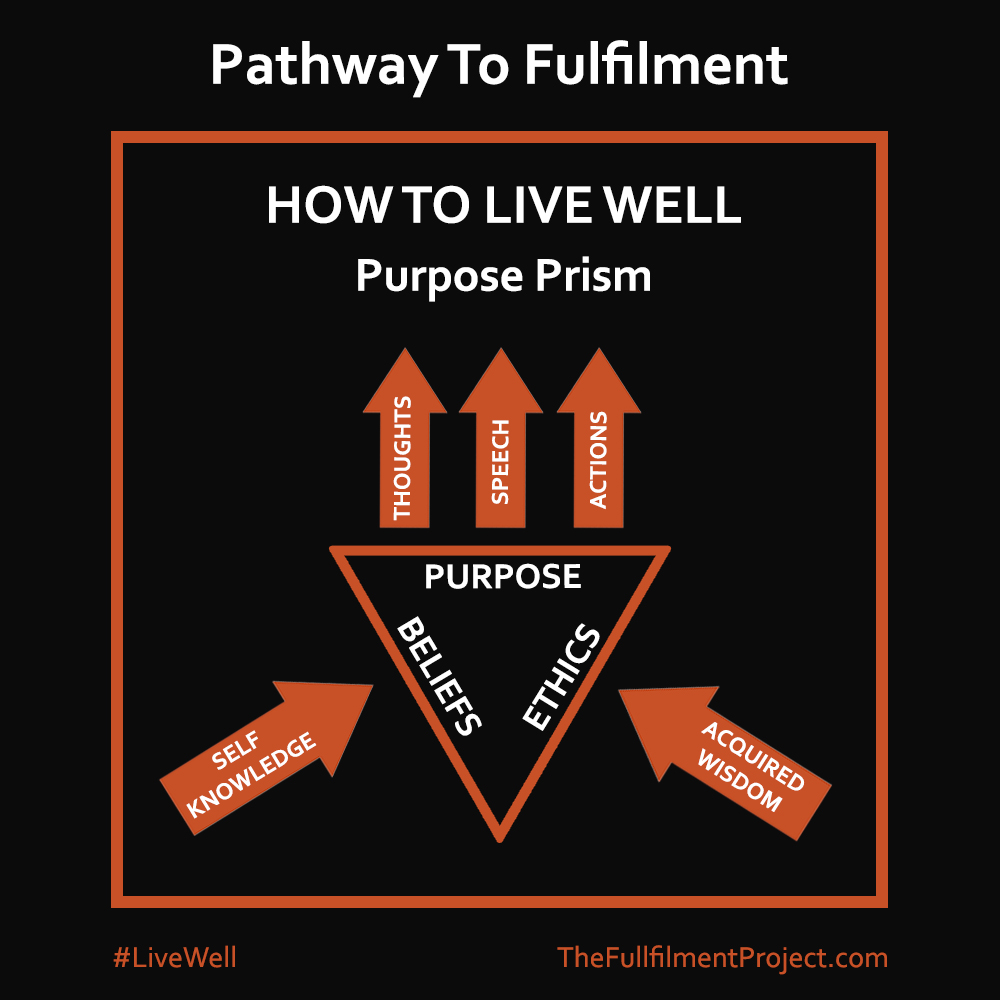
After working your way through this journey so far, you will have a solid foundation for how to start living your life better. From this knew understanding of yourself, your defined beliefs and ethics form part of what I call your Purpose Prism, the third piece of this prism being your purpose. You will go through a process of building on your beliefs and your ethics, weaving in Acquired Wisdom and Principles Of A Life Well Lived, and define your personal purpose. This prism is the filter through which you will see and experience the world, and it will influence your thoughts, speech and actions, making them wiser in nature. Your purpose comes from a vision of a better world that you want to help create.

Step 6: Living Your Purpose

You will then be set to start applying your beliefs, ethics and purpose to your life, to find your best way to live them out in your thoughts, speech and actions, to act on your vision of a better world through everything that you do. This is living your life on purpose. All of this work will mean that both happiness and success become personal, and therefore fulfilling, all three of which are bi-products of a life well lived. They then feed back into your self-knowledge, acquired wisdom, health, relationships and your beliefs, ethics and purpose, and on it goes, because this journey is a life long endeavour. Follow the path to fulfilment and live well my friends.