Gratitude For What We Can Give

“Remember this: Whoever sows sparingly will also reap sparingly, and whoever sows generously will also reap generously.”

Bible, 2 Corinthians 9; 6

Thanksgiving

I have been reflecting this past week on what it is that we can be grateful for, given that we, and so many others, have suffered under the pervasive effects of the Coronavirus pandemic. Primarily, this will be the good health of our family and friends, though we have been separated from them, in many cases. Traditionally, at this time of year we would bring in the crop and store it away for the Winter months, and we would give thanks for the harvest we have received. We would thank God for the blessings of nature and take pride in the work of the community to plant and tend and harvest the crops. It is a time of thanksgiving, as it is referred to across the pond in America.

I am also reminded that the turning of the seasons and the times of the year that certain plants grows and come to their fullest occurs without human involvement, but we have harnessed the cycles of nature to our advantage through farming year after year, working with nature to sustain our community, which is now a global community.

It has been an unusual year this year, to say the least, with many of us having to adjust to staying at home, working from home, and being away from our loved ones. It has tested us, individually and as communities. Many have stepped up and supported others in this time of crisis, with neighbours doing the weekly shop for those who have had to self-isolate,  activities have been set up using Zoom, and other online platforms, to allow us to connect, if only virtually, and many raising money and showing support for our incredible NHS, who have above and beyond the call of duty during this pandemic.

Generally speaking, we no longer have the need to plant, tend and harvest crops as a community, so much of our food is sourced from around the world, and we only need to buy the food we need from the supermarket or local shops. In that sense we are out of touch with nature, our lives are not so integrally connected to the ebb and flow of the seasons as they used to be. Our source of food is not dependent on us having worked to produce it, only having the money to pay for it.

Sharing What We Can

Something that has been difficult for some as their hours at work have been reduced or stopped all together, and many have been furl-owed, causing an uptake in those needing to access Food Banks. I recommend that when you are doing your shopping in the supermarket that you buy extra non-perishable goods and put them in the Food Bank baskets on your way out. We are in this together, and if we can share the food we can buy with those who cannot afford to, then we should. We are never a divided society, unless we choose to be, and the greatest we can be is when we take care of the least of us, so we may all thrive.

What has amazed me over these many months of the pandemic is the extraordinary generosity of spirit that has prevailed. The kindness and the love shown by people. There has been fear and confusion. There was panic buying and there was conspiracy theories, as there still are, there are some that like to see division in the world, because they can profit from it, but the vast majority of us have become our better selves, we have risen to the moment. And if we are talking about what we have been able to reap from this year, I think the community spiritedness of the many across the world is something to be extremely grateful for.

Harvest time is also a key time of the year, the changing of the season from Summer to Autumn. The apparent dying back of nature and the transition to the cold, dark and wet Winter months to come. For me it is a reminder that change is constant in our lives, but as Autumn always proves, the journey is beautiful. Even Winter has it’s own beauty, as do all the seasons.

The Cycles of Life

We can also think of our lives in seasons, as we often do, saying that someone is in their Autumn years, for example. What is interesting about this metaphor is that the seasons are cyclical, they go in a cycle, from Spring back around to Spring again, for millions of years, long before the Human species appeared on the Earth. Our lives, though appearing to be linear, have cycles within them. Our relationships begin and end and new ones begin, our careers often begin in one field and change to another, we have significant parts of our lives that teach us important life lessons, causing a wiser understanding and a new way of living. The Native American Indians see life as a circle. In the words of Black Elk, from the book Black Elk Speaks,

“You have noticed that everything an Indian does [is] in a circle, and that is because the Power of the World always works in circles, and everything tries to be round… …Everything the power of the world does is done in a circle. The sky is round and I have heard that the earth is round like a ball and so are all the stars. The wind, in its greatest power, whirls. Birds make their nests in circles, for theirs is the same religion as ours. The sun comes forth and goes down again in a circle. The moon does the same and both are round. Even the seasons form a great circle in their changing and always come back again to where they were.

The life of a man is a circle from childhood to childhood, and so it is in everything where power moves. Our teepees were round like the nests of birds, and these were always set in a circle, the nation’s hoop, a nest of many nests, where the Great Spirit meant for us to hatch our children.”

Native American Indians see their Elders as returning to a kind of childhood, with their wider vision and fewer boundaries on things. The wisdom of the Elders then being passed onto the younger members of their tribe. There is something to be learned from thinking of our lives as moving in circles, much like the metronome of the seasons, which pre-dates us and will continue to circle around long into the future, as the earth circles the Sun and the Moon circles our planet Earth.

Together Is Better

Much of what has helped us get through this pandemic thus far has been the wisdom of collective responsibility, the fact that the least of us is just as important as the rest of us. It has been revealed that those some saw as lesser, who work in customer services, have been essential in this pandemic, and that they always have been. Without them, how could we buy the food that we need. Also, those that have delivered what we have needed, food and other things. Many of these people that keep society working. All people should be given respect, compassion and empathy. A “thank you” and a “good afternoon” can raise the spirits of someone, especially during times such as these.

Along with collective responsibility, there is also the idea that sometimes we plant the seeds of trees in the knowledge that others will benefit from their shade. We sow the seeds knowing that the harvest will be enjoyed by others. Giving without expecting anything in return. A lesson we can take from this harvest time of year and the way many have risen up to help others during this pandemic. If we all thought in this way, relinquishing the need for our actions to have some self-interest, what a world it would be. This is the path of all spiritual seekers, the path of altruism.

Something to think about…

Think about what it is that you have been given, and what of that you can share with others.

Launching The Pathway To Fulfilment

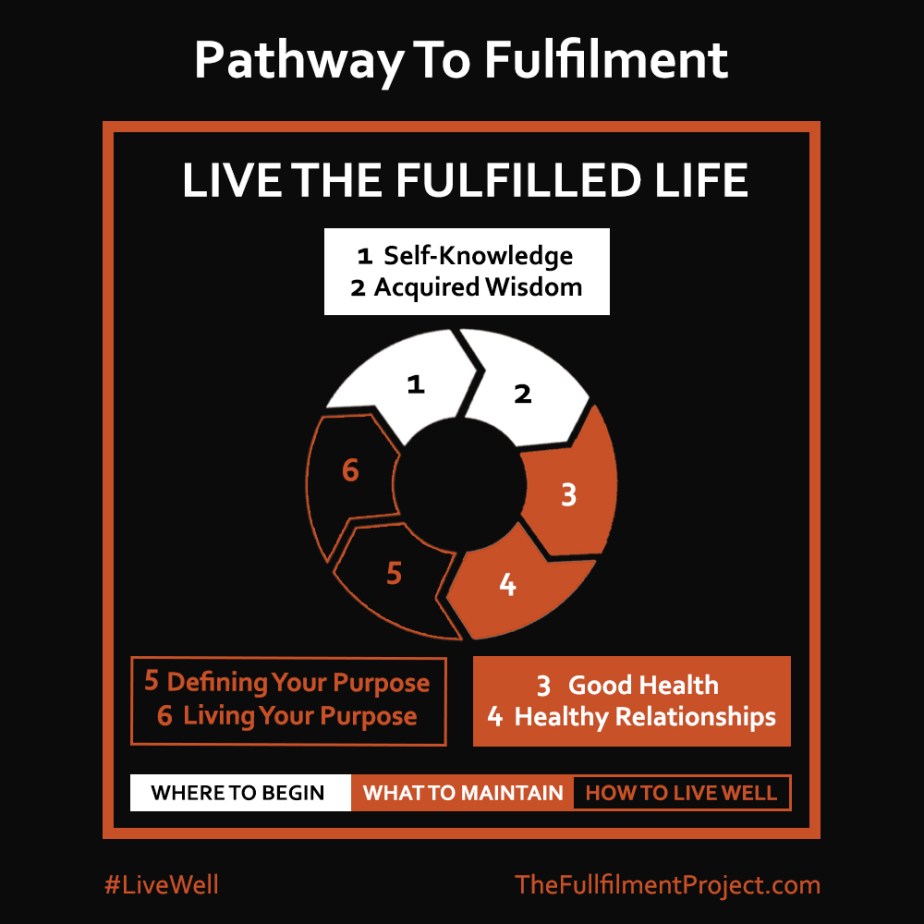
I have done some work on what I have so far called the Fullfilment Framework and renamed it the Pathway To Fulfilment, a more linear and simpler journey. My intention is to create a process by which people can start to live well, and therefore have fulfilment. This is not a life hack or magical cure for what ails you. It is a deeply personal journey of self-discovery, of life balancing and purpose finding. There are four steps of this process which are foundational to a life well lived, they are Self-Knowledge, Acquired Wisdom, Good Health and Healthy Relationships.

The Principles Of A Life Well Lived have been folded into the Acquired Wisdom. I have separated these foundational steps and the other steps of the Pathway To Fulfilment, six steps in total, into Where To Begin, What To Maintain and How To Live Well. Now that I have an outline of a process that I believe will bring about fulfilment in ones life, I aim to add in the detail of the activities and actions you will follow within each step of the journey towards fulfilment and a life well lived. Watch this space and the Facebook Group Community and on Instagram for up and coming updates. This new Pathway To Fullfilment can also be found on the page on this website of the same name.

WHERE TO BEGIN

Step 1: Self-Knowledge

The process begins with getting to know yourself more substantially than you may have before; figuring out what really makes you tick, what you believe and don’t believe, what you think is true and false, what you think is ethical and not ethical, etc. Also, what happiness and success look like to you, personally. It is broad and deep self-knowledge. This is your starting point.

Step 2: Acquired Wisdom

You acquire the wisdom of others, from a variety of sources, spiritual and secular; wisdom that will challenge you and enlighten you, as wisdom should. Often this is achieved by extensive reading, but, with the internet, a lot of this same wisdom can also be obtained through videos, audio books and pod-casts, however you learn best. This wisdom will feed into your self-knowledge, and influence how you see yourself and how you choose to live.

Connected to Acquired Wisdom are ten principles that I believe generate fulfilment, because they are wise principles that will help you navigate the world skilfully and live your life well. I have divided them into those that relate to Yourself and those that relate to Others. The principles related to Self are Growth, Equanimity, Fortitude, Seeking and Self-Competition, and those related to Others are Stewardship, Servant-hood, Reciprocity, Joy Making and Connection. I will be sharing more detail on these moving forward.

WHAT TO MAINTAIN

Step 3: Good Health

Your health should be of great concern, because good health is essential for your well-being and having an active, fulfilling life. I have included the usual physical health and mental and emotional health, and also energy health; all of which could be thought of as a triad of good health. Good physical health includes diet and exercise. Good mental and emotional health includes mastering your emotions and balancing your thoughts. Good energy health includes mastering the Chi (Qi) that flows through your energy system, like blood through your bloodstream, detailed in Traditional Chinese Medicine. To have good health you need to work on all three of these areas.

Step 4: Healthy Relationships

You look at your relationships, and identify those relationships that are good for you and those that are not, and those that are a mixture of the two, that need work to become good. You should continuously work towards all of your relationships being healthy ones; meaning that they bring you happiness rather than stress, they uplift you rather than bring you down. These relationships are in circles of community, which are relationships with yourself, your partner, your family, your friends, your colleagues and your acquaintances, and all are interconnected.

HOW TO LIVE WELL

Step 5: Defining Your Purpose

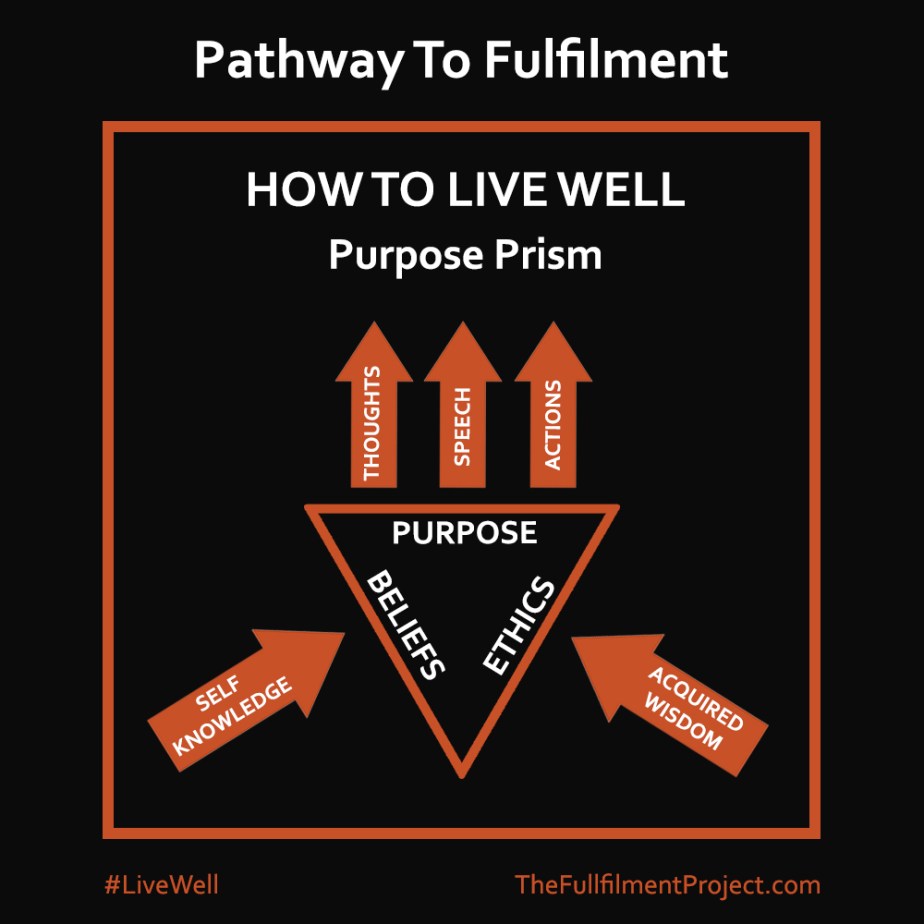
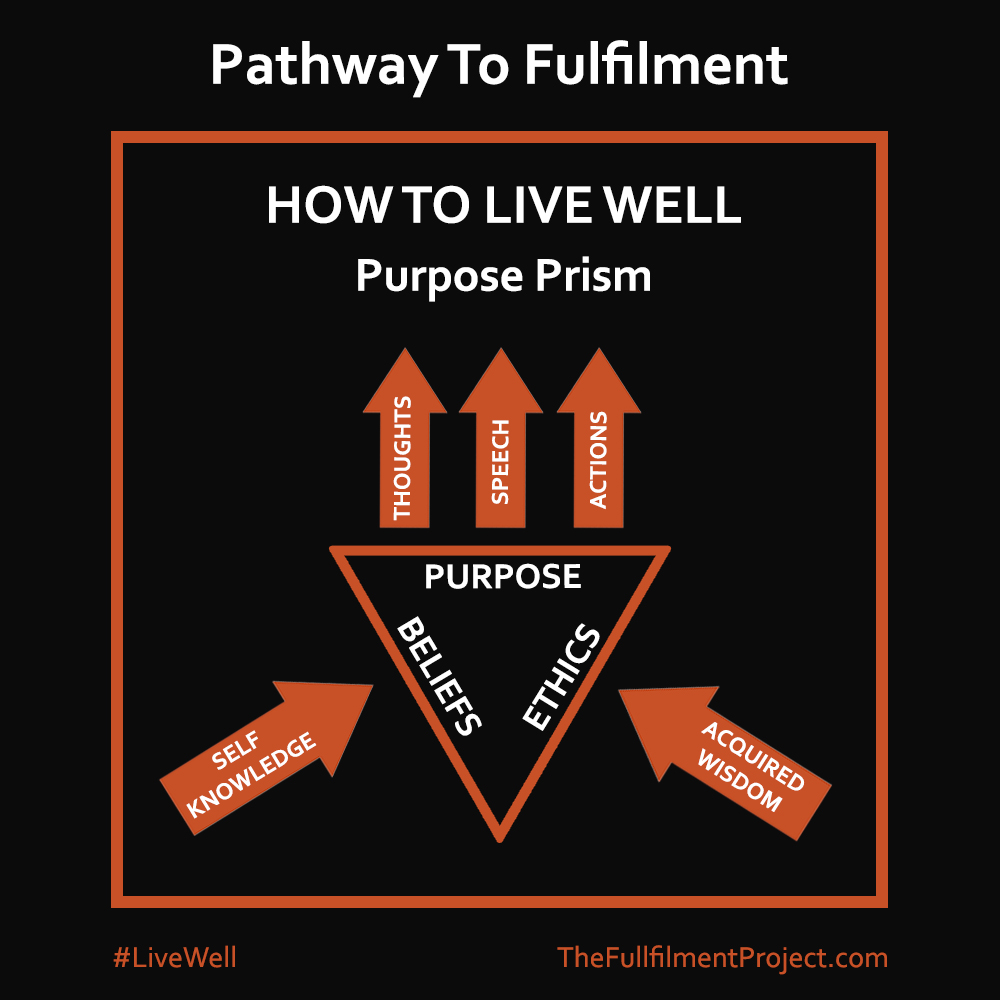
After working your way through this journey so far, you will have a solid foundation for how to start living your life better. From this knew understanding of yourself, your defined beliefs and ethics form part of what I call your Purpose Prism, the third piece of this prism being your purpose. You will go through a process of building on your beliefs and your ethics, weaving in Acquired Wisdom and Principles Of A Life Well Lived, and define your personal purpose. This prism is the filter through which you will see and experience the world, and it will influence your thoughts, speech and actions, making them wiser in nature. Your purpose comes from a vision of a better world that you want to help create.

Step 6: Living Your Purpose

You will then be set to start applying your beliefs, ethics and purpose to your life, to find your best way to live them out in your thoughts, speech and actions, to act on your vision of a better world through everything that you do. This is living your life on purpose. All of this work will mean that both happiness and success become personal, and therefore fulfilling, all three of which are bi-products of a life well lived. They then feed back into your self-knowledge, acquired wisdom, health, relationships and your beliefs, ethics and purpose, and on it goes, because this journey is a life long endeavour. Follow the path to fulfilment and live well my friends.