Making The Most Of 2021

“There is nothing magical about the flip of the calendar, but it represents a clean break, a new hope, and a blank canvas.”

― Jason Soroski

The year of 2020 will go down as possibly the worst year we have lived through, especially for those born after World War Two. The Coronavirus has ravaged our health services, our economies and our personal lives through loss and separation. The end of 2020 and the beginning of 2021 was an emotional one for many, as it means that even though we still need to remain vigilant around keeping ourselves and our loved ones safe, through social-distancing measures, 2020 is behind us.

In 2020, many of us had to adjust to living more solitary lives, with us not being able to mix with friends and family as we normally would, and many had to learn new skills around working from home. The term Key Worker took on new meanings, as supermarket assistants became essential to keeping us all going. Those on the front line in hospitals in our battle with this virus went through seemingly unending heartbreak with a kind of hardy stoicism that made them into superheroes in our eyes. The use of technology like Zoom became the way we remained connected to loved ones, to congregations from places of worship and to colleagues for team meetings, where we gathered remotely. Much of which we will be taking with us through to the coming year.

All of the normal things are true about starting a new year. The days will be getting longer and warmer, we get to set goals for the year ahead and there is a new beginning before us; we can rethink what we want out of life and we can reinvent ourselves to a degree. This is our moment to decide what we want our 2021 to be like. There will still be much that we cannot control, as is the nature of life, but if we accept what we cannot control we can put our focus and our energy into the things we can. The prime example of this is our attitude to the circumstances we are in. If we are working from home, we can see this as a barrier to team cohesion or we can see it as an opportunity to learn new skills and work in a more flexible manner to get our work done. If we have to use technology like Zoom to keep in touch we friends and family, we can learn new ways to connect and be grateful that this pandemic is happening now and not before the invention of the internet.

So, when it comes to setting goals for the coming year I would like you to consider that one of the reasons that new year’s resolutions tend not to work is that as we are resolving to make the changes for the year ahead, by default, we are not thinking of them as permanent changes, therefore we are often not 100% committed. Research on this tells us that even if we are 98% committed, we often do not follow through, because that 2% matters. Instead, if we see the new resolutions as life resolutions with 100% commitment, then the decision is made, it is done, and we do not need to deliberate it any more. We are all in on the new changes we are making.

The areas I recommend you look at making goals in are your health, your career, your relationships and in your self mastery. The last one is around developing a growth mindset, seeing confidence, optimism and resilience as skills to be developed. Also, to go all in on the project, the plans or the challenge you have been putting off. If we have learned anything from 2020 it is that life is precious and a long life is not a guarantee. So, let’s go and make 2021 an amazing year, full of ambitions achieved, kindness shared and joy generated.

How To Make The Best Out Of Life

“One way to get the most out of life is to look upon it as an adventure.” William Feather

How do we make the best out of our lives? This is an age-old question that has seen many different suggested ways of achieving it. I believe that we find this question so hard to answer because we have grown up in a world that favours things more than relationships. If there is a scale of what makes people happy, I believe there would be relationships at the happy end and things somewhere towards the other end of the scale. I’m not saying that things can’t make us feel good; buying a new car, a new piece of clothing or a new mobile phone can make us feel good, but this is not happiness. This is a good feeling created because our bodies release dopamine, a hormone released by the brain.

Whenever we achieve something or we get something we want, our brain releases dopamine to make us feel good. This is partly how our ancestors survived, because finding food or a mate felt good, making us want to do it more and more, it is a survival mechanism. There are many other hormones that our brains release in different situations, causing us to be in different states, whether we are anxious or angry, sad or hungry, the state we are in can dictate how we behave and what we do or say. What state we are in matters, and I believe that we can, to some degree, affect what state we are in, by choosing what we focus on and how we respond to the circumstances that we find ourselves in.

If we let our circumstances dictate our lives, we will be like a ship without a rudder or a sale, and we may be thrown against the rocks by our circumstances. To illustrate this, I have an extreme example of how some, even under the most horrendous circumstances, can choose how they respond to these said circumstances. Viktor Frankl, a Jew, who survived being an Auschwitz concentration camp inmate, imprisoned by the Nazis during World War Two, years later wrote the book Man’s Search For Meaning, a reflection on his time in the concentration camp. Viktor Frankl’s experience and his training as a neurologist and psychiatrist gave him a unique perspective on finding meaning in the worst of circumstances.

In this book he wrote “We who lived in the concentration camps can remember the men who walked through the huts comforting others, giving away their last piece of bread. They may have been few in number, but they offer sufficient proof that everything can be taken from a man but one thing: the last of the human freedoms — to choose one’s attitude in any given set of circumstances, to choose one’s own way.” This is an extreme example, as I have said, but I believe what was said in the quote applies to any human experience. Some circumstances will undoubtedly make it very difficult to “choose one’s attitude,” but I believe that this is the key to making the most out of our lives and how we can lead a happy life rather than the opposite. I know from personal experience that this is not easy, but with practice it is possible.

Another example from history is that of Nelson Mandela, who is famous for memorising the poem Invictus, which was read to you earlier, and how the poem helped him stand when all he wanted to do was lie down, during his time in prison. On the first day he arrived at the prison on Robben Island, that would become his home for the majority of his 27 years in prison, he insisted that the guards address him as Mr Mandela, he would not respond to anything else. In the end, the guards gave in and did so. Nelson Mandela chose his attitude to the circumstances and demanded to be treated as an equal. 27 years later, as he was released from prison, becoming a free man, he realised that if he continued to hate those who imprisoned him, he would never be free. He decided to forgive, and in doing so he lead the whole country as its President to peace through forgiveness.

Choosing one’s attitude to the circumstances we find ourselves in is a powerful way to get the most out of life, it puts us in the driving seat of our lives. It allows us to respond to circumstances rather than react to them. One way to do this, that I have found helps me, is to focus on being grateful for as many things as possible. Grateful for having a family, for having a home, for the air I breath, for the relationships I have, for the challenges that test my patience, for opportunities that life sends my way. It is very hard to be angry and grateful, or sad and grateful.

If you are lucky enough to be born in the western world you have effectively won the lottery. There are countries where the citizens do not have access to the Internet or the government controls the media they have access to and people can be executed for things we take for granted in our day to day lives. These are extreme examples but they are true. A large percentage of the world’s population live on less than £1 a day. In comparison, many of us live a dream life. So, perspective can be a great motivator to become more grateful, and gratitude is a powerful force that can bring happiness to your life.

Sometimes life can seem to give us challenge after challenge to the point where we struggle to keep ourselves going. The impact of the Coronavirus pandemic have brought us many struggles, financial and social, many have lost loved ones or have felt the difficulties of isolation, as we keep our distance from each other in order to keep each other safe. Sometimes life can seem out to break us, but what can keep us strong is the relationships we have. Our strength often comes from other people, others pick us up when we are knocked down by life and we pick up others in the same way. We all live in a community of human connections. We may sometimes feel that we have to go on alone, to stand strong by ourselves, but just asking for a little help can change our whole perspective on what is happening.

Sometimes, when life becomes hard, we can feel that we are not making any progress, we might be making little steps forward towards our goals, but because they are little steps they don’t feel significant. However, baby steps still count, as long as we are moving forward. When life is hard we can end up focusing on the negative, which does two things, it can make us feel miserable and it can mean we miss opportunities that come into our lives. This is when we need to consciously focus on the positive and to create an opportunity mindset, which everyday looks for opportunities. You may believe in God, you may believe in Karma, you may believe in luck, but if we don’t see the opportunities that come into our lives then we will miss out. This reminds me of a story I once heard about a flood that left a man stranded on the roof of his house, surrounded by water. A man came past the house in a small boat to help people to safety, but the man refused the help and said, “God will save me.” Then a helicopter came to pick him up and again he refused saying “Gods will save me.” Soon the water level rose above the house and the man drowned. When he went up to heaven he asked God “Why did you not save me?” and God said “I tried, I sent you a boat and I sent you a helicopter.” Sometimes we need to open our eyes to get the most out of life.

Some say that religion can help you live a good life, which I believe is partly true, it depends on how you apply the teachings of the religion. Most religions have good teachings, but like in the Biblical reading, if the teachings are taken to heart, they do form a strong foundation for our lives. The teachings of the world religions invariably preach forgiveness, gratitude and love, they promote the necessity of community and that we should be generous in spirit, these are the ways in which we can make the most out of our lives. We all know this, but we do not always put it into practice. I am guilty of this myself, as we all are, but if we try every day to be better than we were the day before, then we can make our lives a wondrous experience, full of hope and joy, of friendship and love. We can create a community that includes as many people as we choose to include.

Our lives are not just our place of worship community, our job community, our family and friends community, we often live at the intersection of the relationships we have with others, but this is not a bad thing. The best in life exists on the boarders of two neighbouring places, just look at the edges of jungles and open land, or where fresh water meets the sea. Life thrives in these places, and it is the same in our own lives. Our relationships are in a way the framework of our lives. Our beliefs are our foundation and both are needed to be strong enough to withstand the storms of life. Let us all strive to be grateful and generous, joyful and respectful, loving and open to new opportunities, and focused on building positive relationships with those in our lives.

How To Live Your Purpose

“If you have a strong purpose in life, you don’t have to be pushed. Your passion will drive you there.”
Roy T. Bennett

Starting With Your Why

The work of Simon Sinek has popularised the idea of having a Why with his book Start With Why: How Great Leaders Inspire Everyone To Take Action and his TED Talk How Great Leader Inspire Action. However, how can you use your Why to figure out what you should be doing in your life, your purpose?

As Simon Sinek rightly tells us, your Why is your origin story, it is the reason behind why you do the things you do. It is how you were raised, the early experiences you had and the decisions you made leading up to adulthood. In essence it is who we are. It is not always clear how to define your Why, but with self-reflection and self-observation you can find it.

Take me for example, I have a desire to figure out how to live life well and to share this with others. I have led worship in Unitarian churches for several years and worked in customer service and special needs education and started this blog without knowing my Why. It took the discovery of Simon Sinek’s book and some focused self-reflection to realise that my Why is to help others to live well, to find fulfilment. In all the areas of my life that I have mentioned I felt at home when helping others.

You might feel comfortable being a leader, being creative, working in a team or working alone. Whatever you do that makes you feel happy or content, these are clues as to your Why, because you feel good doing these things. Your Why is what defines you as a person. If you need guidance on finding your Why I recommend you read Simon Sinek’s book Find Your Why: A Practical Guide for Discovering Purpose for You and Your

Turning Your Why Into Your Purpose

Once you have defined your Why, you will be able to use it as a compass to direct you towards the things you should be doing. Ideally, your job should be aligned with your Why. In other words your work should make you feel happy, successful and fulfilled.

This is largely effected by the environment you work in, the leader(s) you have and the people you work with. But, if you know your Why then you can choose work that is aligned with it. Work that you can really get your teeth into and make a difference in the world.

At the moment, with the difficulties caused by the Coronavirus pandemic, we have to do the work that is available. As needs must we must go. However, if you are interviewing for a job it is a good opportunity to interview them at the same time.

Choosing The Right Work

A good question to ask interviewers is how they reward performance. If they reward good performance with bonuses, money incentives, for hitting the numbers they set, then the company values your output over you. If they reward good performance in a way that values you as an employee then the environment you would work in will be more fulfilling and you will feel looked after.

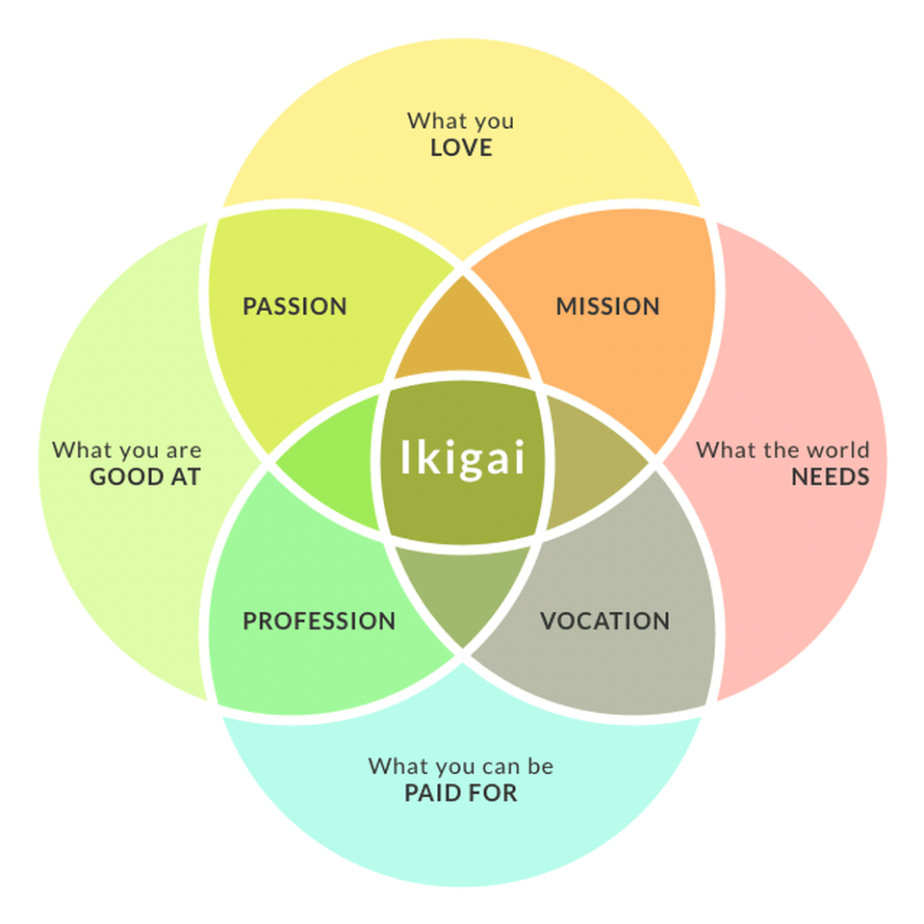
You should also look to work in roles that fit your Why, that align with who you are. The work we do in the world matters. If we are not doing what we are meant to be doing, then resentment and unfulfilment sets in. I recommend using the Ikigai method, where you look at What You Love, What You Are Good At, What You Can Get Paid For and What The World Needs. This will then reveal your Passion, Profession, Vocation and Mission. Knowing your Why will help you fill in these categories and find your Ikigai, your Purpose in life.

Conclusion

When we start with defining our Why we can start to figure out why we do what we do and then what we want to be doing in our life. Once we know our Why we can narrow down what we are meant to be doing, what our Purpose is. And when we live out our purpose, our work feels like a privilege.

Defining Your Purpose

Starting With Yourself

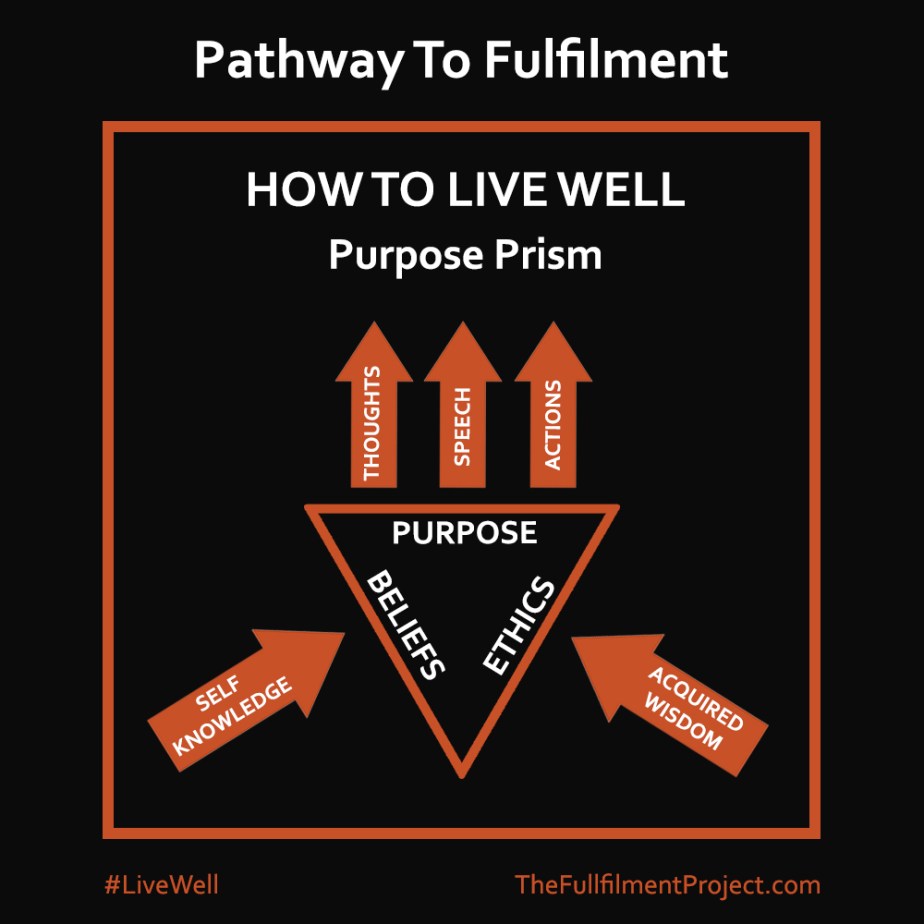
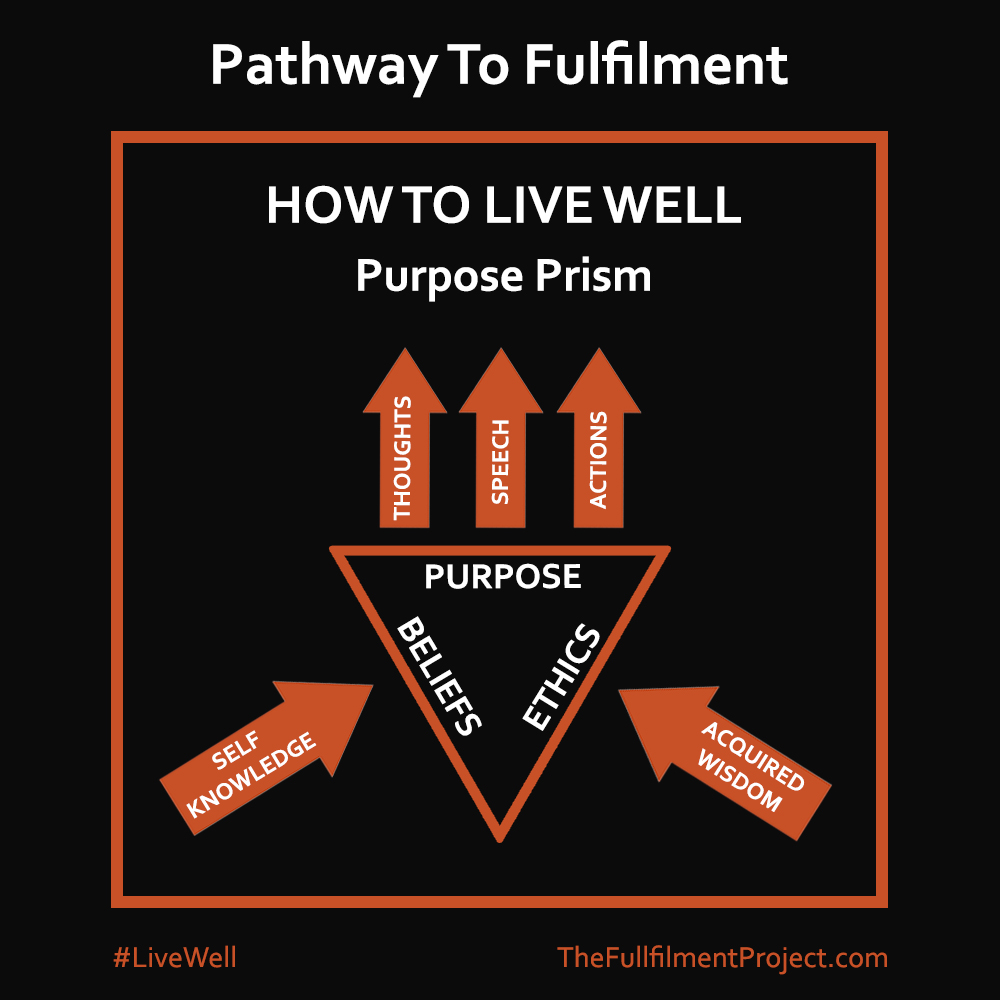
The Pathway To Fulfilment has the steps that it does because the end result are thoughts, speech and actions that are aligned with your purpose that you will define. They come from your Purpose Prism, which includes your beliefs, your ethics and your purpose.

You will have gained deep Self-Knowledge (Step 1), which is when you will define your beliefs and ethics, and you will have Acquired Wisdom (Step 2). A purpose can then be defined aligned with these elements from Step 1 and Step 2 that together will make your thoughts, speech and actions full of altruism and wisdom.

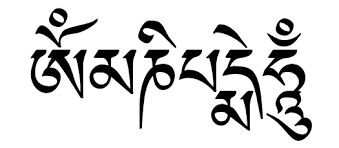
Om Mani Padme Hum

In regards to altruism and wisdom, there is a Buddhist mantra, Om Mani Padme Hum, which explains how, in Buddhist understanding, one reaches enlightenment. Om is made up of through sounds A – U – M. These represent thoughts, speech and actions, and once we are enlightened these are pure. Mani means Jewel, which represents altruism. Padme means Lotus, which represents wisdom. Hum is unity of both infinite altruism and infinite wisdom, both of which are needed to become enlightened, in Buddhist understanding.

The reason I am asking you to begin with self-knowledge, then to acquire wisdom, and to figure out your beliefs and your ethics, is so that your purpose will be imbued with both altruism and wisdom, and that your purpose becomes your unity, your Hum. Your thoughts, speech and actions dictate how your life will be, because whether your life is good or bad, enjoyable or not is firstly based on your thoughts, of how you see the world, and secondly the impact that your speech and actions have on those around you.

How We Walk Through The World

If we walk lightly through the world, trying to live in balance and to help others, then we will live a more fulfilling life. Also, in order for us to find a purpose in life, we need to know ourselves really well, to have gone deep into the parts of our minds that we often shy away from, but also to develop a wise understanding of how the world works and how we can have a positive impact on it.

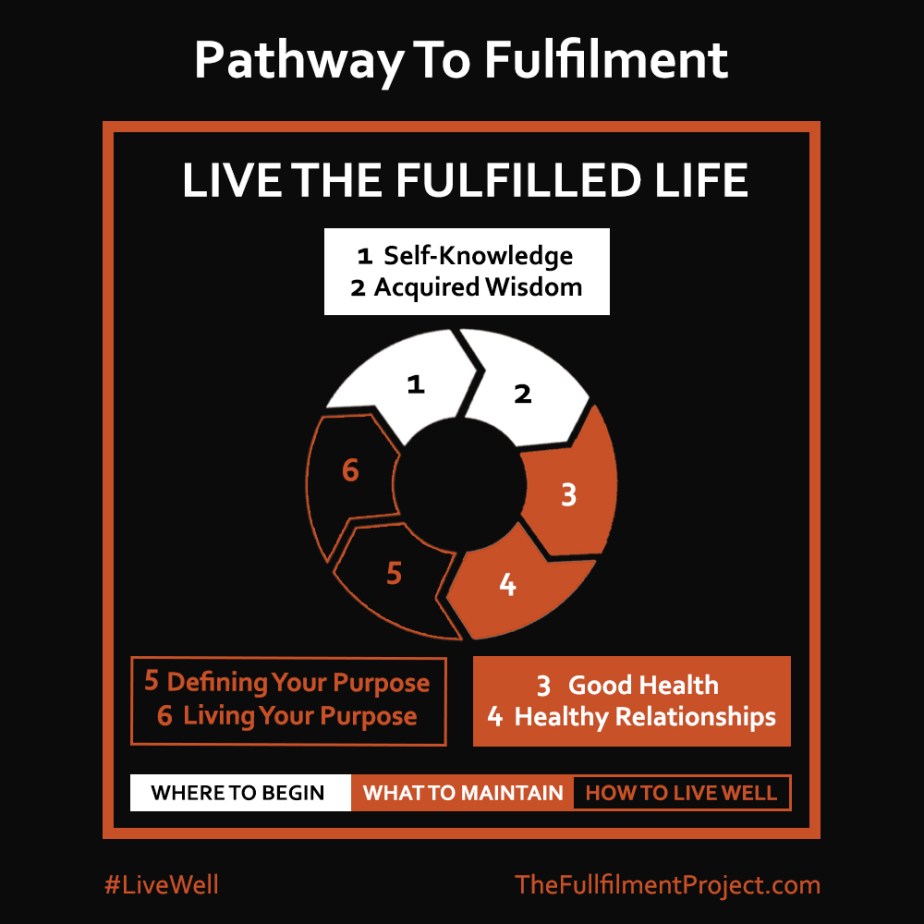
This is why Defining Your Purpose and Living Your Purpose are Steps 5 and 6. There is work you must do with yourself before a purpose can become clear. This work will not always be easy, but it is necessary, and I will be putting together a guide to help you along this Pathway to Fulfilment. It will take time to put together, as I want the pathway to be simple and the steps to be clearly defined, which means there is a lot to distill down into a clear and effective pathway. The outline of the pathway is set out below.

Something To Think About…

Think about how you currently live your life, how you treat others and how you earn a living. Are these ways that make you feel good? If not, what changes could you make?

Gratitude For What We Can Give

“Remember this: Whoever sows sparingly will also reap sparingly, and whoever sows generously will also reap generously.”

Bible, 2 Corinthians 9; 6

Thanksgiving

I have been reflecting this past week on what it is that we can be grateful for, given that we, and so many others, have suffered under the pervasive effects of the Coronavirus pandemic. Primarily, this will be the good health of our family and friends, though we have been separated from them, in many cases. Traditionally, at this time of year we would bring in the crop and store it away for the Winter months, and we would give thanks for the harvest we have received. We would thank God for the blessings of nature and take pride in the work of the community to plant and tend and harvest the crops. It is a time of thanksgiving, as it is referred to across the pond in America.

I am also reminded that the turning of the seasons and the times of the year that certain plants grows and come to their fullest occurs without human involvement, but we have harnessed the cycles of nature to our advantage through farming year after year, working with nature to sustain our community, which is now a global community.

It has been an unusual year this year, to say the least, with many of us having to adjust to staying at home, working from home, and being away from our loved ones. It has tested us, individually and as communities. Many have stepped up and supported others in this time of crisis, with neighbours doing the weekly shop for those who have had to self-isolate,  activities have been set up using Zoom, and other online platforms, to allow us to connect, if only virtually, and many raising money and showing support for our incredible NHS, who have above and beyond the call of duty during this pandemic.

Generally speaking, we no longer have the need to plant, tend and harvest crops as a community, so much of our food is sourced from around the world, and we only need to buy the food we need from the supermarket or local shops. In that sense we are out of touch with nature, our lives are not so integrally connected to the ebb and flow of the seasons as they used to be. Our source of food is not dependent on us having worked to produce it, only having the money to pay for it.

Sharing What We Can

Something that has been difficult for some as their hours at work have been reduced or stopped all together, and many have been furl-owed, causing an uptake in those needing to access Food Banks. I recommend that when you are doing your shopping in the supermarket that you buy extra non-perishable goods and put them in the Food Bank baskets on your way out. We are in this together, and if we can share the food we can buy with those who cannot afford to, then we should. We are never a divided society, unless we choose to be, and the greatest we can be is when we take care of the least of us, so we may all thrive.

What has amazed me over these many months of the pandemic is the extraordinary generosity of spirit that has prevailed. The kindness and the love shown by people. There has been fear and confusion. There was panic buying and there was conspiracy theories, as there still are, there are some that like to see division in the world, because they can profit from it, but the vast majority of us have become our better selves, we have risen to the moment. And if we are talking about what we have been able to reap from this year, I think the community spiritedness of the many across the world is something to be extremely grateful for.

Harvest time is also a key time of the year, the changing of the season from Summer to Autumn. The apparent dying back of nature and the transition to the cold, dark and wet Winter months to come. For me it is a reminder that change is constant in our lives, but as Autumn always proves, the journey is beautiful. Even Winter has it’s own beauty, as do all the seasons.

The Cycles of Life

We can also think of our lives in seasons, as we often do, saying that someone is in their Autumn years, for example. What is interesting about this metaphor is that the seasons are cyclical, they go in a cycle, from Spring back around to Spring again, for millions of years, long before the Human species appeared on the Earth. Our lives, though appearing to be linear, have cycles within them. Our relationships begin and end and new ones begin, our careers often begin in one field and change to another, we have significant parts of our lives that teach us important life lessons, causing a wiser understanding and a new way of living. The Native American Indians see life as a circle. In the words of Black Elk, from the book Black Elk Speaks,

“You have noticed that everything an Indian does [is] in a circle, and that is because the Power of the World always works in circles, and everything tries to be round… …Everything the power of the world does is done in a circle. The sky is round and I have heard that the earth is round like a ball and so are all the stars. The wind, in its greatest power, whirls. Birds make their nests in circles, for theirs is the same religion as ours. The sun comes forth and goes down again in a circle. The moon does the same and both are round. Even the seasons form a great circle in their changing and always come back again to where they were.

The life of a man is a circle from childhood to childhood, and so it is in everything where power moves. Our teepees were round like the nests of birds, and these were always set in a circle, the nation’s hoop, a nest of many nests, where the Great Spirit meant for us to hatch our children.”

Native American Indians see their Elders as returning to a kind of childhood, with their wider vision and fewer boundaries on things. The wisdom of the Elders then being passed onto the younger members of their tribe. There is something to be learned from thinking of our lives as moving in circles, much like the metronome of the seasons, which pre-dates us and will continue to circle around long into the future, as the earth circles the Sun and the Moon circles our planet Earth.

Together Is Better

Much of what has helped us get through this pandemic thus far has been the wisdom of collective responsibility, the fact that the least of us is just as important as the rest of us. It has been revealed that those some saw as lesser, who work in customer services, have been essential in this pandemic, and that they always have been. Without them, how could we buy the food that we need. Also, those that have delivered what we have needed, food and other things. Many of these people that keep society working. All people should be given respect, compassion and empathy. A “thank you” and a “good afternoon” can raise the spirits of someone, especially during times such as these.

Along with collective responsibility, there is also the idea that sometimes we plant the seeds of trees in the knowledge that others will benefit from their shade. We sow the seeds knowing that the harvest will be enjoyed by others. Giving without expecting anything in return. A lesson we can take from this harvest time of year and the way many have risen up to help others during this pandemic. If we all thought in this way, relinquishing the need for our actions to have some self-interest, what a world it would be. This is the path of all spiritual seekers, the path of altruism.

Something to think about…

Think about what it is that you have been given, and what of that you can share with others.
Launching The Pathway To Fulfilment

I have done some work on what I have so far called the Fullfilment Framework and renamed it the Pathway To Fulfilment, a more linear and simpler journey. My intention is to create a process by which people can start to live well, and therefore have fulfilment. This is not a life hack or magical cure for what ails you. It is a deeply personal journey of self-discovery, of life balancing and purpose finding. There are four steps of this process which are foundational to a life well lived, they are Self-Knowledge, Acquired Wisdom, Good Health and Healthy Relationships.

The Principles Of A Life Well Lived have been folded into the Acquired Wisdom. I have separated these foundational steps and the other steps of the Pathway To Fulfilment, six steps in total, into Where To Begin, What To Maintain and How To Live Well. Now that I have an outline of a process that I believe will bring about fulfilment in ones life, I aim to add in the detail of the activities and actions you will follow within each step of the journey towards fulfilment and a life well lived. Watch this space and the Facebook Group Community and on Instagram for up and coming updates. This new Pathway To Fullfilment can also be found on the page on this website of the same name.

WHERE TO BEGIN

Step 1: Self-Knowledge

The process begins with getting to know yourself more substantially than you may have before; figuring out what really makes you tick, what you believe and don’t believe, what you think is true and false, what you think is ethical and not ethical, etc. Also, what happiness and success look like to you, personally. It is broad and deep self-knowledge. This is your starting point.

Step 2: Acquired Wisdom

You acquire the wisdom of others, from a variety of sources, spiritual and secular; wisdom that will challenge you and enlighten you, as wisdom should. Often this is achieved by extensive reading, but, with the internet, a lot of this same wisdom can also be obtained through videos, audio books and pod-casts, however you learn best. This wisdom will feed into your self-knowledge, and influence how you see yourself and how you choose to live.

Connected to Acquired Wisdom are ten principles that I believe generate fulfilment, because they are wise principles that will help you navigate the world skilfully and live your life well. I have divided them into those that relate to Yourself and those that relate to Others. The principles related to Self are Growth, Equanimity, Fortitude, Seeking and Self-Competition, and those related to Others are Stewardship, Servant-hood, Reciprocity, Joy Making and Connection. I will be sharing more detail on these moving forward.

WHAT TO MAINTAIN

Step 3: Good Health

Your health should be of great concern, because good health is essential for your well-being and having an active, fulfilling life. I have included the usual physical health and mental and emotional health, and also energy health; all of which could be thought of as a triad of good health. Good physical health includes diet and exercise. Good mental and emotional health includes mastering your emotions and balancing your thoughts. Good energy health includes mastering the Chi (Qi) that flows through your energy system, like blood through your bloodstream, detailed in Traditional Chinese Medicine. To have good health you need to work on all three of these areas.

Step 4: Healthy Relationships

You look at your relationships, and identify those relationships that are good for you and those that are not, and those that are a mixture of the two, that need work to become good. You should continuously work towards all of your relationships being healthy ones; meaning that they bring you happiness rather than stress, they uplift you rather than bring you down. These relationships are in circles of community, which are relationships with yourself, your partner, your family, your friends, your colleagues and your acquaintances, and all are interconnected.

HOW TO LIVE WELL

Step 5: Defining Your Purpose

After working your way through this journey so far, you will have a solid foundation for how to start living your life better. From this knew understanding of yourself, your defined beliefs and ethics form part of what I call your Purpose Prism, the third piece of this prism being your purpose. You will go through a process of building on your beliefs and your ethics, weaving in Acquired Wisdom and Principles Of A Life Well Lived, and define your personal purpose. This prism is the filter through which you will see and experience the world, and it will influence your thoughts, speech and actions, making them wiser in nature. Your purpose comes from a vision of a better world that you want to help create.

Step 6: Living Your Purpose

You will then be set to start applying your beliefs, ethics and purpose to your life, to find your best way to live them out in your thoughts, speech and actions, to act on your vision of a better world through everything that you do. This is living your life on purpose. All of this work will mean that both happiness and success become personal, and therefore fulfilling, all three of which are bi-products of a life well lived. They then feed back into your self-knowledge, acquired wisdom, health, relationships and your beliefs, ethics and purpose, and on it goes, because this journey is a life long endeavour. Follow the path to fulfilment and live well my friends.