Thoughts On Change

I wear prayer beads which are made from black volcanic rock. They remind me that even rock can become liquid, given the right circumstances. The lessons I take from these prayer beads are fourfold.

Firstly, change effects everything. You cannot step into the same river twice, because the water is different. Secondly, like the river and volcanic lava, circumstances dictate a lot of what happens, but flowing with change allows new opportunities. Thirdly, the essence of what makes the volcanic rock, has remained, from lava to rock to prayer beads. Fourthly, whether the rock is lava, rock or prayer beads, like all things, it still has purpose. Every atom has a purpose, every person has a purpose, every living being on this interconnected, living, breathing planet of ours has a purpose.

These thoughts remind me of a poem I wrote. Here it is:

Finding Contentment

“Be thankful for what you have; you’ll end up having more. If you concentrate on what you don’t have, you will never, ever have enough”
― Oprah Winfrey

When thinking about contentment and what to talk about in this blog post I thought about what makes me content. I thought about my wife and daughters, the books that I read, how I feel when I am painting pictures, and then I started thinking about things that make me laugh, things that make me smile. Contentment, as a subject, is a big subject to tackle in something as short as a blog post, but I thought that it was also an important subject to talk about too, especially after the stresses and changes, the grief and the trauma that we have had to deal with over the past 18 months.

So, what then can be the solution to the age-old problem of how to be content? If we are all different people then how can there be one answer to this problem? Many different people have tried to come up with an answer, each with a different perspective on the issue, often driven by their theological or philosophical beliefs. Some we know to be powerful spiritual figures such as the Buddha and Jesus, others were, and are, just philosophers trying to answer the question of how to be content. The rest of us, generally, just try to make the best of things. With all of the difficulties we each face in our lives it is hard to find the time to philosophise about the ways and means of finding contentment. For the majority of us we spend our days working hard to have money to pay the bills and the rent, or mortgage, hoping to have a little left over at the end of the month to treat ourselves, and the ones we love.

Yet, somewhere in the busyness that is our lives we do find some time to set aside to enjoy ourselves, whether it be spending time with the kids, going for a drink with friends, a walk in the woods or just staying in to watch something on the TV, we all do somehow manage to find time to enjoy ourselves a little. This time spent relaxing and enjoying ourselves is greatly necessary for us to go on functioning in the jobs that we do and the responsibilities that we have, we need to laugh and play and get back to the things which make us who we individually are. But is this contentment or is it just making the best of things?

I would say that we can find moments of contentment in these periods of relaxation and enjoyment. We have all, I think, or at least I hope, had moments when we’ve paused and thought ‘my life is good right now, the good things outweigh the bad things and I am happy.’ An attitude of enjoying the small thing in life can be a useful attitude to have, as it helps us deal with the big problems we all face. The old saying ‘The best things in life are free’ is in a similar vein, and is good advice, often given by parents, or grandparents, to children who want things that are expensive and well advertised on the TV.

That being said, contentment can seem a complicated or difficult state of mind to achieve. But perhaps it isn’t contentment that is complicated but ourselves. Perhaps it is our own complications that can make it so difficult for us to achieve contentment, consistently. We have many thoughts running through our minds each day, as well as many emotions, either flaring up, such as anger, or lingering, such as sadness. There is a constant flow of both thoughts and emotions, almost like a river, which swells and runs dry over and over. With such turbulent minds it is no wonder that we find it difficult to settle and be content.

People also deal with things differently. In any situation there are those who are totally emotionally involved, and as a result their emotions jump up and down with the ups and downs of life. Others do not engage their emotions very much at all, and so are quite detached from any ups and downs that life throws at them. We all know people that fit either of these types of behaviour, and we know people who are both negative about life and those who are positive. I can be beneficial to think about how positive or negative we are to life’s us and downs. 

How we feel about our lives is often caused by our reactions to the events within it. Our reactions to the events of life are the responses that our brains throw up almost without us thinking about it, they are habits that we have formed over our whole lifetime. For example, if we disagree with something do we get angry very quickly and say the first thing that comes to mind, while we are angry, or do we take time to create a considered argument to explain how and why we disagree. If something bad happens to us do we react emotionally, getting angry or upset about our favourite cup getting broken or missing the bus to work, or do we think that the cup was only a thing and can be replaced and even though we missed our bus there will be another one along soon?

Things are only good or bad depending on how we see them. Roger Walsh M.D., Ph.D. put it well when he wrote “We do not see things only as they are, but also as we are.” If you think about that for a moment it is actually quite profound. This is only a quotation, but if you think about it in a wider context you could say that everything we see, or even experience, is coloured by the way we are at the time, how we are feeling, if we are tired, if we are in a rush or taking our time. This might be an obvious point that I am making but it is something we often forget when we are reacting to things that happen to us, because we are reacting. But if we remember that what we are experiencing from moment to moment is affected by how we are in those moments then we have a better chance of dealing well with the ups and downs of life, and I would say a better chance of being content as well. This is consciously choosing to be in a beautiful state, not an angry state or a stressed state, but a beautiful one.

Talking of beautiful states, the Euros 2020 final was a big moment in my home country’s footballing history, where England made it to the final of the Euros, something many football fans thought would never happen. Prior to the result of the match, the mood of the nation had been lifted, whether you enjoy football or not, the positivity has been infectious and we have been living in a happier state, generally, until of course we lost in penalties again. But we must remember that both Italy, who we faced in the final, and England have had a really difficult time during the pandemic and the joy we felt in both of our nations up to the final, and more so for Italy now, mark a new chapter in our national stories, it is a great contrast to the suffering we have had. The deeper the turmoil the higher the joy and the better we can choose to live; this is also true even when our football team does not win. And with the Olympics starting in Tokyo I hope each nations spirits will be lifts as they follow their athletes who are competing.

In order to be more content it is perhaps better to act instead of react, by which I mean taking control of the moments before we react so that we can make better decisions in what we say and what we do, in response to any situation. There is a Buddhist Mindfulness practice called the Three Minute Breathing Space to be used when we feel angry or stressed about something. The practice consists of stopping what you are doing and taking some slow and deep breathes for three minutes, or less if you like. It is a quick time out from the stresses of life, which can help enormously if you live particularly stressful lives. Practices like this can reduce stress and give us the presence of mind to avoid reacting to situations without thinking about what we intend to say or do in response to them.

We all have ways that help us de-stress, ways that we have developed through out our lives, hobbies that we have chosen to do, activities that are part of our daily routine, which are enjoyable and fun. But, these things are rarely structured activities as part of a path to find contentment, they are the things that make life enjoyable and fun, when it can be. There is nothing wrong with making the best out of life and enjoying it as much as possible. In many ways I would say that this is a road to contentment itself, but for those that want a more structured approach to finding contentment there is religion or a spiritual path. Here are some words on contentment from the some of the great religions of the world.

The Buddha said: ‘Contentment is the highest wealth.’ (Dhp.204), meaning that when we are content we do not need to get anything, go anywhere or be anything to be happy because we already are, and thus, contentment is more valuable than any possession or accomplishment. The Buddha describes the monk’s contentment like this: ‘He is satisfied with a robe to cover his body and alms food to satisfy his stomach and having accepted no more than is sufficient he goes his way, just as a bird flies here and there taking with it no more than its wings.’(D.I,71).

In the Bible, in the book of Timothy 6:verse 6-8 it says:

“Now there is great gain in godliness with contentment, for we brought nothing into the world, and we cannot take anything out of the world. But if we have food and clothing, with these we will be content.”

In Yoga, in the Hindu tradition, there are the Niyamas, ten ethical guidelines, which are the foundation of skillful living, or living in a morally good way. The second Niyama is called Santosha, or Contentment, and the expectation is this:

Nurture contentment, seeking joy and serenity in life. Be happy, smile and uplift others. Live in constant gratitude for your health, your friends and your belongings, Don’t complain about what you don’t possess. Identify with the eternal You, rather than mind, body or emotions. Keep the mountaintop view that life is an opportunity for spiritual progress. Live in the eternal now.

This is all good advice, and it makes it clear to me that on the road to contentment a spiritual path can be beneficial, because we are given advice on how to live in order to be content. There is a direct relationship between the directions given and the attainment of contentment, as many who have followed spiritual paths have stated in the past.

But what about those of us who are making the best of things, those of us that have busy lives spent doing what we can to provide for our families and ourselves, and follow our own spiritual paths when we can. Life can be difficult, and keeping a calm perspective on things when life doesn’t always go to plan is not an easy thing to do. I recommend using the wisdom of the many religions of the world, and the wisdom of those around us, our friends and family as well, they are our helpers, they sustain us as we sustain them. Our paths through life are also greatly helped by the enjoyment of life itself, our pleasure in the small things, and not wanting more than the world has allowed us to have. I believe it is a blessing to be alive at all, everything else is a bonus.
How to find fulfilment

“Your soul is the power and

core of who you are.

Feed it well.”

– Anonymous


Recently I have been reflecting a lot on what is meant by fulfilment, whether it is selfish or generous to seek it. How it is that we might find fulfilment and what it actually is. As human beings, we are all unique in our likes and dislikes, our personality and our passions, our behaviours and our tendencies. So, it makes sense that fulfilment would be an individual attainment, it would not be the same for everyone.

cropped-the-fullfilment-project-logo-profile-pic-black-white-red-v32.jpg

Since February last year I have been writing this blog about fulfilment, which I call The Fullfilment Project, with Fulfilment spelt with ‘FULL’ at the beginning, to signify a full life. I have been exploring happiness and success and what they mean in relation to fulfilment and I have come to believe that for fulfilment to occur we need to have both happiness and success, which to some degree is obvious. However, many who are looking for either happiness or success, I believe, focus on unfulfilling goals, as they are misguided by our culture and unhelpful beliefs. I am not now or have I previously claimed to have figured out the way to find fulfilment, I am an explorer looking for answers by asking questions and diving into hypotheses, and I have found some conclusions along the way, which I would like to share with you in this blog post.

I have created what I call a Fullfilment Framework, pieces of the puzzle of how to live a fulfilling life. These are drawn from personal experience and meditations, as well as seeking wisdom from both secular and religious sources. Wisdom comes in many forms, but it is still wisdom. In order to live a fulfilling life, I believe we need to begin with a good foundation, which is the core of a life well lived. There are three things I think we need in our fulfilment foundation.

Firstly, we need good self-knowledge, a deep understanding of ourselves, through self-reflection, knowing our values and beliefs and being tested in difficult situations and seeing how we deal with them. Secondly, we need acquired wisdom. Self-knowledge is not enough to guide us on a fruitful path, we also need to be steeped in wisdom, from secular, philosophical and religious sources. Thirdly, we need what I call the Good Health Triad. This is focusing on building for ourselves good mental health, good physical health and good energy or Chi health. Chi is an Eastern word for the life energy that flows within us and to have good health we need good Chi. All of these things we cannot do alone, we need friendships, companionship, and sometimes professional support, we need to learn good dietary and exercise habits and ways to boost and maintain our chi, all of which are good things.

From this Foundation comes our values and beliefs, which are like a prism through which we see the world, through which we think, speak and act in the world. The next level of finding fulfilment, I think, is to find out our ‘why’, our reason for doing all that we do. It is the purpose that guides us, distilled from our values and beliefs, from our self-knowledge and acquired wisdom. It can be difficult to figure out our ‘why’ with clarity. Often, we borrow from quotations or religious and philosophical ideas. I attend a Unitarian church, which was built on the idea that each individual person has a right to explore their own theology, to search for their spiritual truth rather than be told what The Truth is. All Unitarians connect with that, which is why they gather together and attend a Unitarian church. However, for each of them this may not be their personal ‘why’, because everyone is an individual, with different histories, experiences, values and beliefs. This is why I believe it is so important for each of us to search for what we believe our purpose to be in this life. It should be our North Star that guides us through both the calm and the troubled waters of life.

“…our North Star that guides us through both

the calm and the troubled waters of life.”


Simon Sinek-Start With WhyThen, when we discover our ‘Why’ we must discover how we are going to bring this ‘Why’ to life in our day to day lives. This is what I call our ‘Way’. In his book, Start With Why, Simon Sinek sets out the importance of finding your ‘why’ in order to live a purposeful life. He talks about how companies also need to clearly define their ‘why’, companies such as Apple have a clearly defined Why, to empower the individual against the big system. He also gives individual examples of Martin Luther King Junior who gave the “I have a dream” speech, not the “I have a plan speech”, as Simon Sinek puts it, and the Wright Brothers, who figured out powered manned flight for the first time, working out of their bicycle shop, with the intention of changing the world with their invention.
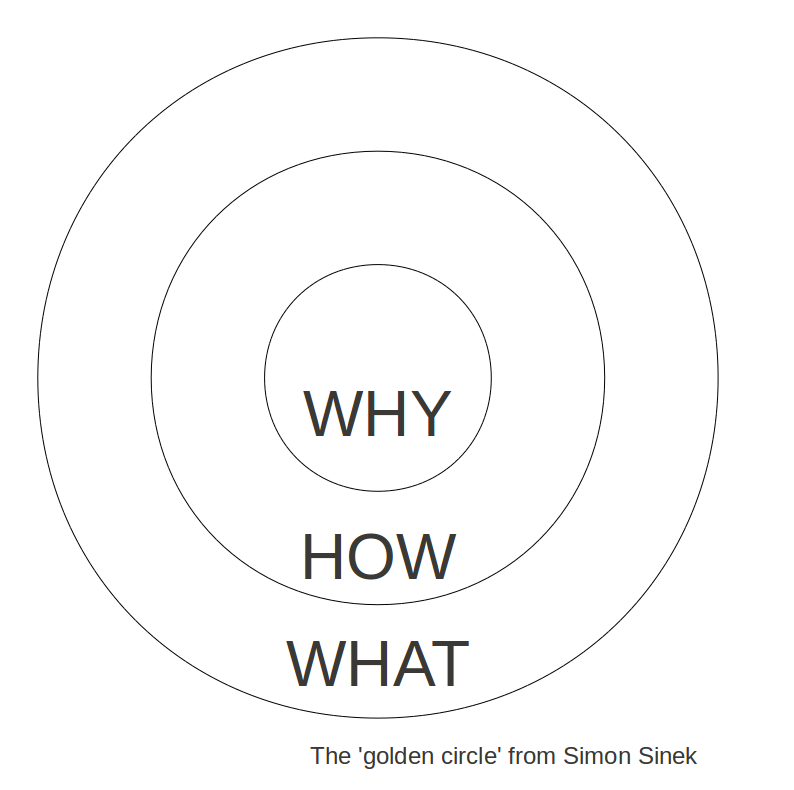
Simon Sinek says that we need to have clarity of our why first, then we can work outGolden_circle ‘how’ we express this why and then finally ‘what’ we do to prove the why we have. He calls this the Golden Circle, in the centre is the Why, then next the How and on the outside of the circle is the What, and it looks a bit like a bullseye. The important point here is that our human brains work from the why to the what when making decisions. The part of the brain that is responsible for decision making and our feelings like trust and loyalty is the Limbic Brain, which has no capacity for language. This is why we more easily agree with things that match our values and beliefs, not the details and the factual information.
My personal exploration of fulfilment has led me to a phrase that has hit home for me. The phrase is “To help others find fulfilment is to fulfil what it means to be human.” When this phrase first popped into my head I dismissed it as flippant and without substance, but through further reflection and meditation on this I have come to think that it has a certain depth to it that I did not initially appreciate.

“To help others find fulfilment is to

fulfil what it means to be human.”

On an evolutionary level we have evolved to be social animals, and during caveman times there would have been some in the group hunting and gathering food while others in the group would perform other functions for the survival of the collective whole. We evolved to have what Simon Sinek describes as a circle of safety, that everyone in the tribe made sure that they were all protected from the dangers outside of the tribe, whether this be the weather, dangerous animals or the scarce food and resources. It is hard-wired into our DNA to uplift those in our tribe, whether this is our family, our team or our congregation.

To encourage us to behave in a way that supports the tribe, evolution gave us some hormones that control certain behaviours. Our bodies produce Dopamine when we make achievements, it is an incentive to progress and we get a hit of Dopamine whenever we hit a milestone or tick something off our to-do list. Our bodies produce Serotonin when we perceive that others like or respect us. Our bodies produce Oxytocin when we are with our closest friends or trusted colleagues, it is the feeling of friendship, love and deep trust. All of which feel good.

The point I am making is that we have evolved to have hormones that actively encourage us to build meaningful, deep relationships, to strive for progress and try and get the affection and respect of those we care about. In other words, to feel happy and successful, on a biological level, we need other people. We need friends and family, loved ones and people we love. These relationships are key to living a fulfilling life. There is a problem though when we actively look to get these feelings that come from these hormones in unhelpful ways. For example, when we use social media and we get a like or a notification we get a hit of Dopamine, which feels really good, so we do it more, effectively replacing people with a device.

Life is beter in flip flopsAdvertising companies tell us that we will become either happy or successful if we buy their product or service, only to be told a few months down the line that a new product or service will do the same, but neither a product or a service will make us happy, as they are invariably transient, they change or break and the happiness promised is really only excitement and joy. We are often told that the measure of success is the amount of money we have or the amount of things we own, but it really does depend on how we measure success, as individuals.


I believe that success is very much intertwined with happiness and that you cannot have one without the other. As human beings we are hardwired to strive after progress, but if we are deeply unhappy or depressed, progress is not a clear focus for us. So, you could say that we need to be happy to succeed and we need to succeed to be happy, but the success really does need to be in an area that we passionately care about, something that is in line with our values and beliefs, in line with our ‘why.’ Which is why it is so important to figure out what our ‘why’ is.

Many religious scriptures tell us that in order to be happy we must first help others be happy. I think this is partly because we are hard-wired with our hormones to feel good when we help others to be happy in their lives. Their smile makes us smile, especially if we are the cause of it. However, this comes with a warning, we must ensure that we take care of ourselves as well. If we are not careful we can spend all of our time making sure everyone else is OK and we do not look after ourselves. A balance is needed, which is why we need a good fulfilment foundation.

When it comes to success, achieving success with others feels more magnified than a solo achievement. Even athletes who take part in sports events individually could not achieve success without a coach and their loved ones supporting them. When we focus on goals that are innately selfish, like earning a large amount of money, we often sacrifice our relationships to earn the money, which is an empty success when achieved, because it brings very little happiness. But if we do it with the motivation to help others we feel great happiness when we succeed, because of the positive effect we have on others.

I am now a firm believer that both happiness and success are reciprocal, in that they are received, in part, when we give them to others. And as fulfilment is largely dependent on both happiness and success, fulfilment is reciprocal as well, but it is not something that we can go out and find, like a treasure hunt, fulfilment is a sense of being that comes from living life well, through positive relationships, a good understanding of ourselves, the wisdom of others, good health, and living in a way that brings more joy, love and peace into the world than their opposites. To help others find fulfilment is to fulfil what it means to be human.


Something to reflect on:

Whether you believe that we only get one life or not, to live deeply is to live well. cultivate positive relationships, help others when you can and strive to be your best self, so you can help other to do the same. This is a worthy goal and we need a worthy goal to live a fulfilling life.

Stepping into the unknown

“Until you step into the unknown,

you don’t know what you’re made of.”

― Roy T. Bennett


Making choices

In life there are many avenues to go down, many paths to take, or not as the case may be. Some of these paths lead to dead ends and some to wonderful opportunities. The challenge we have is that we never know beforehand, for certain, if making a particular choice will bring a positive outcome or not. Each time we are stepping into the unknown. We can, however, as the saying goes, learn from our mistakes and use our experience to weigh up the options and make a decision. Some say we should go with our gut, with what feels right, but if this is not tempered with wisdom and experience then we will only be following our instincts, which are primed for survival, not necessarily leading a fulfilling life.


The unknown could be a new job, a new relationship, trying a new hobby or something that changes lots of things in our lives like moving to another town or city. We make these sorts of changes every day, but they still come with uncertainty and some anxiety. Each new change begins with a decision and leads to more decisions along the way. I would argue that no approach to making decisions is the best or the worst, as we each live individual lives and we are all individual people, but there are some things that can help when we are stepping into the unknown, which I will come onto in a moment.


Why do we step into the unknown?

However, first of all I would like to explore why we might feel the need to step into the unknown. It has long been part of the human spirit to push beyond our boundaries into uncharted territories. Human history is full of examples of men and women that have strived beyond the boundaries of their day to create new innovations and break records, whether this is manned powered flight or reaching the South Pole on foot.


For most of us such challenging goals are not things that we aim to do, partly because we are interested in other things and partly because we have commitments in our lives that need our attention and focus. That being said, we all have things that we are passionate about, things that we would happily do for free if time and circumstances permitted. This is the unknown territory that I want to talk about today, the venturing into the things that we are passionate about. Often, we don’t jump into our passions because we have responsibilities that we feel we must commit to or we lack the confidence to do so.


“…the past does not equal the future.”


More often than not we do not follow our passions because we have had bad experiences trying new things in the past and we think that the same thing will happen again. There is an important principle connected to this that I have recently being trying to apply in my life, which is that the past does not equal the future. A lot of people, including myself, are held back by failure, because based on past experience we expect to fail again. The problem is that we see failure as a negative thing because of our past experiences. If we accept that we will fail sometimes then we can employ all of the resources that we have to make it work and to succeed.


Not everything is instantly obtainable

We also live in a time when almost everything is instant. Whatever it is you want to buy, often there is an option to have it delivered the same day. We can do our banking on our mobile phones, we can send an email to someone and they will receive it a few seconds later, no matter where in the world they are. Innovation has made our lives a lot more convenient, but not easier. This is because we expect everything to be instant, but many of the important things in life take time and effort. For example, relationships take time and effort to become strong and durable through the ups and downs of life. It is the little moments of asking how someone’s day is going and caring about the answer, of engaging in small talk in the moments between doing other things. These things help to build strong, healthy relationships.


Too often we are spending time with people without spending time with them. I’ve seen couples in restaurants where they are both on their mobile phones and not looking at or communicating with the person they came to the restaurant with. It has become an accepted thing to do to scroll through our Facebook feed instead of making a connection with the person we are with. This has had a knock-on effect that means young people are finding it difficult to build relationships, because the social skills that are normally built up through trial and error as a child cannot be practiced if they are looking at a screen and not a person.


Failure also seems all the more magnified because if we expect something to be instantly successful, and we fall at the first hurdle, we give up. We are becoming conditioned for insecurity when we should be conditioned to fail our way to success. I guarantee that every successful person who is famous for their success has failed more times than most other people have. It is not about how many times you get knocked down, it is about how many times you keep getting up. Having this sort of mentality will enable us to stride forth into the unknown with the confidence to fail and try again.


For this to work, however, we need to have the right motivation. Wanting to be successful so that we can be rich is a motivation, but it will inevitably lead to an emptiness, because you cannot buy happiness. If, on the other hand, we want to be successful so that we can help more people live better lives, then fulfilment will be our reward. Motivation is key and it has to fit with our values and beliefs, this above all else is important, because to live a fulfilling life our thoughts, speech and actions should reflect what we value and what we believe.


Wisdom guides us

But where do our beliefs and values come from? They are manifestations from the culture and community we grow up in, the examples our parents give us and how they raised us, as well as the experiences that we have had. Through all of this input we piece together what we believe and what we value. All of this then effects the decisions that we make on a day to day basis, but I believe that if we are to make wise decisions in life then we should seek out wisdom, which can be found in any of the many religious scriptures, philosophical and secular texts from around the world. If we have wise guidelines or principles to follow, then stepping into the unknown will seem less scary. I suggest firstly analysing what is holding you back from stepping into the unknown and try to overcome it, through seeking wisdom and figuring out your beliefs and values. These things will guide you on your path. It helps to accept whatever is in front of you on your path and then figure out how to deal with it.


Something to reflect on:

Often what is holding us back is our own misguided beliefs and the baggage we carry from past experiences. Holding on to bad experiences weighs us down. Once we let them go we are more free to move forwards. This is not easy but essential if we are to live a fulfilling life.

Poem: I Am Here

The earth spins on its axis creating this day,
And every other day and night since
before life blossomed here.
The earth hurtles through space around our
shining star, creating years and seasons.
This place, this point in space where
I sit and write these words will never be
visited again by this earth.
This earth, spinning and orbiting,
this galaxy turning, this universe expanding
and I am sitting here writing these words,
these observations.
Here in this moment I write words on
the remnants of a once living tree.
Words that moments ago did not exist
as they do here, together, expressing
something deep within me that can
barely find expression. I am here.

By David Meachem

The blessings of bordom

“Boredom always precedes

a period of great creativity.”

– Robert M. Pirsig


In the age of instant food, TV and same day delivery there is very little that we have to wait for anymore. There was a time when we had to wait a whole week to see the next episode of a TV series, but now we can binge watch a whole series in one sitting if we want to. The rise in technological communication has meant that we have a world of both knowledge and entertainment accessible anytime anywhere through a variety of devices that can access the internet. So why is it that we feel the urge to reach for our mobile phones after having nothing to do for more than 30 seconds?


The rise of convenience

Part of the problem is that it has become so convenient to download and access a plethora of apps that can do almost anything you could imagine, if you can think of it then there is probably an app for it. As the app market became big business the gaps in the market began to be filled and someone built a app to fit each of these gaps, not necessarily to improve the lives of people or to better enable humanity to become our best selves, but to fill the gaps in the market. Often the apps that we can see as we scroll through the options in the Apple Store or Google Play are manifestations from the ebbs and flows of fads and popular culture, like the variety of bottle flip games for example. Convenience has become such a market commodity that the experience of having to wait for things has become a rarity.


Addiction to devices

Another part of the problem is that unwittingly we have become addicted to our mobile phones, and more specifically social media. There are a number of studies I am sure that back up the fact that more and more of us have become addicted to our mobile phones, we are never really separated from them. We use them as alarm clocks to wake us up, then we check our emails and Facebook notifications before getting out of bed, we spend time scrolling down the news feeds liking post after post, then we share some posts that we like and wait for others to like our post. Then we spend time through out the day with our heads down transfixed by our devices instead of interacting with the people we are physically ‘spending time’ with. We impatiently keep checking our Facebook posts to see how many people have liked them, refreshing our timeline every few seconds to see if the number of likes has gone up.


This is an extreme example, but many of us, including me, do some of these things on a regular basis, but we think that it is OK, as it has become the new normal in our culture. We can sit with work mates during lunch or with our friends or relatives in a restaurant and no one is talking to each other because everyone is looking at their mobile phones. People in their early 20s and younger are losing the art of conversation, it seems, because, having grown up with mobile phones from an early age they have not practiced the art of having a conversation face to face. Relationships are suffering because the skills needed to have successful relationships are practiced while awkwardly bumbling through social interactions as a teenager onward.


There is now scientific evidence that the use of mobile phones, and specifically social media, generate Dopamine in our bodies, which is one of our feel good chemicals which is also released when people drink, take drugs and gamble. Addiction to these things is really an addiction to Dopamine, and we are allowing children to have access to mobile phones and social media from a very young age, which needless to say, will not have a positive outcome. I am not saying that I am somehow above such things, I too have a mobile phone and go on social media, but I am trying to be mindful of its negative aspects so I can avoid my mobile phone ruling my life. Social media and mobile phones are tools to be used by us for the greater good, if you can see them that way.


The blessings of boredom

When I was a child I spent a lot of time climbing trees, building dens and going on ‘adventures’ with my friends and I have very few memories of being bored, because when I was growing up in the 1980s and 1990s we largely had to make our own fun. It was the very fact that we would have had periods of boredom that we began to invent things to do, often very creative things. I remember trying to build a zip wire in my back garden, which incidentally didn’t work, and making our own Scooby Doo style horror films with a camcorder and whatever costumes we could cobble together. Being bored is a gift that can precede the most wonderfully creative projects.


In our modern culture there seems to be an aversion to boredom, because it is uncomfortable and the marketing messages that we receive day in day out from companies trying to sell us distractions tell us that boredom is almost a sin. If we drown out our uncomfortable experiences with distractions then we are censoring our emotions, which is akin to clipping the wings of a bird. If we do not allow ourselves to experience life in it’s fullness then how can we ever learn to fly.