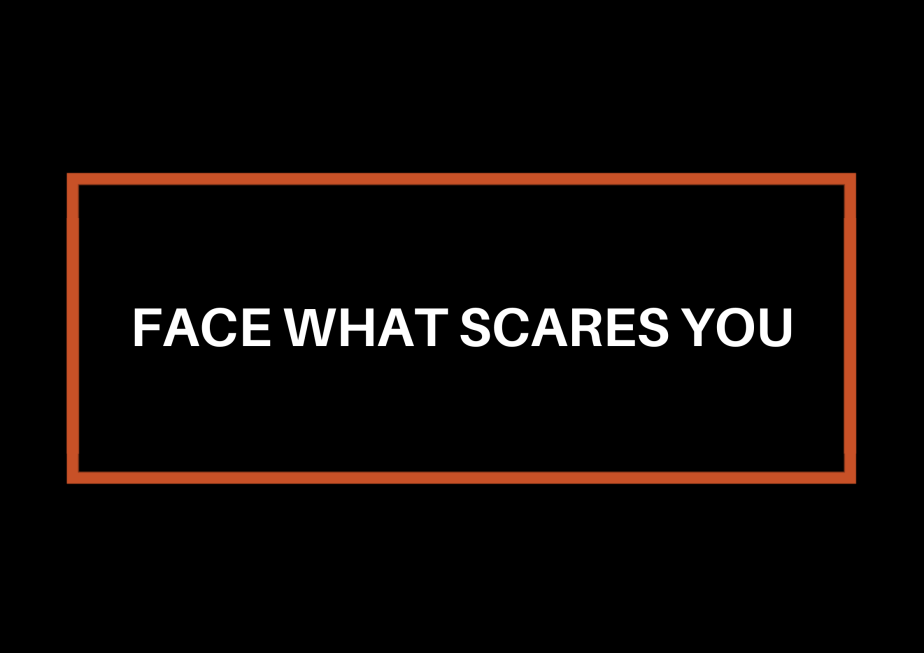
Face What Scares You

There is a Buddhist idea that comes from the Sanscrit word ‘maitri’, which means loving-kindness. Quite often, we are hard on ourselves, and we put ourselves down, or we are judgemental towards others. In each of these cases, we are thinking about ourselves or others based on opinions and beliefs that we have collected over the years. Opinions and beliefs that may not have any truth to them at all.

This is also true of the things that scare us. The reason we are scared of people or situations is because of our opinions and beliefs about them. It is as if we are running away from them without actually looking at them. When we apply loving-kindness to ourselves, we are looking at ourselves openly and with an embracing sensibility that diffuses negative thinking until what remains is only positive.

If we apply loving-kindness to the things that scare us, when we are curious, when we are interested in why these things scare us, then they lose their power. They lose their power simply because you have chosen not to run away, we have chose to face them. I am not saying that this will be easy, but it is worth it.

Progress Is A Journey

Each year we have four season, Spring, Summer, Autumn and Winter. Life moves in cycles in many ways in our lives and sometimes our progress feels like Summer and sometimes it feels like Winter. However, this is not the end of the story, as Spring follows Winter and on it goes.

When we make progress in anything it will stop and start, it will take sharp left turns and the terrain will changes as you go. Progress is far from a linear step by step process. Life ensures that we have both challenges and rewards.

For a long time I saw progress as a linear process of climbing a metaphorical mountain, but real progress has metaphorical valleys and desserts, forests and oceans. I realise now a wiser way to think about progress is as a journey. It is the destination that should be our focus and we will figure out the route. As Friedrich Nietzsche once said “One who has a ‘why’ to live for can endure almost any ‘how’.”

Making A Better Tomorrow

Life is a series of moments. Some are good and some are bad. This is pretty obvious. However, we often don’t think in this way about the time we spend and the experiences we have. Sometimes we think a bad situation is permanent and will always be like that. Sometimes we think a good situation will not last.

It is true that all thing shall pass. That is to say that everything is temporary and part of a process. When a bad thing happens we can’t wish it away or try to change what happened. What we do have power over, however, is what we choose to do about the situation we are in.

If we see where we are and what is happening as a process we can plan and set goals and work towards a better situation. If you don’t like you job or your relationship or your home life change it. Either work on making it better or make a change. A new job might be better than staying where you are. An honest conversation with your manager might improve your working environment. There are always things you can do to make this moment a step towards and better tomorrow.

Break The Bias

Today is International Women’s Day, which celebrates the social, economic, cultural, and political achievements of women. This is something that is needed to balance how women are seen in society. Many companies and organisations are equal, with women holding positions of CEO downwards, but not every company culture supports equality. This can also be said of society as a whole.

To me, equality is a sign of respect from one human being to another. We all have different skills and experience which allows us to thrive in some roles in both the workplace and outside of it, but not in others. Opportunities should be given without any assumptions being made about whether they will suit either a man or a women, and should be offered based on merit.

This brings us to the slogan of International Women’s Day, which is #breakthebias. In order for their to be true equality then the bias towards men being more capable needs to end. In order to love a fulfilling life we need to feel as if we are progressing, which means we need access to opportunities to progress. One thing you can do I to try and see past the stereotypes and judgements and see the other person as human first, the same as you. There is no bias if we are all seen as human beings.

Building A Better World

Today is Dr Suess Day and one of my favourite quotes from Dr Seuss books is “Don’t give up. I believe in you all. A person’s a person. No matter how small.” ― Dr. Seuss, “Horton Hears a Who!” I love all of his books, but this is one of my favourites.

We all have our highs and lows in life, our advantages and disadvantages. We are all fighting battles that others can’t see, some big and some small. The message that this quote gives me is firstly, believing in ourselves is necessary for progress to happen, it is is also necessary for others to believe in us too. You could be the person that causes someone to believe in themselves, to become their best self. There is power in believing in others.

Secondly, everyone has equal validity and worth. Therefore, kindness and respect should be a given with all interactions. If someone acts in a way that belittles or hurts others they should be held to account for their actions, but we should still respect their humanity. Never fall for thinking of others as less than human. This opens the door to inhuman treatment of fellow human beings.

Believe in others and they will believe in themselves. Treat all with kindness and respect. This is how we build a better world.

Change Is Not Progress

Two of the Principles I live by are ‘Change is constant’ and ‘Progress is a journey.’ They are not the same thing, but they are both helpful.

Often people think they are making progress because they are getting a lot done, but doing the same thing over and over does not help you progress. In order to have progress you need to have a destination in mind and you need to push yourself out of your comfort zone and try new things.

The destination could be a losing X number of pounds in weight. You will need to change what you eat and your habits around food to take you to where you want to be. Just eating less won’t help.

Change is automatic and it requires no effort, but it is wise to remember the nature of change, and say to yourself ‘This too will pass.’ Both good things and bad things in your life are temporary. Remembering this will help us see the light in the darkness of our despair and the preciousness of our joy in the good things in our lives.

Understanding both change and progress are needed to live a fulfilling life.

Mastering Your Work

While we work we are often asked by our Manager to complete a Personal Development Plan. This is often limited to office based work, but applies to any field of employment. This can be seen as another task to do or it is seen as a tick box exercise. The PDP is in fact a huge opportunity.

It is an opportunity to actively develop yourself, to take ownership of your career and progress to the level or role that gives you the most fulfilment.

In my opinion your PDP should begin with the values of the company you work for as well as your own values. This is because it is important that these values are compatible. You should include how you learn, how you work and what your skills and experience are. This will give you a good foundation to build your PDP from.

Set short goals, usually weekly, mid-term goals, usually quarterly and long term goals, usually yearly. I would also review your progress against these goals on a regular basis. I will be trying daily reviews at the end of my shift to highlight what went well, what I could have done better, what I learned and what actions I will take from the learning.

I feel that daily reviews will speed up my development and make sure it does not plateau at a low level. Try it yourself and see how you go. If it is too frequent, try weekly reviews. You will not regret it.

Lockdown Blues or an Opportunity in Disguise

“There is no power for change greater than a community discovering what it cares about.” – Margaret J. Wheatley

The global pandemic we know as the Coronavirus has had a wide ranging impact on the lives of so many across the world, on our health, our wellbeing and our finances, hitting some much harder than others. Many of us have had to go into self isolation, due to illness or being at high risk. Schools have closed and children are being educated at home through the wonders of the internet. Many adults are also working from home via the internet as well or have lost their jobs and some companies will not survive this pandemic. The way we do everything, including basic things like our shopping, has changed. These are challenging times.

Every Challenge is an Opportunity for a New Possibility

When challenges arise in our lives we really have two ways of looking at them, either to look at the negative impact of the challenge on our lives and how we feel or to look at the things the situation can teach us and the opportunities it provides. Resilience is built on overcoming adversity. If you are in lockdown, imposed by your government, or in self-isolation, as you are following the sensible advice to stay at home, this is an opportunity to reconnect with what is important in your lives and reevaluate your priorities.

Panic at the Supermarket

Panic does not help in situations like this. Panic buying hurts others and therefore it hurts us. When we panic we go into a fight or flight mode of thinking, which only helps when you are in immediate danger, and it should end once that immediate danger is gone. Generally speaking, we are not in immediate danger, this very moment, there is not a tiger about to eat us or a madman with a gun pointed at us, we are in a dangerous situation that requires reasonable steps to keep ourselves and others safe, so we should follow the advice of our Government and health care system.

If those in our society that are supporting us through this pandemic cannot get what they need to live, how can they help us to get through this. Equally, if we are ignorant of the sensible measures we need to implement, then we put ourselves and others in danger. For example, there are some in America who have said that as they are Christian and are covered in the blood of Jesus they are able to go to church with lots of other people and they cannot see that they could get sick or pass the Coronavirus on to others.

I have no issues with the beliefs of others, people can believe what they want, but when people’s actions could cause hurt to others then this is not good. One reaction to a situation like the one we find ourselves in is to dive into our beliefs in religious teachings to make us feel less afraid. The problem here though is that, if taken to an extreme, it is all focused on the individual, the fear makes us selfish and irrational. Part of me does not blame these people for being hijacked by their fight or flight system, but actions do have consequences, and ignorance is no excuse.

Good Health Is Foundational

As we all know our health is important. I would say that our health is central to our entire wellbeing and should be a daily focus, not just when a pandemic hits the fan. We can take this pandemic as a trigger to turn our attention to our health, and if you have to stay at home you have more time to focus on improving your diet, and your physical, mental and energy health. Take up yoga, meditate, go for walks or runs, journal your experiences and take the time to improve your overall health, to either recover from an illness or prepare your body to fend off whatever illnesses you may have to come, even if they are not a global pandemic. We have access to pretty much the entire culmination of human understanding on every topic via the internet. We have to be careful to make sure we check the sources of information when we get it online. I would advise checking at least three different sources to see if they agree, and remember that Wikipedia can be edited by anyone.

Recentre and Recalibrate

It is also a chance to find ourselves again, to spend time with ourselves away from the normal busy lives we lead. To look at our priorities, what we care about and what we should not bother with. It is a perfect time to look at defining our Why, as well as our values and beliefs, as I mention in my Fullfilment Framework. To do some self reflection and set some goals. We do not normally get so much time to do this sort of thing.

Some of you are ‘Key Workers’ and may not have the same time available because you are literally saving lives and supporting our economy, but the effect of this pandemic will be massive on all of us and, like all traumatic situations, we can be crippled by it or rise to the occasion and become better versions of ourselves. All those who are helping others at this difficult time I salute you, you are the best of humanity and the guardian angels that we all need right now. If you are not a Key Worker then please do what you can to support your neighbours, family and friends, and if advised stay at home.

Necessity is the Mother of Invention

We have all had to change how we connect with others, primarily via the internet. Zoom has become and invaluable way for people to connect. Teams at work, exercise classes, spiritual groups, you name it we are gathering together via Zoom. Facebook groups and email groups are exploding into a ferver of interaction to discuss the pandemic and support each other. Positivity is bringing so many people together. It is strange to feel so much community spirit without physically spending time with others, but the best of humanity is coming out to play and it is awesome. I am currently playing a game of chess with my elderly Father via WhatsApp message and he is beating me.

The Importance of Our Relationships

This has all highlighted how important our relationships are, they are the glue that holds our wellbeing together. What this pandemic has highlighted to me is how we cannot deepen our relationships with friends, family or colleagues through a screen as easily as we can face to face. It is the little moments of conversation and interaction, asking how the other person is doing and caring about the answer. It is the difference between a hug and the picture of a hug or a handshake and an emoji of a hi five. Physical connection is vital to healthy relationships and once this pandemic is over we need to not go back to interacting primarily through a device like a mobile phone, but to spend face to face time with those in our lives. This is one of the greatest lessons to learn from this situation.

Final Thoughts

I think this pandemic has also caused much of the superficial things that we thought divided us to drop to the wayside, as this crisis has created a shared human story that we are all experiencing. People out on their daily exercises are waving hi to strangers when they never would have before; we are beginning to see each other as human beings first. This is something I hope we do not lose when this is all over and we find a new normal, one of shared values, of oneness, of an understanding that all aspects of society are important. Without those who work in a supermarket being there for us at this difficult time we would not be able to live. Let’s hope the paradigm shifts to one of equality and respect, and that this paradigm stays for the foreseeable future.

Stepping Into The Unknown

“How can you know what you’re capable of if you don’t embrace the unkown?”
― Esmeralda Santiago, Conquistadora

In life there are many avenues to go down, many paths to take, or not as the case may be. Some of these paths lead to dead ends and some to wonderful opportunities. The challenge we have is that we never know beforehand, for certain, if making a particular choice will bring a positive outcome or not. Each time we are stepping into the unknown. We can, however, as the saying goes, learn from our mistakes and use our experience to weigh up the options and then make a decision. Some say we should go with our gut, with what feels right, but if this is not tempered with wisdom and experience, then we will only be following our instincts, which are primed for survival, not necessarily leading a fulfilling life.

The unknown could be a new job, a new relationship, trying a new hobby or something that changes lots of things in our lives, like moving to another town or city. We make these sorts of changes every day, but they still come with uncertainty and some anxiety. Each new change begins with a decision and leads to more decisions along the way. I would argue that no approach to making decisions is the best or the worst, as we each live individual lives and we are all individual people, but there are some things that can help when we are stepping into the unknown, which I will come onto in a moment.

However, first of all I would like to explore why we might feel the need to step into the unknown. It has long been part of the human spirit to push beyond our boundaries into uncharted territories. Human history is full of examples of men and women that have strived beyond the boundaries of their day to create new innovations and break records, whether this is manned powered flight or reaching the South Pole on foot.

For most of us such challenging goals are not things that we aim to do, partly because we are interested in other things and partly because we have commitments in our lives that need our attention and focus. That being said, we all have things that we are passionate about, things that we would happily do for free if time and circumstances permitted. This is the unknown territory that I want to talk about today, the venturing into the things that we are passionate about. Often, we don’t jump into our passions because we have responsibilities that we feel we must commit to or we lack the confidence to do so.

More often than not we do not follow our passions because we have had bad experiences trying new things in the past and we think that the same thing will happen again. There is an important principle connected to this that I have recently been trying to apply in my life, which is that the past does not equal the future. A lot of people, including myself, are held back by failure, because based on past experience we expect to fail again. The problem is that we see failure as a negative thing because of our past experiences. If we accept that we will fail sometimes then we can employ all of the resources that we have to make it work and to succeed.

We also live in a time when almost everything is instant. Whatever it is you want to buy, often there is an option to have it delivered the same day. We can do our banking on our mobile phones, we can send an email to someone and they will receive it a few seconds later, no matter where in the world they are, as long as they have an internet connection. Innovation has made our lives a lot more convenient, but not easier. This is because we expect everything to be instant, but many of the important things in life take time and effort. For example, relationships take time and effort to become strong and durable through the ups and downs of life. It is the little moments of asking how someone’s day is going and caring about the answer, of engaging in small talk in the moments between doing other things. These things help to build strong, healthy relationships.

Too often we are spending time with people without spending time with them. I’ve seen couples at restaurants where they are both on their mobile phones and not looking at or communicating with the person they came to the restaurant with. It has become an accepted thing to do to scroll through our Facebook feed on our mobile phones, instead of making a connection with the person we are with. This has had a knock-on effect that means young people are finding it difficult to build relationships, because the social skills that are normally built up through trial and error as a child cannot be practiced if they are looking at a screen and not a person.

Failure also seems all the more magnified because if we expect things to be instantly successful, and if we fall at the first hurdle, we give up. We are becoming conditioned for insecurity when we should be conditioned to fail our way to success. I guarantee that every successful person who is famous for their success has failed more times than most other people have tried. It is not about how many times you get knocked down, it is about how many times you keep getting up and try again. Having this sort of mentality will enable us to stride forth into the unknown with the confidence to fail and try again.

For this to work, however, we need to have the right motivation. Wanting to be successful so that we can be rich is a motivation, but it will inevitably lead to an emptiness, because you cannot buy happiness. If, on the other hand, we want to be financially successful so that we can help more people live better lives, then fulfilment will be our reward. Motivation is key and it has to fit with our values and beliefs, this above all else is important, because to live a fulfilling life our thoughts, speech and actions should reflect what we value and what we believe.

But where do our beliefs and values come from? They are manifestations from the culture and community we grow up in, the examples our parents give us and how they raised us, as well as the education and experiences that we have had. Through all of this input we piece together what we believe and what we value. All of this then effects the decisions that we make on a day to day basis, but I believe that if we are to make wise decisions in life then we should be wisdom seekers, and I believe that wisdom can be found in any of the many religious scriptures and philosophical texts from around the world, amongst other places. If we have wise guidelines or principles to follow, then stepping into the unknown will seem less scary.

Something else that can help us in our ventures into the unknown is to have an attitude of asking ourselves “what if…?” What if we tried something new, what if we gave it a go, what if? Being open to the many positive possibilities that could result from trying something new means that we will more likely have a positive outcome. It is also a way of getting past the barrier of failure, a way to overcome our fear of criticism or looking like a fool; what if we succeeded, what if we achieved our dreams. This allows us to consider the possibility of actually succeeding, rather than becoming consumed by the thought of failure.

For me, this is a call to action, for us all to be a beacon of light, because we went first, we stepped into the unknown unsure what will happen, but with faith in the idea that there are benefits in both failure and success, and that our values and beliefs will guide us towards a better world. To strive for a world where everyone respects the inherent worth and dignity of every person. If we strive to be the light for those around us, then we will become beacons for good and we can dispel the bad in the world, bit by bit. It also means that others will be the light for us as well, this is what being part of a community and a fellowship is all about. If we can achieve this, then we can walk into the unknown and bravely accept what is before us on our path.

I would like to end with a poem entitled, Our Deepest Fear by Marianne Williamson, which speaks to what I have been discussing today. It mentions God in the poem, but if your beliefs that do not include God, then please think of the word God in the context of your own beliefs.

Our Deepest Fear
By Marianne Williamson

Our deepest fear is not that we are inadequate.
Our deepest fear is that we are powerful beyond measure.
It is our light, not our darkness
That most frightens us.

We ask ourselves
Who am I to be brilliant, gorgeous, talented, fabulous?
Actually, who are you not to be?
You are a child of God.

Your playing small
Does not serve the world.
There’s nothing enlightened about shrinking
So that other people won’t feel insecure around you.

We are all meant to shine,
As children do.
We were born to make manifest
The glory of God that is within us.

It’s not just in some of us;
It’s in everyone.

And as we let our own light shine,
We unconsciously give other people permission to do the same.
As we’re liberated from our own fear,
Our presence automatically liberates others.
Just Do It

“Success is not final, failure is not fatal: it is the courage to continue that counts.”

– Winston Churchill


The slogan of Nike is “Just Do It”, which is a call to action, but the action is deeply personal. When we hear Just Do It we are directed in our minds to the thing we are unsure about, the thing we are scared to do, but we are drawn to doing. We all have things that we want to do but we don’t think we are able to do or we feel that it will end in failure, so we don’t even try. I think having such doubts comes from previous failure that hurt us deeply in the past, and have become a forgotten wound that has healed and left a scare deep in our subconscious.

There is a moment between when we think about doing this thing we are scared to do and our brains talking us out of it. It is this moment of a few seconds when if we don’t act then it is unlikely that we will Just Do It. Many of us feel that we need confidence before we can do new things or that we need courage to do it. Both of these are often true, but there is something that comes before confidence and courage. Before we can have confidence, or courage, I believe that we first need clarity, we need to know what our Why is. If we understand the reason why we do what we do we can understand everything that we do. It is the act of discovering our raison d’être, our reason for being. When we know our reason for being we develop confidence in our own abilities, fueled by our passion for what we value. First we need clarity, then we get confidence and then we take the step of Just Doing It by having the courage to give it a go.

Courage, by the way, is not having the confidence to do something before you do it, no, it is giving it a go even if you are scared. The courage always comes with being scared, and the more scared you are the more courage you need to give it a go anyway. The clarity we have in what we believe and value is a sort of compass pointing us in the direction our soul wants us to go to and our confidence is a platform we can use to jump from when we take risks and try new things.

I have had a difficult time over the past decade when my confidence has been shaken to its core and anxiety seemed to take over my everything. However, I am taking back my confidence and my courage by finding clarity and being willing to give new things a go. I know that you can do the same. We have all had things that have knocked us down, but it is not about how many times we get knocked down but how many times we get back up. If we always get up one more time than we get knocked down we can rebuild, restore and move forwards. As long as we are moving forwards baby steps count too. So think of that thing you are putting off doing and Just Do It.


Something to reflect on:

Knowing thyself is the key to success at anything. Clarity leads to confidence, which leads to courage. Whatever is in your heart to do, just do it.


The Power of Yet

“I truly believe in positive synergy,

that your positive mindset gives you

a more hopeful outlook, and belief

that you can do something great

means you will do something great.”

-Russell Wilson


It is all in the mindset

Much in life comes down to whether we think we can do something or if we cannot. These choices can sometimes seem fixed, but nothing could be further from the truth. Our brains are in a constant flux of change. Every new experience changes how we understand and view our past experiences and our memories can change as a result. Often there is a tendency to tell ourselves that we cannot do something, because either the evolution of our brains is trying to keep us safe by sticking to a cautious approach or we have had bad experiences trying new things in the past and we consequently back away from anything that is new or difficult.


It is our mindsets that are either fixed or flexible. The terms fixed mindset and growth mindset describe mental states that are both self imposed and imposed by our environment. If we are told that we have been successful because we are smart then we assume unconsciously that success comes from fixed personality traits. People with this mindset crumble when they hit a challenge beyond their capabilities. They do not have the mental flexibility to navigate around a challenge. If we are told that we are successful because we work hard then we assume unconsciously that success comes from hard work and determination. People with this mindset become lateral thinkers, they think outside of the box and when a challenge is beyond them they are more likely to keep trying until the challenge is overcome.


We are the architects of our lives

What we tell our children about their success becomes part of their mindset throughout life. Importantly what we tell ourselves can be with us throughout our lives as well. If you find yourself saying that you cannot do something out of a belief that it is beyond you then I encourage you to add the word ‘yet’ to the end of the sentence. “I can’t drive a car yet.” “I can’t draw yet.” “I can’t play the guitar yet.” “I can’t find a new job yet.” “I can’t run a marathon yet.” Whatever it is, there is power in the word ‘yet.’ Give it a try.


Something to reflect on:

Your power or your weakness is often based on a belief that you hold, whether consciously or not. Behaviour is based on conscious and unconscious beliefs. What beliefs do you have that are holding you back?

2017 goals achieved? How to set 2018 goals.

“A goal properly set is halfway reached.”

—Zig Ziglar


It has come to the end of 2017, have you achieved all that you wanted to this year? Did you set goals this time last year that went undone? We often set unrealistic goals or we set achievable goals but do not put into place the habits and targets we need to achieve them. I will set out 5 steps that will help you achieve your goals for 2018.


Step 1: Decide on what you goal is going to be.


The first step is an obvious but crucial one, to make a decision on what you want to achieve and then deciding to act on this. This decision, however, needs to be made in the full conviction that you will achieve it. No half measures, no self doubt. Decision with conviction is the first and vital step to making positive change in your life.


Step 2: Reverse engineer the path to the goal.


Without a plan, or a map, to get you from where you are today to where you will be when you have achieved your goal, you can waste time doing unnecessary things by getting caught up in activities or strategies that do not help progress you towards your goal. This is wasted energy and time and this can have a negative impact on your motivation to continue, because you might begin to question whether it is worth it after all. So, start from having the goal achieved and work back through the steps that you would need to take to get there. Ask yourself what are the key actions that you will need to take. Ask what is the key knowledge and experience that you will need to have. Ask what key support you will need from mentors, family members and friends. We all need support sometimes, we cannot do everything alone. Ask what costs there will be and how you will finance the achieving of this goal. Finally, ask what habits you will need to have in order to work towards this goal. This will all give you a road map from where you are now to where you will be when you have achieved the goal.

Top Tip:

A short cut to achieving a goal is to find someone who is a high performer in the area you want to achieve in that has reached this goal themselves and find out the steps that they took to get there.


Step 3: Set daily, weekly and monthly targets.


Once you have reverse engineered the necessary steps, knowledge and experience to achieve your goal you will need to set up regular targets to get you to your goal. These should include daily goals which build on the habits that you will need to have, for example, if your goal is to loose weight a daily target could be to complete a simple exercise routine before you start your day that takes 15 minutes. If this is done every day the impact over a year will be massive. Then set weekly targets, for example, you could create a diet plan that includes mainly healthy foods 6 days out of the week with 1 day as your cheat day when you can eat want you want as a rewards for being consistent the rest of the week. Then set a target for a set number of months. If the goal will take 1 year then set a target for every 3 months. This will allow you to keep on track and all of the little successes each day, week or month will keep you be motivated as well.


Step 4: Set reminders to check in on progress at the start of each month.


Setting a reminder in your calendar to check in on your progress, whether it is a paper one or a digital one on your mobile phone or computer, is very important. This allows you to assess where you are doing well and where you might need to improve or make changes on your journey to achieve your goal. I would suggest the 1st of every month would be a good time to do this. As we move through life we become more knowledgeable and experience bring with it wisdom that can help move you closer to your goal sooner. Reflecting on your progress on a regular basis will also help you stay motivated to keep going, because you can see how far you have come already and how well you are doing. This self-reflection should involve comparing what you have done so far to the targets you have set yourself and whether you have achieved them, and then making some notes on what has gone well and what changes you might need to make.


Step 5: Make yourself accountable to the targets and the goal.


This is a strategy that can really help you stay on track to achieve your goal. Find yourself someone who will hold you accountable on the progress towards your goal. It is best if this person is someone that you trust and you have a good relationship with, but not someone who will not be supportive or who will not push when you need to be pushed. Usually, it is a good idea to pick a relative or a friend who will support you and motivate you when you are struggling to keep going. This will be your Accountability Buddy.  Sharing with them your plan to achieve the goal and the daily, weekly and monthly targets you have set yourself is needed here, so they can keep tabs on how you are doing. I would suggest setting up times when you can get together or talk over the phone to reflect on how you are doing. I would suggest using the monthly reminder to reflect on your progress as a good time to do this. Once you have sat down yourself to self-reflect then share this with your Accountability Buddy and discuss what went well and how you could do better.


Final Thoughts


Setting goals can be a tricky business because we are often pressured by outside forces to make changes in our lives. This could be pressure from family and friends, from messages through the media on how we should live or act, and it could be pressures from our place of work. When we set goals they should reflect our inner drives, our reason for being. In short they should come from our ‘Why’. Finding out what our Why is will be the single most important thing you can do. We all have a Why, but many of us are not sure what it is.

Your Why is the motivation behind everything that you do, it is as I say, your reason for being. Mine is to help others find fulfilment in their lives. For others it might be to be an amazing sports person or to be the best parent they can be. If you are unsure how to figure out what your Why is then I recommend you read the book Start With Why by Simon Sinek, or watch his TED Talk “How Great Leaders Inspire Action” which summarises the main points of the book, this will bring clarity to your Why. There is a companion book called Find Your Why, which I have yet to read but this may help you find further clarity. You could also visit the website www.startwithwhy.com. Start with your Why and set your goals in line with it, that way you won’t achieve your goal and then find that it does not fulfill you as you thought it might when the goal was set. Checking out my Fullfilment Framework found on the menu of this blog site can also help on your journey to finding your Why and your Way, two essential components to living a fulfilled life.