Finding Steady Ground

For a while now I’ve felt a little lost, in the sense that I didn’t feel like I was living up to the purpose I had found for myself and I was just coasting. It felt as if I had a purpose but no motivation to work towards it. Having Fibromyalgia I feel exhausted most of the time, so taking the time to work on my purpose is hard. Though I do need some sort of steady ground to keep me centred and from which to build.

I have a Buddhist faith, although I would also class myself as Unitarian, and I haven’t meditated or prayed at my shrine for a long time and watching this interview with Shia LeBeouf shifted something in me. He is someone who has hurt people and this recently spilled out into the public eye, which brought him to rock bottom. However, he found a way forward through a Catholic faith, as well as doing the work with other groups to get sober and make amends for the hurt he caused to others.

I guess seeing his transformation through faith I have realised the importance a daily religious practice has on giving you structure and a steady ground on which to move through the world. It has to be a daily practice though. My approach of prayer on an ad hoc basis has not worked. This is part of the work of finding fulfilment, to have daily practices that nourish the soul and clear the mind. I will try again.

Attachment To Ourselves

In many religious traditions there is a focus on non-attachment to the Self. Sometimes we can have different selves that we are attached to, because the way we see ourselves depends on the context we are in at any given time. We might behave differently at work than we do at home for example. This occurs because we are living our lives through our perceived expectations of others. In other words we are living in ways that fit with how we want others to see us.

When we live this way, we are not being true to who we are in at least one of these places. Part of the work of living a fulfilling life is to figure out our beliefs, values and ethics and to live by them everywhere we are. A part of living a spiritual path is to move away from focusing on a separate Self and to recognise the oneness within which we live. These two journies are very much connected.

Questioning Our Beliefs

Beliefs are conclusions that we assume to be the truth. We often say that beliefs come from faith, but a belief unquestioned becomes a closed door. When we say we belong to a particular religion we are often identifying with a belief system which has institutionalised beliefs into a specific way of seeing the world.

Though the guidance from religions can be beneficial, if they go unexplored and unquestioned this is not a spiritual journey, it is a spiritual roundabout. Beliefs are important, particularly religious ones, because they deal with the nature of reality. However, I feel these beliefs should not go unquestioned. If beliefs are seen as a working model of how the world works, we can then repeatedly test it to see if it produces joy, happiness and fulfilment. These are the measure of a life well lived.

Feeling At Home

I have a few places where I feel like I belong. One of them is being at home with my wife and daughters. This is my home base, to use a baseball euphemism. To extend this euphemism further, I feel that when it comes to my religious beliefs my Unitarian chapel is my religious base. I feel at home in any Unitarian church or chapel.

When it comes to feeling connected to the natural world, being near trees and grass, flowers and all of the animals, birds and insects that share the Earth with us, feels like being in my natural world base.

You will have places and situations which are your bases, places where you feel a connection to something outside of yourself, and this is a very good thing. These bases are spaces in which we should spend time just being, and exploring all that it means to be a human being, and more than that, being the individual human being that we each are.

What Should We Unlearn?

Our reality is largely what we are told that it is, from the explanations and examples of our parents to the education we receive to the religion or lack of religion that we follow. Our starting point for understanding our place in the world, or the universe, is received from other people.

It is only later in life, as our childhood becomes adulthood that we really start to question the foundations of understanding that we have been taught. Some understandings, particularly religious ones, it seems, can last a lifetime without being questioned.

There are many understandings of things, both religious and non-religious, that create divisions, which are further worsened by seeing a them and an us. More and more I am starting to believe that there are no divisions or categories or labels except the ones we create to understand the world and the universe, to give us a framework from which to go about our daily lives.

Don’t get me wrong, without such things we would not have science or medicine or a great many other things, but there is much, I think, that we have to unlearn about how we see each other and our place in the grand scheme of things.

Causes and Conditions

Everything in life is a result of causes and conditions, whether these be man made or simply the circumstances we find ourselves in. The thing to do is to try and understand the causes and conditions so we can improve our situation, whatever it is.

There are many different points of view on how to understand causes and conditions, religious, philosophical and scientific. In my view, when there is an agreement between these three areas of human understanding, the truth becomes available.

You may follow a particular way of thinking or a particular religion, and this should always be your first port of call, but it is important to be open to the ideas from other points of view. If we understand why we are in the situation we are in we can find a clearer way forward and we can live a better life.

Also, when people behave badly towards us, we can try to understand the causes and conditions that influenced the way they are behaving, which then opens up the possibility of treating them with compassion. Even if someone is angry, to be angry is to suffer. Meeting anger with compassion often turns their anger into the emotion behind the anger; sadness, frustration or confusion for example. This opens a door to help them and resolve the situation peacefully.

Finding Contentment

“Be thankful for what you have; you’ll end up having more. If you concentrate on what you don’t have, you will never, ever have enough”
― Oprah Winfrey

When thinking about contentment and what to talk about in this blog post I thought about what makes me content. I thought about my wife and daughters, the books that I read, how I feel when I am painting pictures, and then I started thinking about things that make me laugh, things that make me smile. Contentment, as a subject, is a big subject to tackle in something as short as a blog post, but I thought that it was also an important subject to talk about too, especially after the stresses and changes, the grief and the trauma that we have had to deal with over the past 18 months.

So, what then can be the solution to the age-old problem of how to be content? If we are all different people then how can there be one answer to this problem? Many different people have tried to come up with an answer, each with a different perspective on the issue, often driven by their theological or philosophical beliefs. Some we know to be powerful spiritual figures such as the Buddha and Jesus, others were, and are, just philosophers trying to answer the question of how to be content. The rest of us, generally, just try to make the best of things. With all of the difficulties we each face in our lives it is hard to find the time to philosophise about the ways and means of finding contentment. For the majority of us we spend our days working hard to have money to pay the bills and the rent, or mortgage, hoping to have a little left over at the end of the month to treat ourselves, and the ones we love.

Yet, somewhere in the busyness that is our lives we do find some time to set aside to enjoy ourselves, whether it be spending time with the kids, going for a drink with friends, a walk in the woods or just staying in to watch something on the TV, we all do somehow manage to find time to enjoy ourselves a little. This time spent relaxing and enjoying ourselves is greatly necessary for us to go on functioning in the jobs that we do and the responsibilities that we have, we need to laugh and play and get back to the things which make us who we individually are. But is this contentment or is it just making the best of things?

I would say that we can find moments of contentment in these periods of relaxation and enjoyment. We have all, I think, or at least I hope, had moments when we’ve paused and thought ‘my life is good right now, the good things outweigh the bad things and I am happy.’ An attitude of enjoying the small thing in life can be a useful attitude to have, as it helps us deal with the big problems we all face. The old saying ‘The best things in life are free’ is in a similar vein, and is good advice, often given by parents, or grandparents, to children who want things that are expensive and well advertised on the TV.

That being said, contentment can seem a complicated or difficult state of mind to achieve. But perhaps it isn’t contentment that is complicated but ourselves. Perhaps it is our own complications that can make it so difficult for us to achieve contentment, consistently. We have many thoughts running through our minds each day, as well as many emotions, either flaring up, such as anger, or lingering, such as sadness. There is a constant flow of both thoughts and emotions, almost like a river, which swells and runs dry over and over. With such turbulent minds it is no wonder that we find it difficult to settle and be content.

People also deal with things differently. In any situation there are those who are totally emotionally involved, and as a result their emotions jump up and down with the ups and downs of life. Others do not engage their emotions very much at all, and so are quite detached from any ups and downs that life throws at them. We all know people that fit either of these types of behaviour, and we know people who are both negative about life and those who are positive. I can be beneficial to think about how positive or negative we are to life’s us and downs. 

How we feel about our lives is often caused by our reactions to the events within it. Our reactions to the events of life are the responses that our brains throw up almost without us thinking about it, they are habits that we have formed over our whole lifetime. For example, if we disagree with something do we get angry very quickly and say the first thing that comes to mind, while we are angry, or do we take time to create a considered argument to explain how and why we disagree. If something bad happens to us do we react emotionally, getting angry or upset about our favourite cup getting broken or missing the bus to work, or do we think that the cup was only a thing and can be replaced and even though we missed our bus there will be another one along soon?

Things are only good or bad depending on how we see them. Roger Walsh M.D., Ph.D. put it well when he wrote “We do not see things only as they are, but also as we are.” If you think about that for a moment it is actually quite profound. This is only a quotation, but if you think about it in a wider context you could say that everything we see, or even experience, is coloured by the way we are at the time, how we are feeling, if we are tired, if we are in a rush or taking our time. This might be an obvious point that I am making but it is something we often forget when we are reacting to things that happen to us, because we are reacting. But if we remember that what we are experiencing from moment to moment is affected by how we are in those moments then we have a better chance of dealing well with the ups and downs of life, and I would say a better chance of being content as well. This is consciously choosing to be in a beautiful state, not an angry state or a stressed state, but a beautiful one.

Talking of beautiful states, the Euros 2020 final was a big moment in my home country’s footballing history, where England made it to the final of the Euros, something many football fans thought would never happen. Prior to the result of the match, the mood of the nation had been lifted, whether you enjoy football or not, the positivity has been infectious and we have been living in a happier state, generally, until of course we lost in penalties again. But we must remember that both Italy, who we faced in the final, and England have had a really difficult time during the pandemic and the joy we felt in both of our nations up to the final, and more so for Italy now, mark a new chapter in our national stories, it is a great contrast to the suffering we have had. The deeper the turmoil the higher the joy and the better we can choose to live; this is also true even when our football team does not win. And with the Olympics starting in Tokyo I hope each nations spirits will be lifts as they follow their athletes who are competing.

In order to be more content it is perhaps better to act instead of react, by which I mean taking control of the moments before we react so that we can make better decisions in what we say and what we do, in response to any situation. There is a Buddhist Mindfulness practice called the Three Minute Breathing Space to be used when we feel angry or stressed about something. The practice consists of stopping what you are doing and taking some slow and deep breathes for three minutes, or less if you like. It is a quick time out from the stresses of life, which can help enormously if you live particularly stressful lives. Practices like this can reduce stress and give us the presence of mind to avoid reacting to situations without thinking about what we intend to say or do in response to them.

We all have ways that help us de-stress, ways that we have developed through out our lives, hobbies that we have chosen to do, activities that are part of our daily routine, which are enjoyable and fun. But, these things are rarely structured activities as part of a path to find contentment, they are the things that make life enjoyable and fun, when it can be. There is nothing wrong with making the best out of life and enjoying it as much as possible. In many ways I would say that this is a road to contentment itself, but for those that want a more structured approach to finding contentment there is religion or a spiritual path. Here are some words on contentment from the some of the great religions of the world.

The Buddha said: ‘Contentment is the highest wealth.’ (Dhp.204), meaning that when we are content we do not need to get anything, go anywhere or be anything to be happy because we already are, and thus, contentment is more valuable than any possession or accomplishment. The Buddha describes the monk’s contentment like this: ‘He is satisfied with a robe to cover his body and alms food to satisfy his stomach and having accepted no more than is sufficient he goes his way, just as a bird flies here and there taking with it no more than its wings.’(D.I,71).

In the Bible, in the book of Timothy 6:verse 6-8 it says:

“Now there is great gain in godliness with contentment, for we brought nothing into the world, and we cannot take anything out of the world. But if we have food and clothing, with these we will be content.”

In Yoga, in the Hindu tradition, there are the Niyamas, ten ethical guidelines, which are the foundation of skillful living, or living in a morally good way. The second Niyama is called Santosha, or Contentment, and the expectation is this:

Nurture contentment, seeking joy and serenity in life. Be happy, smile and uplift others. Live in constant gratitude for your health, your friends and your belongings, Don’t complain about what you don’t possess. Identify with the eternal You, rather than mind, body or emotions. Keep the mountaintop view that life is an opportunity for spiritual progress. Live in the eternal now.

This is all good advice, and it makes it clear to me that on the road to contentment a spiritual path can be beneficial, because we are given advice on how to live in order to be content. There is a direct relationship between the directions given and the attainment of contentment, as many who have followed spiritual paths have stated in the past.

But what about those of us who are making the best of things, those of us that have busy lives spent doing what we can to provide for our families and ourselves, and follow our own spiritual paths when we can. Life can be difficult, and keeping a calm perspective on things when life doesn’t always go to plan is not an easy thing to do. I recommend using the wisdom of the many religions of the world, and the wisdom of those around us, our friends and family as well, they are our helpers, they sustain us as we sustain them. Our paths through life are also greatly helped by the enjoyment of life itself, our pleasure in the small things, and not wanting more than the world has allowed us to have. I believe it is a blessing to be alive at all, everything else is a bonus.
How to find fulfilment

“Your soul is the power and

core of who you are.

Feed it well.”

– Anonymous


Recently I have been reflecting a lot on what is meant by fulfilment, whether it is selfish or generous to seek it. How it is that we might find fulfilment and what it actually is. As human beings, we are all unique in our likes and dislikes, our personality and our passions, our behaviours and our tendencies. So, it makes sense that fulfilment would be an individual attainment, it would not be the same for everyone.

cropped-the-fullfilment-project-logo-profile-pic-black-white-red-v32.jpg

Since February last year I have been writing this blog about fulfilment, which I call The Fullfilment Project, with Fulfilment spelt with ‘FULL’ at the beginning, to signify a full life. I have been exploring happiness and success and what they mean in relation to fulfilment and I have come to believe that for fulfilment to occur we need to have both happiness and success, which to some degree is obvious. However, many who are looking for either happiness or success, I believe, focus on unfulfilling goals, as they are misguided by our culture and unhelpful beliefs. I am not now or have I previously claimed to have figured out the way to find fulfilment, I am an explorer looking for answers by asking questions and diving into hypotheses, and I have found some conclusions along the way, which I would like to share with you in this blog post.

I have created what I call a Fullfilment Framework, pieces of the puzzle of how to live a fulfilling life. These are drawn from personal experience and meditations, as well as seeking wisdom from both secular and religious sources. Wisdom comes in many forms, but it is still wisdom. In order to live a fulfilling life, I believe we need to begin with a good foundation, which is the core of a life well lived. There are three things I think we need in our fulfilment foundation.

Firstly, we need good self-knowledge, a deep understanding of ourselves, through self-reflection, knowing our values and beliefs and being tested in difficult situations and seeing how we deal with them. Secondly, we need acquired wisdom. Self-knowledge is not enough to guide us on a fruitful path, we also need to be steeped in wisdom, from secular, philosophical and religious sources. Thirdly, we need what I call the Good Health Triad. This is focusing on building for ourselves good mental health, good physical health and good energy or Chi health. Chi is an Eastern word for the life energy that flows within us and to have good health we need good Chi. All of these things we cannot do alone, we need friendships, companionship, and sometimes professional support, we need to learn good dietary and exercise habits and ways to boost and maintain our chi, all of which are good things.

From this Foundation comes our values and beliefs, which are like a prism through which we see the world, through which we think, speak and act in the world. The next level of finding fulfilment, I think, is to find out our ‘why’, our reason for doing all that we do. It is the purpose that guides us, distilled from our values and beliefs, from our self-knowledge and acquired wisdom. It can be difficult to figure out our ‘why’ with clarity. Often, we borrow from quotations or religious and philosophical ideas. I attend a Unitarian church, which was built on the idea that each individual person has a right to explore their own theology, to search for their spiritual truth rather than be told what The Truth is. All Unitarians connect with that, which is why they gather together and attend a Unitarian church. However, for each of them this may not be their personal ‘why’, because everyone is an individual, with different histories, experiences, values and beliefs. This is why I believe it is so important for each of us to search for what we believe our purpose to be in this life. It should be our North Star that guides us through both the calm and the troubled waters of life.

“…our North Star that guides us through both

the calm and the troubled waters of life.”


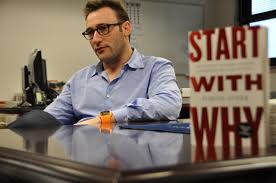
Simon Sinek-Start With WhyThen, when we discover our ‘Why’ we must discover how we are going to bring this ‘Why’ to life in our day to day lives. This is what I call our ‘Way’. In his book, Start With Why, Simon Sinek sets out the importance of finding your ‘why’ in order to live a purposeful life. He talks about how companies also need to clearly define their ‘why’, companies such as Apple have a clearly defined Why, to empower the individual against the big system. He also gives individual examples of Martin Luther King Junior who gave the “I have a dream” speech, not the “I have a plan speech”, as Simon Sinek puts it, and the Wright Brothers, who figured out powered manned flight for the first time, working out of their bicycle shop, with the intention of changing the world with their invention.
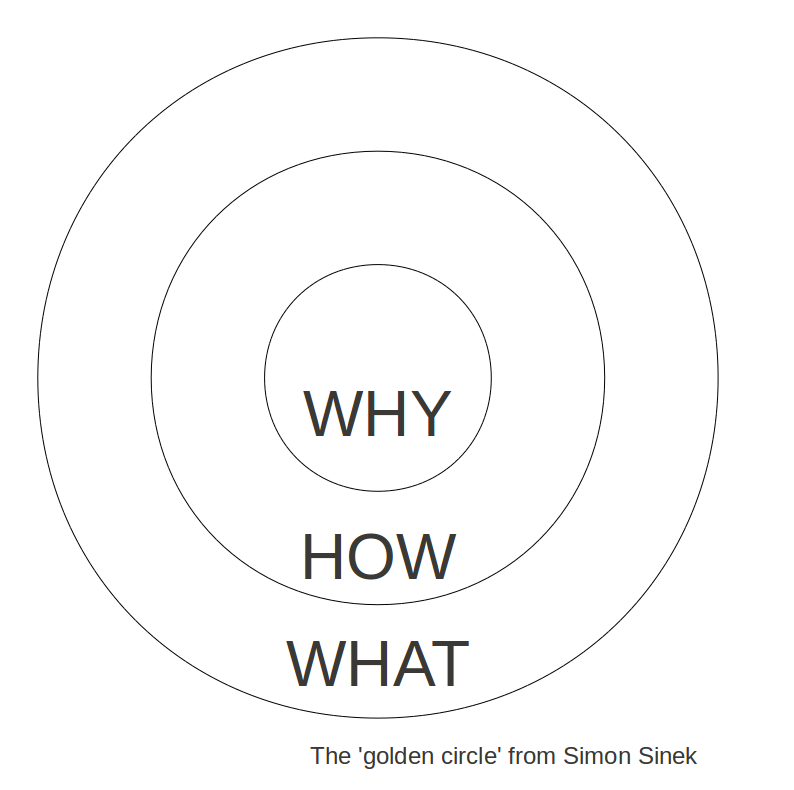
Simon Sinek says that we need to have clarity of our why first, then we can work outGolden_circle ‘how’ we express this why and then finally ‘what’ we do to prove the why we have. He calls this the Golden Circle, in the centre is the Why, then next the How and on the outside of the circle is the What, and it looks a bit like a bullseye. The important point here is that our human brains work from the why to the what when making decisions. The part of the brain that is responsible for decision making and our feelings like trust and loyalty is the Limbic Brain, which has no capacity for language. This is why we more easily agree with things that match our values and beliefs, not the details and the factual information.
My personal exploration of fulfilment has led me to a phrase that has hit home for me. The phrase is “To help others find fulfilment is to fulfil what it means to be human.” When this phrase first popped into my head I dismissed it as flippant and without substance, but through further reflection and meditation on this I have come to think that it has a certain depth to it that I did not initially appreciate.

“To help others find fulfilment is to

fulfil what it means to be human.”

On an evolutionary level we have evolved to be social animals, and during caveman times there would have been some in the group hunting and gathering food while others in the group would perform other functions for the survival of the collective whole. We evolved to have what Simon Sinek describes as a circle of safety, that everyone in the tribe made sure that they were all protected from the dangers outside of the tribe, whether this be the weather, dangerous animals or the scarce food and resources. It is hard-wired into our DNA to uplift those in our tribe, whether this is our family, our team or our congregation.

To encourage us to behave in a way that supports the tribe, evolution gave us some hormones that control certain behaviours. Our bodies produce Dopamine when we make achievements, it is an incentive to progress and we get a hit of Dopamine whenever we hit a milestone or tick something off our to-do list. Our bodies produce Serotonin when we perceive that others like or respect us. Our bodies produce Oxytocin when we are with our closest friends or trusted colleagues, it is the feeling of friendship, love and deep trust. All of which feel good.

The point I am making is that we have evolved to have hormones that actively encourage us to build meaningful, deep relationships, to strive for progress and try and get the affection and respect of those we care about. In other words, to feel happy and successful, on a biological level, we need other people. We need friends and family, loved ones and people we love. These relationships are key to living a fulfilling life. There is a problem though when we actively look to get these feelings that come from these hormones in unhelpful ways. For example, when we use social media and we get a like or a notification we get a hit of Dopamine, which feels really good, so we do it more, effectively replacing people with a device.

Life is beter in flip flopsAdvertising companies tell us that we will become either happy or successful if we buy their product or service, only to be told a few months down the line that a new product or service will do the same, but neither a product or a service will make us happy, as they are invariably transient, they change or break and the happiness promised is really only excitement and joy. We are often told that the measure of success is the amount of money we have or the amount of things we own, but it really does depend on how we measure success, as individuals.


I believe that success is very much intertwined with happiness and that you cannot have one without the other. As human beings we are hardwired to strive after progress, but if we are deeply unhappy or depressed, progress is not a clear focus for us. So, you could say that we need to be happy to succeed and we need to succeed to be happy, but the success really does need to be in an area that we passionately care about, something that is in line with our values and beliefs, in line with our ‘why.’ Which is why it is so important to figure out what our ‘why’ is.

Many religious scriptures tell us that in order to be happy we must first help others be happy. I think this is partly because we are hard-wired with our hormones to feel good when we help others to be happy in their lives. Their smile makes us smile, especially if we are the cause of it. However, this comes with a warning, we must ensure that we take care of ourselves as well. If we are not careful we can spend all of our time making sure everyone else is OK and we do not look after ourselves. A balance is needed, which is why we need a good fulfilment foundation.

When it comes to success, achieving success with others feels more magnified than a solo achievement. Even athletes who take part in sports events individually could not achieve success without a coach and their loved ones supporting them. When we focus on goals that are innately selfish, like earning a large amount of money, we often sacrifice our relationships to earn the money, which is an empty success when achieved, because it brings very little happiness. But if we do it with the motivation to help others we feel great happiness when we succeed, because of the positive effect we have on others.

I am now a firm believer that both happiness and success are reciprocal, in that they are received, in part, when we give them to others. And as fulfilment is largely dependent on both happiness and success, fulfilment is reciprocal as well, but it is not something that we can go out and find, like a treasure hunt, fulfilment is a sense of being that comes from living life well, through positive relationships, a good understanding of ourselves, the wisdom of others, good health, and living in a way that brings more joy, love and peace into the world than their opposites. To help others find fulfilment is to fulfil what it means to be human.


Something to reflect on:

Whether you believe that we only get one life or not, to live deeply is to live well. cultivate positive relationships, help others when you can and strive to be your best self, so you can help other to do the same. This is a worthy goal and we need a worthy goal to live a fulfilling life.

In search of truth

“If you really look for truth,

don’t assume anything – just seek.”

– Sadhguru


Presenting Truth

In every religion there is a prophet or sage that presents us with, what I am calling, universal truths, presented in a way that is understandable by the people they are preaching to. If we take the Bible as a case in point, as we have just finished the Easter weekend. We can look at the parables of Jesus and take from them truths, which we can then apply to our lives. Those who preach truth inevitably disrupt the status quo, much to the frustration of those who rely on the status quo, who have their own version of truth that is often aimed at either distracting or manipulating the masses. A contemporary example of this is the mass media who share their own narrative of what you can buy to bring you happiness. This is often why prophets and sages are so dis-barraged. A poignant and extreme example of this is the crucifixion of Jesus, someone who preached peace, love and selfless actions. Something that is prominent in our minds as we end the Easter week of the Christian calendar.


Accepting, Not Accepting and Seeking Truth

We have to be careful when receiving truth from anyone, even prophets and sages, because if someone tells us something claiming that it is a universal truth, and we believe them, it will not bring us closer to truth. If we decide not to believe them then we do not get closer to truth. However, if we admit that we do not know and we go seeking truth, then we will become closer to it, because it is in the seeking that we find truth.

“Do not accept any of my words on faith…

Only accept what passes the test

by proving useful and beneficial in your life.”

– The Buddha


Applying Truth To Our Lives

It is the application of universal truths within our lives that allows us to seek and find these truths. It is important to listen to prophets and sages, as well as scientists and historians, when seeking truths. Many have become wise through seeking and applying truths and seeing what works and what doesn’t, so listening to them can give us short cuts and sign posts towards truth. Part of the human condition is to look beyond our survival instincts and needs and look for meaning in our lives.


This is the main reason we search for universal truths, because we hope that these truths will equal meaning. Often we hope that if we are told what is the truth then we will also be given meaning, but neither truth nor meaning can be attained by the receipt of parables. We have to go looking for truth and then to apply it to our lives and see what sticks, what makes a difference. Truth is a life long pursuit, it is not the collecting of stories or even facts, it is goal we seek and the journey to get there as well. When held up in this regard it becomes a kind of catalyst for positive change in our lives. Do not settle for the truth you are told, see if it works in your life and then share it with those who need to hear it, so they can see if it works in their lives as well, as we can all be seekers and teachers of truth.


The problem with division

“When fear displaces reason, the result is often irrational hatred and division.”

– Al Gore


We have all experienced division in one form or another, often in the groups of people we share our lives with, because we interact with them the most and opinions and beliefs can cause friction and division.


Division and disagreement are not the same

Having a difference of opinion is not the same as division, though in the many public spheres of society it is seen as such, especially in politics and religion, as cliche as this is. Disagreeing and division can be seen as the same thing, as if to have a point of view you have to be one extreme or another. This creates the unfortunate paradigm of a polarised society. We have seen this in the recent presidential elections in America and the confrontational tweets, comments and rants from President Trump.


We also see it in the politics in the UK, with many feeling that they have to be either Conservative or Labour supporters, and these are seen by many as polar opposites. This disagreeing in a society that appears to value, and in some cases promote, a them and us mentality has brought about a situation where there is little room for people to debate and disagree and still remain on good terms. It is definitely something that is promoted in the media and in TV programs because it improves the ratings, because, though we might not openly admit it, many of us enjoy watching other people at loggerheads. This has given rise to the era of reality TV, soap operas and gossip magazines. Rarely in these type of programs and magazines are people getting along and being nice to each other.


Division creates conflict

At the heart of every division is a conflict created by the very division itself. This begins when we are born into the world and all of our senses are jumbled up and we have not yet learned to differentiate between things. Slowly we learn to know the difference between ourselves and others, between colours and object, and this goes on until we have categorised everything so that we can understand the world and operate within it. This often then leads onto catetorising groups of people, almost as tribes, like football  teams and religions groups.


Many of the great sages and prophets from the variety of world religions and philosophies from around the world have promoted the idea that we have to unlearn these categories, as they are in effect divisions which set one thing against another, such as man and nature or culture and culture or person and person. But deeper than that they promote the idea of an overall oneness to the universe that, once acknowledged, will allow us to temper our conflicts and remove them, because once the divisions are gone then so are the conflicts.


We all have a part to play

Often when we are in the middle of a conflict with someone we are offended largely because we see the conflict as the other persons fault and their responsibility to walk away or solve the conflict, because they started it. However, this is massively dis-empowering, because this leaves all of the power with the other person. In every conflict that we are apart of we have a part to play, either because we in some way contributed to the conflict by our behaviour or lack of actions, or we have a chance to end the conflict with what we choose to say and do, or not say and not do.


For example, if someone is very angry and shouting at you, putting ourselves in their shoes or asking questions and listening actively we can find out the cause of their behaviour. Often when we do this we can easily resolve the problem by focusing on the cause rather than the behaviour. Taking some responsibility in every situation gives us the power to make change in the world and help more people than we hinder. Division and conflict are things that we can all work to minimise in our lives, and as a result we can have a positive impact on the world, leaving it better than we found it.

5 Books to help you get your life on track

“Books are the training weights of the mind.”

-Epictetus


Books, it has been said, are windows into the soul and the doorways into dreams, but they also have the function by which we broaden our minds, sharpening our intellect and help ourselves live better lives. They are signposts on the path to happiness, success and fulfilment, the ingredients of a life well lived. These are 5 books that I believe will lead to a life well lived. They span the categories of health, self-improvement and spirituality. All three of these categories relate to the Foundation in my Fullfilment Framework, which is an evolving framework which I believe will lead to living a fulfilled life. (You can click on the titles of the books to take you to Amazon should you wish to buy a copy, though there are many other excellent online outlets where you could buy the books).


1. Start With Why, How Great Leaders Inspire Everyone To Take Action by Simon Sinek


“There are many ways to motivate people to do things, but loyalty comes from the ability to inspire people. Only when the WHY is clear and when people believe what you believe can a true loyal relationship develop.”


I am going to begin with Start With Why, an excellent book for figuring out your own ‘Why’, whether as an individual or as a company. Our ‘Why’ is our purpose, our reason for being, it is the thing that is behind every decision we make and every action we take, it is an essential part of our mind, body and soul. Our ‘Why’ is formed by the time we are in our early 20s, but many of us do not know what it is, or we do but we do not understand it well enough to utilise it in making a fulfilled life for ourselves. It is only now in my mid-thirties that I have figured out my ‘Why’, which is to help others be fulfilled in their lives. My Why is the motivation I use when at work, at church, with friends or with family, it is also the reason I have begun writing this blog.

This book takes us through the world that does not start with Why and the consequences of it. It then goes on to talk about the biology of our human brains and how the concept of Why is in harmony with our biology. It then goes on to discuss the successes various famous people and companies have had because they know their ‘Why’. The book is an excellent introduction to the concept of having a Why and it will help you figure out what your Why is, so you can align your life with it.


2. The Motivation Manifesto by Brendon Burchard


“We must ask: When will we be ready to ascend to another level of existence.”


This book is about focusing your life for success. It begins with ‘The Declaration of Personal Power.’ It is about reclaiming our sense of self and channeling our energy into self renewal and success in our lives. Section One in the book looks at our human nature and how we are affected by freedom, fear and motivation. We have conditioned responses to each of these, but if we were to take control of our responses then we can be free, courageous and generate our own motivation.

Section Two goes through a list of nine declaration on what we shall do, for example, “We Shall Reclaim Our Agenda” and “We Shall Defeat Our Demons.” These declaration empower us to be in the driving seat of our lives so that we can make our lives magnificent. This is something we can all do, every single one of us.


3. Healing Foods, Eat Your Way to a Healthier Life by Neal’s Yard Remedies


“The food we eat has an overreaching effect on our health and well-being, whether we are conscious of it or not.”


This book contains a wealth of knowledge about how food can be used to heal and to help us live a healthy life. It begins with different dietary patterns and diversity from around the world. It compares GM foods to food the way nature intended (organic) and it goes through the benefits of supplements. The main body if the book is an extensive look at the foods that heal. The food types are divided into Fruits, Vegetables, Nuts, Seeds and Sprouts, Medicinal Herbs, Culinary Herbs, Cereals and Grains, Pulses, Spices, Fats and Oils, Fermented Foods, Meats, Oily Fish and Other Foods. There is also a section with some wonderful Recipes That Heal and recipes set out into daily meals and types of foods. For a healthy body and a sense of well-being, our physical health is essential. Everything tat we eat and drink becomes our bodies, we are what we eat.


4. The Way of Qigong, The Art and Science of Chinese Energy Healing by Kenneth S. Cohen


“Qi is the Chinese word for “life energy.”… …Gong means “work” or “benefit acquired through perseverance and practice.” Thus, qigong means working with the life energy, learning how to control the flow and distribution of qi to improve the health and harmony of mind and body.”


Qigong is an ancient practice of generating and controlling the energy that flows through our bodies, which is a distinctly Eastern practice and a major part of Chinese medicine. In the Western model of medicine the focus is on treating the symptoms without trying to find the cause(s). I have experienced this first hand with my onset of Fibromyalgia. I went to see a variety of experts who could only see their specific section of the body and its functions, but having been treated by practitioners of Chinese medicine I can vouch for the fact that the focus is more on the whole body and fixing the cause of the illness, to bring the body back into balance.

This book firstly explains what Qigong is, its history and scientific evidence proving that it works. It then explains Qigong basics, ways of using Qigong to heal yourself and living a Qigong lifestyle. The book goes into a lot of depth, but explains everything in a way that makes sense and is easy to follow, with physical practices that are not very different from Tai Chi. In the West energy healing, or Qigong, is little known about, but it is slowly filtering into our culture in the same way that Martial Arts, Yoga and Tai Chi have done, it is only a matter of time.


5. Spiritual Renegade’s Guide to the Good Life by Lama Marut


“This book is for desperados. It’s for those who know life is short and who are tired of wasting day after day in low-level unhappiness as they wait for the next high-level version… …It’s a guide for those tired of trying to become well-adjusted to a perverse society and who are willing – even eager – to deviate from the norm.”


This book comes from a Buddhist standpoint, but it acknowledges the teachings of other world religions, and takes a common sense view of how to live a spiritual life, which, as every Prophet and Sage has taught, usually goes against the system. In our case it goes against the Capitalist culture we live in, which is designed to keep us unhappy, so we will keep buying things to keep the economy rolling on. Stepping off this hamster wheel and fighting the power by being content is the first step, because contentment is entry level happiness, the first step towards enlightenment, or perfect happiness.

What I like about this book is the short sections within each chapter which allow us to absorb the points made and practices suggested. There is also a Couch Potato Contemplation and an Action Plan at the end of each chapter. The Couch Potato Contemplation is something to reflect on from the chapter that you have just read, but rather than treating it like a serious meditation, it is something to just sit and think about while sat on the couch. The Action Plan is a behaviour to try and embody based on the teachings in the chapter we have just read, something simple but that challenges the status quo for the better. Each section also has a QR code that we can scan with our mobile phone, which takes us to YouTube Videos of Lama Marut giving teachings related to the section we have just read, to embed the learning and explore the ideas presented.


There is a Recommended Reading List on my blog site that has these books and many others under the categories:

  • Happiness, Health and Success
  • Theology and Philosophy
  • History and Science
  • Fiction


Resources


YouTube Channel of Dr John Bergman, who talks about how to achieve good health naturally without chemicals like medication.

YouTube Channel of Lama Marut, a Buddhist Lama who teaches deep Buddhist teachings in easy to understand lectures.

Website of Jim MacRitchie, a Qigong Acupuncturist who teaches Qigong classes (There are free Qigong resources on this website).

Website of Simon Sinek, discussing the concept of ‘Why’ and resources to use this concept to improve your life and that of others.