Focus On The How Not The Why

Life runs away from us backwards into our pasts, giving us the sense that we are being propelled forwards in time, when we think about it. But our speed is constant, which is why we don’t really feel it day to day. The thing to do is to pay attention, be mindful and enjoy the scenary. Time gives us no choice but to age, if we are lucky.

The grey and the wrinkles are gifts. They remind us how far we have come and that we are still here. That we still have choices of how we can live. The how is the most imprtant thing, more so than the why.

Figure out the how and the why will take care of itself.

To Serve First Thrive

Put on your oxygen mask first is the instruction to parents when being given a safety briefing on a plane before the flight begins. The reason is that if you are unconscious, you can not help your child.

Equally, in day to day life, if you spend your time helping others and not looking after yourself, then you will become depleted, and your metaphorical cup will be empty. If you fill up your cup, then you have more to give.

In order to serve, you must first thrive yourself. To give you must first have plenty. This applies to your health, both mental and physical. To help others, you need to thrive so that the energy you give to others leaves you with energy to take care of yourself, too.

You also see the world and other people through the prism of yourself. You see things as you are, not how they are.

Do The Work

I was watching an interview with Jay Shetty on Impact Theory and he said something that resonated with me. It was something that is really obvious, but my brain omitted the logic of what was said to avoid the risk of making a change in my mindset. We often fear change more than staying the way we are.

Jay was talking about his book Think Like A Monk, which he wrote after living for some time in an ashram as a monk. When he left the life of a monk he spent seven years testing what he had learnt in the real world before then writing the book. The logic that struck me was that he put in the work of learning how to think well while training as a monk and spent seven years testing this out.

Essentially, the obvious truth is that in order to gain self mastery you have to put in the work of mastering your mind. I am some way down the path of self mastery, but I am far from mastering myself, and the journey does not have an end point, it is a life long pursuit. Step one is, as always, admitting that there is a problem and that action is required, but you have to do the work. Progress is not automatic.

Improve Your Life

When a person is depressed we give them antidepressants, which changes their bodies chemistry into a happier state. Our body chemistry is changing all of the time from situation to situation. If we are sleeping it will be one way, if we are exercising it will be another, if we are having an argument it will be another.

What we are physically doing has an impact on our body chemistry, but our thoughts more so. A happy thought and a sad thought create very different states in the body. If we change our thoughts we change our body’s chemistry and we can elevate ourselves to a state of joy or excitement, all with our thinking.

Our thinking patterns have been hard wired into our brains by our beliefs about a variety of things. If we can identify the limiting beliefs and then prove to ourselves that they are untrue, we fundamentally shift ourselves towards a more powerful state of being.

Improve your beliefs, improve your thoughts, improve your life.

Building A Better World

Today is Dr Suess Day and one of my favourite quotes from Dr Seuss books is “Don’t give up. I believe in you all. A person’s a person. No matter how small.” ― Dr. Seuss, “Horton Hears a Who!” I love all of his books, but this is one of my favourites.

We all have our highs and lows in life, our advantages and disadvantages. We are all fighting battles that others can’t see, some big and some small. The message that this quote gives me is firstly, believing in ourselves is necessary for progress to happen, it is is also necessary for others to believe in us too. You could be the person that causes someone to believe in themselves, to become their best self. There is power in believing in others.

Secondly, everyone has equal validity and worth. Therefore, kindness and respect should be a given with all interactions. If someone acts in a way that belittles or hurts others they should be held to account for their actions, but we should still respect their humanity. Never fall for thinking of others as less than human. This opens the door to inhuman treatment of fellow human beings.

Believe in others and they will believe in themselves. Treat all with kindness and respect. This is how we build a better world.

To Read Is To Grow

Many people don’t read on a regular basis. They read social media posts or snippets of news stories on their mobile phones, but reading seems to be something fewer people do for pleasure these days. I may be wrong, but that’s how it seems to me.

Reading has many benefits in terms of keeping the brain active, but the benefits beyond this depend on what you read. If we are to improve ourselves, to become wiser, kinder and happier, then what we read matters more than how often we read.

There are self development books and their are spiritual books, which are also self development books. Books that reach deep into you and show you what not to be and how to be in order to be happy and fulfilled in life. The wiser the content of what you read the happier you feel the more you read it. We all need progress, to varying degrees, and reading good books is the best way I know how to do so. To read is to grow.

Check out my recommended books on the Resources page.

What Is Your Potential?

Some years ago I gave my daughter a small wooden box which contained an acorn and a picture of a tree. Under the tree I wrote the words “Think like a tree.”

The point of this is that we often look at something like an acorn and we only see an acorn. At best we might see it as a squirrel’s lunch, but not what it could be. Every acorn is a potential oak tree. Likewise, we each have the potential to be the wisest, kindest and happiest version of ourselves.

Don’t look at yourself as you currently are, as an acorn, see yourself as a potential giant oak tree, so to speak. You all have the potential to be many things, what is stopping you is how you see yourselves.

2022 Goals: Self Mastery

One thing that all gurus, mentors and motivational coaches advocate for is self mastery. Whether it be mindfulness meditation or achieving goals, understanding and mastering how we think, feel and act allows us to move skilfully through the world.

Step 2 in the Pathway To Fulfilment is Self Mastery, which begins with self knowledge and extends to establishing what you believe, what your values are and what your ethics are. It is a process of self examination and is built on a foundation of acquired wisdom and will lead toward Defining Your Purpose, which is Step 5.

What will you try to develop in yourself this year?

It could be overcoming procrastination or starting a journal. It could be trying new things or mastering what you already do. My advice is to pick no more than two or three things to work on at once, but start, be consistent and set deadlines for your goals, so you can check your progress.

Your Best Self Is Yourself

Many of us want to be like Steve Jobs or Michael Jordon or Barak Obama, but the world already has these people. If we are to strive to be like anybody else we lose, because we lose ourselves in the process.

We can certainly learn lessons from these people, in fact we should learn their lessons, but more important are the lessons we teach ourselves through trying and failing and trying again. When we try new things we learn how We do such things, what our strengths and skills are and how we can use them effectively in the world.

Don’t strive to be the next anybody, strive to be the best version of yourself that you can. Read, watch and learn the lessons of others, understand the wisdom that has come with their experience, but never avoid going out into the world and gaining your own wisdom through your experience.

If nothing else, learn how to be yourself and seek to make a difference in the world, and you will.

Being Creative

The act of being creative is essentially to take existing things and ideas and to create something new out of them. We write with words and we paint with paint. These are the typical things we think of as being creative, but there are many ways to be creative.

However, the things we create end up creating us too, because the act of creating them changes us. We are a different person after each act of creating through what we learn about ourselves and the world via the creative process.

Many people think of the thing they create as their baby. It is not a baby, it is a thing that exists because of you, but it is not a human being.

The human being in the creation process is the creator. If you want to use the Parent Child analogy then the creator is more like the Child, because the process of creating changes us and contributes to creating who we are.

Take It On The Chin

When things go wrong or we make a mistake, often we either blame ourselves and start mentally beating ourselves up or we project blame onto someone else. The first option is clearly self defeating. The second option removes all accountability.

To me taking it on the chin first and foremost means we own up to whatever it is that has gone wrong. We take responsibility. However, we should not just say “it’s my fault.” If we don’t learn from the mistake then we will likely make it again.

I am one for mentally beating myself up, but I believe in being accountable for my actions, so I was often trapped in an anxious cycle of ownership and limiting beliefs. The break through for me has been asking what I can learn from my mistake and what actions I can take to put it right and avoid doing it again.

Taking something on the chin should not be a passive exercise in accountability. It should be an active movement towards self improvement. The only way we can make positive change in the world is if we change ourselves for the better.

Get Out Of Your Own Way

The Resistance is something that effects us all and has been defined by Steven Pressfield as follows. If we try to do anything new, whether creative or not, there is a voice inside our heads that tries to talk us out of it. It says things like “who am I to do this? I don’t have the experience to pull it off” and “I’m too old” or “too young,” and so on.

If being creative or being successful was a film the Resistance would be the villain that needs to be overcome. We all have it and we can all overcome it by just starting and having the discipline to work on what we want to achieve, every day. It is the fear of judgement by others and of failure, this is the Resistance.

If we think of ourselves as amateurs then we will develop habits that allow the Resistance to stop us reaching our full potential. If we think of ourselves as professional then we build in the discipline and the habits to get the work done. When we go to our paid jobs we turn up and work regardless of how we feel, this is being professional.

“Amateurs tweet, Pros get to work.”

– Steven Pressfield

The Obstacle Is The Path

Today is referred to as Bonfire Night in the UK to remember the plot to blow up parliament by radical men who wanted to create change in their country. They saw the parliament as an obstacle to the country they wanted to have.

There is a Zen proverb which states “The obstacle is the path.” Guy Faulks and his men, who tried to blow up parliament, may have agreed with this proverb, but taking lives and destroying property is never the right path

What I think the proverb means is that when we face difficulties in our lives, such as writer’s block, overwhelming workloads, or social anxiety then we should lean into the difficulty. Freezing or running from our difficulties will only give them strength.

Make the decision to move towards difficulty and seek support from those around you, as well as upskilling yourself by reading books or accessing online resources. You will grow in confidence and the difficulty that was magnified by your mind becomes something you can break down into small chunks and you can find a way forward. Go, go and be your best self and you will get to the other side.

Empowering Yourself

The idea of karma is something that often divides people, though many in the western world don’t spend the time to consider its implications, as they are more familiar with the monotheistic religions. I personally do believe in karma and I was thinking about it recently and I had a couple of insights that are relevant for everybody.

My understanding of karma is twofold, my present circumstances are a result of my past actions and my response to my current circumstances will result in my future circumstances.

If you find yourself in a good situation, you could think to yourself ‘I earned this.’ If you find yourself in a bad situation, you could think to yourself ‘I earned this.’ Owning your current situation based on your past actions is powerful. Thinking this way about bad situations could be seen as a negative thinking pattern, but not if you apply the second insight.

After considering your current situation, ask yourself ‘what do I do now to make things better?’ This will mean that you respond to the situation rather than reacting to it. You are asking yourself to put together a plan of action, you are empowering yourself to own whatever situation you find yourself in and move forward. This opportunity is always available, no matter what your present circumstances are.

Finding Contentment

“Be thankful for what you have; you’ll end up having more. If you concentrate on what you don’t have, you will never, ever have enough”
― Oprah Winfrey

When thinking about contentment and what to talk about in this blog post I thought about what makes me content. I thought about my wife and daughters, the books that I read, how I feel when I am painting pictures, and then I started thinking about things that make me laugh, things that make me smile. Contentment, as a subject, is a big subject to tackle in something as short as a blog post, but I thought that it was also an important subject to talk about too, especially after the stresses and changes, the grief and the trauma that we have had to deal with over the past 18 months.

So, what then can be the solution to the age-old problem of how to be content? If we are all different people then how can there be one answer to this problem? Many different people have tried to come up with an answer, each with a different perspective on the issue, often driven by their theological or philosophical beliefs. Some we know to be powerful spiritual figures such as the Buddha and Jesus, others were, and are, just philosophers trying to answer the question of how to be content. The rest of us, generally, just try to make the best of things. With all of the difficulties we each face in our lives it is hard to find the time to philosophise about the ways and means of finding contentment. For the majority of us we spend our days working hard to have money to pay the bills and the rent, or mortgage, hoping to have a little left over at the end of the month to treat ourselves, and the ones we love.

Yet, somewhere in the busyness that is our lives we do find some time to set aside to enjoy ourselves, whether it be spending time with the kids, going for a drink with friends, a walk in the woods or just staying in to watch something on the TV, we all do somehow manage to find time to enjoy ourselves a little. This time spent relaxing and enjoying ourselves is greatly necessary for us to go on functioning in the jobs that we do and the responsibilities that we have, we need to laugh and play and get back to the things which make us who we individually are. But is this contentment or is it just making the best of things?

I would say that we can find moments of contentment in these periods of relaxation and enjoyment. We have all, I think, or at least I hope, had moments when we’ve paused and thought ‘my life is good right now, the good things outweigh the bad things and I am happy.’ An attitude of enjoying the small thing in life can be a useful attitude to have, as it helps us deal with the big problems we all face. The old saying ‘The best things in life are free’ is in a similar vein, and is good advice, often given by parents, or grandparents, to children who want things that are expensive and well advertised on the TV.

That being said, contentment can seem a complicated or difficult state of mind to achieve. But perhaps it isn’t contentment that is complicated but ourselves. Perhaps it is our own complications that can make it so difficult for us to achieve contentment, consistently. We have many thoughts running through our minds each day, as well as many emotions, either flaring up, such as anger, or lingering, such as sadness. There is a constant flow of both thoughts and emotions, almost like a river, which swells and runs dry over and over. With such turbulent minds it is no wonder that we find it difficult to settle and be content.

People also deal with things differently. In any situation there are those who are totally emotionally involved, and as a result their emotions jump up and down with the ups and downs of life. Others do not engage their emotions very much at all, and so are quite detached from any ups and downs that life throws at them. We all know people that fit either of these types of behaviour, and we know people who are both negative about life and those who are positive. I can be beneficial to think about how positive or negative we are to life’s us and downs. 

How we feel about our lives is often caused by our reactions to the events within it. Our reactions to the events of life are the responses that our brains throw up almost without us thinking about it, they are habits that we have formed over our whole lifetime. For example, if we disagree with something do we get angry very quickly and say the first thing that comes to mind, while we are angry, or do we take time to create a considered argument to explain how and why we disagree. If something bad happens to us do we react emotionally, getting angry or upset about our favourite cup getting broken or missing the bus to work, or do we think that the cup was only a thing and can be replaced and even though we missed our bus there will be another one along soon?

Things are only good or bad depending on how we see them. Roger Walsh M.D., Ph.D. put it well when he wrote “We do not see things only as they are, but also as we are.” If you think about that for a moment it is actually quite profound. This is only a quotation, but if you think about it in a wider context you could say that everything we see, or even experience, is coloured by the way we are at the time, how we are feeling, if we are tired, if we are in a rush or taking our time. This might be an obvious point that I am making but it is something we often forget when we are reacting to things that happen to us, because we are reacting. But if we remember that what we are experiencing from moment to moment is affected by how we are in those moments then we have a better chance of dealing well with the ups and downs of life, and I would say a better chance of being content as well. This is consciously choosing to be in a beautiful state, not an angry state or a stressed state, but a beautiful one.

Talking of beautiful states, the Euros 2020 final was a big moment in my home country’s footballing history, where England made it to the final of the Euros, something many football fans thought would never happen. Prior to the result of the match, the mood of the nation had been lifted, whether you enjoy football or not, the positivity has been infectious and we have been living in a happier state, generally, until of course we lost in penalties again. But we must remember that both Italy, who we faced in the final, and England have had a really difficult time during the pandemic and the joy we felt in both of our nations up to the final, and more so for Italy now, mark a new chapter in our national stories, it is a great contrast to the suffering we have had. The deeper the turmoil the higher the joy and the better we can choose to live; this is also true even when our football team does not win. And with the Olympics starting in Tokyo I hope each nations spirits will be lifts as they follow their athletes who are competing.

In order to be more content it is perhaps better to act instead of react, by which I mean taking control of the moments before we react so that we can make better decisions in what we say and what we do, in response to any situation. There is a Buddhist Mindfulness practice called the Three Minute Breathing Space to be used when we feel angry or stressed about something. The practice consists of stopping what you are doing and taking some slow and deep breathes for three minutes, or less if you like. It is a quick time out from the stresses of life, which can help enormously if you live particularly stressful lives. Practices like this can reduce stress and give us the presence of mind to avoid reacting to situations without thinking about what we intend to say or do in response to them.

We all have ways that help us de-stress, ways that we have developed through out our lives, hobbies that we have chosen to do, activities that are part of our daily routine, which are enjoyable and fun. But, these things are rarely structured activities as part of a path to find contentment, they are the things that make life enjoyable and fun, when it can be. There is nothing wrong with making the best out of life and enjoying it as much as possible. In many ways I would say that this is a road to contentment itself, but for those that want a more structured approach to finding contentment there is religion or a spiritual path. Here are some words on contentment from the some of the great religions of the world.

The Buddha said: ‘Contentment is the highest wealth.’ (Dhp.204), meaning that when we are content we do not need to get anything, go anywhere or be anything to be happy because we already are, and thus, contentment is more valuable than any possession or accomplishment. The Buddha describes the monk’s contentment like this: ‘He is satisfied with a robe to cover his body and alms food to satisfy his stomach and having accepted no more than is sufficient he goes his way, just as a bird flies here and there taking with it no more than its wings.’(D.I,71).

In the Bible, in the book of Timothy 6:verse 6-8 it says:

“Now there is great gain in godliness with contentment, for we brought nothing into the world, and we cannot take anything out of the world. But if we have food and clothing, with these we will be content.”

In Yoga, in the Hindu tradition, there are the Niyamas, ten ethical guidelines, which are the foundation of skillful living, or living in a morally good way. The second Niyama is called Santosha, or Contentment, and the expectation is this:

Nurture contentment, seeking joy and serenity in life. Be happy, smile and uplift others. Live in constant gratitude for your health, your friends and your belongings, Don’t complain about what you don’t possess. Identify with the eternal You, rather than mind, body or emotions. Keep the mountaintop view that life is an opportunity for spiritual progress. Live in the eternal now.

This is all good advice, and it makes it clear to me that on the road to contentment a spiritual path can be beneficial, because we are given advice on how to live in order to be content. There is a direct relationship between the directions given and the attainment of contentment, as many who have followed spiritual paths have stated in the past.

But what about those of us who are making the best of things, those of us that have busy lives spent doing what we can to provide for our families and ourselves, and follow our own spiritual paths when we can. Life can be difficult, and keeping a calm perspective on things when life doesn’t always go to plan is not an easy thing to do. I recommend using the wisdom of the many religions of the world, and the wisdom of those around us, our friends and family as well, they are our helpers, they sustain us as we sustain them. Our paths through life are also greatly helped by the enjoyment of life itself, our pleasure in the small things, and not wanting more than the world has allowed us to have. I believe it is a blessing to be alive at all, everything else is a bonus.
Recommended Book: Bushido, the Soul of Japan by Inazo Nitobé

“Kumazawa:—”When others blame thee, blame them not; when others are angry at thee, return not anger. Joy cometh only as Passion and Desire part.”
― Inazo Nitobe, Bushido, The Soul Of Japan

Image Source: Amazon UK

Buy the book here

Why Read This Book

This book gives you an in-depth understanding of the Samurai, as well as Japanese culture. Some of the principles explained in the book are principles we could live by, others such as redress not so much. Bushido, as a way of living is very profound and can enhance your life exponentially.

Contents

  • Bushido as an Ethical System
  • Sources of Bushido
  • Rectitude or Justice
  • Courage, the Spirit of Daring and Bearing
  • Benevolence, the Feeling of Distress
  • Politeness
  • Veracity or Truthfulness
  • Honor
  • The Duty of Loyalty
  • Education and Training of a Samurai
  • Self-Control
  • The Institutions of Suicide and Redress
  • The Sword, the Soul of the Samurai
  • The Training and Position of Woman
  • The Influence of Bushido
  • Is Bushido Still Alive?
  • The Future of Bushido

Summary

The book begins by looking at Bushido as an ethical system and the history of it, to give you a grounded understanding of Bushido. The main content of the book are chapters on the different principle of Bushido that all Samurai wee expected to follow. Many of these principles are universal, but the way they are established and used are intertwined with the Japanese culture and the book ends with a look at the future of Bushido. If you are interested in Japanese or Samurai culture, or you are looking for a better way to live, I recommend you read this book.

Book Recommendation: Managing Oneself by Peter F. Drucker

Source of book cover image: Medium.com

Book can be bought here

Content of book can be read here

Why Read This Book

This is a small book full of deep wisdom around how we function in the workplace, what kind of person we are and what kind of place we should work in. Whether you are young or old, starting your career or further along, this little book can help you both live and work well.

Contents

  • What Are My Strengths?
  • How Do I Perform?
  • What Are My Values?
  • Where Do I Belong?
  • What Should I Contribute?
  • Responsibility for Relationships
  • The Second Half of Your Life
  • About The Author
  • Also By This Author

Summary

This book delves into questions around how we work and questions that we often do not consider when we are choosing where we work and the kind of job we choose to do. Questions like what our values are usually get left out of career conversations. The book goes on to discuss the contributions we make to the workplace and each other, as our relationships matter, and are things we are responsible for growing and maintaining. The book ends with a discussion on the second half of life, and what secondary work we begin in our later years that we are passionate about, whether this be Chair of the church council or Fund Raiser for a charity.

Book Recommendation: Ikigai by Justyn Barnes

Book Cover Image Source: Amazon UK

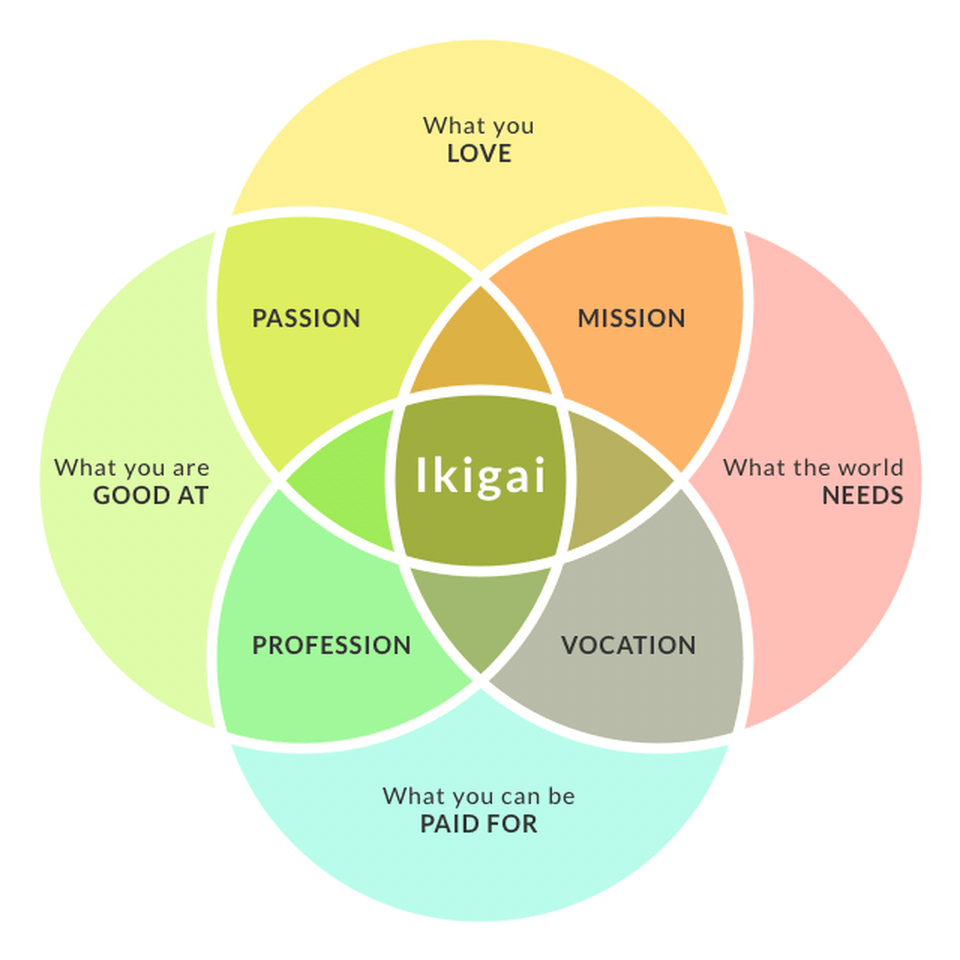
Ikigai Diagram Image Source: ontosomethingnew.org

Buy the book here

Why Read This Book

This is a book that will allow you to clearly figure what your purpose in life is. It is based on a Japanese concept that uses a Venn Diagram to dissect what you do and why you do it to figure out what you want out of life. If you are feeling stuck in a rut or lost in life, this is a must read.

Contents

  • Introduction
  • Aspects of Ikigai
  • What Are You Doing and Why?
  • What You Love
  • What The World Needs
  • What You Can Get Paid For
  • What Are You Good At
  • Finding Your Ikigai
  • Epilogue
  • Recommended Reading
  • Picture Credits

Summary

This book looks at our seven needs, everyday life and how we live longer when we are doing what we are supposed to be doing. It looks at how What You Love and What The World Needs blends to be our Mission, how What the World Needs and What You Can Get Paid for blends to be our Vocation, how What You Can Get Paid For and What You Are Good At blends to be our Profession and How What We Are Good at blends to be our Passion. The centre of all these is our Ikigai, it is a balance life, which incorporates our personal and professional endeavours. This book guides you through the process of completing your own Ikigai diagram to rethink your life.