2022 Goals: Defining Your Purpose

There is a lot of talk about finding your Purpose and then everything being good in your life. It is not as simple as that, but it is important to figure it out.

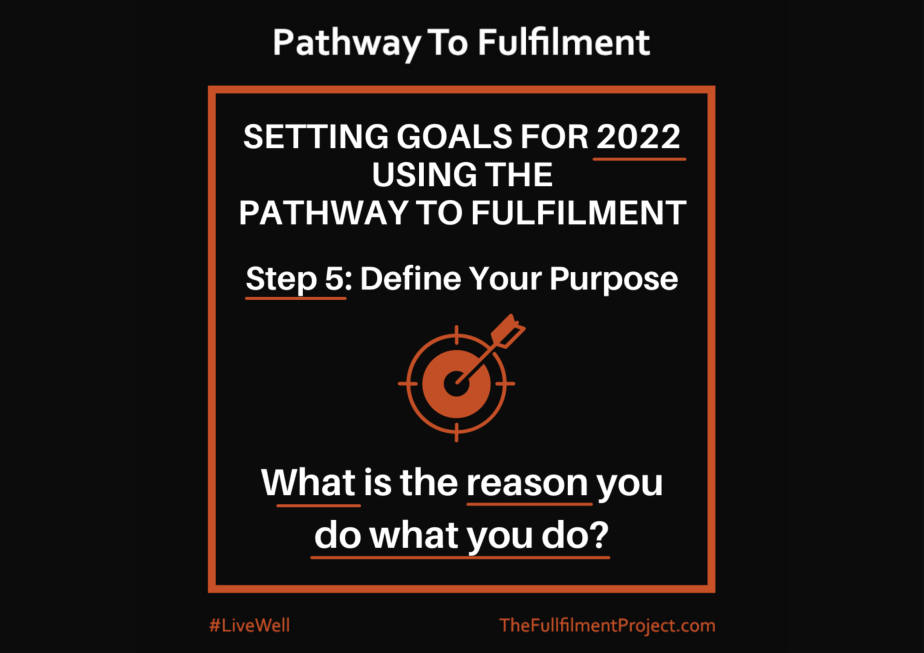
Step 5 in the Pathway To Fulfilment is Defining Your Purpose. This step comes after Step 1 and 2, where you firstly Acquire Wisdom and then develop Self Knowledge and then Self Mastery.

This process involves figuring out what your beliefs, values and ethics are. Then looking at the reason you do everything you do in life. Behind each reason is your Purpose. My Purpose is to help others live well.

So, what will you do this year to work on defining your Purpose?

You could look at what principle you already live by, you could define your beliefs about the important things in life, you could figure what you value or what your ethics are.

Being Creative

The act of being creative is essentially to take existing things and ideas and to create something new out of them. We write with words and we paint with paint. These are the typical things we think of as being creative, but there are many ways to be creative.

However, the things we create end up creating us too, because the act of creating them changes us. We are a different person after each act of creating through what we learn about ourselves and the world via the creative process.

Many people think of the thing they create as their baby. It is not a baby, it is a thing that exists because of you, but it is not a human being.

The human being in the creation process is the creator. If you want to use the Parent Child analogy then the creator is more like the Child, because the process of creating changes us and contributes to creating who we are.

Book Recommendation: Managing Oneself by Peter F. Drucker

Source of book cover image: Medium.com

Book can be bought here

Content of book can be read here

Why Read This Book

This is a small book full of deep wisdom around how we function in the workplace, what kind of person we are and what kind of place we should work in. Whether you are young or old, starting your career or further along, this little book can help you both live and work well.

Contents

  • What Are My Strengths?
  • How Do I Perform?
  • What Are My Values?
  • Where Do I Belong?
  • What Should I Contribute?
  • Responsibility for Relationships
  • The Second Half of Your Life
  • About The Author
  • Also By This Author

Summary

This book delves into questions around how we work and questions that we often do not consider when we are choosing where we work and the kind of job we choose to do. Questions like what our values are usually get left out of career conversations. The book goes on to discuss the contributions we make to the workplace and each other, as our relationships matter, and are things we are responsible for growing and maintaining. The book ends with a discussion on the second half of life, and what secondary work we begin in our later years that we are passionate about, whether this be Chair of the church council or Fund Raiser for a charity.

Knowing Yourself

Often it can be easy to become the things that those around us want us to be. With peer pressure, the pressure from modern culture to dress a certain way or act a certain way and the expectations of our parents all add to who we think we should be. However, this is not always who we actually are. If the version of ourselves that we present to the world is different from how we are in our own head, or in private, then something is wrong.


The problem is that if we live to other people’s expectations then we are never going to feel fulfilled, because all that we do will be for the benefit of others. To live life as your authentic self takes courage, because you will be judged by someone, maybe many, in your life. But if you do it, if you live as you with conviction then my friends you can become your best selves. Your achievements will then feel worth it.


When the way you live your life is aligned with your values and beliefs then your heart will feel full, contentment will permeate your thoughts and your levels of stress will be reduced. The thing to do is to get to know yourself, deeply.


Your Values


Your values are simply the things in life that you value. I know obvious right? What I mean is the things that you have strong feelings about. The things that stand out as important to you. Is it your family, your friends, is it justice or charity? Is it creativity or making money? None of these are good or bad, but they get to the essence of who you are.

I value creativity, stewardship, kindness and leadership very highly. I value my family highly too. I also value equality and respect for others. Figuring out what values are important to you will fill in part of the picture of who you authentically are.


Your Beliefs 


Beliefs are about how you think the world works and how you think people should behave. Beliefs include religious ideas as well as human ideas. It might be that God’s grace is real. It might be that karma is real. It might be that we should try to lift other up and not put them down. It might be that the winner takes it all and the loser dismissed.


There is a morality to figuring out our beliefs. They define what is right and wrong in your eyes. Figuring out what you believe about all sorts of things is really important. To question the beliefs that are given to you by others and decide if you too believe them, deep down in your heart, is very important too. We are all individuals and living life by someone else’s beliefs can be detrimental to us.

What Is Your Vocation

We all have jobs, generally speaking, but they are often not things that we have chosen because we deeply believe in the work we are doing. Often the job we have is simply a way of exchanging our time and energy for money to live on. If the work is in contrast to our values or beliefs then this can be a stressful situation. Some places of work are also focused on how much productivity they can squeeze out of us rather than helping us to reach our full potential.

Some of you will have things that you do outside of work, things that you have chosen to do. Things that you are passionate about. Things you are literally doing for free, because you love it. One thing I do is preaching in a Unitarian church. You might be a Scout leader, a volunteer in a charity shop, a volunteer in a food bank, a writer or a blogger. These are signs of the things that you could flourish at if you were doing it as you actual job. Your vocation can become your job if you have the courage to take a chance and go for it.

All of this is about figuring out who you are, how you work, what you deeply care about and living your best life, because you know your self. This is life’s mission, a personal journey such as this avoids a life that will feel wasted at it’s end, because you will be living on your terms, in your way, and not living your life through the expectations and peer pressure of others.

Go forth and discover your wonderful self and live according to your values and beliefs. Be courageous and live true to who you are.

Remedies To A Crisis

“Self-control is strength. Right thought is mastery. Calmness is power.” James Allen

Not Being In Control

We are going through a lot of anxiety across the world at the moment with the outbreak of the Coronavirus, there is much uncertainty around our health, whether we have the virus or if we will get it, whether we will lose our jobs, and when we have lost our jobs how we will pay the bills, whether our loved ones are safe, and how long this will all last. Some countries appear to be managing this crisis better than others, and these countries have been predominantly governed by women, whose natural instinct is often taken care of their people. Male leaders tend to be more head strong and want to appear to be strong.

These are generalisations, and not all male or female leaders fit these archetypes, but the global leadership styles that have kept some citizens safe and others not is quite telling. I think the degree to which people feel their leader(s) are taking care of them in a crisis is the degree to which we feel less or more anxious.

For example, some companies have said that they will guarantee that their staff will get paid, or at least 80% oft their salary, and that no one will be fired. Some smaller companies cannot afford to do this unfortunately, but those who are told that they will be taken care of will do all they can to keep their company going through this crisis, they will collectively protect their company because their leaders protected them.

On an individual level, it can be difficult to cope with the uncertainty, and the anxiety that arises from it, especially if we feel that we are not taken care of. Some express their anxiety through anger, we have seen an increase in domestic violence during this crisis. Some express this through trying to control unusual situations.

I heard a story from a friend of mine, who works on a shop, that an elderly man tried to attack her with a shovel, because she would not give him a refund for it, due to him not being able to provide a receipt. The shovel only cost £3, but I suspect he was trying to control the situation because he did not feel that he had control over other things due to this crisis.

In my experience, and through my research into how to live well, I think there are some crucial remedies to anxiety, especially when the anxiety is related to not feeling in control.

Self-Awareness

If we spend time being with our unpleasant emotions, as difficult as this is, if we can have the bravery to just be with them and not run away into distractions and intoxication then we can begin to see what things trigger our anxiety or our anger, or why we criticise and belittle others, then we can begin to develop deep self-awareness. The longer we spend being with ourselves in this way the more we are able to figure out our triggers for negative thoughts and behaviour and to find ways to handle these things better.

If we can figure out our triggers we can develop techniques to reduce our reactions to them, or if this is not possible, to find ways to avoid the triggers, for the sake of our own wellbeing. This is the life long process of self-improvement that will increase our quality of life and our wellbeing, because it will raise our happiness levels and improve our relationships.

Self-Control

If we can become more self-aware we can take responsibility for our own emotions and respond to situations rather than react to them. If we can begin to manage our emotions better we will have more control over what happens in our lives, because even though we cannot control being in the situations we find ourselves in necessarily, because we are already in them, we have a choice of how we act in the following moments.

If we have self-awareness and have developed self-control, then we have clearer thinking and can act out of compassion and altruism, and we can see further into the future of possibilities and determine our best course of action for a positive outcome. This type of mastery is mastery of the self, and it takes years to develop, but if we do not start then we will spend a lot of our lives reacting, often negatively, to each and every situation we find ourselves in and our happiness levels will plummet and our levels of anxiety will go up, because we will have less certainty.

When we let the uncertain nature of the world shake our sense of being we will always struggle. Self-awareness and self-control build a stoicism that will allow us to weather the storms of life and enjoy the fruits of it too.

Gratitude and Kindness

These are two of the most powerful antidotes to anxiety, in the moment. When we are grateful for the little things in life, then our bodies conspire to make us feel good with the hormones it produces. The same is true of being kind to others. To be grateful and to be kind makes us feel good and it reduces the hormones our bodies produce when we feel anxious.

Simply listing ten things we are grateful for every morning, making sure we smile at people and give them compliments, these are things we can all do, and if they become our daily habits then the crisis we are all in does not seem as bad. We develop the feeling that we are in this together and that we will get through this.

So, spend time with yourself, getting to know how you react and respond to difficult situations. Develop better strategies to manage yourself in these situations. Be more grateful for what you have and kinder to others around you. Do these things and this crisis will be easier to manage and you will be on your way to self mastery and a wonderful life.
The Power of Yet

“I truly believe in positive synergy,

that your positive mindset gives you

a more hopeful outlook, and belief

that you can do something great

means you will do something great.”

-Russell Wilson


It is all in the mindset

Much in life comes down to whether we think we can do something or if we cannot. These choices can sometimes seem fixed, but nothing could be further from the truth. Our brains are in a constant flux of change. Every new experience changes how we understand and view our past experiences and our memories can change as a result. Often there is a tendency to tell ourselves that we cannot do something, because either the evolution of our brains is trying to keep us safe by sticking to a cautious approach or we have had bad experiences trying new things in the past and we consequently back away from anything that is new or difficult.


It is our mindsets that are either fixed or flexible. The terms fixed mindset and growth mindset describe mental states that are both self imposed and imposed by our environment. If we are told that we have been successful because we are smart then we assume unconsciously that success comes from fixed personality traits. People with this mindset crumble when they hit a challenge beyond their capabilities. They do not have the mental flexibility to navigate around a challenge. If we are told that we are successful because we work hard then we assume unconsciously that success comes from hard work and determination. People with this mindset become lateral thinkers, they think outside of the box and when a challenge is beyond them they are more likely to keep trying until the challenge is overcome.


We are the architects of our lives

What we tell our children about their success becomes part of their mindset throughout life. Importantly what we tell ourselves can be with us throughout our lives as well. If you find yourself saying that you cannot do something out of a belief that it is beyond you then I encourage you to add the word ‘yet’ to the end of the sentence. “I can’t drive a car yet.” “I can’t draw yet.” “I can’t play the guitar yet.” “I can’t find a new job yet.” “I can’t run a marathon yet.” Whatever it is, there is power in the word ‘yet.’ Give it a try.


Something to reflect on:

Your power or your weakness is often based on a belief that you hold, whether consciously or not. Behaviour is based on conscious and unconscious beliefs. What beliefs do you have that are holding you back?

Know where you are starting from

Sometimes we feel paralysed by life and we feel that we should be doing something greater, something better, but we are unsure what this is. Fear of the future and the regret of the past paralyses us. It is important to pay attention to both the future and the past, but we have to do this in the right way.

When we are fearful of the future or regretful of the past our mind is rarely in the present, we are fully focused on the fear and the regret. If we are not present in the moment then we are preventing ourselves from being happy or successful in the present. We cannot act in the future or the past, but we can act in the present, so to get out of this paralysis we have to focus on what is happening now.

I used to spend a lot of my time thinking about what the future may bring, what my life might be like without knowing what I wanted to do with my life. I was so focused on the future I was missing the present. This is something that many of us do. We either don’t have a clear idea of what we want to achieve or we do have an idea but we aren’t sure what we need to do to reach this achievement, because we haven’t researched what we think we want. To figure out what we want to achieve with our career or our health or our relationships, we need to research our plans and start from where we are. This process has three stages to it: Grounding, Reflection and Decisive Action.

Grounding.

We need to move our focus and ground ourselves in the present. Asking ourselves what we are happy with and what we are unhappy with, what we have control over and what we don’t. This is our base camp and the end goal will be the summit of a theoretical mountain. Knowing ourselves deeply is always the best place to start. If we know ourselves then we will make decisions in our best interests.

Reflection

Next we need to reflect on our past through the prism of our present. We should reflect on our experience, our skills, our strengths, our interests, our values and our beliefs. Understanding how all of these things make up who we are in this present moment is very important.

This will help us to realise two things. What our overarching purpose is in our lives and from this what we want to see manifest in our lives. Our purpose is our why, why we do what we do and the way we do it. My ‘Why’ is “Finding purpose is a path we all walk together, through helping each other find happiness and success,” which is why I write this blog. Your ‘Why’ will help you find what you want to manifest in your life.

When we find our ‘Why’ and what we want to manifest in our life, next we should research it and find out all of its aspects before reverse engineering the steps from where we are now to where we want to be.

These first two stages will not happen over night, becoming grounded in the present involves developing new mental habits, which takes practice and dedication. However, it does help to think of this as creating new habits which will replace old ones, rather than trying to remove the old habits. This is a matter of where we put your focus.

Decisive Action

When we have grounded ourselves in our present circumstances and reflected on our skills and experience, our values and beliefs, then the next step is to set steps to achieve on the way to the goal. These will be metaphorical milestone on the climb up the mountain to achieve what we want to see happen in our lives.

An important step that many miss out is to research the goals we want to achieve in order to clarify what is involved and, importantly, if it is truly what we want to see happen. Some goals are set because something looks or sounds good or others are doing it and it is right for them. Just as we reflect deeply on ourselves, we have to put the same effort into analysing our goals. If the research is not done then we may achieve our intended goal but it may not produce the fulfilment we expect.

We each walk through our lives picking up experiences and memories, skills and understandings. Our sense of self is formed like a sculpture chipped out of rock over time, bearing the marks of these things. Each of our lives is a journey and our happiness and success are shaped by everything we experience and everything we think, say and do. Therefore, in order to live fulfilling lives our goals need to match who we are. Ground yourself in the present, reflect on your past and this will help you reach your desired goals in your future, the summit of that metaphorical mountain.

What is getting in the way of you finding the goals that match your true self?

Know thyself before leading others 

Gaining a deep understanding of yourself brings with it a feeling of being comfortable in one’s own skin, and this brings an inner confidence that is emitted out to everyone around you. It is about knowing what you value and what you believe. Your values and beliefs are your centre of gravity, so to speak, they are the compass and bearing of every decision you make. However, this is only a starting point of building yourself up as someone people look to for advice, collaboration and leadership.

You will need to prove yourself too, as someone who can be relied upon, who can be trusted and can lead others. This also has to be consistent, good leaders help those around them consistently, which builds trust. Without trust no organisation or team will succeed or work well together.

Knowing yourself is only the beginning, it is the foundation from which to build your new happier and successful self, and a place to begin as a leader. Good leaders inspire others to follow them through what they do, what they say, and how they treat those around them. If you look after those around you well consistently then are already a leader.

Stand in your own truth

I have heard the phrase “Standing in your own truth” a number of times and it has me intrigued. It has taken me some time to mull over what this deceptively deep statement means. At its most simple, I think it means being yourself and at its most complex it delves into the psyche and explores what is meant by the self and how we see ourselves in relation to the world and the society in which we live.

To me standing in your own truth means, firstly, that we have a good sense of who we are and, secondly, that we have the confidence to step forth into the world with this self on show. Something that leaves us vulnerable and shows our courage simultaneously. It is a step into the unknown grounded in the knowledge that we can take on whatever life can throw at us, but without deviating from our own truth, our own genuine self. This to me is courage itself, and is something we should all try to do. Standing in your own truth is better than following the apparent truth of someone else.