To Serve First Thrive

Put on your oxygen mask first is the instruction to parents when being given a safety briefing on a plane before the flight begins. The reason is that if you are unconscious, you can not help your child.

Equally, in day to day life, if you spend your time helping others and not looking after yourself, then you will become depleted, and your metaphorical cup will be empty. If you fill up your cup, then you have more to give.

In order to serve, you must first thrive yourself. To give you must first have plenty. This applies to your health, both mental and physical. To help others, you need to thrive so that the energy you give to others leaves you with energy to take care of yourself, too.

You also see the world and other people through the prism of yourself. You see things as you are, not how they are.

The Law Of Influence

The third Law of Stratospheric Success for the book The Go-Giver is The Law of Influence.

“Your influence is determined by how abundantly you place other people’s interests first.”

The Go-Giver

We all know people that regularly put themselves first, who ensure that their interests are met before focusing on others. Generally we do not trust these people. We have a built-in sense of community and what makes a community work. Instinctively we do not trust selfish people. Instinctively we trust those who take care of others first.

We also know when someone is pretending to care about others. Genuine empathy and compassion build strong bonds. So if you put the interests of others first then you will be trusted and your opinion is more respected. Therefore, the more you put others first the more influence you have. A good leader is a servant leader. They serve those that they lead. If you do not have a good leader to follow then be a good leader yourself.

The Law Of Compensation

The second Law of Stratospheric Success for the book The Go-Giver is The Law of Compensation.

“Your income is determined by how many people you serve and how well you serve them.”

The Go-Giver

When you have a customer facing job you get paid a certain amount of money, as you help one customer at a time. The higher up the chain you go the more money you get paid. With this comes more responsibility for serving more people, as your decisions affect more people. However, it also matters how well you serve people.

Service is not doing the bidding of others, it is giving people what they need. Great service is this and improving other people’s lives. Service with a smile brightens someone’s day. Having a conversation while serving someone makes them feel seen and heard.

When not customer facing, making big decisions through compassion and a moral compass means that people’s lives are improved and not negatively impacted. A CEO can take care of their employees. In fact I would say that this is the CEO’s primary role. If a CEO takes care of their employees then the employees will take care of the customers and the customers will be loyal and in turn take care of the business.

Serving Others Better

One of the principles I try to live by is ‘own your journey’ and another is ‘serve others,’ and to me these are very much linked. If we have our own issues with our health, relationships, work, etc that we leave unresolved, because we don’t want to deal with them, we are not in a good position to serve others. Therefore, in order to serve others well we need to make sure we are in a good place.

The way we make sure we are in a good place is to take ownership of our problems and find solutions for them. Anyone who has reached advanced stages of a spiritual practice will be effective in serving others, because they have put in the work of resoling their problems. Whether you are spiritual or not, you still have to do the work.

Imagine having such peace of mind and clarity that you help to solve the problems of others effectively. If more people took ownership of their lives the world would be a better place. Let’s do the work and make it better together.

Serve Others

One of my driver’s in life is to serve others. Not because it sounds good or that I intend to benefit from it, it is because serving others is something my parents modelled for me and it is now part of who I am.

I also feel that if we all spent some of our time serving others then the self interest, which is so pervasive in modern culture, will be reduced and society as a whole will be better off. It is also the right thing to do.

Service towards others makes us humble and helps us appreciate the help that others give to us. Also, we cannot be effective in life without working with other people. We need mentors and colleagues, friends and family, leaders to follow and those who we lead.

If we all look after the person the right of us and to the left of us we can do amazing things. There is a saying I have heard, but I am unsure on its origins.

If you want to go quickly go alone. If you want to go far go together.

Building A Community

When a tree grows there are usually other plants and herbs that grow around it and the type of tree will often dictate what grows around it. So much do that when native people who were looking for a particular medicinal herb they would look for a particular type of tree.

The relationship between a tree and the plants and herbs that grow around it is often decades in the making. When we reflect on the many communities to which we belong we can see the time and symbiosis that is required for communities to thrive. Depending on the community we may be the tree or we may be the herb, neither has more or less values that the other, they simply serve a different function in that community.

Working In Tandem

I was walking to work yesterday and an elderly couple passed me on a tandem bike and it occurred to me that this is a good metaphor for good leadership.

On a tandem bike the person at the front, the ‘Leader,’ directs the whole ‘team’ in a particular agreed direction and the person at the back, the ‘Worker,’ trusts that the direction they are going is right.

Also, both the Leader and the Worker put in the work to move the whole team forward. Each has their own role, the Leader’s job is to say I am going over there based on their vision and ask the Workers to follow them, but the Workers have to agree to get on the bike and put in the work to move everyone forward. In other words the Workers have to be enrolled in the direct the Leader wants to go.

The Leader has to have the trust of the Workers and, ideally, they should have values that are aligned with each other. We usually follow someone we trust and trust is based on shared values and strong relationships.

So, if you are a leader, make sure you have the back of everyone you lead and take the risk of leading; in other words you own failures and you give away praise to your team for the successes.

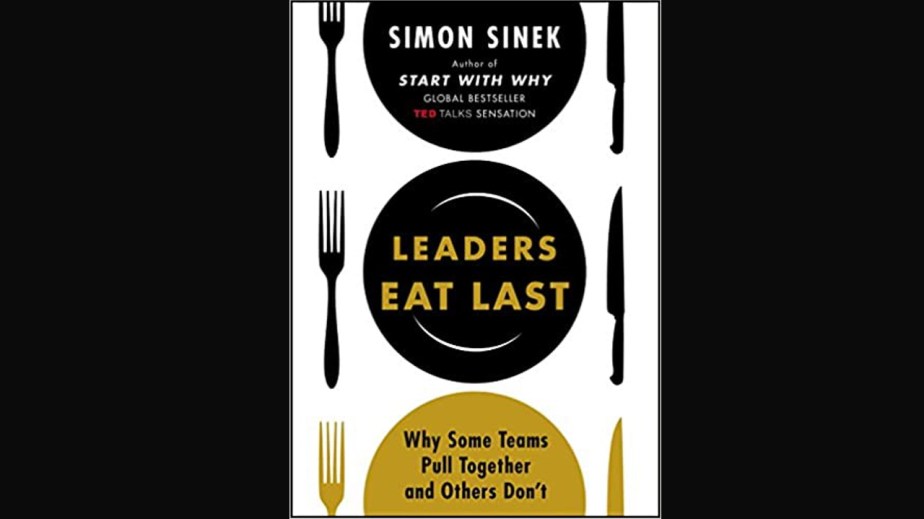
Recommended Book: Leaders Eat Last: Why Some Teams Pull Together and Others Don’t by Simon Sinek

“If your actions inspire others to dream more, learn more, do more and become more, you are a leader.”
― Simon Sinek

Image source: Amazon UK

Buy this book here

Why Read This Book

If you are in a leadership position, or are aspiring to be. this is an essential book to read. Also, if you want to help improve the culture of your workplace or to understand what it means to be a great leader,this is the book for you.

Contents

Part 1: Our need to feel safe

  • Protection from above
  • Employees are people too
  • Belonging
  • Yeah, but . . .

Part 2: Powerful forces

  • When enough is enough
  • E.D.S.O.
  • The big C
  • Why we have leaders

Part 3: Reality

  • The courage to do the right thing
  • Snowmobile in the desert

Part 4: How we got here

  • The boom before the bust
  • The boomers all grown up

Part 5: The abstract challenge

  • Abstraction kills
  • Modern abstraction
  • Managing the abstraction
  • Imbalance

Part 6: Destructive abundance

  • Leadership lesson 1: So goes the culture, so goes the company
  • Leadership lesson 2: So goes the leader, so goes the culture
  • Leadership lesson 3: Integrity matters
  • Leadership lesson 4: Friends matter
  • Leadership lesson 5: Lead the people, not the numbers

Part 7: A society of addicts

  • At the center of all our problems is us
  • At any expense
  • The abstract generation

Part 8: Becoming a leader

  • Step 12
  • Shared struggle
  • We need more leaders.
  • Appendix: A Practical Guide to Leading Millenials
  • Acknowledgements
  • Notes
  • Bibliography
  • Index

Summary

This book primarily explains why it is the role of leadership in organisations to take care of those in their charge, rather than just being in charge. The concept of the circle of safety within an organisation that means we are protected from outside dangers like the effects of the stock market or new innovations, and pandemics, which in turn creates more trust, cooperation and innovation. When we feel like we do not have to protect ourselves from our bosses, who might sack us if our numbers are not as high as they want them to be, then the organisation collectively works harder to protect the company from outside dangers.

The book also talks about how inhuman our decisions can become the further away we get from the people they effect. We have evolved to keep clear social links with around 150 people, so big organisations can mean the leaders at the top do not personally know those at the bottom, and the book talks about how leaders can resolve this by creating the right culture in their organisation. There are five leadership lessons, backed up by examples of both how it can go wrong and how it can go right. And the book ends with advice on becoming a leader and a new additional chapter on leading Millenials.