Finding Meaning Through Spirituality

What we often lack is meaning and purpose in life. With so many choices that we can make and so many interests and the interests of others pulling us in different directions we can make bad choices with big consequences. The benefit of spirituality is that it gives us structure, boundaries and of course both purpose and meaning, without formalised rules to follow. Without a guide that comes from a spiritual tradition we look for structure, purpose and meaning wherever we can find it.

This is why people join groups, whether it be a gang, supporting a football team or a religion. In any group that we join in order to feel like we belong, the rules and ethics are subscribed, they are the things we adopt in order to be accepted into the group. By and large there is no problem with this, as this is the way social beings live. We accept the laws in the country we live in because we want to live there. Others will accept the teachings of a religion in order to worship in a particular religious building. I advocate for joining a church or mosque, synagogue or temple because the usual end result is that good morals and ethics become central to life. 

However, formalised religion is not for everyone. Some wish to choose the rules and practices that they live by, which is a good way to live, as long as you have the ability to decipher what is wisdom and what is propaganda. There are many self proclaimed teachers of truth out there in the wonderful world of the internet.

Anyone can start a YouTube channel and start sharing their thoughts. Some reach a level of popularity and fame that suggests that they may know what they are talking about, people like Russel Brand and Jordan Peterson, who incidentally divide opinion due to their strong views. The rule of thumb when it comes to taking on the teachings of others is to ask yourself if following their advice is making you happier and more fulfilled. If it works then keep listening. if it doesn’t move on.

Walking A Spiritual Path

When you are on a spiritual path you are kind of on two journeys at the same time. In one we look to improve ourselves and become better people and in the other we look to improve the world around us and try to make it a better world. In his book Soul Boom, Rainn Wilson describes these like Kung Fu and Star Trek. The TV series Kung Fu represents an individual spiritual journey of self discovery, self discipline and finding meaning within. The original TV series Star Trek represents a better society where there is equality and equity, where an interracial kiss is normal and where meaning is found in serving the greater good.

In his book, Rainn Wilson writes, “What good is a spiritual path that only enriches our own inner peace while hundreds of millions go hungry and conversely how do we sustainably serve those millions if our hearts are hard, cold and filled with selfish ego or materialistic motives. How can there be peace without justice? There is an ongoing dance, a conversation between two moral paths that lie ahead of us. We seek personal enlightenment so that we can serve more, have an outward orientation and help create a better world. And when we undertake this service we are in turn internally awakened and fulfilled to an even greater degree.” [Rainn Wilson, Soul Boom – Scribed from a YouTube interview with Rich Roll where the passage was read out]


Rainn Wilson sees this as a kind of Yin Yang relationship, that each feeds into the other and requires the other. There is no better world without better people and no better people without a better world. As spiritual seekers we can take the best of the worlds religious faiths that speak to our individual morals, ethics and sense of how the universe works and make them our own, but we have to be prepared to walk the spiritual path of self awareness, self betterment and self wisdom, while we also help others around us who are walking their own paths, with their own challenges.

I wrote a poem some time ago called Spiritual Warrior and I feel that this is what walking a spiritual path is like. It takes courage to look at the inner depths of yourself and to try and mould yourself into a more enlightened person. The image of Siddhartha Gautama sitting under the Bodhi tree meditating, having decided not to move from that spot until he became enlightened, comes to mind. As the story goes, as Siddhartha Gautama began his seated quest, the demon Mara sent all of his monsters to tempt and torment him, but they had no effect and when he opened his eyes he was enlightened and became the Buddha. We do not have real demons tormenting us, but we have thoughts, memories and mental conditions that can make it difficult to walk the spiritual path, but, when we walk together, we are the Yin to each other’s Yang.

To Read Is To Grow

Many people don’t read on a regular basis. They read social media posts or snippets of news stories on their mobile phones, but reading seems to be something fewer people do for pleasure these days. I may be wrong, but that’s how it seems to me.

Reading has many benefits in terms of keeping the brain active, but the benefits beyond this depend on what you read. If we are to improve ourselves, to become wiser, kinder and happier, then what we read matters more than how often we read.

There are self development books and their are spiritual books, which are also self development books. Books that reach deep into you and show you what not to be and how to be in order to be happy and fulfilled in life. The wiser the content of what you read the happier you feel the more you read it. We all need progress, to varying degrees, and reading good books is the best way I know how to do so. To read is to grow.

Check out my recommended books on the Resources page.

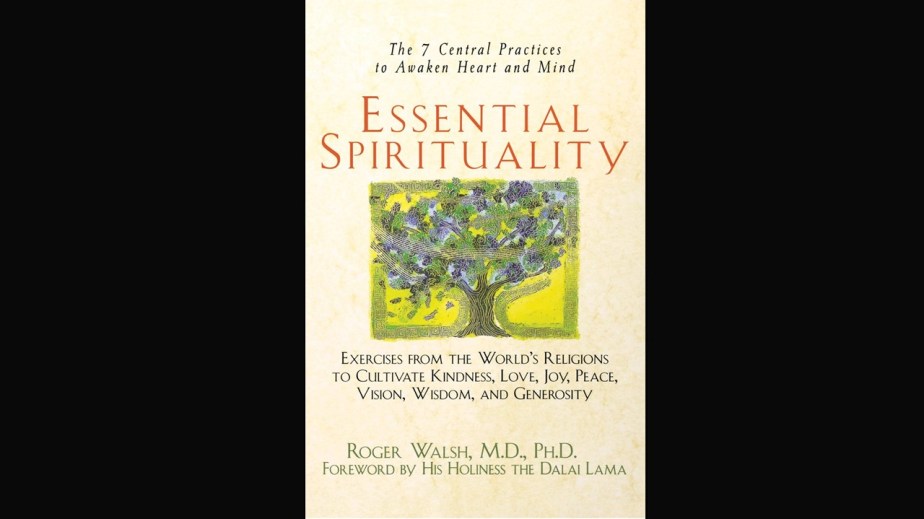
Book Recommendation: Essential Spirituality: The 7 Central Practices to Awaken Heart and Mind by Roger Walsh

“Our lives are rich with opportunities and our challenge is to live them to the full. All of us can be the creative artists of our lives.”
― Roger Walsh

Image Source: Amazon UK

Get The Book Here

Why Read This Book

This book covers seven practices that religions across the world include, practices that can help restore balance and create happiness in our lives. It is a book to read and then revisit to help you live a balanced and happy life.

Contents

  • Foreword by His Holiness the Dalai Lama
  • Introduction
  • 1.    Unveiling the Sacred
  • 2.    Discovering the Seven Practices
  • 3.    Using This Book
  • 4.    Spiritual Practices: What Do They Do and How Do They Do It?
  • The Seven Practices
  • Practice One: Transform Motivation: Reduce Craving and Find Your Soul’s Desire
  • 5.    The Secret of Happiness
  • 6.    Exercises to Reduce Craving
  • 7.    Find Your Soul’s Desire: Redirect Motivation
  • 8.    Exercises to Redirect Desires
  • 9.    The Higher Reaches of Desire
  • Practice Two: Cultivate Emotional Wisdom: Heal the Heart and Learn to Love
  • 10.    The Gift of Love
  • 11.    The Challenge of Difficult Emotions
  • 12.    Reducing Fear and Anger
  • 13.    Cultivate Love and Gratitude
  • 14.    The Higher Reaches of Love
  • Practice Three: Live Ethically: Feel Good by Doing Good
  • 15.    The Value of Virtue
  • 16.    What is an Ethical Life?
  • 17.    Exercises in Ethical Living
  • 18.    The Higher Reaches of Ethical Life
  • Practice Four: Rest in Peace: Concentrate and Calm the Mind
  • 19.    Your Meandering Mind
  • 20.    Develop a Peaceful Mind
  • 21.     The Higher Reaches of Concentration and Calm
  • Practice Five: Awaken Spiritual Vision: See Clearly and Recognize the Sacred In All Things
  • 22.    The Healing Power of Awareness
  • 23.    Exercises in Awareness
  • 24.    Seeing the Sacred in All Things
  • 25.    Exercises in Sacred Seeing
  • 26.    The Higher Reaches of Vision
  • Practice Six: Cultivate Spiritual Intelligence:  Awakening Wisdom and Understanding Life
  • 27.    What is Wisdom?
  • 28.    Awakening Wisdom
  • 29.    Exercises in Wisdom
  • 30.    The Higher Reaches of Wisdom
  • Practice Seven: Express Spirit in Action: Generosity and the Joy of Service
  • 31.    The Spirit of Service
  • 32.    Developing a Generous Heart
  • 33.    Exercises in Generosity and Service
  • 34.    The Higher Reaches of Generosity
  • 35.    Enjoy Your Self: Awakened Heart, Awakened Mind
  • Source Notes
  • Further Reading
  • Bibliography
  • Index

Summary

This book explores the different behaviours and ideas that cause us to be unhappy and to suffer, and practices to remedy them. There are seven practices, as the title of the book suggests, but there are also exercises within each chapter that are simple, but beneficial, for example “Exercise 9, Discover Your Future Self,” from the section entitled Exercises To Redirect Desires.

The author explores these subjects through the lens of the scriptures of our world religions and the writings of philosophers. It is practical, yet this book includes profound, deep wisdom. Whether you are religious or not, I recommend this book, it will apply some perspective to your life and help you find your path to a life well lived. The book is extensive, but you can dip into the section that relates to your current issues and find the guidance and exercises to help.

How to find fulfilment

“Your soul is the power and

core of who you are.

Feed it well.”

– Anonymous


Recently I have been reflecting a lot on what is meant by fulfilment, whether it is selfish or generous to seek it. How it is that we might find fulfilment and what it actually is. As human beings, we are all unique in our likes and dislikes, our personality and our passions, our behaviours and our tendencies. So, it makes sense that fulfilment would be an individual attainment, it would not be the same for everyone.
cropped-the-fullfilment-project-logo-profile-pic-black-white-red-v32.jpg

Since February last year I have been writing this blog about fulfilment, which I call The Fullfilment Project, with Fulfilment spelt with ‘FULL’ at the beginning, to signify a full life. I have been exploring happiness and success and what they mean in relation to fulfilment and I have come to believe that for fulfilment to occur we need to have both happiness and success, which to some degree is obvious. However, many who are looking for either happiness or success, I believe, focus on unfulfilling goals, as they are misguided by our culture and unhelpful beliefs. I am not now or have I previously claimed to have figured out the way to find fulfilment, I am an explorer looking for answers by asking questions and diving into hypotheses, and I have found some conclusions along the way, which I would like to share with you in this blog post.

I have created what I call a Fullfilment Framework, pieces of the puzzle of how to live a fulfilling life. These are drawn from personal experience and meditations, as well as seeking wisdom from both secular and religious sources. Wisdom comes in many forms, but it is still wisdom. In order to live a fulfilling life, I believe we need to begin with a good foundation, which is the core of a life well lived. There are three things I think we need in our fulfilment foundation.

Firstly, we need good self-knowledge, a deep understanding of ourselves, through self-reflection, knowing our values and beliefs and being tested in difficult situations and seeing how we deal with them. Secondly, we need acquired wisdom. Self-knowledge is not enough to guide us on a fruitful path, we also need to be steeped in wisdom, from secular, philosophical and religious sources. Thirdly, we need what I call the Good Health Triad. This is focusing on building for ourselves good mental health, good physical health and good energy or Chi health. Chi is an Eastern word for the life energy that flows within us and to have good health we need good Chi. All of these things we cannot do alone, we need friendships, companionship, and sometimes professional support, we need to learn good dietary and exercise habits and ways to boost and maintain our chi, all of which are good things.

From this Foundation comes our values and beliefs, which are like a prism through which we see the world, through which we think, speak and act in the world. The next level of finding fulfilment, I think, is to find out our ‘why’, our reason for doing all that we do. It is the purpose that guides us, distilled from our values and beliefs, from our self-knowledge and acquired wisdom. It can be difficult to figure out our ‘why’ with clarity. Often, we borrow from quotations or religious and philosophical ideas. I attend a Unitarian church, which was built on the idea that each individual person has a right to explore their own theology, to search for their spiritual truth rather than be told what The Truth is. All Unitarians connect with that, which is why they gather together and attend a Unitarian church. However, for each of them this may not be their personal ‘why’, because everyone is an individual, with different histories, experiences, values and beliefs. This is why I believe it is so important for each of us to search for what we believe our purpose to be in this life. It should be our North Star that guides us through both the calm and the troubled waters of life.

“…our North Star that guides us through both

the calm and the troubled waters of life.”

 

Simon Sinek-Start With WhyThen, when we discover our ‘Why’ we must discover how we are going to bring this ‘Why’ to life in our day to day lives. This is what I call our ‘Way’. In his book, Start With Why, Simon Sinek sets out the importance of finding your ‘why’ in order to live a purposeful life. He talks about how companies also need to clearly define their ‘why’, companies such as Apple have a clearly defined Why, to empower the individual against the big system. He also gives individual examples of Martin Luther King Junior who gave the “I have a dream” speech, not the “I have a plan speech”, as Simon Sinek puts it, and the Wright Brothers, who figured out powered manned flight for the first time, working out of their bicycle shop, with the intention of changing the world with their invention.

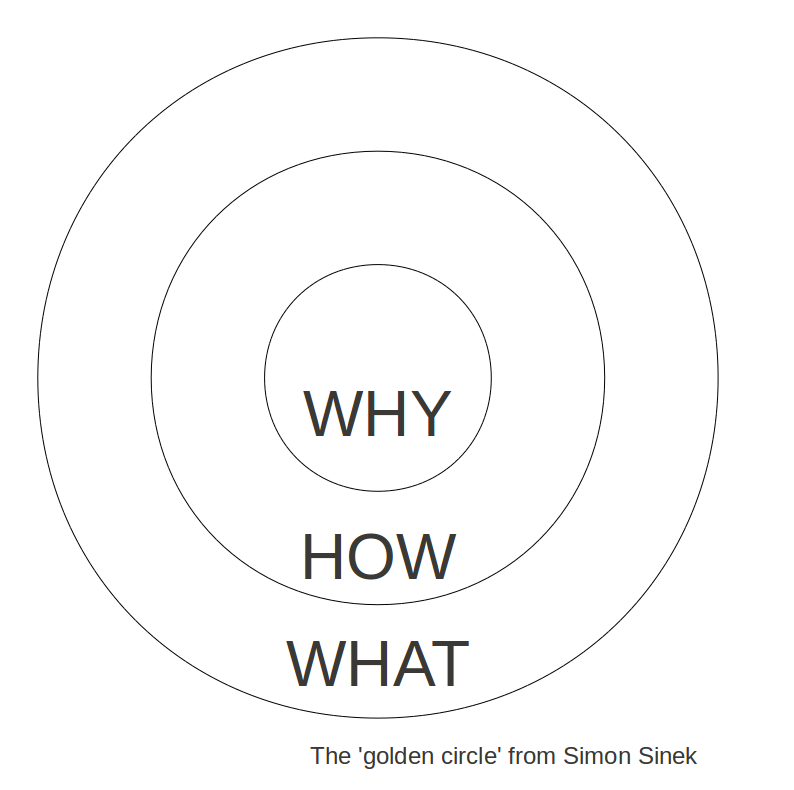
Simon Sinek says that we need to have clarity of our why first, then we can work outGolden_circle ‘how’ we express this why and then finally ‘what’ we do to prove the why we have. He calls this the Golden Circle, in the centre is the Why, then next the How and on the outside of the circle is the What, and it looks a bit like a bullseye. The important point here is that our human brains work from the why to the what when making decisions. The part of the brain that is responsible for decision making and our feelings like trust and loyalty is the Limbic Brain, which has no capacity for language. This is why we more easily agree with things that match our values and beliefs, not the details and the factual information.
My personal exploration of fulfilment has led me to a phrase that has hit home for me. The phrase is “To help others find fulfilment is to fulfil what it means to be human.” When this phrase first popped into my head I dismissed it as flippant and without substance, but through further reflection and meditation on this I have come to think that it has a certain depth to it that I did not initially appreciate.

“To help others find fulfilment is to

fulfil what it means to be human.”

On an evolutionary level we have evolved to be social animals, and during caveman times there would have been some in the group hunting and gathering food while others in the group would perform other functions for the survival of the collective whole. We evolved to have what Simon Sinek describes as a circle of safety, that everyone in the tribe made sure that they were all protected from the dangers outside of the tribe, whether this be the weather, dangerous animals or the scarce food and resources. It is hard-wired into our DNA to uplift those in our tribe, whether this is our family, our team or our congregation.

To encourage us to behave in a way that supports the tribe, evolution gave us some hormones that control certain behaviours. Our bodies produce Dopamine when we make achievements, it is an incentive to progress and we get a hit of Dopamine whenever we hit a milestone or tick something off our to-do list. Our bodies produce Serotonin when we perceive that others like or respect us. Our bodies produce Oxytocin when we are with our closest friends or trusted colleagues, it is the feeling of friendship, love and deep trust. All of which feel good.

The point I am making is that we have evolved to have hormones that actively encourage us to build meaningful, deep relationships, to strive for progress and try and get the affection and respect of those we care about. In other words, to feel happy and successful, on a biological level, we need other people. We need friends and family, loved ones and people we love. These relationships are key to living a fulfilling life. There is a problem though when we actively look to get these feelings that come from these hormones in unhelpful ways. For example, when we use social media and we get a like or a notification we get a hit of Dopamine, which feels really good, so we do it more, effectively replacing people with a device.

Life is beter in flip flopsAdvertising companies tell us that we will become either happy or successful if we buy their product or service, only to be told a few months down the line that a new product or service will do the same, but neither a product or a service will make us happy, as they are invariably transient, they change or break and the happiness promised is really only excitement and joy. We are often told that the measure of success is the amount of money we have or the amount of things we own, but it really does depend on how we measure success, as individuals.

I believe that success is very much intertwined with happiness and that you cannot have one without the other. As human beings we are hardwired to strive after progress, but if we are deeply unhappy or depressed, progress is not a clear focus for us. So, you could say that we need to be happy to succeed and we need to succeed to be happy, but the success really does need to be in an area that we passionately care about, something that is in line with our values and beliefs, in line with our ‘why.’ Which is why it is so important to figure out what our ‘why’ is.

Many religious scriptures tell us that in order to be happy we must first help others be happy. I think this is partly because we are hard-wired with our hormones to feel good when we help others to be happy in their lives. Their smile makes us smile, especially if we are the cause of it. However, this comes with a warning, we must ensure that we take care of ourselves as well. If we are not careful we can spend all of our time making sure everyone else is OK and we do not look after ourselves. A balance is needed, which is why we need a good fulfilment foundation.

When it comes to success, achieving success with others feels more magnified than a solo achievement. Even athletes who take part in sports events individually could not achieve success without a coach and their loved ones supporting them. When we focus on goals that are innately selfish, like earning a large amount of money, we often sacrifice our relationships to earn the money, which is an empty success when achieved, because it brings very little happiness. But if we do it with the motivation to help others we feel great happiness when we succeed, because of the positive effect we have on others.

I am now a firm believer that both happiness and success are reciprocal, in that they are received, in part, when we give them to others. And as fulfilment is largely dependent on both happiness and success, fulfilment is reciprocal as well, but it is not something that we can go out and find, like a treasure hunt, fulfilment is a sense of being that comes from living life well, through positive relationships, a good understanding of ourselves, the wisdom of others, good health, and living in a way that brings more joy, love and peace into the world than their opposites. To help others find fulfilment is to fulfil what it means to be human.


Something to reflect on:

Whether you believe that we only get one life or not, to live deeply is to live well. cultivate positive relationships, help others when you can and strive to be your best self, so you can help other to do the same. This is a worthy goal and we need a worthy goal to live a fulfilling life.

The problem with division

“When fear displaces reason, the result is often irrational hatred and division.”

– Al Gore


We have all experienced division in one form or another, often in the groups of people we share our lives with, because we interact with them the most and opinions and beliefs can cause friction and division.


Division and disagreement are not the same

Having a difference of opinion is not the same as division, though in the many public spheres of society it is seen as such, especially in politics and religion, as cliche as this is. Disagreeing and division can be seen as the same thing, as if to have a point of view you have to be one extreme or another. This creates the unfortunate paradigm of a polarised society. We have seen this in the recent presidential elections in America and the confrontational tweets, comments and rants from President Trump.


We also see it in the politics in the UK, with many feeling that they have to be either Conservative or Labour supporters, and these are seen by many as polar opposites. This disagreeing in a society that appears to value, and in some cases promote, a them and us mentality has brought about a situation where there is little room for people to debate and disagree and still remain on good terms. It is definitely something that is promoted in the media and in TV programs because it improves the ratings, because, though we might not openly admit it, many of us enjoy watching other people at loggerheads. This has given rise to the era of reality TV, soap operas and gossip magazines. Rarely in these type of programs and magazines are people getting along and being nice to each other.


Division creates conflict

At the heart of every division is a conflict created by the very division itself. This begins when we are born into the world and all of our senses are jumbled up and we have not yet learned to differentiate between things. Slowly we learn to know the difference between ourselves and others, between colours and object, and this goes on until we have categorised everything so that we can understand the world and operate within it. This often then leads onto catetorising groups of people, almost as tribes, like football  teams and religions groups.


Many of the great sages and prophets from the variety of world religions and philosophies from around the world have promoted the idea that we have to unlearn these categories, as they are in effect divisions which set one thing against another, such as man and nature or culture and culture or person and person. But deeper than that they promote the idea of an overall oneness to the universe that, once acknowledged, will allow us to temper our conflicts and remove them, because once the divisions are gone then so are the conflicts.


We all have a part to play

Often when we are in the middle of a conflict with someone we are offended largely because we see the conflict as the other persons fault and their responsibility to walk away or solve the conflict, because they started it. However, this is massively dis-empowering, because this leaves all of the power with the other person. In every conflict that we are apart of we have a part to play, either because we in some way contributed to the conflict by our behaviour or lack of actions, or we have a chance to end the conflict with what we choose to say and do, or not say and not do.


For example, if someone is very angry and shouting at you, putting ourselves in their shoes or asking questions and listening actively we can find out the cause of their behaviour. Often when we do this we can easily resolve the problem by focusing on the cause rather than the behaviour. Taking some responsibility in every situation gives us the power to make change in the world and help more people than we hinder. Division and conflict are things that we can all work to minimise in our lives, and as a result we can have a positive impact on the world, leaving it better than we found it.

5 Books to help you get your life on track

“Books are the training weights of the mind.”

-Epictetus


Books, it has been said, are windows into the soul and the doorways into dreams, but they also have the function by which we broaden our minds, sharpening our intellect and help ourselves live better lives. They are signposts on the path to happiness, success and fulfilment, the ingredients of a life well lived. These are 5 books that I believe will lead to a life well lived. They span the categories of health, self-improvement and spirituality. All three of these categories relate to the Foundation in my Fullfilment Framework, which is an evolving framework which I believe will lead to living a fulfilled life. (You can click on the titles of the books to take you to Amazon should you wish to buy a copy, though there are many other excellent online outlets where you could buy the books).


1. Start With Why, How Great Leaders Inspire Everyone To Take Action by Simon Sinek


“There are many ways to motivate people to do things, but loyalty comes from the ability to inspire people. Only when the WHY is clear and when people believe what you believe can a true loyal relationship develop.”


I am going to begin with Start With Why, an excellent book for figuring out your own ‘Why’, whether as an individual or as a company. Our ‘Why’ is our purpose, our reason for being, it is the thing that is behind every decision we make and every action we take, it is an essential part of our mind, body and soul. Our ‘Why’ is formed by the time we are in our early 20s, but many of us do not know what it is, or we do but we do not understand it well enough to utilise it in making a fulfilled life for ourselves. It is only now in my mid-thirties that I have figured out my ‘Why’, which is to help others be fulfilled in their lives. My Why is the motivation I use when at work, at church, with friends or with family, it is also the reason I have begun writing this blog.

This book takes us through the world that does not start with Why and the consequences of it. It then goes on to talk about the biology of our human brains and how the concept of Why is in harmony with our biology. It then goes on to discuss the successes various famous people and companies have had because they know their ‘Why’. The book is an excellent introduction to the concept of having a Why and it will help you figure out what your Why is, so you can align your life with it.


2. The Motivation Manifesto by Brendon Burchard


“We must ask: When will we be ready to ascend to another level of existence.”


This book is about focusing your life for success. It begins with ‘The Declaration of Personal Power.’ It is about reclaiming our sense of self and channeling our energy into self renewal and success in our lives. Section One in the book looks at our human nature and how we are affected by freedom, fear and motivation. We have conditioned responses to each of these, but if we were to take control of our responses then we can be free, courageous and generate our own motivation.

Section Two goes through a list of nine declaration on what we shall do, for example, “We Shall Reclaim Our Agenda” and “We Shall Defeat Our Demons.” These declaration empower us to be in the driving seat of our lives so that we can make our lives magnificent. This is something we can all do, every single one of us.


3. Healing Foods, Eat Your Way to a Healthier Life by Neal’s Yard Remedies


“The food we eat has an overreaching effect on our health and well-being, whether we are conscious of it or not.”


This book contains a wealth of knowledge about how food can be used to heal and to help us live a healthy life. It begins with different dietary patterns and diversity from around the world. It compares GM foods to food the way nature intended (organic) and it goes through the benefits of supplements. The main body if the book is an extensive look at the foods that heal. The food types are divided into Fruits, Vegetables, Nuts, Seeds and Sprouts, Medicinal Herbs, Culinary Herbs, Cereals and Grains, Pulses, Spices, Fats and Oils, Fermented Foods, Meats, Oily Fish and Other Foods. There is also a section with some wonderful Recipes That Heal and recipes set out into daily meals and types of foods. For a healthy body and a sense of well-being, our physical health is essential. Everything tat we eat and drink becomes our bodies, we are what we eat.


4. The Way of Qigong, The Art and Science of Chinese Energy Healing by Kenneth S. Cohen


“Qi is the Chinese word for “life energy.”… …Gong means “work” or “benefit acquired through perseverance and practice.” Thus, qigong means working with the life energy, learning how to control the flow and distribution of qi to improve the health and harmony of mind and body.”


Qigong is an ancient practice of generating and controlling the energy that flows through our bodies, which is a distinctly Eastern practice and a major part of Chinese medicine. In the Western model of medicine the focus is on treating the symptoms without trying to find the cause(s). I have experienced this first hand with my onset of Fibromyalgia. I went to see a variety of experts who could only see their specific section of the body and its functions, but having been treated by practitioners of Chinese medicine I can vouch for the fact that the focus is more on the whole body and fixing the cause of the illness, to bring the body back into balance.

This book firstly explains what Qigong is, its history and scientific evidence proving that it works. It then explains Qigong basics, ways of using Qigong to heal yourself and living a Qigong lifestyle. The book goes into a lot of depth, but explains everything in a way that makes sense and is easy to follow, with physical practices that are not very different from Tai Chi. In the West energy healing, or Qigong, is little known about, but it is slowly filtering into our culture in the same way that Martial Arts, Yoga and Tai Chi have done, it is only a matter of time.


5. Spiritual Renegade’s Guide to the Good Life by Lama Marut


“This book is for desperados. It’s for those who know life is short and who are tired of wasting day after day in low-level unhappiness as they wait for the next high-level version… …It’s a guide for those tired of trying to become well-adjusted to a perverse society and who are willing – even eager – to deviate from the norm.”


This book comes from a Buddhist standpoint, but it acknowledges the teachings of other world religions, and takes a common sense view of how to live a spiritual life, which, as every Prophet and Sage has taught, usually goes against the system. In our case it goes against the Capitalist culture we live in, which is designed to keep us unhappy, so we will keep buying things to keep the economy rolling on. Stepping off this hamster wheel and fighting the power by being content is the first step, because contentment is entry level happiness, the first step towards enlightenment, or perfect happiness.

What I like about this book is the short sections within each chapter which allow us to absorb the points made and practices suggested. There is also a Couch Potato Contemplation and an Action Plan at the end of each chapter. The Couch Potato Contemplation is something to reflect on from the chapter that you have just read, but rather than treating it like a serious meditation, it is something to just sit and think about while sat on the couch. The Action Plan is a behaviour to try and embody based on the teachings in the chapter we have just read, something simple but that challenges the status quo for the better. Each section also has a QR code that we can scan with our mobile phone, which takes us to YouTube Videos of Lama Marut giving teachings related to the section we have just read, to embed the learning and explore the ideas presented.


There is a Recommended Reading List on my blog site that has these books and many others under the categories:

  • Happiness, Health and Success
  • Theology and Philosophy
  • History and Science
  • Fiction


Resources


YouTube Channel of Dr John Bergman, who talks about how to achieve good health naturally without chemicals like medication.

YouTube Channel of Lama Marut, a Buddhist Lama who teaches deep Buddhist teachings in easy to understand lectures.

Website of Jim MacRitchie, a Qigong Acupuncturist who teaches Qigong classes (There are free Qigong resources on this website).

Website of Simon Sinek, discussing the concept of ‘Why’ and resources to use this concept to improve your life and that of others.