
“Your soul is the power and
core of who you are.
Feed it well.”
– Anonymous
Recently I have been reflecting a lot on what is meant by fulfilment, whether it is selfish or generous to seek it. How it is that we might find fulfilment and what it actually is. As human beings, we are all unique in our likes and dislikes, our personality and our passions, our behaviours and our tendencies. So, it makes sense that fulfilment would be an individual attainment, it would not be the same for everyone.

Since February last year I have been writing this blog about fulfilment, which I call The Fullfilment Project, with Fulfilment spelt with ‘FULL’ at the beginning, to signify a full life. I have been exploring happiness and success and what they mean in relation to fulfilment and I have come to believe that for fulfilment to occur we need to have both happiness and success, which to some degree is obvious. However, many who are looking for either happiness or success, I believe, focus on unfulfilling goals, as they are misguided by our culture and unhelpful beliefs. I am not now or have I previously claimed to have figured out the way to find fulfilment, I am an explorer looking for answers by asking questions and diving into hypotheses, and I have found some conclusions along the way, which I would like to share with you in this blog post.
I have created what I call a Fullfilment Framework, pieces of the puzzle of how to live a fulfilling life. These are drawn from personal experience and meditations, as well as seeking wisdom from both secular and religious sources. Wisdom comes in many forms, but it is still wisdom. In order to live a fulfilling life, I believe we need to begin with a good foundation, which is the core of a life well lived. There are three things I think we need in our fulfilment foundation.
Firstly, we need good self-knowledge, a deep understanding of ourselves, through self-reflection, knowing our values and beliefs and being tested in difficult situations and seeing how we deal with them. Secondly, we need acquired wisdom. Self-knowledge is not enough to guide us on a fruitful path, we also need to be steeped in wisdom, from secular, philosophical and religious sources. Thirdly, we need what I call the Good Health Triad. This is focusing on building for ourselves good mental health, good physical health and good energy or Chi health. Chi is an Eastern word for the life energy that flows within us and to have good health we need good Chi. All of these things we cannot do alone, we need friendships, companionship, and sometimes professional support, we need to learn good dietary and exercise habits and ways to boost and maintain our chi, all of which are good things.
From this Foundation comes our values and beliefs, which are like a prism through which we see the world, through which we think, speak and act in the world. The next level of finding fulfilment, I think, is to find out our ‘why’, our reason for doing all that we do. It is the purpose that guides us, distilled from our values and beliefs, from our self-knowledge and acquired wisdom. It can be difficult to figure out our ‘why’ with clarity. Often, we borrow from quotations or religious and philosophical ideas. I attend a Unitarian church, which was built on the idea that each individual person has a right to explore their own theology, to search for their spiritual truth rather than be told what The Truth is. All Unitarians connect with that, which is why they gather together and attend a Unitarian church. However, for each of them this may not be their personal ‘why’, because everyone is an individual, with different histories, experiences, values and beliefs. This is why I believe it is so important for each of us to search for what we believe our purpose to be in this life. It should be our North Star that guides us through both the calm and the troubled waters of life.
“…our North Star that guides us through both
the calm and the troubled waters of life.”
 Then, when we discover our ‘Why’ we must discover how we are going to bring this ‘Why’ to life in our day to day lives. This is what I call our ‘Way’. In his book, Start With Why, Simon Sinek sets out the importance of finding your ‘why’ in order to live a purposeful life. He talks about how companies also need to clearly define their ‘why’, companies such as Apple have a clearly defined Why, to empower the individual against the big system. He also gives individual examples of Martin Luther King Junior who gave the “I have a dream” speech, not the “I have a plan speech”, as Simon Sinek puts it, and the Wright Brothers, who figured out powered manned flight for the first time, working out of their bicycle shop, with the intention of changing the world with their invention.
Simon Sinek says that we need to have clarity of our why first, then we can work out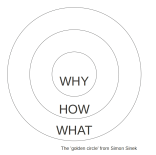 ‘how’ we express this why and then finally ‘what’ we do to prove the why we have. He calls this the Golden Circle, in the centre is the Why, then next the How and on the outside of the circle is the What, and it looks a bit like a bullseye. The important point here is that our human brains work from the why to the what when making decisions. The part of the brain that is responsible for decision making and our feelings like trust and loyalty is the Limbic Brain, which has no capacity for language. This is why we more easily agree with things that match our values and beliefs, not the details and the factual information.
My personal exploration of fulfilment has led me to a phrase that has hit home for me. The phrase is “To help others find fulfilment is to fulfil what it means to be human.” When this phrase first popped into my head I dismissed it as flippant and without substance, but through further reflection and meditation on this I have come to think that it has a certain depth to it that I did not initially appreciate.
“To help others find fulfilment is to
fulfil what it means to be human.”
On an evolutionary level we have evolved to be social animals, and during caveman times there would have been some in the group hunting and gathering food while others in the group would perform other functions for the survival of the collective whole. We evolved to have what Simon Sinek describes as a circle of safety, that everyone in the tribe made sure that they were all protected from the dangers outside of the tribe, whether this be the weather, dangerous animals or the scarce food and resources. It is hard-wired into our DNA to uplift those in our tribe, whether this is our family, our team or our congregation.
To encourage us to behave in a way that supports the tribe, evolution gave us some hormones that control certain behaviours. Our bodies produce Dopamine when we make achievements, it is an incentive to progress and we get a hit of Dopamine whenever we hit a milestone or tick something off our to-do list. Our bodies produce Serotonin when we perceive that others like or respect us. Our bodies produce Oxytocin when we are with our closest friends or trusted colleagues, it is the feeling of friendship, love and deep trust. All of which feel good.
The point I am making is that we have evolved to have hormones that actively encourage us to build meaningful, deep relationships, to strive for progress and try and get the affection and respect of those we care about. In other words, to feel happy and successful, on a biological level, we need other people. We need friends and family, loved ones and people we love. These relationships are key to living a fulfilling life. There is a problem though when we actively look to get these feelings that come from these hormones in unhelpful ways. For example, when we use social media and we get a like or a notification we get a hit of Dopamine, which feels really good, so we do it more, effectively replacing people with a device.
 Advertising companies tell us that we will become either happy or successful if we buy their product or service, only to be told a few months down the line that a new product or service will do the same, but neither a product or a service will make us happy, as they are invariably transient, they change or break and the happiness promised is really only excitement and joy. We are often told that the measure of success is the amount of money we have or the amount of things we own, but it really does depend on how we measure success, as individuals.
I believe that success is very much intertwined with happiness and that you cannot have one without the other. As human beings we are hardwired to strive after progress, but if we are deeply unhappy or depressed, progress is not a clear focus for us. So, you could say that we need to be happy to succeed and we need to succeed to be happy, but the success really does need to be in an area that we passionately care about, something that is in line with our values and beliefs, in line with our ‘why.’ Which is why it is so important to figure out what our ‘why’ is.
Many religious scriptures tell us that in order to be happy we must first help others be happy. I think this is partly because we are hard-wired with our hormones to feel good when we help others to be happy in their lives. Their smile makes us smile, especially if we are the cause of it. However, this comes with a warning, we must ensure that we take care of ourselves as well. If we are not careful we can spend all of our time making sure everyone else is OK and we do not look after ourselves. A balance is needed, which is why we need a good fulfilment foundation.
When it comes to success, achieving success with others feels more magnified than a solo achievement. Even athletes who take part in sports events individually could not achieve success without a coach and their loved ones supporting them. When we focus on goals that are innately selfish, like earning a large amount of money, we often sacrifice our relationships to earn the money, which is an empty success when achieved, because it brings very little happiness. But if we do it with the motivation to help others we feel great happiness when we succeed, because of the positive effect we have on others.
I am now a firm believer that both happiness and success are reciprocal, in that they are received, in part, when we give them to others. And as fulfilment is largely dependent on both happiness and success, fulfilment is reciprocal as well, but it is not something that we can go out and find, like a treasure hunt, fulfilment is a sense of being that comes from living life well, through positive relationships, a good understanding of ourselves, the wisdom of others, good health, and living in a way that brings more joy, love and peace into the world than their opposites. To help others find fulfilment is to fulfil what it means to be human.
Something to reflect on:
Whether you believe that we only get one life or not, to live deeply is to live well. cultivate positive relationships, help others when you can and strive to be your best self, so you can help other to do the same. This is a worthy goal and we need a worthy goal to live a fulfilling life.


 The Fullfilment Project