Don’t Call It Mental Health

It seems that the idea of mental health permeates Western culture as a requirement of wellbeing and a keen focus for employers and self-help gurus alike. The problem with the term and idea of mental health is that it is innately something that you have or you don’t. To feel that we don’t have it makes us feel that our life and mental state is below par and, therefore, less worthy than those who have it. It can make us feel that we are not enough.

I agree with Simon Sinek that a better term is ‘mental fitness’. It better describes the gradient upon which mental wellness sits. It becomes a scale and a skill to improve. It opens up the idea of working towards mental wellbeing one step at a time, much like building up strength or stamina. It implies a journey and not a binary situation where you have it or not. It allows for bad days and good days and avoids the self degradation that befalls those who do not feel mentally well. This includes those who have experienced war, as a soldier and a civilian.

Having A Mindset For Wellness

Your well-being is very much in your control. It is about habits, behaviours and making the right decisions. Sometimes life can cause us to pick up bad habits, bad behaviours and cause to make bad decisions. Indulging in what feels or tastes good does not always mean we live a good life.

However, we can learn new habits and behaviours and we can make better decisions. What we need is guidance, guidance on thinking well and on living well. Whether this comes from a religious source or a mentor, there is support out there, we just need to look for it. It begins with how we think. If we think well we can be well.

How To Generate Wellness

Life comes down to accumulation and balance. What we eat, drink and breathe over time becomes our bodies. The good and the bad is taken in and assimilated. The accumulation of what our body takes in every day bends towards good health or illness. The thoughts we have and the things we allow our minds to be exposed to every day will bend towards good mental and emotional health or mental illness.

Our daily habits also have an a cumulative affect. If we practice Chi Kung (Qigong), Tai Chi or Yoga every day our energy levels and energy quality will be good. If we meditate every day our mind will be calmer and more focused. If we focus on our professional success and make small improvements on a daily basis, we will succeed exponentially. It has been said that if we study a subject for one hour a day we can become a world expert in five years.

All of these things need to be balanced too. If we focus too much on our mind we will neglect our body, and vice versa. We need a synergy between mind and body where each influences the other positively. Accumulation and balance, when well managed, will generate wellness.

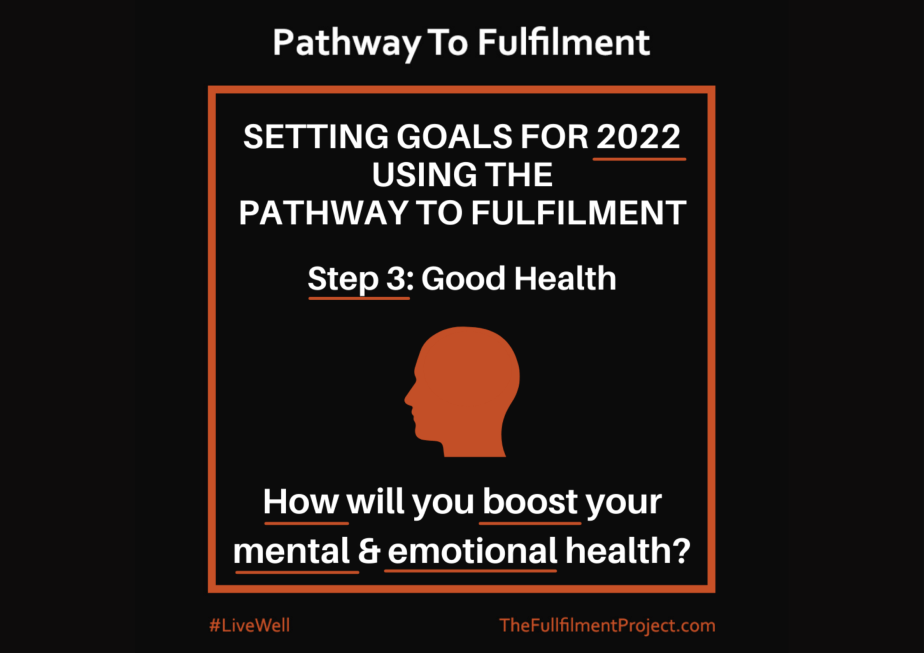
2022 Goals: Mental and Emotional Health

Step 3 in the Pathway To Fulfilment is Good Health, which includes Mental and Emotional Health and two other elements which I will discuss in the coming days.

This is a topic that is often ignored or not discussed for fear of being judged or characterised negatively. However, to take on the task of ensuring your own wellbeing in this area is empowering and essential to live a fulfilling.

It creates opportunities that were otherwise obscured by the challenges that mental health difficulties create. A lot of this work is to figure out what makes us feel happy or joyful and what makes us feel sad or angry. It is understanding how we respond to the world and the people in our lives and whether our thoughts are helpful or a hindrance.

So, how will you boost your mental and emotional health this year?

You could start a journal, see a therapist, start a hobby, clear the air with someone in your life, or start meditating. There are lots of small things you can do that will make a big difference.

Being Together

Yesterday we went to a Halloween party as a family. The children played musical statues and musical chairs and everyone ate well, danced and had a great time. It was good to be with other people.

There is something special about coming together for a shared celebration and just having a good time. This is something that left a hole in our lives when such things were banned during the several pandemic lockdowns over last year and this year.

We thrive when we are part of a ‘tribe’ and we celebrate together. The shared experience solidifies relationships and helps us to feel as if we belong. To be happy, successful and ultimately fulfilled in life we need to belong and spend time with those in our tribe, our community.

Cultivating Wellbeing

Wellbeing is often thought of as an ambition to feel better and laugh more. This is like looking at a garden and focusing on the need to have flowers. This is upside down thinking. If we were to plant the seeds, cultivate the soil, water the ground and ensure there is good sunlight, then flowers will appear. If we cultivate our bodies, so we may feel physically well, cultivate our relationships, so we may feel connected to others, cultivate our thinking, so we may feel mentally well, and cultivate our purpose, so that we have a direct towards which we work, laughter, joy, love and a feeling of wellbeing will blossom all by themselves. Without this wellbeing will never blossom.

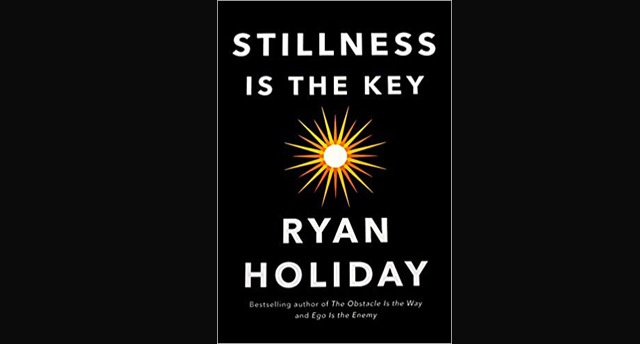
Book Recommendation: Stillness Is The Key by Ryan Holiday

Why Read This Book

If life is feeling chaotic and challenging, with the feeling that there is little stillness in your life, this book will help bring you wisdom and bring stillness to your everyday existence. It is a remedy for the challenges of modern life.

Contents

  • PREFACE
  • INTRODUCTION

PART 1: MIND

  • The Domain Of The Mind
  • Become Present
  • Limit Your Inputs
  • Empty The Mind
  • Slow Down, Think Deeply
  • Start Journaling
  • Cultivate Silence
  • Seek Wisdom
  • Find Confidence, Avoid Ego
  • Let Go
  • On To What’s Next…

PART 2: SPIRIT

  • The Domain Of The Soul
  • Choose Virtue
  • Heal The Inner Child
  • Beware Desire
  • Enough
  • Bathe In Beauty
  • Accept A Higher Power
  • Enter Relationships
  • Conquer Your Anger
  • All Is One
  • On To What’s Next…

PART 3: BODY

  • The Domain Of The Body
  • Say No
  • Take A Walk
  • Build A Routine
  • Get Rid Of Your Stuff
  • Seek Solitude
  • Be A Human Being
  • Go To Sleep
  • Find A Hobby
  • Beware Escapism
  • Act Bravely
  • On To The Final Act
  • AFTERWORD
  • WHAT’S NEXT?
  • ACKNOWLEDGEMENTS
  • SOURCES AND BIBLIOGRAPHY

Summary

This little book is a soulful look at the human condition through the lens of the mind, the soul and the body. There are lots of examples of well known people’s lives and how they struggled and succeeded in different ways of being to bring about stillness. There is a lot of advice about how to live in a way that brings about stillness and a clear exploration of the pitfalls that push it away, based on these examples of real situations, including Tiger Woods’s personal demons and the US President John F. Kennedy’s handling of the Cuban missile crisis. Ryan Holiday has the steady voice of a wise elder in this book, someone who deeply understands what it means to live a life with stillness.

Knowing Yourself

Often it can be easy to become the things that those around us want us to be. With peer pressure, the pressure from modern culture to dress a certain way or act a certain way and the expectations of our parents all add to who we think we should be. However, this is not always who we actually are. If the version of ourselves that we present to the world is different from how we are in our own head, or in private, then something is wrong.


The problem is that if we live to other people’s expectations then we are never going to feel fulfilled, because all that we do will be for the benefit of others. To live life as your authentic self takes courage, because you will be judged by someone, maybe many, in your life. But if you do it, if you live as you with conviction then my friends you can become your best selves. Your achievements will then feel worth it.


When the way you live your life is aligned with your values and beliefs then your heart will feel full, contentment will permeate your thoughts and your levels of stress will be reduced. The thing to do is to get to know yourself, deeply.


Your Values


Your values are simply the things in life that you value. I know obvious right? What I mean is the things that you have strong feelings about. The things that stand out as important to you. Is it your family, your friends, is it justice or charity? Is it creativity or making money? None of these are good or bad, but they get to the essence of who you are.

I value creativity, stewardship, kindness and leadership very highly. I value my family highly too. I also value equality and respect for others. Figuring out what values are important to you will fill in part of the picture of who you authentically are.


Your Beliefs 


Beliefs are about how you think the world works and how you think people should behave. Beliefs include religious ideas as well as human ideas. It might be that God’s grace is real. It might be that karma is real. It might be that we should try to lift other up and not put them down. It might be that the winner takes it all and the loser dismissed.


There is a morality to figuring out our beliefs. They define what is right and wrong in your eyes. Figuring out what you believe about all sorts of things is really important. To question the beliefs that are given to you by others and decide if you too believe them, deep down in your heart, is very important too. We are all individuals and living life by someone else’s beliefs can be detrimental to us.

What Is Your Vocation

We all have jobs, generally speaking, but they are often not things that we have chosen because we deeply believe in the work we are doing. Often the job we have is simply a way of exchanging our time and energy for money to live on. If the work is in contrast to our values or beliefs then this can be a stressful situation. Some places of work are also focused on how much productivity they can squeeze out of us rather than helping us to reach our full potential.

Some of you will have things that you do outside of work, things that you have chosen to do. Things that you are passionate about. Things you are literally doing for free, because you love it. One thing I do is preaching in a Unitarian church. You might be a Scout leader, a volunteer in a charity shop, a volunteer in a food bank, a writer or a blogger. These are signs of the things that you could flourish at if you were doing it as you actual job. Your vocation can become your job if you have the courage to take a chance and go for it.

All of this is about figuring out who you are, how you work, what you deeply care about and living your best life, because you know your self. This is life’s mission, a personal journey such as this avoids a life that will feel wasted at it’s end, because you will be living on your terms, in your way, and not living your life through the expectations and peer pressure of others.

Go forth and discover your wonderful self and live according to your values and beliefs. Be courageous and live true to who you are.

Book Recommendation: Man’s Search For Meaning by Viktor E Frankl

Image Source: amazon.co.uk

Buy the book here

Why Read This Book


This book is an insider’s view of the Nazi concentration camps from a Psychiatrist who lived in them as a Jewish prisoner. A view that came to see meaning even in the greatest of suffering. It is a book that reflects the idea that we can choose our attitude in any given circumstances. It is an empowering read that includes Viktor E Frankl’s Logotherapy, which is a structured way to find meaning in one’s life. For someone who wants to reach their full potential this is a must read.

Contents

  • Preface by Gordon W. Allport
  • Preface to the 1992 Edition
  • PART ONE
  • Experiences in a Concentration Camp
  • PART TWO
  • Logotherapy in a Nutshell
  • POSTSCRIPT 1984
  • The Case for a Tragic Optimism
  • About the Author

Summary

As is evident from the contents list this book if primarily about two things, the experiences that Viktor Frankl had while he was a prisoner of Nazi concentration camps, which included harrowing accounts as well as moments of joy. Also, how these experiences and what he witnessed brought him to the realisation that the underlying drive of human beings is to find meaning in life, and that meaning can change depending on the momentary circumstances we find ourselves in and that this meaning can only be realised by the individual themselves. This then lead him to use his training as a Psychiatrist to develop his Logotherapy, which is explained in clear detail in the second part of the book. This book is difficult to read at times, but the challenges of reading Part One bring context and depth to the Logotherapy explanation in Part Two, so I would recommend reading the whole book if you can.

The Foundation To A Life Well Lived

“Time well spent leads to life well lived.”

― Martin Uzochukwu Ugwu

I have been working on my Fullfilment Framework and have made some developmental changes to it, which I will unveil fully in another blog post. I would like to focus on just one aspect of this new framework model in this post. That is the Foundation.

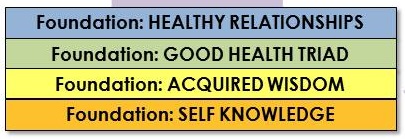
The Foundation is now made up of four sections, with the new addition of Healthy Relationships. This means that the four sections are Self Knowledge, Acquired Wisdom, Good Health Triad and Healthy Relationships. I realised through reflection and exploring what makes life fulfilling that I had omitted a significant aspect of all our lives, which is the relationships that we have. I will go into this in more detail later in this blog post.

Self Knowledge

I have put Self Knowledge at the bottom of the Foundation, as I believe self knowledge is the rock upon which we can build the foundation of our lives. If we do not know ourselves well then how can we know what we want out of life, what we value and what we believe. Self knowledge is the basis of what we think, say and do. If we do not have a good understanding of ourselves then we will be guessing what we want out of life and everything in it will be half-hearted and will not bring about fulfilment. We will also be living life either reacting to the events within it, not really having any direction or plan, or we will be living out other peoples plans for us, and our true selves become lost in a life wasted.

It has been a philosophical imperative since the days of Socrates to “Know Thyself.” It is also sage advice, as it will dictate what we get out of life, and whether you believe we only have one life or not, if we follow the path of others and do not explore what makes us who we are we will likely not spend our lives well, because we will not be forging our own paths through life.

Acquired Wisdom

Self knowledge will only get us so far in life. It will help crystallize what we want out of life and how we want to live, but we can still make mistakes along the way. Part of a life well lived is being wise about the choices we make and how we spend our time. The wisdom of others can help us here.

Whether you are a religious person or not our human history is filled with the words of wiser people than us. The wisdom of humanity comes from religious and philosophical writings, from scientists, from the native peoples of the world and from our own parents.

It is important not only to listen to the wise words of those around us, but also to become avid readers. Acquiring the wisdom of others and applying it to our lives can mean that not only do we not have to rely solely on trial and error, but also we spend the time we have exponentially better. It helps us live more deeply and to be able to look back at the end of life and say we lived well.

Good Health Triad

The Good Health Triad is three areas where we should aim to have good health in order to have good wellbeing. The first is the most obvious, it is good physical health. Going to the gym once in a while won’t be enough. We need to consistently exercise to our level in ways that are not detrimental to our health. For some gentle and often is better, especially if they are physically disabled. For some running marathons is good for them. Find your exercise routine at your level.

This also means a good diet. Not just eating everything that we are told is good for us, but rather figuring out the best diet for your body. This could be more vegetables than fruit to keep your diet more alkaline than acidic, it could mean spicy food or not, it could be dairy free. There are lots of options. This involves research, listening to your body and trying different types of food. Most diet advice is good, but don’t go for every fad diet that pops up in the media. Find your best diet and go to see a nutritionist if needs be.

The third element of the Good Health Triad is good energy health. As Chinese medicine discovered a long time ago, and Western medicine is slowly accepting, we have an energy system that allows Qi or Chi to flow along the meridians within our body. Much like our blood flows through our veins and nerve signals travel through our nervous system, our Chi flows through our meridian system. If our Chi does not flow freely or is unbalanced our health deteriorates.

Practicing Qigong or Tai Chi every day can help, as well as going for Acupuncture or Qigong Acupuncture, which is done using the practitioners own Chi instead of needles, will help to maintain good, healthy Chi. Ensuring we cover all three areas of this Good Health Triad will mean we live longer and feel better, so we are more able to achieve what we want to achieve, do what we want to do and live fulfilling lives.

Healthy Relationships

We all have relationships, with our family, our friends, our partner, our work colleagues, and so on. Some relationships are better than others, but I would argue that they should all be healthy relationships. What I mean by this is ideally we should not have any relationships in our lives that are detrimental to our wellbeing. Relationships that cause us stress, anxiety or self loathing need to be removed from our lives. Stress is something that can have such a negative impact on our health that people can die due to the consequences of stress on their bodies.

Those we have relationships with, in whatever area of our lives, should lift us up and make us feel connected. They should make us feel like we are part of something, a collective of good people. Our relationships should make us happy more than sad.

We should also try to cultivate our good relationships so that they grow and become stronger too. All relationships need maintaining through spending time with those people, finding out what is going on with them, being there for them when they need us and not only caring about ourselves.

The biggest barrier to healthy relationships in our current culture is mobile phones and tablets. People are spending more time on their devices than with each other, even if they are together they are looking at screens. If there is a momentary lull in the conversation there is an urge to pull out our mobile phones and scroll through our social media feeds.

Relationships are built on the little moments between other things, when we are waiting for a meeting to start or for a bus to arrive we can strike up a conversation, ask how someone’s day is going, etc. This is how we build strong, healthy relationships. We should also avoid things like gossip, which are corrosive to trust and cooperation.

Something to think about

What three changes will you make in line with this Foundation to improve your life and wellbeing in 2020?