Convenience Is About The Destination And Not The Journey

Convenience is about the destination and not the journey. When making our way to the summit of a mountain, we can climb up on foot, or we can take a helicopter. The problem with taking the helicopter is that so much is missed in the journey.

When we climb on foot, we see things that we can not see from the air in a helicopter. We push our limits and learn what we are capable of, and we work together with others, cheering each other on and being cheered pn by others because the climb is hard and the victory is earned.

When we take shortcuts and do not do the work, the destination feels empty. There is no sense of accomplishment.

Find The Quiet In The Storm

Find the quiet in the storm,
Find the path in the chaos.
The quiet is the mountain,
The path is the light.
Find the balance between the two.

We all live through challenging, noisy times and chaotic times, too. Not necessarily every day, but it happens to us all. To try and control the storm or the chaos would be a fools errand really as the world can not be controlled. The only thing we can realistically control is ourselves; our minds and the paths we choose to follow.

To find quiet in our minds amongst the storm around us, to find it despite the storm is a skill that can be practised and mastered. To practise meditation is to lift the mental weights that build the capability to be quiet and calm when all around you is not.

Similarly, the paths we choose in life define us, but there are so many paths, so many choices to make each day. To choose a path and to stick with it is also a skill. To follow a path amongst the chaos is not easy, but it is possible. The trick is to see the light that illuminates your chosen path and to follow it, no matter what.

These two things, the stillness in your mind and the path you follow, are different things, both with their own importance. The challenge is to balance them both. Too much stillness, and you don’t get anywhere. Only follow the path, and you can get lost along the way. This is the challenge of living a wise and intentional life.

Unlearning Our Divisions

We are born into this world without prejudice, without judgement, without hate. We are born one with the human race. We learn to name things and catogerise things and to say what is good and what is bad and who are good and who are bad. We sort the world into this and that, us and them. These are divisions, whether they are small or big, and at the heart of every division is a conflict. Two opposing things set apart by the way we think about them. To understand our place in the world we go through this process of organising everything into divisions, this is natural and necessary.

However, the challenge is to discern one thing from another without having prejudice and judgement of others to cloud our view of the world. To pre-judge or to have prejudice is to assume things about a certain thing or person based on how we have categorised them. It has little to do with them. We think they are this and they are that. Often this way of thinking is passed down from generation to generation and we have whole communities that are in conflict with each other because of what they are told about each other.

To break out of such thinking, when all around us our loved ones think in this way, is very difficult. However, the task of unlearning these divisions is essential in order to live a peaceful and happy life, which is the purpose of a spiritual practice. It is the deliberate practice of dissolving divisions, the end result of which is wisdom.

We Are All Connected

“The energy you use to get a drink of water comes from sunshine working its way up to you through the food chain – in a real sense, light lifts the cup to your lips. The apparent wall between your body and the world is more like a picket fence.” (Page 27, Buddha’s Brain, The Practical Neuroscience of Happiness, Love and Wisdom by Rick Hanson, PH.D. and Richard Mendius, MD)

I have long pondered the connectivity of us and our world/universe. From the energy we need to live coming from our Sun to the elements that make up us and our planet being forged in a long dead sun to the interwoven weather systems and ecosystems across our planet to the interwoven cultures that mingle through the immigration of people and ideas; we are very much connected. That being said we often get in our own way by demanding independence from others and seeing other people as different and strange.

You could say that all divisions are created by ourselves through a process of trying to understand the world in which we move and education systems that classify and categorise things. Much needs to be unlearned in order to reduce division in the world. Unlearning our learned divisions is the work of the wise; the work coming first and the wisdom follows. It is up to each of us to choose how we see ourselves and how we see others, the future of our collective world depends on this choice that we each must make.

Give Yourself Permission

For a long time I have struggled with achieving the same levels of success as my peers. I have questioned whether there is something wrong with me or if everyone else is just better than me and then I had a revelation. I had this revelation a few weeks ago, but it felt like just a theory and, consequently, I did not apply it to my life straight away. The revelation was that I can give myself permission to thrive.

This might sound silly or somewhat obvious, but I have grown up with others doing things for me a lot of the time. My parents took such good care of me I barely had to struggle or strive for anything. I benefited from the privilege of being white and middle class too. All this meant that when I hit the real world I subconsciously expected things to carry on as easily as they have always done, but they didn’t. Consequently, I felt average and mediocre.

What I needed to do was give myself permission to take ownership of my life, my health and my work. When I have been in leadership positions I have worked well in these roles and been a decent servant leader, but when I thought about describing myself in this way it felt disingenuous. The core of my realisation is that when others asked me to step into these roles I thrived and rather than waiting for others to give me permission, I can simply give myself permission.

This became empowering, where before I felt rather disempowered. Weirdly, for the first time I felt like I could take ownership of my life, fully and wholeheartedly, and you can too. Give yourself permission; own your life and you can thrive.

The Wisdom of Humility

In Buddhism there are levels of wisdom like glasses that help you see clearer and clearer until you are enlightened. It got me thinking about the way we sometimes cling onto our current level of understanding of something and avoid learning more because it might undermine our current thoughts on whatever it is.

This is the Ego getting in the way of wisdom. The Ego does not want to be proven wrong, as this would undermine it’s sense of self importance. As strong as the Ego may appear to be it is fragile. When another person or the world undeniably proves the Ego wrong it hurts and it can feel a little broken. The antidote to this is humility, the act of asking what the correct thing is in order to learn and grow. It is being open to being wrong.

The core belief, therefore, has to be that learning is life long and we don’t know all the answers all the time. We become students of life for life. Humility is not weakness, it is a strength, which seems contradictory to what our culture tells us. The problem with culture here is that it promises to reward the Ego with money, success and material things. We may even receive these things, but they only feed an unquenchable thirst for more of the same, and when we don’t receive them our Ego hurts.

It is better to be humble, as this develops resilience to the wins and losses of life and on balance leaves us happier.

Life On Sale

Much like Black Friday, we spend spend spend in the Boxing Day sales. We often buy things we don’t need just because it has 50% off, or some such discount, but we don’t often stop to think if we need what we are buying at a discounted rate. Are we buying because it’s on sale or because we actually want or need it?

We often do the same if something is free. We may be on a strict no sugar diet but if a company is giving away free cans of their sugar-laced drink we grab two of them. This is usually put down to a lack of will power, which is true, but there is a lot of manipulation from companies who want to sell you things as well. It will help if you live by principles that lead to a healthier and happier life, and to developing a high motivation to stick to these principles. Then, sale or no sale you will live well.

Humility In Action

There is a story about a samurai and a wise man that goes something like this. A samurai once stopped a village elder on the roadside and asked him to define heaven and hell. The wise man responded by saying, “you are too stupid to understand something like that.” The samurai flew into a rage, took out their sword and raised it above their head to bring down onto the wise man. The wise man then said calmly “that is hell.” The samurai stopped, lowered his sword and reflected on the wise man’s words. The wise man then said, “and that is heaven.” The samurai bowed in respect and continued with their journey.

It is said that for a samurai to use their sword they must make the decision to use it before they take it out, as they must draw blood once it has been taken out. The decision, therefore, is not changed once decided. I would like to argue that we should be humble enough to change our decision once it has been made, when there is new information that requires a better course of action. This takes humility, which is a skill we all need to practice. Sometimes someone wiser than us will show us a better way and we should listen, acknowledge them and act in accordance with this new found wisdom.

Living A Fulfilling Life

I am discovering through becoming more independent and confident in my job as a Complaint Handler that my health, happiness and success are all in my hands. This is to say that only I can achieve these things for myself, through good daily habits and believing in my own capabilities. Obvious I know, but not always easy to believe.

It begins with wisdom and self mastery, which leads into health and relationships, and ultimately purpose. These are all aspects of a life well lived, a life that in and of itself is a pathway that leads towards fulfilment. When we live well fulfilment is a natural state of being.

The Wisdom Of Suffering

No one likes to suffer, this is universal when it comes to the human condition. Suffering is a part of reality, in the sense that to be alive means, at some level, we suffer. We get hungry, we get cold, we don’t get what we want and we get what we don’t want. It could be either physical or emotional pain, or some might say psychological pain. Sometimes the situation we are in create unavoidable suffering. For these situations I hope you get the support you need.

However, generally speaking, how we interpret suffering will have an impact on our level of happiness. If it makes us feel helpless then we can fall into depression, if we are not careful. Though suffering can be a route to walk a spiritual path. Suffering can be a pathway to God or enlightenment, but we must be careful here. To use suffering to get closure to God or enlightenment does not work, you simply end up worshiping suffering.

Suffering can, however, be used as a tool to understand the human condition and how to live well. For example, certain situations would cause great suffering for us, but very little for others. This tells us that suffering is relative. It is relative because the amount to which it hurts us is linked to the amount we are attached to either our sense of Self, or Ego, or to things and experiences. When these are threatened or damaged the level of our suffering is often linked to our level of attachment. In this way we could ask how suffering can be a guide on the pathway to a life well lived.

Looking The Wrong Way

Water is evaporated from the oceans of the world and the water vapour becomes clouds. The clouds rain on the hills. The rain become rivers and the river make their way to the ocean. This, as we learned in school, is the water cycle.

When we look at a cloud we rarely think of the ocean. We think of the rain that is about to fall on us that will either ruin our day or water our garden, depending on how you look at it. Likewise, we don’t often think about the causes of the things that happen in our lives. We focus on the effects of what happens.

A lot of what happens in life are a result of our habits, our diet, whether we exercise, the way we think about things and how we react to things. All based on our habits. We have patterns of behaviour that mean we have similar experiences again and again in life, due to our habits.

The point is that we are looking at the rain and we should be looking at the ocean.

Taking Reality As It Is

When on a spiritual path or the path to self mastery we need to be careful to take reality as it is. We can see life as heaven or hell, depending on how we see our circumstances. Neither of which will necessarily be a true reflection of reality.

We often overlay our past experiences onto what is happening and make assumptions about what people mean or what impact something will have on us. There is much wisdom in the teachings of both religious and secular leaders.

One way of testing if an approach to life is a wise one is whether it makes you happier or not. Wisdom followed correctly should make you happier and your life better. If following a teaching or advice makes you more unhappy, I would argue that it is not wisdom. Wisdom is the root to a happier life.

2022 Goals: Acquiring Wisdom

The first Step on my Pathway To Fulfilment is Acquired Wisdom. It is the first step because without wisdom it can be hard to find happiness and success, and therefore fulfilment. On the path through life we can make bad choices and make big mistakes that cause us to suffer, due to a lack of wisdom.

What wisdom can do is reduce the suffering we experience in life, through the usual trial and error, and help us to find the right kind of happiness and success for us.

So, what ways will you seek out wisdom in 2022?

One way to acquire wisdom is to read good books. There are plenty of good books in the Recommended Reading List on the Resources page. You could also find a lot of wisdom on YouTube and where you listen to podcasts. You can also seek out mentors. There are lots of ways to acquire wisdom.

The Lessons Of Life

The experiences we have help to steer our way through life by causing us to pull away or pull closer to aspects of life, depending on what happens to us, and the meaning we apply to the experiences.

There is a saying that ‘when the student is ready the teacher will appear.’ I believe that this is true of the experiences we have. If we look through the lens of a student as we navigate through life, then the experiences we have become our teachers.

There is a danger, however, that unless we have the clarity of wisdom, we will likely draw inaccurate conclusions and make assumptions that skew our understanding. This is why Acquiring Wisdom is the first Step in my Pathway To Fulfilment.

Life can be a great teacher when we begin with wisdom, because it opens us up to new and unexplored wisdom. If we begin with ignorance, the lessons that life offers are often not even seen and we succumb to fear, shame and anger; emotions that dominate those without wisdom.

Your Best Self Is Yourself

Many of us want to be like Steve Jobs or Michael Jordon or Barak Obama, but the world already has these people. If we are to strive to be like anybody else we lose, because we lose ourselves in the process.

We can certainly learn lessons from these people, in fact we should learn their lessons, but more important are the lessons we teach ourselves through trying and failing and trying again. When we try new things we learn how We do such things, what our strengths and skills are and how we can use them effectively in the world.

Don’t strive to be the next anybody, strive to be the best version of yourself that you can. Read, watch and learn the lessons of others, understand the wisdom that has come with their experience, but never avoid going out into the world and gaining your own wisdom through your experience.

If nothing else, learn how to be yourself and seek to make a difference in the world, and you will.

Why Should We Read?

The first step on my Pathway To Fulfilment is to Acquire Wisdom. It is essential, I feel, to have a grounding in wisdom, because on a journey to living a fulfilling life the more wisdom we begin with the less time we spend making mistakes and going down blind alleys.

The traditional way of acquiring said wisdom is to read, to read lots and read broadly. This is still an effective way to do it, and I will explain why in a moment, but the same information can be obtained through conversations with well informed people, exploring websites or watching YouTube videos. Many universities have lectures on any subject you could want to study free on YouTube.

The advantage I have found in reading books is that often someone has poured their life experience into the book they have written and this is invaluable. Also, a book does not require batteries and can easily be carried around and shared with others.

When you have acquired a number of books you will end up with your own personal library and simply looking at the books you have read will remind you of snippets of wisdom without needing to read the books again. Though reading some books again after you have lived a little bit of life will bring a new perspective to the ideas and words in them.

So, read frequently and broadly, but also take advantage of the masses of resources available on the world wide web. I have a list of books that I recommend on the Resources page, please do have a look.

Finding Contentment

“Be thankful for what you have; you’ll end up having more. If you concentrate on what you don’t have, you will never, ever have enough”
― Oprah Winfrey

When thinking about contentment and what to talk about in this blog post I thought about what makes me content. I thought about my wife and daughters, the books that I read, how I feel when I am painting pictures, and then I started thinking about things that make me laugh, things that make me smile. Contentment, as a subject, is a big subject to tackle in something as short as a blog post, but I thought that it was also an important subject to talk about too, especially after the stresses and changes, the grief and the trauma that we have had to deal with over the past 18 months.

So, what then can be the solution to the age-old problem of how to be content? If we are all different people then how can there be one answer to this problem? Many different people have tried to come up with an answer, each with a different perspective on the issue, often driven by their theological or philosophical beliefs. Some we know to be powerful spiritual figures such as the Buddha and Jesus, others were, and are, just philosophers trying to answer the question of how to be content. The rest of us, generally, just try to make the best of things. With all of the difficulties we each face in our lives it is hard to find the time to philosophise about the ways and means of finding contentment. For the majority of us we spend our days working hard to have money to pay the bills and the rent, or mortgage, hoping to have a little left over at the end of the month to treat ourselves, and the ones we love.

Yet, somewhere in the busyness that is our lives we do find some time to set aside to enjoy ourselves, whether it be spending time with the kids, going for a drink with friends, a walk in the woods or just staying in to watch something on the TV, we all do somehow manage to find time to enjoy ourselves a little. This time spent relaxing and enjoying ourselves is greatly necessary for us to go on functioning in the jobs that we do and the responsibilities that we have, we need to laugh and play and get back to the things which make us who we individually are. But is this contentment or is it just making the best of things?

I would say that we can find moments of contentment in these periods of relaxation and enjoyment. We have all, I think, or at least I hope, had moments when we’ve paused and thought ‘my life is good right now, the good things outweigh the bad things and I am happy.’ An attitude of enjoying the small thing in life can be a useful attitude to have, as it helps us deal with the big problems we all face. The old saying ‘The best things in life are free’ is in a similar vein, and is good advice, often given by parents, or grandparents, to children who want things that are expensive and well advertised on the TV.

That being said, contentment can seem a complicated or difficult state of mind to achieve. But perhaps it isn’t contentment that is complicated but ourselves. Perhaps it is our own complications that can make it so difficult for us to achieve contentment, consistently. We have many thoughts running through our minds each day, as well as many emotions, either flaring up, such as anger, or lingering, such as sadness. There is a constant flow of both thoughts and emotions, almost like a river, which swells and runs dry over and over. With such turbulent minds it is no wonder that we find it difficult to settle and be content.

People also deal with things differently. In any situation there are those who are totally emotionally involved, and as a result their emotions jump up and down with the ups and downs of life. Others do not engage their emotions very much at all, and so are quite detached from any ups and downs that life throws at them. We all know people that fit either of these types of behaviour, and we know people who are both negative about life and those who are positive. I can be beneficial to think about how positive or negative we are to life’s us and downs. 

How we feel about our lives is often caused by our reactions to the events within it. Our reactions to the events of life are the responses that our brains throw up almost without us thinking about it, they are habits that we have formed over our whole lifetime. For example, if we disagree with something do we get angry very quickly and say the first thing that comes to mind, while we are angry, or do we take time to create a considered argument to explain how and why we disagree. If something bad happens to us do we react emotionally, getting angry or upset about our favourite cup getting broken or missing the bus to work, or do we think that the cup was only a thing and can be replaced and even though we missed our bus there will be another one along soon?

Things are only good or bad depending on how we see them. Roger Walsh M.D., Ph.D. put it well when he wrote “We do not see things only as they are, but also as we are.” If you think about that for a moment it is actually quite profound. This is only a quotation, but if you think about it in a wider context you could say that everything we see, or even experience, is coloured by the way we are at the time, how we are feeling, if we are tired, if we are in a rush or taking our time. This might be an obvious point that I am making but it is something we often forget when we are reacting to things that happen to us, because we are reacting. But if we remember that what we are experiencing from moment to moment is affected by how we are in those moments then we have a better chance of dealing well with the ups and downs of life, and I would say a better chance of being content as well. This is consciously choosing to be in a beautiful state, not an angry state or a stressed state, but a beautiful one.

Talking of beautiful states, the Euros 2020 final was a big moment in my home country’s footballing history, where England made it to the final of the Euros, something many football fans thought would never happen. Prior to the result of the match, the mood of the nation had been lifted, whether you enjoy football or not, the positivity has been infectious and we have been living in a happier state, generally, until of course we lost in penalties again. But we must remember that both Italy, who we faced in the final, and England have had a really difficult time during the pandemic and the joy we felt in both of our nations up to the final, and more so for Italy now, mark a new chapter in our national stories, it is a great contrast to the suffering we have had. The deeper the turmoil the higher the joy and the better we can choose to live; this is also true even when our football team does not win. And with the Olympics starting in Tokyo I hope each nations spirits will be lifts as they follow their athletes who are competing.

In order to be more content it is perhaps better to act instead of react, by which I mean taking control of the moments before we react so that we can make better decisions in what we say and what we do, in response to any situation. There is a Buddhist Mindfulness practice called the Three Minute Breathing Space to be used when we feel angry or stressed about something. The practice consists of stopping what you are doing and taking some slow and deep breathes for three minutes, or less if you like. It is a quick time out from the stresses of life, which can help enormously if you live particularly stressful lives. Practices like this can reduce stress and give us the presence of mind to avoid reacting to situations without thinking about what we intend to say or do in response to them.

We all have ways that help us de-stress, ways that we have developed through out our lives, hobbies that we have chosen to do, activities that are part of our daily routine, which are enjoyable and fun. But, these things are rarely structured activities as part of a path to find contentment, they are the things that make life enjoyable and fun, when it can be. There is nothing wrong with making the best out of life and enjoying it as much as possible. In many ways I would say that this is a road to contentment itself, but for those that want a more structured approach to finding contentment there is religion or a spiritual path. Here are some words on contentment from the some of the great religions of the world.

The Buddha said: ‘Contentment is the highest wealth.’ (Dhp.204), meaning that when we are content we do not need to get anything, go anywhere or be anything to be happy because we already are, and thus, contentment is more valuable than any possession or accomplishment. The Buddha describes the monk’s contentment like this: ‘He is satisfied with a robe to cover his body and alms food to satisfy his stomach and having accepted no more than is sufficient he goes his way, just as a bird flies here and there taking with it no more than its wings.’(D.I,71).

In the Bible, in the book of Timothy 6:verse 6-8 it says:

“Now there is great gain in godliness with contentment, for we brought nothing into the world, and we cannot take anything out of the world. But if we have food and clothing, with these we will be content.”

In Yoga, in the Hindu tradition, there are the Niyamas, ten ethical guidelines, which are the foundation of skillful living, or living in a morally good way. The second Niyama is called Santosha, or Contentment, and the expectation is this:

Nurture contentment, seeking joy and serenity in life. Be happy, smile and uplift others. Live in constant gratitude for your health, your friends and your belongings, Don’t complain about what you don’t possess. Identify with the eternal You, rather than mind, body or emotions. Keep the mountaintop view that life is an opportunity for spiritual progress. Live in the eternal now.

This is all good advice, and it makes it clear to me that on the road to contentment a spiritual path can be beneficial, because we are given advice on how to live in order to be content. There is a direct relationship between the directions given and the attainment of contentment, as many who have followed spiritual paths have stated in the past.

But what about those of us who are making the best of things, those of us that have busy lives spent doing what we can to provide for our families and ourselves, and follow our own spiritual paths when we can. Life can be difficult, and keeping a calm perspective on things when life doesn’t always go to plan is not an easy thing to do. I recommend using the wisdom of the many religions of the world, and the wisdom of those around us, our friends and family as well, they are our helpers, they sustain us as we sustain them. Our paths through life are also greatly helped by the enjoyment of life itself, our pleasure in the small things, and not wanting more than the world has allowed us to have. I believe it is a blessing to be alive at all, everything else is a bonus.
Defining Your Purpose

Starting With Yourself

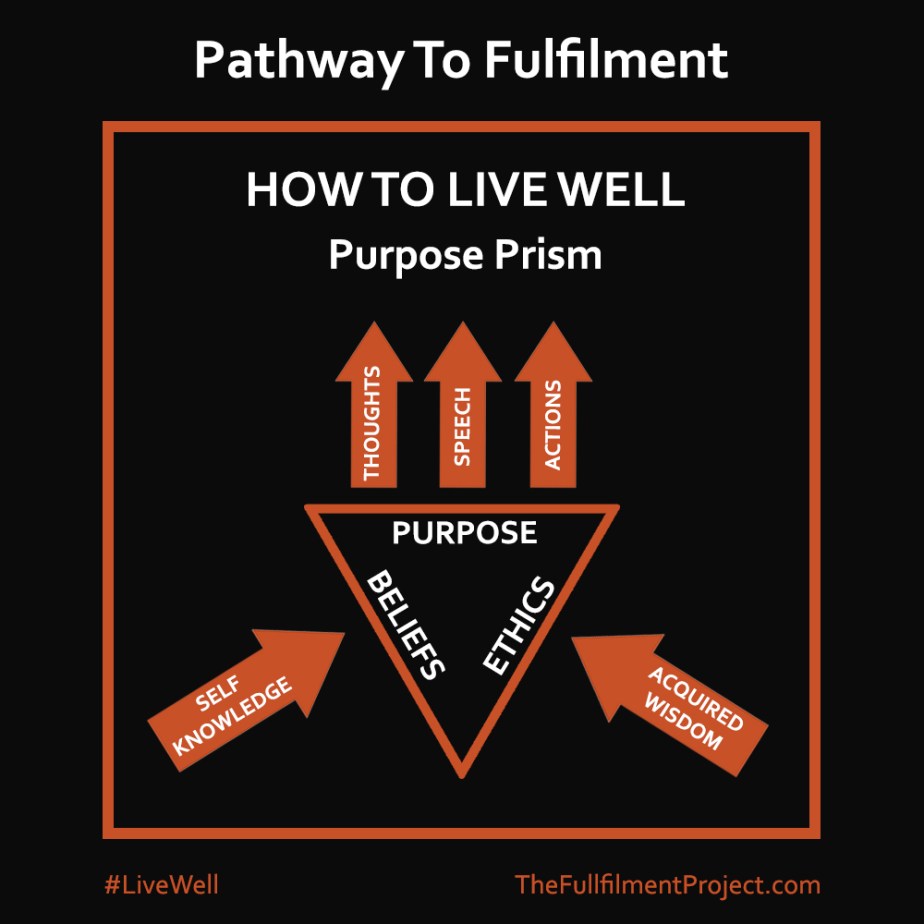
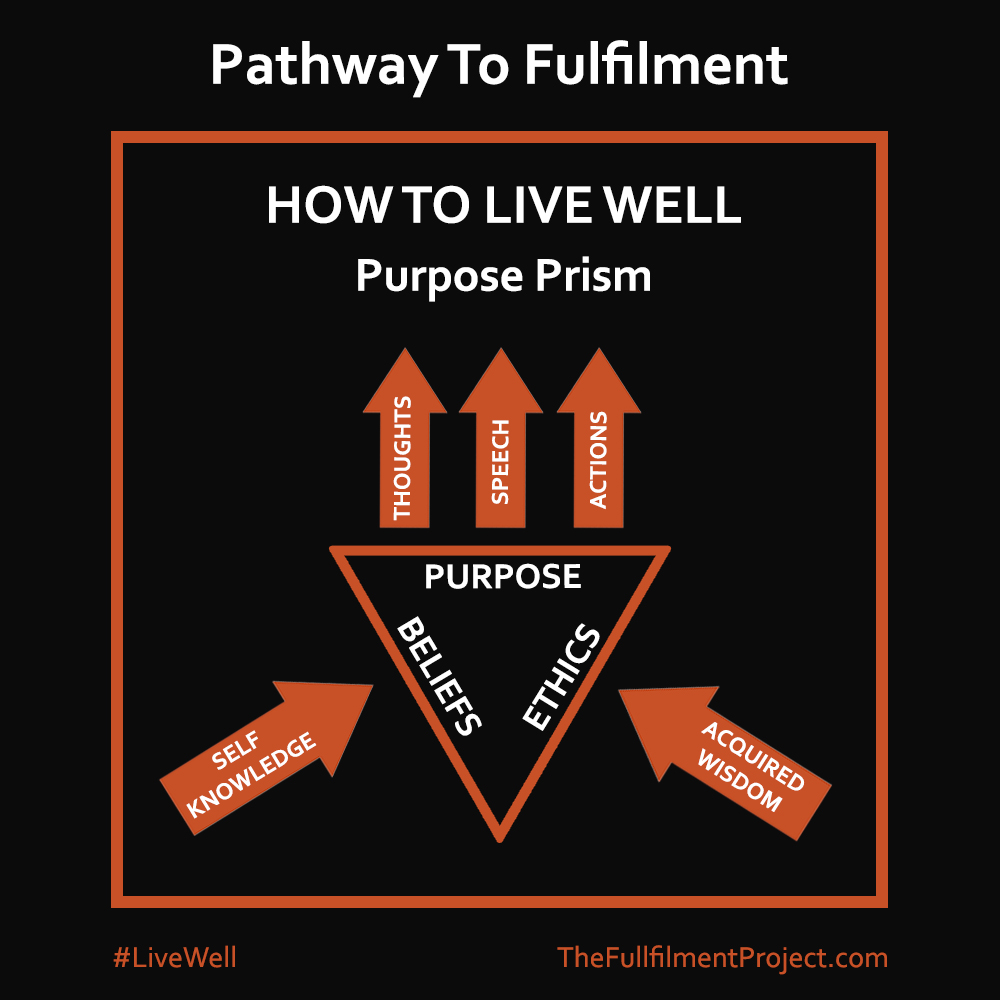
The Pathway To Fulfilment has the steps that it does because the end result are thoughts, speech and actions that are aligned with your purpose that you will define. They come from your Purpose Prism, which includes your beliefs, your ethics and your purpose.

You will have gained deep Self-Knowledge (Step 1), which is when you will define your beliefs and ethics, and you will have Acquired Wisdom (Step 2). A purpose can then be defined aligned with these elements from Step 1 and Step 2 that together will make your thoughts, speech and actions full of altruism and wisdom.

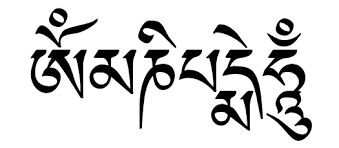
Om Mani Padme Hum

In regards to altruism and wisdom, there is a Buddhist mantra, Om Mani Padme Hum, which explains how, in Buddhist understanding, one reaches enlightenment. Om is made up of through sounds A – U – M. These represent thoughts, speech and actions, and once we are enlightened these are pure. Mani means Jewel, which represents altruism. Padme means Lotus, which represents wisdom. Hum is unity of both infinite altruism and infinite wisdom, both of which are needed to become enlightened, in Buddhist understanding.

The reason I am asking you to begin with self-knowledge, then to acquire wisdom, and to figure out your beliefs and your ethics, is so that your purpose will be imbued with both altruism and wisdom, and that your purpose becomes your unity, your Hum. Your thoughts, speech and actions dictate how your life will be, because whether your life is good or bad, enjoyable or not is firstly based on your thoughts, of how you see the world, and secondly the impact that your speech and actions have on those around you.

How We Walk Through The World

If we walk lightly through the world, trying to live in balance and to help others, then we will live a more fulfilling life. Also, in order for us to find a purpose in life, we need to know ourselves really well, to have gone deep into the parts of our minds that we often shy away from, but also to develop a wise understanding of how the world works and how we can have a positive impact on it.

This is why Defining Your Purpose and Living Your Purpose are Steps 5 and 6. There is work you must do with yourself before a purpose can become clear. This work will not always be easy, but it is necessary, and I will be putting together a guide to help you along this Pathway to Fulfilment. It will take time to put together, as I want the pathway to be simple and the steps to be clearly defined, which means there is a lot to distill down into a clear and effective pathway. The outline of the pathway is set out below.

Something To Think About…

Think about how you currently live your life, how you treat others and how you earn a living. Are these ways that make you feel good? If not, what changes could you make?

Launching The Pathway To Fulfilment

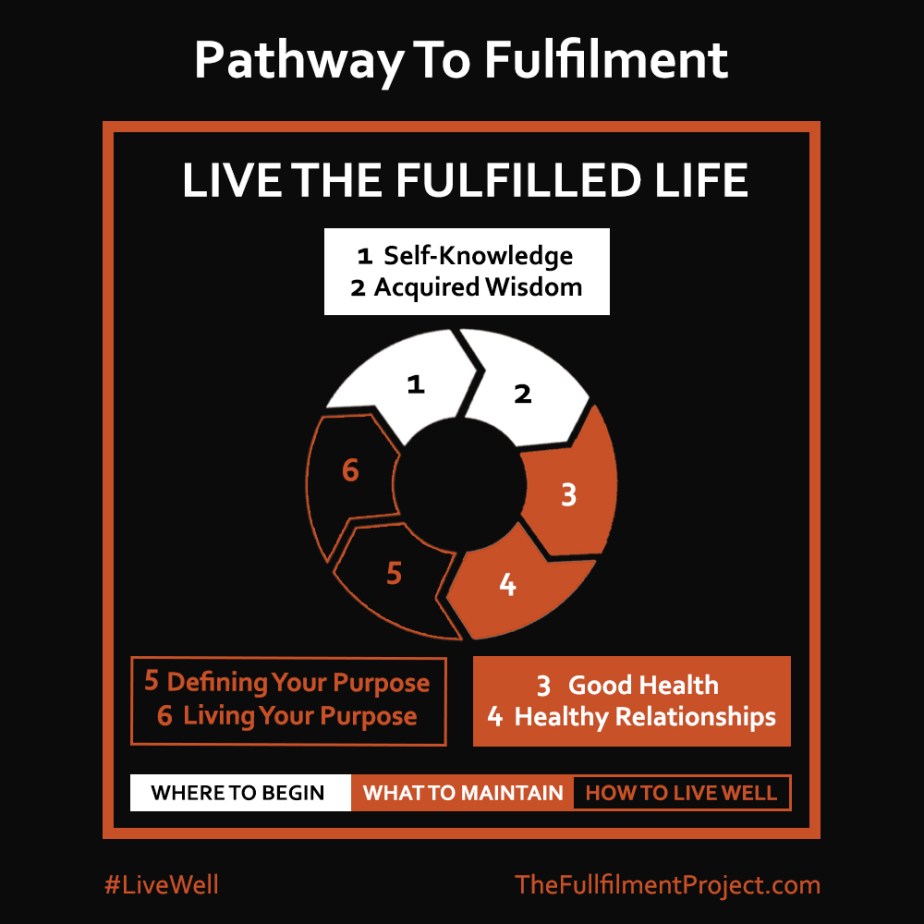
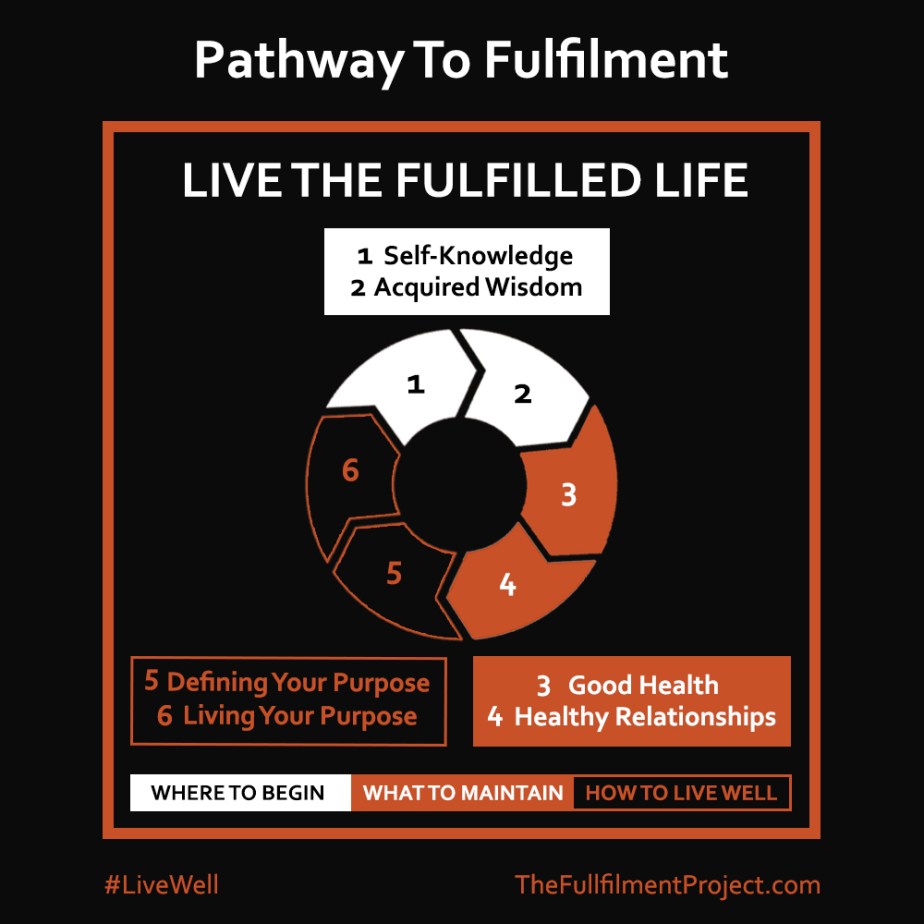
I have done some work on what I have so far called the Fullfilment Framework and renamed it the Pathway To Fulfilment, a more linear and simpler journey. My intention is to create a process by which people can start to live well, and therefore have fulfilment. This is not a life hack or magical cure for what ails you. It is a deeply personal journey of self-discovery, of life balancing and purpose finding. There are four steps of this process which are foundational to a life well lived, they are Self-Knowledge, Acquired Wisdom, Good Health and Healthy Relationships.

The Principles Of A Life Well Lived have been folded into the Acquired Wisdom. I have separated these foundational steps and the other steps of the Pathway To Fulfilment, six steps in total, into Where To Begin, What To Maintain and How To Live Well. Now that I have an outline of a process that I believe will bring about fulfilment in ones life, I aim to add in the detail of the activities and actions you will follow within each step of the journey towards fulfilment and a life well lived. Watch this space and the Facebook Group Community and on Instagram for up and coming updates. This new Pathway To Fullfilment can also be found on the page on this website of the same name.

WHERE TO BEGIN

Step 1: Self-Knowledge

The process begins with getting to know yourself more substantially than you may have before; figuring out what really makes you tick, what you believe and don’t believe, what you think is true and false, what you think is ethical and not ethical, etc. Also, what happiness and success look like to you, personally. It is broad and deep self-knowledge. This is your starting point.

Step 2: Acquired Wisdom

You acquire the wisdom of others, from a variety of sources, spiritual and secular; wisdom that will challenge you and enlighten you, as wisdom should. Often this is achieved by extensive reading, but, with the internet, a lot of this same wisdom can also be obtained through videos, audio books and pod-casts, however you learn best. This wisdom will feed into your self-knowledge, and influence how you see yourself and how you choose to live.

Connected to Acquired Wisdom are ten principles that I believe generate fulfilment, because they are wise principles that will help you navigate the world skilfully and live your life well. I have divided them into those that relate to Yourself and those that relate to Others. The principles related to Self are Growth, Equanimity, Fortitude, Seeking and Self-Competition, and those related to Others are Stewardship, Servant-hood, Reciprocity, Joy Making and Connection. I will be sharing more detail on these moving forward.

WHAT TO MAINTAIN

Step 3: Good Health

Your health should be of great concern, because good health is essential for your well-being and having an active, fulfilling life. I have included the usual physical health and mental and emotional health, and also energy health; all of which could be thought of as a triad of good health. Good physical health includes diet and exercise. Good mental and emotional health includes mastering your emotions and balancing your thoughts. Good energy health includes mastering the Chi (Qi) that flows through your energy system, like blood through your bloodstream, detailed in Traditional Chinese Medicine. To have good health you need to work on all three of these areas.

Step 4: Healthy Relationships

You look at your relationships, and identify those relationships that are good for you and those that are not, and those that are a mixture of the two, that need work to become good. You should continuously work towards all of your relationships being healthy ones; meaning that they bring you happiness rather than stress, they uplift you rather than bring you down. These relationships are in circles of community, which are relationships with yourself, your partner, your family, your friends, your colleagues and your acquaintances, and all are interconnected.

HOW TO LIVE WELL

Step 5: Defining Your Purpose

After working your way through this journey so far, you will have a solid foundation for how to start living your life better. From this knew understanding of yourself, your defined beliefs and ethics form part of what I call your Purpose Prism, the third piece of this prism being your purpose. You will go through a process of building on your beliefs and your ethics, weaving in Acquired Wisdom and Principles Of A Life Well Lived, and define your personal purpose. This prism is the filter through which you will see and experience the world, and it will influence your thoughts, speech and actions, making them wiser in nature. Your purpose comes from a vision of a better world that you want to help create.

Step 6: Living Your Purpose

You will then be set to start applying your beliefs, ethics and purpose to your life, to find your best way to live them out in your thoughts, speech and actions, to act on your vision of a better world through everything that you do. This is living your life on purpose. All of this work will mean that both happiness and success become personal, and therefore fulfilling, all three of which are bi-products of a life well lived. They then feed back into your self-knowledge, acquired wisdom, health, relationships and your beliefs, ethics and purpose, and on it goes, because this journey is a life long endeavour. Follow the path to fulfilment and live well my friends.

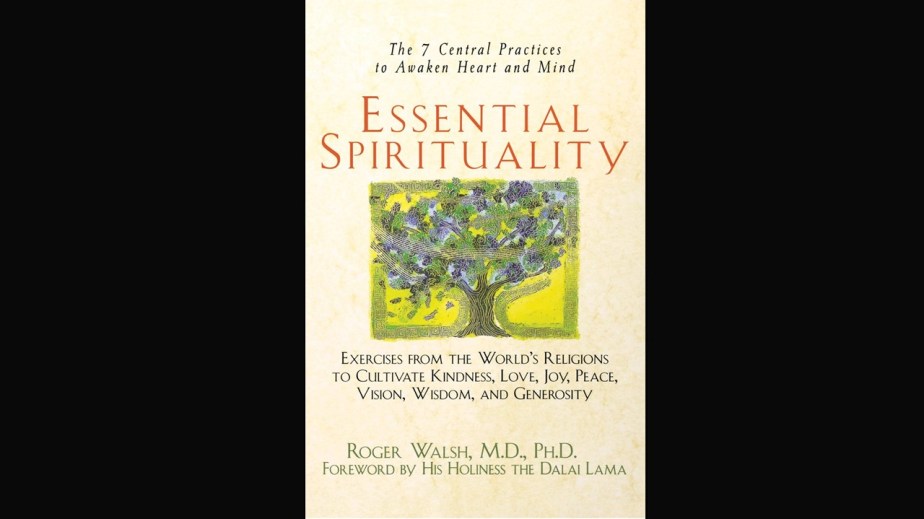
Book Recommendation: Essential Spirituality: The 7 Central Practices to Awaken Heart and Mind by Roger Walsh

“Our lives are rich with opportunities and our challenge is to live them to the full. All of us can be the creative artists of our lives.”
― Roger Walsh

Image Source: Amazon UK

Get The Book Here

Why Read This Book

This book covers seven practices that religions across the world include, practices that can help restore balance and create happiness in our lives. It is a book to read and then revisit to help you live a balanced and happy life.

Contents

  • Foreword by His Holiness the Dalai Lama
  • Introduction
  • 1.    Unveiling the Sacred
  • 2.    Discovering the Seven Practices
  • 3.    Using This Book
  • 4.    Spiritual Practices: What Do They Do and How Do They Do It?
  • The Seven Practices
  • Practice One: Transform Motivation: Reduce Craving and Find Your Soul’s Desire
  • 5.    The Secret of Happiness
  • 6.    Exercises to Reduce Craving
  • 7.    Find Your Soul’s Desire: Redirect Motivation
  • 8.    Exercises to Redirect Desires
  • 9.    The Higher Reaches of Desire
  • Practice Two: Cultivate Emotional Wisdom: Heal the Heart and Learn to Love
  • 10.    The Gift of Love
  • 11.    The Challenge of Difficult Emotions
  • 12.    Reducing Fear and Anger
  • 13.    Cultivate Love and Gratitude
  • 14.    The Higher Reaches of Love
  • Practice Three: Live Ethically: Feel Good by Doing Good
  • 15.    The Value of Virtue
  • 16.    What is an Ethical Life?
  • 17.    Exercises in Ethical Living
  • 18.    The Higher Reaches of Ethical Life
  • Practice Four: Rest in Peace: Concentrate and Calm the Mind
  • 19.    Your Meandering Mind
  • 20.    Develop a Peaceful Mind
  • 21.     The Higher Reaches of Concentration and Calm
  • Practice Five: Awaken Spiritual Vision: See Clearly and Recognize the Sacred In All Things
  • 22.    The Healing Power of Awareness
  • 23.    Exercises in Awareness
  • 24.    Seeing the Sacred in All Things
  • 25.    Exercises in Sacred Seeing
  • 26.    The Higher Reaches of Vision
  • Practice Six: Cultivate Spiritual Intelligence:  Awakening Wisdom and Understanding Life
  • 27.    What is Wisdom?
  • 28.    Awakening Wisdom
  • 29.    Exercises in Wisdom
  • 30.    The Higher Reaches of Wisdom
  • Practice Seven: Express Spirit in Action: Generosity and the Joy of Service
  • 31.    The Spirit of Service
  • 32.    Developing a Generous Heart
  • 33.    Exercises in Generosity and Service
  • 34.    The Higher Reaches of Generosity
  • 35.    Enjoy Your Self: Awakened Heart, Awakened Mind
  • Source Notes
  • Further Reading
  • Bibliography
  • Index

Summary

This book explores the different behaviours and ideas that cause us to be unhappy and to suffer, and practices to remedy them. There are seven practices, as the title of the book suggests, but there are also exercises within each chapter that are simple, but beneficial, for example “Exercise 9, Discover Your Future Self,” from the section entitled Exercises To Redirect Desires.

The author explores these subjects through the lens of the scriptures of our world religions and the writings of philosophers. It is practical, yet this book includes profound, deep wisdom. Whether you are religious or not, I recommend this book, it will apply some perspective to your life and help you find your path to a life well lived. The book is extensive, but you can dip into the section that relates to your current issues and find the guidance and exercises to help.

Our Life Long Journey-What Path Should We Follow?

“Your life is a journey. Your attitude is the guide.”
PJ Ferguson

Caught In a Pandemic

Today we are globally in difficult times with the Coronavirus pandemic, but different countries are handling it differently; some better than others, as these are unprecedented events. America seems to be falling into division and chaos, and in the UK there seems to be confusing advice on what we can and cannot do, leading to anxiety in some and other taking advantage and not following sensible advice to keep us. Other countries have done better and worse, depending on your point of view. It can seem that the future is uncertain and full of difficulty, but we cannot necessarily tell what the future will hold, as it has yet to happen.

Whatever our future holds, let us follow the wise words of those who came before us, who led with compassion and love, those who shone a light of hope in difficult times, like the prophets of our many religions and people like Martin Luther King and Nelson Mandela; leaders who helped us move towards a better way of living. Let us always have hope for the best, and as we make our way into the future, many things will come and go, and we will move past this pandemic, hopefully learning collectively and individually how to live a more balanced life. As we have slowed down and been confined indoors it has been an opportunity to pause and reflect on how we want to live. As many have said, when things go back to normal, it will be a new normal. It is up to us how this new normal will look for us, how our beliefs and ideas about life will influence our lives moving forward.

Our Journeys

As we move forward, we will all have different experiences and different journeys that we each take everyday. Before the Pandemic, there were both every day and religious journeys that we would take, those that work had a journey that they took to get to their job each day; whether by car, bus or train. Many are now working from home, including myself. Others who don’t work will have things that they did and places that they went to regularly, which have also changed.

Whatever we do with each day there are habits that we form, and familiar routines that we go through, as we go to familiar places. These journeys always seem to take less time and are comforting in some way, perhaps due to their familiarity, and the fact that they form part of the fabric of our lives and are connected sometimes to our habits and routines, like walking the dog or going to the pub on a Friday night. These journeys can be down the road, or to another town or city, or even to another country. Whatever the journey, and whatever the destination, there is always a reason for the journey, a purpose for going.

The Events In Life

Many of us have significant events that happen to us on the many journeys that we take, occasionally it is an event which we feel we are lucky to walk away from, a car crash, an illness, a decision which might of ended badly if we had made a different choice, all of these can be life changing, they can make us reassess our lives and our priorities. Sometimes these events are something a little less extreme, like meeting someone and falling in love, having a baby, getting the job you wanted, or just coming to a realisation that causes a change in direction in our lives. Everyday any of these things can happen, life is changing all the time, and our interactions with others are often what cause these changes.

We Go Through Life Together

The journey that we each take through life is one that we share with our friends, and our family, and the things that we do are witnessed by our children. Even though we spend our efforts passing on wisdom and knowledge that we have discovered in the course of our lives, we also pass on examples of how to behave through our actions, we are role models for our children and the actions that we take, and the path through life that we choose, can be copied. The path we take can become the path that our children take, so it would be best to live in a way that we want our children to live, to live up to the wise lesson that we try to instill in them.

We are never alone in the life we lead, there are always people with which we interact; people at work, people on the bus, people in a congregation, friends and family. We live very interconnected lives, and in doing so we learn from each other everyday, we always know more than we did the day before, we are always learning through our experiences, our education, our everyday interactions.

Putting Things Into Perspective

In a way this is how mankind has evolved over the centuries, our interactions have manifested in a collaboration of ideas and knowledge, that has given us the development of human beings from early man to our current level of intelligence and development. This trend will continue, and the paths that we all take will inform the wider community, and the human race as a whole. We are all part of a greater society, and our actions are like drops of water in a lake, the ripples spread out along the water’s surface, eventually having a far-reaching effect on the rest of our world.

We are all parts of a whole and we all have individual lives to lead as well. It is a paradox of sorts. We all want to do what is best for ourselves, yet we also want to do what is best for others too. So how then should we live our lives? What paths should we take on our journey from birth to death? That is something we all have to work out for ourselves, though I do advise looking into the teachings of the many prophets, spiritual leaders, and wise sages that have contributed to the pool of spiritual knowledge that can be found in any of the holy texts and scriptures that every culture has.

Every culture has this knowledge because each of them have had someone who has understood it and documented it, and because this knowledge is not restricted to any one culture, it is a universal wisdom which is part of the universe, and is there to be discovered by anyone who has the ability to see it and understand it. So, think about what path you want to make through life, and how you want to live, then take that first step and keep walking.

Something to think about…

Sometimes life gives us a challenge that can be an opportunity. What challenges do you have currently that could be an opportunity?

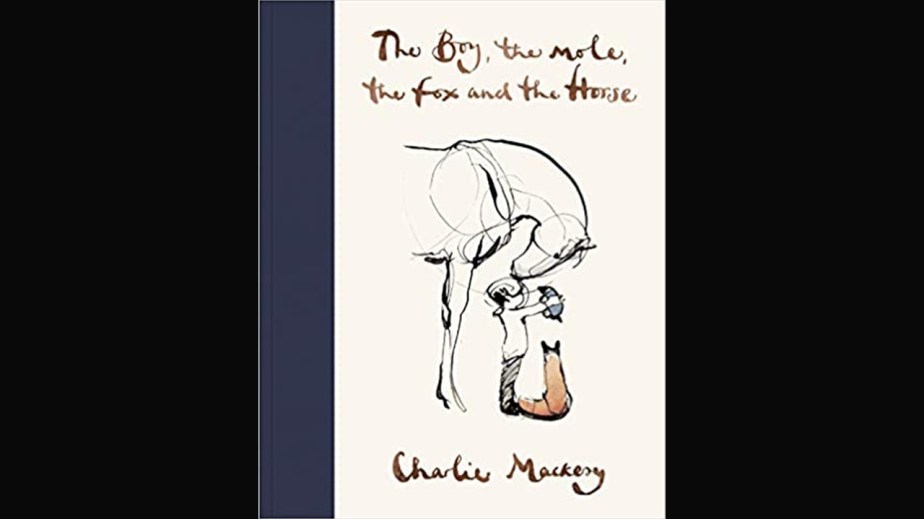
Book Recommendation: The Boy, The Mole, The Fox and The Horse by Charlie Mackesy

Images Source: Amazon.co.uk

Illustration Copyright Charlie Mackesy

Buy A Copy Here

Why Read This Book

This book is beautifully illustrated that is full of gems of wisdom. There are pages that make you stop and think and others that uplift spirits. A joyful and philosophical book for children and adults alike.

Contents

There are no contents as such.

Summary

The book follows the journey of a boy, a mole, a fox and a horse on a journey through the wilderness. The book can be read from beginning to end, but you can dip into the book anywhere and find a nugget of wisdom and beautiful illustrations.

Two of my favourite pages are one where there is stain from a tea cup on the page and all the characters are illustrated looking at it. The words say “Is it the moon?” asked the boy. “It’s a tea cup stain… said the mole, “and where there’s tea there’s cake.” The mole loves cake. My other favourite page is an illustration of the boy riding the horse with the mole and the fox is walking alongside. The words say “What is the bravest thing you’ve ever said?” asked the boy. “Help”, said the horse. It is a truly beautiful book.