The Gift Of Giving

A lot of what we do at Christmas is traditional or habitual. We do the things we always do, whether it be national tradition or family tradition. We usually cook an enormous Christmas lunch and eat far too much, and probably watch Christmas TV. We may even watch the Queen’s speech, if you live in the UK.

We also give and receive presents, buying what we hope the recipient will like. It is a time of generosity; of spirit and of actions. We hear the story of Jesus being born in a stable with seemingly poor parents, yet they are visited by three wise men and given gold, frankincense and merr. We also hear the story of Father Christmas flying around the world and giving presents to children.

Many people give more to charity at Christmas too, as the generous spirit of the season is so infectious. It is certainly a time of giving. There is a lot of focus on the recipient when we give. Will they like it? In the case of charity, will it help them? However, there is something to be said for how giving makes us feel. When we give we feel good, but less so if we give in order to feel good, and more so if we give in order to make others feel good. I know which one I prefer.

Redefining Art

When we think of Art, we usually think of Monet, Van Gogh or some other famous painter or sculpture. We think of the things we see in art galleries, but those in Tate Modern, what is called Modern Art, is sometimes debated about regarding whether they are in fact Art.

I have an Art background and I have struggled with agreeing that some Modern Art pieces or installations are Art. The room with lights turning off and on that won the Turner Prize some years ago comes to mind.

The definition of Art given by Seth Godin in his book Linchpin is “Art is a gift that changes the recipient.” I like this definition, because it does not limit Art to particular skills or materials. He goes on to give the elements that are needed for something to be Art.

He says “Art is a personal act of courage, something one human does that creates change in another.” “By definition, Art is human… …because intent matters.” “Art is original.” “The last element that makes it art is that it’s a gift.” He also points out that “…it’s art when a great customer service person uses a conversation to convert an angry person into a raving fan.”

This definition of Art broadens it out to allow all of us to be Artists. A cook is not an Artist, but a Chef is. You too can be an Artist, so be courageous and give with the skills you have to make a difference and change someone for the better. This is a giving time of year, at Christmas, but make this a day habit and you will have a big positive impact on the world.

How We See Each Other

It is better, in my opinion, to seek to understand other people’s point of view and to respect them, even when disagreeing with their opinion. This is to try and see all people as having good sides and bad, with good habits and bad, with good fortune and with problems.

We all, really, want to be happy and avoid pain. And if we think about the people we know, those who are our friends and those we call wife or husband, girlfriend or boyfriend, we accept these people, warts and all.  We look past any of the imperfections that they may have and we see them as beautiful people, often because of these imperfections.

Though, the way we see our partners will always be different from the way others see them, because we all see things differently, which in itself makes us all individuals. However, this capacity to see past imperfections and see beauty in others is something that we all can do, it is an ability we all share, to varying degrees.

Building Resilience

We have many things in life that can eat away at our resilience, and we all have different level of resilience. Some things are brushed off by some and others will find them very challenging.

A lot of our resilience comes down to our thinking, on whether we have a fixed mindset or a growth mindset, and how we explain positive and negative things to ourselves. A good book on this subject is Learned Optimism by Martin E. P. Seligman, PhD.

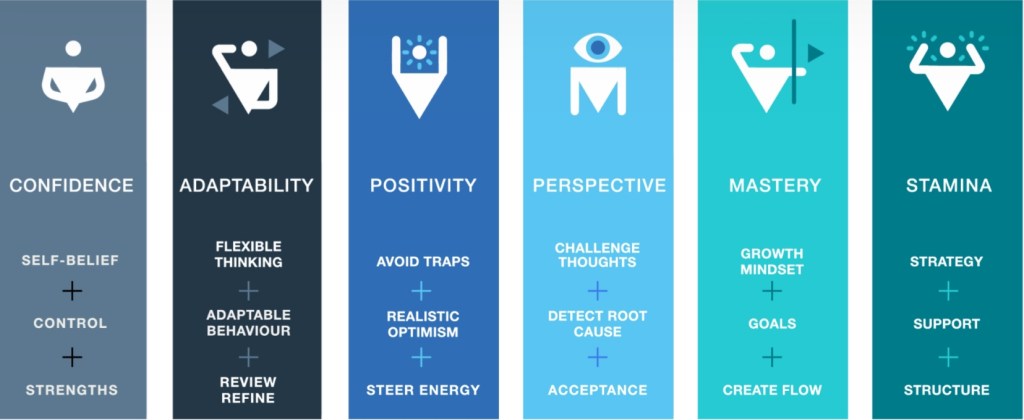
There is also a good model for resilience called the Resilience Edge Model shown below. You can get more information about this model on the website if you follow the link above.

Image Source: resilienceedge.com

Looking For Clarity

When speaking about how he felt when he walked out of prison after being imprisoned for 27 years, Nelson Mandela said “As I walked out the door toward the gate that would lead to my freedom, I knew if I didn’t leave my bitterness and hatred behind, I’d still be in prison.” This to me is a powerful reminder that holding onto hatred and bitterness can cause us pain, and forgiveness can bring about freedom.

This moment of clarity that Nelson Mandela had as he walked out of prison to be a free man defined how he would later lead South Africa, as its President, towards unity and reconciliation. Sometimes in our own lives we have moments of clarity that are like epiphanies and these should be cherished and be explored, because they can define how we continue to live our lives.

The decisions we make every day on how we should treat each other, how we should conduct ourselves, these are important decisions to be made. If we feel, however, that trying to find such moments of clarity is too difficult then we can look to those people greater than ourselves for their moments of clarity. We can look to people like Nelson Mandela and others for examples on how to live through what we are living through, and how to thrive.

Make A Difference

We spend a lot of our time putting things off until tomorrow, but the problem with tomorrow is that we never get there. If we form a habit of putting things off then the habit means we perpetually avoid doing the thing we need to do.

For all of us, we have a day which is our last day and so much that would benefit the world goes undone, because it was put off until tomorrow.

If you want to make the world better, if you want to make a difference, then do the thing you are scared to do, do it. Go all in and do it. The worst that can happen is that it doesn’t work or you need to make it better. Whatever may happen, it will be better than never doing it at all.

Go and make a difference.

What Game Are You Playing?

In life there are two types of ‘game’, the finite game and the infinite game. This is discussed by Simon Sinek in his book The Infinite Game, and he discusses it in this video. I have mentioned it on this blog before too.

The finite game is defined as having fixed rules, known players and the point is to win, which is the end of the game. Football for example. The infinite game is defined as having flexible rules, known and unknown players and the point is to stay in the game. Playing catch with your 3 year old for example.

A lot of day to day human activities are infinite; running a business, being in a relationship, customer service, being a parent, etc. However, often, especially in business, we talk about winning or being number 1 or the best at (fill in the blank), without realising that we are playing the wrong game.

There is no such thing as being number 1 at parenting, though many think they are. There is no such thing as being number 1 at customer service, though many companies claim that they are. You cannot win love or be the best at health. Somethings are just without a clear end.

Life is an infinite game. None of us will come out of it alive, but we want to keep living as long as we can. Within the many infinite games we play in our personal and professional lives there are also finite games too. There are also goals that we set which, once completed, stop as a goal and we find another one.

In life we are more likely to be successful if we play by the right rules for the different ‘games’ we play. In our relationships, we want to nourish them for the long term. When it comes to our health, we want to eat, drink and exercise for our long term health. And with anything that improves our wellbeing, if we are competing, we compete with ourselves.

Being Perfect VS Creating Value

When we avoid putting our work out into the world or suggesting an idea we have, we will often use the excuse that it is not ready or that it is not perfect. This is a form of hiding, hiding from feedback and hiding from potential failure. When we do this the world misses out.

When we say something provides value, we mean that it has benefited a person or people, because it has entered their lives. Things that create value are never perfect, they are invariably led by human interactions, either with a thing created by a person or with a person themselves. The value comes from human connection, empathy and respect. The interaction makes someone’s life better.

To me something that creates value is ‘hand made,’ a person has created it for another person. When you speak to a company and a Customer Service Advisor goes above and beyond, when they ask about your day and mean it, this adds value. When you walk down the street and you says good morning to someone, this adds value.

This type of interaction is invaluable to the quality of life it give others. People sometimes don’t say hello to strangers or have a chat with someone because they don’t feel confident in knowing what to say. Knowing what to say is another form of perfect. You can start with “Good morning. How is your day today?” and see where the conversation goes. Most good conversations are unplanned, but both parties are fully engaged.

So, do you want to hide behind being perfect or do you want to make other people’s lives better by creating value? If you want to create value, then engage with others and see what happens. It will never be perfect, but you will potentially make someone’s day, week or year.

Understanding Vulnerability

When we think of people being vulnerable we often think of young children, old people or those with a disability. However, we can all be vulnerable at some time or other, and it can be temporary, sporadic or permanent. Life events can make us vulnerable. We could lose a loved one, lose our job, have an unexpectedly large bill to pay, suddenly become severely unwell, have a sudden increase in caring responsibilities and the list goes on.

There is a stigma often associated with admitting our vulnerabilities and companies often have a one size fits all approach, which means vulnerabilities are to considered when supporting customers. People often assume others are not vulnerable without even considering the possibility. Vulnerability is something we should be considering and showing empathy towards.

Pre-COVID times a large percentage of UK adults had less than £300 in savings, which means they would have struggled if the boiler broke or their care needed significant repairs, and this has only got worse during the pandemic. Any of us could face a large bill for something unexpected. No one predicted the COVID-19 pandemic but it has left so many people vulnerable.

So, let’s be open about our vulnerabilities and show empathy towards others who may be struggling. Anyone you meet maybe struggling, so be kind, always.

How To Be Number 1

The idea of being number 1 is based on finite thinking. Companies all the time state they are number 1, but this is always based on their own criteria. Often it had has also been part of a winner takes all system that puts colleagues against each other for the fight to earn the most money. Both of these ways of thinking are destructive.

We are also transitioning from the industrial age where factories were king and we are entering the communication age where anyone can start a business with a laptop and a WIFI connection.

This new disruptive way of working is making the old way of working more scarce, where we are paid to do what we are told. This is because companies are in a race to do things cheaper and many jobs have been automated. You can spend decades working for a company only to be made redundant because technology or someone in another country can do your job cheaper.

As bleak as this seems, it provides a tremendous opportunity to become indispensable. Rather than trying to be number 1 in a particular category, invent your own category, a category of 1. Being the best at being you will mean you become a Linchpin, as Seth Godin calls it; someone who is indispensable. So go take on the challenges that those who would rather follow orders won’t tackle.

Go solve interesting problems and go and lead. This is how you gain job security in a cheaper is better business world, because there are companies that understand that human is better, not cheaper.

Your Best Self Is Yourself

Many of us want to be like Steve Jobs or Michael Jordon or Barak Obama, but the world already has these people. If we are to strive to be like anybody else we lose, because we lose ourselves in the process.

We can certainly learn lessons from these people, in fact we should learn their lessons, but more important are the lessons we teach ourselves through trying and failing and trying again. When we try new things we learn how We do such things, what our strengths and skills are and how we can use them effectively in the world.

Don’t strive to be the next anybody, strive to be the best version of yourself that you can. Read, watch and learn the lessons of others, understand the wisdom that has come with their experience, but never avoid going out into the world and gaining your own wisdom through your experience.

If nothing else, learn how to be yourself and seek to make a difference in the world, and you will.

Seeing And Being Seen

Recently, I saw a homeless man asking for change and I stopped to give him some money. I looked at him straight in the eyes, smiled and I said “have a lovely day.” The fact that I acknowledged him and made a human contact seemed to mean more to him than the money. Hundreds of people must walk past him every day and ignore him. I made him feel seen.

This is the power of being seen. Not just looked at but acknowledged and appreciated. Seeing the other person as just as important, as a human being. And when you see other people in this way you make tangible, authentic relationships with them.

To see someone and to be seen by someone are the central connection that creates opportunities to thrive, together.

The Gift Of Giving

Giving is a mind-set, it should not be limited to single acts of generosity. It is something that we can strive to do every moment of our lives. Each time someone shows me kindness by giving me something I try to do something similar for somebody else. I say try, because I do not always get the chance or think to do it, but I do try. And I think in giving back to others that which has been given to us, is putting positive actions out into the world, in the hope that they will be passed onto others again and again, so that we can all build a better world together, just by giving what we can, when we can.

One of the things that I have come to realise is a precious gift to give someone is to listen to them. To give your time to actively listen to what other people want to talk to you about. By ‘actively listen to them’ I mean to not allow your mind to wander, to give the person your full attention and to show them that you are listening to them, with your body language and the way you respond to what they are saying. It doesn’t matter if it is something seemingly unimportant, or something that is very difficult for the other person to deal with, whatever it is, just listening can be a gift.

Stress In The Workplace

There are many jobs which are naturally stressful, like being a Fireman/woman or a Police Officer. There are, however, many jobs which are not inherently stressful, but the working environment makes them so. This is the main cause of stress in the workplace, I would say.

If colleagues are pitted against each other in compitition to earn bonuses, a cut throat, winner take all culture will develop. If colleagues are encouraged to collaborate and find fair outcomes for customers, then a supportive and uplifting culture will develop.

Another consideration is whether things like the values and operating rhythm of the workplace match your own. In other words, are you a good fit for your workplace and your role. Figuring out your own values and how you work best is a great place to start.

Sometimes though, the problem is the view you have of the work you do. I work in complaints and I could say that I speak to angry and rude people all day long, but I don’t. In fact, I speak to people who have problems, often caused by the company I work for, and it is my job to fix the problems and rebuild the relationships between the customers and the company. In other words, see them as human beings first and take responsibility for fixing their issues.

The views we have can blind us to the opportunities that problems provide.

Meet People Where They Are

When we have big plans or we want to bring something new into the world or we are strong with our views, we often forget to see the position other people are in, because we are so focused on our own message.

This way of communicating often feels natural or the right way to behave, but when we do we miss a huge opportunity. When we communicate in this way we meet people where we are, we project 100 percent outwards. This often causes clashes and conflict, because others are doing the same thing.

We could let others communicate 100 percent and become completely passive, but this is not good either. The ideal is to meet people where they are and where we are and aim for a 50/50 exchange. This involves actively listening and caring about the other person and taking turns. All very basic things to do, but often forget to do them.

What To Be Grateful For

Recently I have begun to realise that I am getting on in years. Next year I will have my 40th birthday, a number that seems a lot bigger now it is pending in my life. I’ve also got more grey hair appearing. At first I had the usual fear based reaction that makes you question if you’ve done all that you set out to do and makes you reassess everything.

I felt myself going down a rabbit hole of despair and I caught myself and six words changed my mindset immediately. I am grateful for the grey. Many people do not live to 40. I realised that every year, every day is a privilege many have not had.

Advertising companies and our culture in general will have you wanting to be grateful for material things, things that you can buy and own. In my view these are the wrong things to be grateful for, as nice as they are.

Be grateful for waking up this morning, for have the health that you have, the partner you have, for having a home and food to eat, for having a job that pays the bills, for having friends and colleagues, for the challenges that help you grow, and for having been born at all.

If you are grateful for these things then your life will be so much happier and you will live a more present life.

Love What You Do

We hear the motivational mantra “Do what you love” a lot in the motivational coaching sphere, and in society generally, but I think it is bad advice if the suggestion is to have the thing you love as your source of income. The thing you love may not be something that you can be paid to do, or at least difficult to get paid for.

This is not to say that you shouldn’t do what you love, but assuming everyone can is misleading. By all means do what you love, but make sure your rent and bills are paid. You will find it even harder to be a success if you end up homeless.

When you are wanting to be successful it is more effective to love what you do. Some people sell coffee in a coffee shop, others create meaningful experiences for customer that lift their day and make them feel good, while selling them coffee. Some manage a team, others lead a team in such a way that every member of the team contributes and works towards a shared vision.

You get my point. Sometimes it is better to love what you do, but also do what you love when you can. We all want different things and have different life experiences and constraints. Don’t feel that you have to do what you love because society says so, do what is best for you.

Always Look For Beauty

For some the day ahead seems to be filled with boredom, for some it is dread. Many have felt the devastating sting of loss that makes it difficult to carry on. Many live the same day every day through the repetition of events and interactions. Many feel lost and don’t know what to do with their day. Many feel as if they have reached rock bottom. Many feel as if they are drowning in debt.

These are realities for a lot of people, but every day there is still beauty in the world. A smile, a sunset, a song, a flower, an opportunity to be generous, an opportunity to be kind. The world is full of beauty and the opportunity to create it. The negative things in life can cause us to be blind to them, so we must actively look for beauty every day. This will increase our sense of gratitude and improve our wellbeing.

It will not solve all of our problems, but it will put us in a better position to solve those problems for ourselves.

Do Something

Often we wait for the right idea, the right job or the right partner before we trying something new. This waiting is a form of hiding, hiding from trying that new thing, because we fear failure or we fear making the wrong choice and wasting our lives.

If we don’t choose something we are wasting our lives. The regrets most elderly people have is the things they did not try. You have time to try and fail and try again. You will also either succeed or learn and then succeed. Failure is essential to success, because we can learn from it.

My advice is this, figure out what your values are, what your beliefs are and what your ethics are. Then go find a project to start, a challenge to take on, a problem to solve or a role to try that aligns with these and see what happens. If it aligns with your values, beliefs and ethics then you will thrive, you will feel empowered and you will feel fulfilled by the work you do.

But you must choose something and start.

Art Is I; Science Is We

This is a quote by Claude Bernard, a French Scientist, and it reflects the two modes of being human; to create individually for the purposes of creating is Art; to create individually or together for the collective good is Science. For me the best Art blurs the line between these two, because some Art changes society.

Art can also be how you live your life, how you interact with people. Leaving a person uplifted after your interaction with them is Art. Solving a person’s problem in the way only you could is Art. It is turning an interaction, a collection of ideas, an opportunity of any kind into something that makes a life or the world better. It is creation in its best sense.

You can change the world for the better. We can change the world for the better. It does not necessarily matter which, only that the lives of others are blessed by your presence. Go be an artist my friend.

Go Ahead And Lead

We think of leaders as big, charismatic characters who lead from the front, who announce their vision and point in the direction they are going in. They inspire us to follow them.

This is not what I mean when I say lead, though to be visionary is certainly needed. To me, leadership is taking care of those around you. It is servant leadership. This type of leadership does not require vision, it requires empathy, compassion, and above all, courage.

It means that you become the solver of other people’s problem and check in with those in your circle, making human connections and taking care of people. Not in big ways but in small uplifting comments or in time spent engaged with someone, and so on. This to me is leadership.

So go ahead and lead.

Trying Something New

Where do our beliefs and values come from? They are manifestations from the culture and community we grow up in, the examples our parents give us and how they raised us, as well as the experiences that we have had. Through all of this input we piece together what we believe and what we value.

All of this then affects the decisions that we make on a day to day basis, but I believe that if we are to make wise decisions in life then we should seek out wisdom as well, which can be found in any of the many religious scriptures and philosophical texts from around the world. If we have wise guidelines or principles to follow then stepping into the unknown will seem less scary.

Something else that can help us in our ventures into the unknown is to have an attitude of asking ourselves “what if…?” What if we tried something new, what if we gave it a go, what if? Being open to the many positive possibilities that could result in trying something new means that we will more likely have a positive outcome.

It is also a way of getting past the barrier of failure, a way to overcome our fear of criticism or looking like a fool; what if we succeeded, what if we achieved our dreams. This allows us to consider the possibility of actually succeeding, rather than becoming consumed by the thought of failure.

Being Creative

The act of being creative is essentially to take existing things and ideas and to create something new out of them. We write with words and we paint with paint. These are the typical things we think of as being creative, but there are many ways to be creative.

However, the things we create end up creating us too, because the act of creating them changes us. We are a different person after each act of creating through what we learn about ourselves and the world via the creative process.

Many people think of the thing they create as their baby. It is not a baby, it is a thing that exists because of you, but it is not a human being.

The human being in the creation process is the creator. If you want to use the Parent Child analogy then the creator is more like the Child, because the process of creating changes us and contributes to creating who we are.

Self Made Possibilities

I was scrolling through my news feed on Facebook and a picture of a purple flower growing out of a brick wall appeared and it struck a chord with me. It reminded me that many people have been successful when they started off with nothing and no one on their side. Also, there have been many who had everything and did nothing with it.

The possibilities we have in life are sometimes given to us through the things we are born with or born into, but much of what is required for success to happen is self made. The possibilities for success have to be seen and then the work done to make them a reality.

Success that is worthwhile pursuing is always self made. Success that is given to us is not really success.

Which Is Right?

Some find a perfectly mown lawn beautiful, others find a field of wild flowers beautiful. Which is better? Neither is better, because it depends on the context and the option of those looking at them.

If you wanted to play a game of cricket then a field of knee high wild flowers would not be a good place to play. I neatly mown cricket pitch is better. If you want to paint a colourful landscape painting then a field of knee high wild flowers is better.

Some find the neat lines mown on a football pitch to be beautiful. The order and the precision align with their values. Some find the splashes of colours and life giving properties of wild flowers to be beautiful. The randomness and pollination align with their values.

Neither one is better than the other. It depends on context and personal opinion.

Inner And Outer Circles

In the business world there is often what is referred to as an inner circle, a group of high ranking colleagues who have their own circle that the majority are kept out of. There are also examples of inner circles in other types of organisation too.

The problem with inner circles is that they create a division that casts everyone as lesser or below those in the inner circle. I guess you could say that everyone else is in the outer circle.

Any division creates conflict and there is an us and a them. Within an organisation if there is division within it, hopes of working together are reduced. The idea of a circle is a positive one though, what matters is how many people are included within it. It is better to be inclusive than exclusive. The more we include the better our society will be.

What We Tell Ourselves

We need to consider the things we tell ourselves about ourselves. When we internalise the voices of others they become part of our inner dialogue. This includes what our parents say, what our friends say, what our employer says, what the news says and also what the teachings of our religion or philosophy says. All of these voices become part of who we are, but if we do nothing to take control of what we allow to become part of our inner voice, then we give up much of our power and self-control to the direction of others.

It is important, I feel, to do some mental spring cleaning every now and again to take a fresh look at what internal voices we want to follow and what internal voices we don’t. Some of this is of course subconscious, so is not obvious, but keeping a journal to put down thoughts, feelings and experiences and questioning these can lead to powerful realisations about why we make the decisions we make. In more extreme situations reaching out for support from a Councillor or Cognitive Behavioural Therapist can be invaluable. For most of us self-reflection and opening up to friends and family will help us figure out a lot of what is holding us back and find better ways to think and act to bring about a more fulfilling life.

I have reflected on this a lot over the past few years and I truly believe that we can be the architects of our own lives. What we tell ourselves can be with us throughout our lives, being careful what we think and say to ourselves is important. If we find ourselves saying that we cannot do something, because we don’t feel ready, equipped or able, then there is a simple thing we can do to help us get out of this trap. If you find yourself saying that you cannot do something out of a belief that it is beyond you, then I encourage you to add the word ‘yet’ to the end of each negative thought. “I can’t drive a car yet.” “I can’t draw yet.” “I can’t lose weight yet.” “I can’t find a new job yet.” “I can’t run a marathon yet.” Whatever it is, there is power in the word ‘yet.’ It opens up the possibility and hope of achieving whatever it is in the future, and it is empowering rather than dis-empowering.

Why Should We Read?

The first step on my Pathway To Fulfilment is to Acquire Wisdom. It is essential, I feel, to have a grounding in wisdom, because on a journey to living a fulfilling life the more wisdom we begin with the less time we spend making mistakes and going down blind alleys.

The traditional way of acquiring said wisdom is to read, to read lots and read broadly. This is still an effective way to do it, and I will explain why in a moment, but the same information can be obtained through conversations with well informed people, exploring websites or watching YouTube videos. Many universities have lectures on any subject you could want to study free on YouTube.

The advantage I have found in reading books is that often someone has poured their life experience into the book they have written and this is invaluable. Also, a book does not require batteries and can easily be carried around and shared with others.

When you have acquired a number of books you will end up with your own personal library and simply looking at the books you have read will remind you of snippets of wisdom without needing to read the books again. Though reading some books again after you have lived a little bit of life will bring a new perspective to the ideas and words in them.

So, read frequently and broadly, but also take advantage of the masses of resources available on the world wide web. I have a list of books that I recommend on the Resources page, please do have a look.

What Is Normal?

When we look at a bottle of shampoo it will often say that it is for Normal Hair. In our culture we have an idea of what normal is, it is what the majority of people we know do or say, or in the case of shampoo, the type of hair that the majority of people have. I would like to suggest that normal is simply what is most popular, it is not a trait by which people should be judged.

In marketing, companies will often aim their interruptions at the majority in the hopes that everyone will pay for their product or service. There is a fundamental problem with that. Either the product or service is designed for a particular kind of person, in which case it is not for everyone, or it is aimed at everyone and therefore no one, because we are not all the same.

In culture, we often want to be ‘normal’ and to fit in, but when we try to act or think in ways that are the most popular then we are not being ourselves. We are performing a role to be accepted, but everyone ends up doing the dance of normality and losing themselves in the process.

What we should do, in my opinion, is to figure out what our values are, what we believe and, importantly, what our ethics are. This will determine which people we will enjoy spending our time with. We can identify our ‘tribe’ and we will then genuinely fit in and thrive. The goal with this is to belong rather than to be accepted, and these are two very different things.

Choosing Hope

We often don’t believe something is possible, that we cannot achieve or do certain things. We have a diminished sense of hope. This belief, I would argue, is a choice, whether made consciously or not. Our life experiences, and the meanings we place on them, direct our thinking when it comes to our abilities.

However, every new experience changes how we understand and view our past experiences and our current selves. This process of new understanding can actually cause our memories to change, because what we remember is always held in our present mind, along with our understanding of it.

We might remember new details which change what we think happened or a change in our understanding of what happened can profoundly alter how we feel about these memories. For example, I have been living with Fibromyalgia for over ten years and for a long time it felt debilitating, with pain in my joints and muscles and feeling exhausted most of the time.

But, as is often the case, this struggle became something that led me to understanding how Chi (Qi), or energy, flows through our bodies and how Chi Kung (Qigong) gives us the ability to master our own Chi. It has put me on a path towards self mastery and a profound understanding that we are in fact our own saviours, we can heal ourselves, if we learn how. Hope very often rises like a phoenix from the ashes of the trauma and challenges in our lives. Hope has a power to transform how we look at ourselves and our circumstances.

As Maya Angelou said in her poem Still I Rise,

Up from a past that’s rooted in pain
I rise