Don’t Be Authentic

Like choosing a character in a computer game based on their skills and characteristics, we get to choose our character by the choices we make every day, big and small.

Quite often, these choices are small, like miner course corrections that a pilot makes as the plane gets buffeted by winds and storms along the way to the planes destination. There are times in life, though, when we make what feel like life altering decisions. This can be in relationships, at work or where we choose to live, and many other areas in our lives.

One for me was when I worked in a coffee shop run by two businessmen, and they offered me a job with lots of money and travel prospects. I had just got married and was moving to another city. My gut told me that lots of travel opportunities would mean spending lots of time in hotels and not with my wife. I had to decide what was more important, money or time with my wife. I turned down the big money in favour of time with my wife.

I’m not mentioning this to say something about myself, I’m mentioning it to illustrate the kinds of decisions that become compass markers in the direction that our character takes. It might have worked out well if I had taken the job offer and I may not have been away from my wife all the time, but I went with my gut and I’m happy with the decision I made.

The point is that making decisions big and small tells us who we are. They mould our characters and sense of self. It is more important to be aligned with our character, to be ourselves than to aim to be authentic. Often, people will excuse bad behaviour by saying that they are being authentic. Hitting someone in the face because you are having a bad day is being authentic in the same way that a 2 year old is authentic. It is better to be true to yourself with the choices that you make. True to your principles and values, which comprise your character.

The Atomic Bomb And The Infinite Scroll

When navigating the world countries and companies will try to invent things to tip the balance in their favour. In the case of the atomic bomb, during the second world war America was concerned that Germany was building a bomb that could destroy entire cities so they set about figuring out how to create an atomic bomb themselves. They put together a team of physicists and others to secretly figure out and build this new bomb. When the first bomb was tested J. Robert Oppenheimer, the lead physicist, is said to have quoted the Bhagavad-Gita with “Now I am become Death, the destroyer of worlds.” He regretted the invention. Then America dropped two atomic bombs in Japan killing many many innocent people and the age of the nuclear bomb began.

Aza Raskin invented the infinite scroll on mobile devices. This meant that when you scroll down on your social media account new content keeps being generated infinitely. The inventor said afterwards “It’s as if social media companies are taking behavioral cocaine and just sprinkling it all over your interface and that’s the thing that keeps you like coming back and back and back.” Extreme maybe, but the hit of dopamine that you get from finding a new video or post that you like over and over again is creating a society addicted to their devices.

The first example of the Atomic Bomb is far more extreme than the infinite scroll, but the point is that we need to consider the consequences of what we do. Making decisions for moral and ethical reasons could not be needed more. We are seemingly more divided and more obsessed with status and money than we have been before. It is time to live lives with values and principles.

The Gift Is In The Giving

I was given a medallion with an embossed image of St Christopher carrying a child across a river by my father recently. He has carried it around with him for many years and the shiny outer brassy layer of metal has worn away in places revealing the shinier silvery metal underneath. It is well worn and well used.

I don’t believe that it will give me luck or protection, but it feels like a legacy, a gift that I should carry around with me throughout my life, which I will. The importance is in the giving and the belief of my father that it will help me. The gift is in the giving and its intention, and that is why I will honour the gift and keep it with me.

Life On Sale

Much like Black Friday, we spend spend spend in the Boxing Day sales. We often buy things we don’t need just because it has 50% off, or some such discount, but we don’t often stop to think if we need what we are buying at a discounted rate. Are we buying because it’s on sale or because we actually want or need it?

We often do the same if something is free. We may be on a strict no sugar diet but if a company is giving away free cans of their sugar-laced drink we grab two of them. This is usually put down to a lack of will power, which is true, but there is a lot of manipulation from companies who want to sell you things as well. It will help if you live by principles that lead to a healthier and happier life, and to developing a high motivation to stick to these principles. Then, sale or no sale you will live well.

Teams Need A Purpose

In any organisation every team needs a Purpose. Often a company will have an overarching Purpose and/or Values, but if this is either not articulated well or made relevant to every team within the company, then productivity can drop off, as can retention of staff.

Everyone needs a reason to go to work, other than just to pay the bills. If our job gives meaning and purpose to our lives then we will be happier and will work harder for the company we work for. The assumption that staff will only work for a paycheck is a shortsighted view that many leaders have.

So, if you are a leader within your organisation, review how effective your company’s Purpose, Values or Principles are and work to ensure every member of staff feels that they are contributing towards them. This will increase levels of fulfilment and productivity, and will make them want to stay.

What Principles Do You Live By?

To many in the western secular world the idea of living by principles will seem somewhat alien. However, many cultures of the past, and, to a degree, the present, have principles or values that are seen as important to live by.

Many of the most successful people have principles that they use to guide their decision making and how the spend their time. For example, someone who values integrity will likely stick to their word, do what they say they are going to do and make sure they are consistent on their positive habits.

As strange this concept might be for you, I recommend looking at principles in two ways. Firstly, review what you care about, what you value. Secondly, review your goals and what you want out of life. Then see where there is a cross over. For example, you might value good health and you want to achieve more at work. If you build in habits that optimise your health you will likely have more energy to put into your work. Your Principle to live by might be ‘healthy habits are productive habits.’

Try out a few principles and see what fits. You do have to commit to loving by your new principles for a while before disregarding them as a bad fit or unhelpful. Sincerely try each new habit for a month and see what happens.

2022 Goals: Living Your Purpose

It is one thing to figure out what your Purpose is, but it is another to act on it. To live by your Purpose takes courage and determination, because it can put you at odds with people in your life and can require you to make some difficult choices.

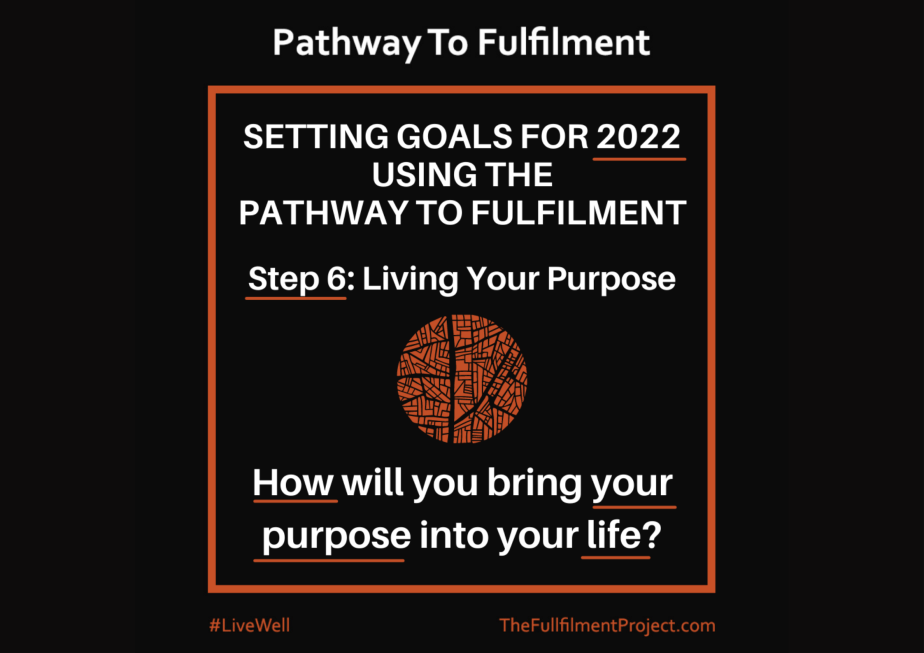
Step 6 in the Pathway To Fulfilment is Living Your Purpose. Once you have gone through Acquiring Wisdom, Self Mastery and Defining Your Purpose, if you do not live your Purpose it will have all been just a theoretical exercise. In order to live well and have a fulfilling life, you have to live by your Purpose, once you have defined it.

So, what will you do this year to live by your Purpose?

I appreciate that you may not yet have defined your Purpose, but you can work on it this year. While this important work is being undertaken you could figure out your principles, beliefs, values and ethics and live by them. These will be guides to how you live your day to day life.

Once you have defined your Purpose, however, you will be ready to set your sights on your north star and make big decisions on how you want to live your life over the next months and years.

2022 Goals: Defining Your Purpose

There is a lot of talk about finding your Purpose and then everything being good in your life. It is not as simple as that, but it is important to figure it out.

Step 5 in the Pathway To Fulfilment is Defining Your Purpose. This step comes after Step 1 and 2, where you firstly Acquire Wisdom and then develop Self Knowledge and then Self Mastery.

This process involves figuring out what your beliefs, values and ethics are. Then looking at the reason you do everything you do in life. Behind each reason is your Purpose. My Purpose is to help others live well.

So, what will you do this year to work on defining your Purpose?

You could look at what principle you already live by, you could define your beliefs about the important things in life, you could figure what you value or what your ethics are.

Recommended Book: Bushido, the Soul of Japan by Inazo Nitobé

“Kumazawa:—”When others blame thee, blame them not; when others are angry at thee, return not anger. Joy cometh only as Passion and Desire part.”
― Inazo Nitobe, Bushido, The Soul Of Japan

Image Source: Amazon UK

Buy the book here

Why Read This Book

This book gives you an in-depth understanding of the Samurai, as well as Japanese culture. Some of the principles explained in the book are principles we could live by, others such as redress not so much. Bushido, as a way of living is very profound and can enhance your life exponentially.

Contents

  • Bushido as an Ethical System
  • Sources of Bushido
  • Rectitude or Justice
  • Courage, the Spirit of Daring and Bearing
  • Benevolence, the Feeling of Distress
  • Politeness
  • Veracity or Truthfulness
  • Honor
  • The Duty of Loyalty
  • Education and Training of a Samurai
  • Self-Control
  • The Institutions of Suicide and Redress
  • The Sword, the Soul of the Samurai
  • The Training and Position of Woman
  • The Influence of Bushido
  • Is Bushido Still Alive?
  • The Future of Bushido

Summary

The book begins by looking at Bushido as an ethical system and the history of it, to give you a grounded understanding of Bushido. The main content of the book are chapters on the different principle of Bushido that all Samurai wee expected to follow. Many of these principles are universal, but the way they are established and used are intertwined with the Japanese culture and the book ends with a look at the future of Bushido. If you are interested in Japanese or Samurai culture, or you are looking for a better way to live, I recommend you read this book.

Launching The Pathway To Fulfilment

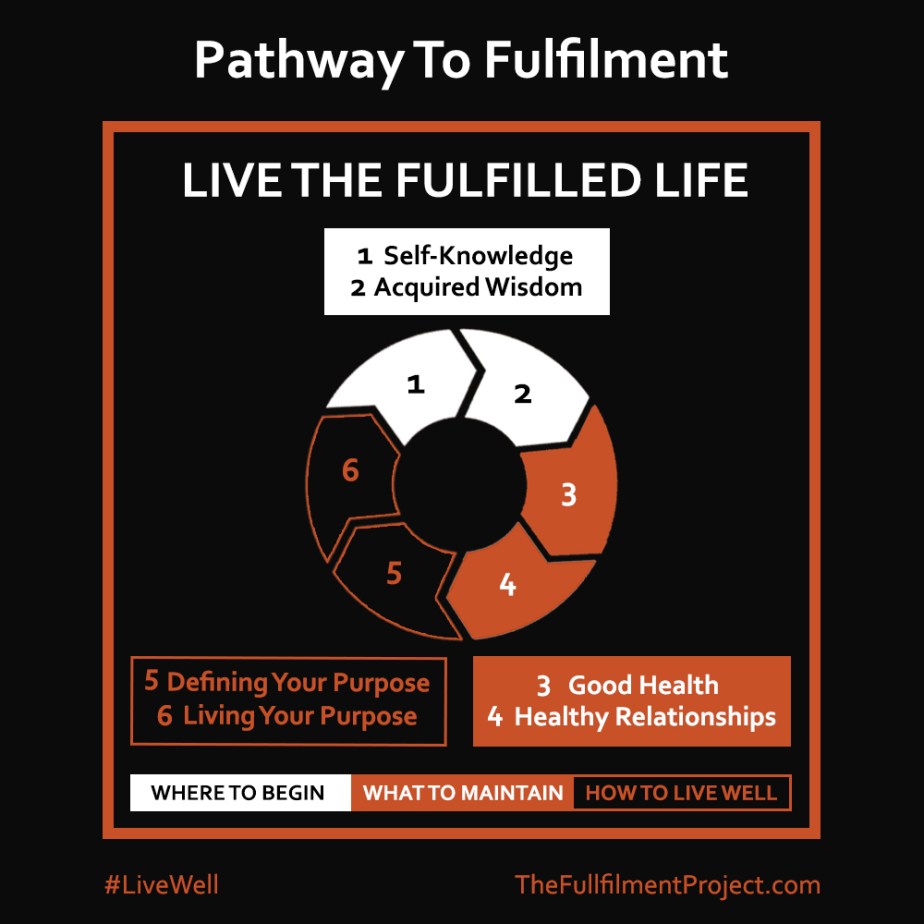
I have done some work on what I have so far called the Fullfilment Framework and renamed it the Pathway To Fulfilment, a more linear and simpler journey. My intention is to create a process by which people can start to live well, and therefore have fulfilment. This is not a life hack or magical cure for what ails you. It is a deeply personal journey of self-discovery, of life balancing and purpose finding. There are four steps of this process which are foundational to a life well lived, they are Self-Knowledge, Acquired Wisdom, Good Health and Healthy Relationships.

The Principles Of A Life Well Lived have been folded into the Acquired Wisdom. I have separated these foundational steps and the other steps of the Pathway To Fulfilment, six steps in total, into Where To Begin, What To Maintain and How To Live Well. Now that I have an outline of a process that I believe will bring about fulfilment in ones life, I aim to add in the detail of the activities and actions you will follow within each step of the journey towards fulfilment and a life well lived. Watch this space and the Facebook Group Community and on Instagram for up and coming updates. This new Pathway To Fullfilment can also be found on the page on this website of the same name.

WHERE TO BEGIN

Step 1: Self-Knowledge

The process begins with getting to know yourself more substantially than you may have before; figuring out what really makes you tick, what you believe and don’t believe, what you think is true and false, what you think is ethical and not ethical, etc. Also, what happiness and success look like to you, personally. It is broad and deep self-knowledge. This is your starting point.

Step 2: Acquired Wisdom

You acquire the wisdom of others, from a variety of sources, spiritual and secular; wisdom that will challenge you and enlighten you, as wisdom should. Often this is achieved by extensive reading, but, with the internet, a lot of this same wisdom can also be obtained through videos, audio books and pod-casts, however you learn best. This wisdom will feed into your self-knowledge, and influence how you see yourself and how you choose to live.

Connected to Acquired Wisdom are ten principles that I believe generate fulfilment, because they are wise principles that will help you navigate the world skilfully and live your life well. I have divided them into those that relate to Yourself and those that relate to Others. The principles related to Self are Growth, Equanimity, Fortitude, Seeking and Self-Competition, and those related to Others are Stewardship, Servant-hood, Reciprocity, Joy Making and Connection. I will be sharing more detail on these moving forward.

WHAT TO MAINTAIN

Step 3: Good Health

Your health should be of great concern, because good health is essential for your well-being and having an active, fulfilling life. I have included the usual physical health and mental and emotional health, and also energy health; all of which could be thought of as a triad of good health. Good physical health includes diet and exercise. Good mental and emotional health includes mastering your emotions and balancing your thoughts. Good energy health includes mastering the Chi (Qi) that flows through your energy system, like blood through your bloodstream, detailed in Traditional Chinese Medicine. To have good health you need to work on all three of these areas.

Step 4: Healthy Relationships

You look at your relationships, and identify those relationships that are good for you and those that are not, and those that are a mixture of the two, that need work to become good. You should continuously work towards all of your relationships being healthy ones; meaning that they bring you happiness rather than stress, they uplift you rather than bring you down. These relationships are in circles of community, which are relationships with yourself, your partner, your family, your friends, your colleagues and your acquaintances, and all are interconnected.

HOW TO LIVE WELL

Step 5: Defining Your Purpose

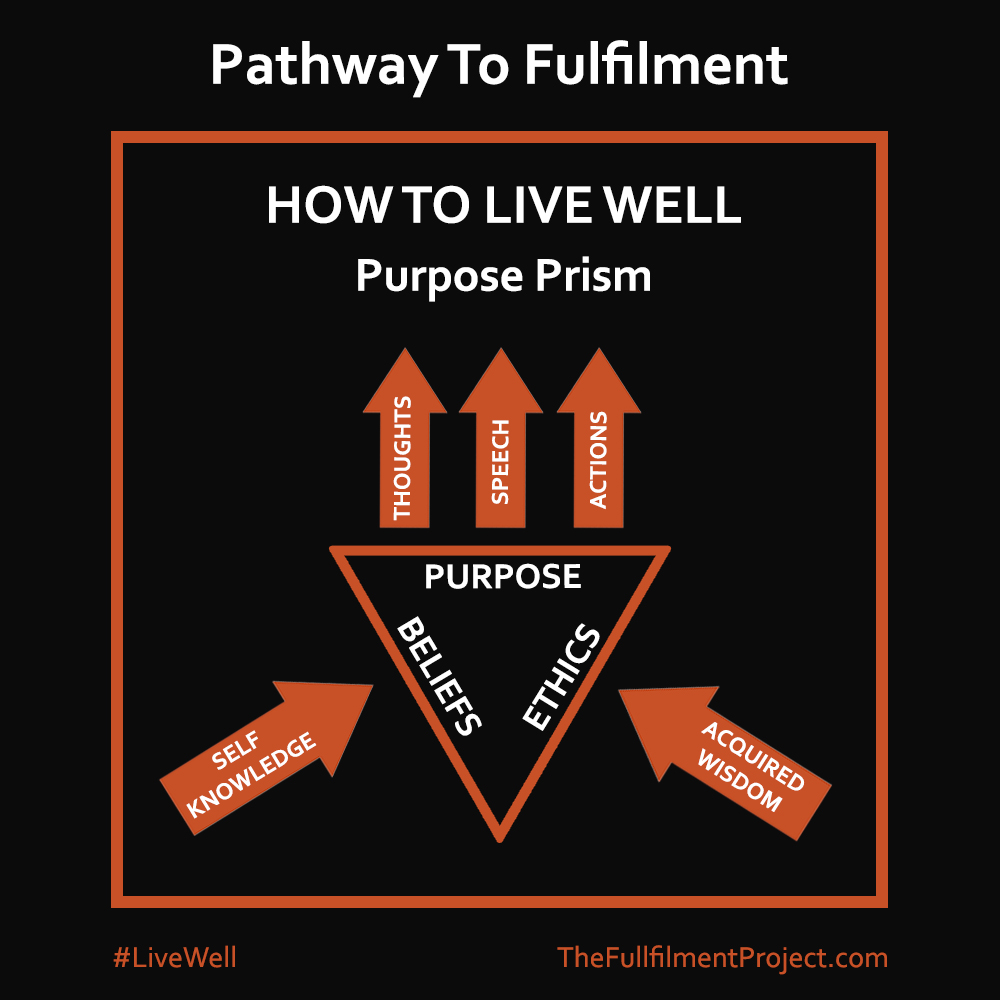
After working your way through this journey so far, you will have a solid foundation for how to start living your life better. From this knew understanding of yourself, your defined beliefs and ethics form part of what I call your Purpose Prism, the third piece of this prism being your purpose. You will go through a process of building on your beliefs and your ethics, weaving in Acquired Wisdom and Principles Of A Life Well Lived, and define your personal purpose. This prism is the filter through which you will see and experience the world, and it will influence your thoughts, speech and actions, making them wiser in nature. Your purpose comes from a vision of a better world that you want to help create.

Step 6: Living Your Purpose

You will then be set to start applying your beliefs, ethics and purpose to your life, to find your best way to live them out in your thoughts, speech and actions, to act on your vision of a better world through everything that you do. This is living your life on purpose. All of this work will mean that both happiness and success become personal, and therefore fulfilling, all three of which are bi-products of a life well lived. They then feed back into your self-knowledge, acquired wisdom, health, relationships and your beliefs, ethics and purpose, and on it goes, because this journey is a life long endeavour. Follow the path to fulfilment and live well my friends.

The Missing Piece Of A Life Well Lived

“People who truly understand what is meant by self-reliance know they must live their lives by ethics rather than rules.”

Wayne Dyer

Our Beliefs

We all have our own beliefs, things that we believe to be true. It might be that all children are precious or that the environment needs to be protected or that money is the route of all evil. You may agree with some of these beliefs but maybe not all of them. Our beliefs are part of what makes us who we are, and also what links us to other people; we gravitate towards others who believe in what we believe. This is human nature.

Our Actions

Our actions in life are often directly related to our beliefs. If you believe that being kind is important then you will often be kind to others, for example. However, often our actions are triggered by our emotions and are reactions to the immediate situation we are in. Our character plays a part too, but our actions are not always aligned with our beliefs. We might believe that we should take care of the environment but find it hard to give up on our big fancy car that guzzles fuel.

The Missing Piece

There is often a missing piece between beliefs and actions, and that is ethics. Ethics are moral principles we hold as important, which extend our beliefs into a code to live by. If we have a strong ethical code then our actions will more robustly align with our beliefs. It takes effort to put together an ethical code for ourselves. First we must clearly define our beliefs through self-exploration, by asking ourselves deep questions about what we believe and then putting our beliefs down on paper.

Then once our beliefs are clearly defined we need to reflect on what the ethical extensions are for each belief. For example, if you were to believe that it is important to be kind then the ethic of that would be something like to treat others as they wish to be treated, sometimes called the platinum rule. Your actions would then reflect this ethic and the route belief more consistently.

In order to live well, we need to live intentionally, with purpose. This is the importance of figuring out your Why, your overriding purpose for your life, but this is built on top of your beliefs and your ethics, which is all built on deep self-knowledge. It is to know yourself intimately and have the courage to live by your beliefs, your ethics and your Why. A life well lived is a courageous one aligned with who you are and how you can help those around you to live their best life. Fulfilment in life comes from living well, so join in the fulfilment revolution and figure out your beliefs and your ethics and have the courage to live by them.

Something To Think About

What are your beliefs and their corresponding ethics, and how will you bring these into your life?

Knowing Yourself

Often it can be easy to become the things that those around us want us to be. With peer pressure, the pressure from modern culture to dress a certain way or act a certain way and the expectations of our parents all add to who we think we should be. However, this is not always who we actually are. If the version of ourselves that we present to the world is different from how we are in our own head, or in private, then something is wrong.


The problem is that if we live to other people’s expectations then we are never going to feel fulfilled, because all that we do will be for the benefit of others. To live life as your authentic self takes courage, because you will be judged by someone, maybe many, in your life. But if you do it, if you live as you with conviction then my friends you can become your best selves. Your achievements will then feel worth it.


When the way you live your life is aligned with your values and beliefs then your heart will feel full, contentment will permeate your thoughts and your levels of stress will be reduced. The thing to do is to get to know yourself, deeply.


Your Values


Your values are simply the things in life that you value. I know obvious right? What I mean is the things that you have strong feelings about. The things that stand out as important to you. Is it your family, your friends, is it justice or charity? Is it creativity or making money? None of these are good or bad, but they get to the essence of who you are.

I value creativity, stewardship, kindness and leadership very highly. I value my family highly too. I also value equality and respect for others. Figuring out what values are important to you will fill in part of the picture of who you authentically are.


Your Beliefs 


Beliefs are about how you think the world works and how you think people should behave. Beliefs include religious ideas as well as human ideas. It might be that God’s grace is real. It might be that karma is real. It might be that we should try to lift other up and not put them down. It might be that the winner takes it all and the loser dismissed.


There is a morality to figuring out our beliefs. They define what is right and wrong in your eyes. Figuring out what you believe about all sorts of things is really important. To question the beliefs that are given to you by others and decide if you too believe them, deep down in your heart, is very important too. We are all individuals and living life by someone else’s beliefs can be detrimental to us.

What Is Your Vocation

We all have jobs, generally speaking, but they are often not things that we have chosen because we deeply believe in the work we are doing. Often the job we have is simply a way of exchanging our time and energy for money to live on. If the work is in contrast to our values or beliefs then this can be a stressful situation. Some places of work are also focused on how much productivity they can squeeze out of us rather than helping us to reach our full potential.

Some of you will have things that you do outside of work, things that you have chosen to do. Things that you are passionate about. Things you are literally doing for free, because you love it. One thing I do is preaching in a Unitarian church. You might be a Scout leader, a volunteer in a charity shop, a volunteer in a food bank, a writer or a blogger. These are signs of the things that you could flourish at if you were doing it as you actual job. Your vocation can become your job if you have the courage to take a chance and go for it.

All of this is about figuring out who you are, how you work, what you deeply care about and living your best life, because you know your self. This is life’s mission, a personal journey such as this avoids a life that will feel wasted at it’s end, because you will be living on your terms, in your way, and not living your life through the expectations and peer pressure of others.

Go forth and discover your wonderful self and live according to your values and beliefs. Be courageous and live true to who you are.

Principles To Live By

“A people that values its privileges above its principles soon loses both.”
― Dwight D. Eisenhower

There are many sets of rules or principles in our culture that act as guides of how to live, if we choose to follow them. There are religious ones, self-improvement ones and business success ones. One of the oldest known in modern culture are the Ten Commandments, found in the Hebrew bible and the Old Testament in the Christian bible. There are others however.


There is the Golden Rule, ‘do to others what you would have them do to you.’ Which is found in most religious writings across the world, in one form or another. One of my favourite sets of rules is from the small but excellent book, The Go-Giver: A Little Story About a Powerful Business Idea by Bob Burg and John D. Mann. In it the protagonist learns 5 laws of stratospheric success. It is business orientated, but they apply to every day life as well. Here they are:

  1. The Law of Value: Your true worth is determined by how much more you give in value than you take in payment.
  2. The Law of Compensation: Your income is determined by how many people you serve and how well you serve them.
  3. The Law of Influence: Your influence is determined by how abundantly you place other people’s interests first.
  4. The Law of Authenticity: The most valuable gift you have to offer is yourself.
  5. The Law of Receptivity: The key to effective giving is to stay open to receiving.

In life however, I think living by rules can sometimes feel restrictive, as constructive as they might be. I personally think it is better to live by principles. This means you have a reason why you do what you do and what you do and how you do it are more flexible, as long as they align with your principles. I have put together ten principle as part of my reworking or the Fullfilment Framework. This is a work in progress, so as ever, feedback is welcomed in the comments.


Principles of a Life Well Lived


I have distilled down principles that are good to live by to ten specific principles that I believe will collectively help us feel happy and successful in life and as a result feel fulfilled. These are the principles of a life well lived, categorised into Self and Others.


Self: Growth

As human beings if we feel we are not growing as individuals then our lives feel like they are stagnating to some degree and we lose any kind of fulfilment. We need to develop in our jobs, if not in our spiritual or personal realms. To gain deeper understandings and to improve is a inner drive that is greater or smaller depending on your personality, but I would say it is always there.

We also need to have a growth mindset to get the best out of life. To have a destination in mind but to be flexible on the route. To favour hard work and problem solving over believing that we have fixed, innate qualities like being creative or not being good with numbers. We become good at anything with learning and practice. Water flows around obstacles and makes its own paths. Equally, a tree that bends in the wind will not break and it continues to grow, as this is its nature, much like growth is part of our nature.


Self: Equanimity

This is very difficult, it is the art of being calm and collected in any given situation, good or bad. It is mastery over our emotions. It is not getting emotionally pulled into situations so much that the situation dictates how we feel and what we do. Self-mastery includes equanimity, keeping experiences in perspective in the greater scheme of things. It is not abstaining from emotions; it is Mastery over them.


Self: Fortitude

We all have challenges in our lives, some are overcoming procrastination to work on something important to us and some are life changing events that threaten derail our whole lives. When we have a goal in life, a North Star that we are aiming for, we need the drive to work on this every day. No matter what our challenges are, having the fortitude to keep going when life pushes back will mean we achieve the good success we deserve.

Self: Seeking

Part of the Fullfilment Foundation is Acquiring Wisdom, which is part of Seeking. What I mean by Seeking is the act of exploring the unknown, to yearn for explanations of why things happen the way they do, but also to have the courage to step into the unknown in life when the prospect fills us with fear. This can be in our job, in relationships and in personal projects, and it can potentially challenge the values and beliefs that we have defined for ourselves.

This is part of the process of seeking, it is being open to change when new experiences bring new information, new wisdom that we have not been aware of before.It is following a spiritual path or a path of self-exploration, depending on your theological beliefs. It is the path of the wisdom warrior, to courageously seek a deeper understanding.


Self: Self-Competition

In life, we often compare ourselves to others, we compete with them, even if this is only in our own minds. This will either make us feel self-important if we are ahead, or feel bad about ourselves, if we are behind. This is not productive at all if winning is everything. Comparing a standard of work with others can be useful, but it is best to compare our current selves with our previous selves. To be better today than we were yesterday.


This is how all the great achievers think, whether individuals or companies, those who innovate and change the world compete with themselves, not their competition. This means they can focus their Why, on bringing to life the vision they have developed from their Why.


Others: Stewardship

Greatness comes from leaving things better than you found them. Not being satisfied with the status quo because it kind of works OK. When this is done with the intention of improving things for others the benefit is magnified for yourself and others. It is planting trees when you know others will benefit from its shade. This is a kind of entrepreneurial spirit, the act of looking for things that need to be improved and making changes to achieve this.


Others: Servanthood

A good leader takes care of those around them, it is not a rank, it is a mindset. A good leader serves others. In life, we do not need to be in the position of a Manager or a Supervisor to be a leader, but we do need to have others who will follow us in our endeavours, to help us advance our vision. Servanthood is a rewarding mindset to have because our biochemistry rewards acts of generosity, kindness and compassion, and it is key to our happiness and feeling of fulfilment. However, it is not about being a dog’s body, it is a partnership of giving and receiving. It builds trust and cooperation and our relationships begin to thrive.


Others: Reciprocity

It is important to give, but it is also important to be humble enough to receive as well. It gives others the opportunity to give. Also, when we help others, we feel a sense of fulfilment, we feel good. Fulfilment itself is reciprocal because it requires the helping of others to find fulfilment in their lives. To help others grow and achieve, to feel joy and happiness. When we do this in our relationships and in our work, we feel fulfilled at the end of each day, but we must be able to accept the help from others too.

Others: Joy Making

Joy is different from happiness, because happiness evokes the idea that we are striving for something. Joy on the other hand is about bringing laughter and smiles to people’s faces. It is enjoying the moment, and we can bring this into our own lives through the attitude that we have, we can be joyful; and when we are the joy spreads. When we bring joy into the interactions, we have with others it feeds the souls, so to speak, it increases our wellbeing ten-fold and our lives and the lives of those around us are better for it. To be joyful is to enjoy life to its fullest, to be an ambassador of joy is to bring joy into the lives of others.


Others: Connection

There are two ways I think we should strive to be connected, with the people in our lives and what is often called the Great Mystery; God, Tao, Brahman, or just the Universe itself, that which is bigger that all of us but contains all of us. In life we need healthy relationships, in our personal lives and in our professional lives.

This involves things like regular contact, spending time together, preferably in person rather than via a device, and caring about the wellbeing of the people we know. When we are waiting for a meeting to start at work, or some other situation, asking how people are and listening to the answer, rather than checking our social media status or emails. This is how we build trust and loyalty, how we build depth into our relationships. Above all else it is caring about the other person beyond how you know them, compassion, empathy and love build strong bonds.

The Great Mystery or God can make some feel uncomfortable, even angry when the subject is brought up. However, I am not suggesting that you have to become religious if you are not. I feel that your beliefs should be dictated by your own conscience based, on your experiences and knowledge, and not the opinions or beliefs of others.

That being said, when we do not feel that we are connected to something greater than ourselves, then I think we can feel separated in our existence or full of self-importance, as if we are what is most important. Feeling connected to something larger than ourselves, even if this is the Universe itself, does two things. It helps us feel like we belong here and it keeps us humble to think of ourselves as like a drop of water in an ocean, an essential part of the greater whole.


Final Thoughts

These principles that I am suggesting will, I think, help you feel happy and successful. You might pick a few of them to follow and leave the rest. That is fine, it is not a definitive list, but I believe that they are the core of what it means to live well.

Something To Think About

Which of these principles would you follow? Also, what other principles have you already decided to follow or could you follow?
Stepping into the unknown

“Until you step into the unknown,

you don’t know what you’re made of.”

― Roy T. Bennett


Making choices

In life there are many avenues to go down, many paths to take, or not as the case may be. Some of these paths lead to dead ends and some to wonderful opportunities. The challenge we have is that we never know beforehand, for certain, if making a particular choice will bring a positive outcome or not. Each time we are stepping into the unknown. We can, however, as the saying goes, learn from our mistakes and use our experience to weigh up the options and make a decision. Some say we should go with our gut, with what feels right, but if this is not tempered with wisdom and experience then we will only be following our instincts, which are primed for survival, not necessarily leading a fulfilling life.


The unknown could be a new job, a new relationship, trying a new hobby or something that changes lots of things in our lives like moving to another town or city. We make these sorts of changes every day, but they still come with uncertainty and some anxiety. Each new change begins with a decision and leads to more decisions along the way. I would argue that no approach to making decisions is the best or the worst, as we each live individual lives and we are all individual people, but there are some things that can help when we are stepping into the unknown, which I will come onto in a moment.


Why do we step into the unknown?

However, first of all I would like to explore why we might feel the need to step into the unknown. It has long been part of the human spirit to push beyond our boundaries into uncharted territories. Human history is full of examples of men and women that have strived beyond the boundaries of their day to create new innovations and break records, whether this is manned powered flight or reaching the South Pole on foot.


For most of us such challenging goals are not things that we aim to do, partly because we are interested in other things and partly because we have commitments in our lives that need our attention and focus. That being said, we all have things that we are passionate about, things that we would happily do for free if time and circumstances permitted. This is the unknown territory that I want to talk about today, the venturing into the things that we are passionate about. Often, we don’t jump into our passions because we have responsibilities that we feel we must commit to or we lack the confidence to do so.


“…the past does not equal the future.”


More often than not we do not follow our passions because we have had bad experiences trying new things in the past and we think that the same thing will happen again. There is an important principle connected to this that I have recently being trying to apply in my life, which is that the past does not equal the future. A lot of people, including myself, are held back by failure, because based on past experience we expect to fail again. The problem is that we see failure as a negative thing because of our past experiences. If we accept that we will fail sometimes then we can employ all of the resources that we have to make it work and to succeed.


Not everything is instantly obtainable

We also live in a time when almost everything is instant. Whatever it is you want to buy, often there is an option to have it delivered the same day. We can do our banking on our mobile phones, we can send an email to someone and they will receive it a few seconds later, no matter where in the world they are. Innovation has made our lives a lot more convenient, but not easier. This is because we expect everything to be instant, but many of the important things in life take time and effort. For example, relationships take time and effort to become strong and durable through the ups and downs of life. It is the little moments of asking how someone’s day is going and caring about the answer, of engaging in small talk in the moments between doing other things. These things help to build strong, healthy relationships.


Too often we are spending time with people without spending time with them. I’ve seen couples in restaurants where they are both on their mobile phones and not looking at or communicating with the person they came to the restaurant with. It has become an accepted thing to do to scroll through our Facebook feed instead of making a connection with the person we are with. This has had a knock-on effect that means young people are finding it difficult to build relationships, because the social skills that are normally built up through trial and error as a child cannot be practiced if they are looking at a screen and not a person.


Failure also seems all the more magnified because if we expect something to be instantly successful, and we fall at the first hurdle, we give up. We are becoming conditioned for insecurity when we should be conditioned to fail our way to success. I guarantee that every successful person who is famous for their success has failed more times than most other people have. It is not about how many times you get knocked down, it is about how many times you keep getting up. Having this sort of mentality will enable us to stride forth into the unknown with the confidence to fail and try again.


For this to work, however, we need to have the right motivation. Wanting to be successful so that we can be rich is a motivation, but it will inevitably lead to an emptiness, because you cannot buy happiness. If, on the other hand, we want to be successful so that we can help more people live better lives, then fulfilment will be our reward. Motivation is key and it has to fit with our values and beliefs, this above all else is important, because to live a fulfilling life our thoughts, speech and actions should reflect what we value and what we believe.


Wisdom guides us

But where do our beliefs and values come from? They are manifestations from the culture and community we grow up in, the examples our parents give us and how they raised us, as well as the experiences that we have had. Through all of this input we piece together what we believe and what we value. All of this then effects the decisions that we make on a day to day basis, but I believe that if we are to make wise decisions in life then we should seek out wisdom, which can be found in any of the many religious scriptures, philosophical and secular texts from around the world. If we have wise guidelines or principles to follow, then stepping into the unknown will seem less scary. I suggest firstly analysing what is holding you back from stepping into the unknown and try to overcome it, through seeking wisdom and figuring out your beliefs and values. These things will guide you on your path. It helps to accept whatever is in front of you on your path and then figure out how to deal with it.


Something to reflect on:

Often what is holding us back is our own misguided beliefs and the baggage we carry from past experiences. Holding on to bad experiences weighs us down. Once we let them go we are more free to move forwards. This is not easy but essential if we are to live a fulfilling life.

How to be more confident

“Your doubts will create mountains. Your actions will move them.”

– Mel Robbins


This post is going to be a brief summary of Mel Robbin’s ‘Confidence Crash Course Livestream’ that was replayed on YouTube. It is an outstanding exploration of what confidence actually is and how to manage the self sabotage that gets in the way of us being more confident. I have added in here and their my own take on what was said in this livestream. There is a link at the bottom of the post to the YouTube video to watch the hour and a half video chocked full of good advice. I recommend watching it as there is a lot of content that I have not included here, as there is not enough space in a blog post to cover it all.


Myths about confidence

  1. Confidence is a personality trait

  2. Confidence is fixed

  3. Confidence starts with belief


Truths about confidence

  1. Confidence is a skill

  2. Confidence is situational

  3. Confidence begins with action


There are areas in our lives that we feel more and less confident in, which shows that it  really does depends on the situation we are in more than our overall confidence as a person. Knowing that confidence begins with action means that we have control over our confidence, because…


Confidence is the decision to try


A lot of people feel less confident when starting something new, but it is key to remember that you are always going to either succeed or survive. Either way you will learn something new. It can help to remember Mel’s definition of confidence and replace the word ‘confidence’ with ‘the willingness to try’. This then becomes actionable and we can take the action we need to, so we can take control of the situation we are in and work towards a positive outcome.


Self doubt is the decision not to try


Self doubt is also a decision to avoid taking the action that we do not want to take. It often has become a habit to doubt ourselves rather than trust that our inner voice is capable of directing us in the right direction.


Wise words: “Your doubts will create mountains.

Your actions will move them.”


The 4 traps of self doubt

  1. Hesitating

  2. Hiding

  3. Hypercritical

  4. Helplessness


Hesitating

  • Triggered by uncertainty
  • Waiting
  • Overthinking
  • Wanting your work to be perfect

You will never find the right time to do something. The only solution when we are hesitating is to just do it. When we are waiting to avoid something the solution is to just take action. If we are overthinking a decision it can help to ask someone else to make the decision for us. Many of us are perfectionists and this is also a way of hesitating and avoiding taking action. Remember that ‘good is gold,’ the only person that thinks that it needs to be perfect is us. Good is good enough. Hesitating is a way of staying in control, but it causes us not to take advantage of opportunities. The only answer to avoiding hesitation is to take action.


Hiding

  • Triggered by fear
  • Avoiding people/calls
  • Being silent
  • Being a chicken about money and terms
  • Procrastinating
  • Not talking to new prospects

We avoid the actions that we fear, but saying that we can’t talk to that person or we can’t make that call is wrong. What we actually mean is that we don’t talk to that person or make that call. Avoiding it is a choice that we have control over, we just have to bite the bullet and do it. Procrastinating is another way of hiding from the thing we don’t want to do, it is a way to be in control. We don’t know what will happen when we take action, but we will either succeed or survive.


Hypercritical

  • Triggered by past failures
  • You argue against yourself
  • You focus on the reasons why you can’t
  • You fixate on what could go wrong
  • Your stress has an edge

Often we are hardest on ourselves. We say negative things to ourselves in our heads that we wouldn’t say to anyone else, because they are so harsh. We argue with ourselves, saying things like, “I can’t do that” or “I’m going to fail,” while we are trying to convince ourselves to do something. We often fixate on what could go wrong, rather than what we could get right. Sometimes our stress has an edge to it, it seems quite serious, but only if we focus on the wrong things.


Strategies

  1. Break down big steps
  2. Take small moves forwards
  3. Record your progress


Helplessness

  • Triggered by low self worth
  • You actively play the victim
  • You know the solution
  • You may say that “nothing ever goes my way”
  • You’ve got all the excuses in the book

Actively playing the victim means that we don’t have to take responsibility for things, even when we know the solution we avoid taking action. When something does not go to plan saying “nothing ever goes my way” is another way of not taking responsibility. As is coming up with a long list of excuses. If we own our mistakes we can always find a success in the situation.


Wise word: “The problem isn’t knowing what you want.

The problem is having the courage to say it.”


The 4 traps of self doubt are learned behaviour


Many of us are clear on what we want, we just don’t want to admit it, because we would then have to do something about it and take action. We need to ask ourselves, “Do we have self doubt or a habit of doubting ourselves?” Self doubt is a learned behaviour, often from the people we have spent the most time with. Knowing this means that we can change our behaviour to actions that serve us better. The ingredient we are missing is courage. To get from clarity, which is knowing what we want, to confidence, which gets us what we want, we have to have courage. We have to just do it, even if we are anxious or nervous, because courage is not the absence of fear, it is taking action even when you are scared to do it. Confidence is at the other side of courage.


Clarity > Courage > Confidence


Wise Words: “Changing is hard.

You don’t have to go through it alone.”


One of the best things we can do is to try and bounce back after failure. One strategy to do this is to write a list of all of the failures that we are mentally carrying around with us. All of the failures that we cannot let go of. Then, to write down one important lesson we learned from each one of them. This releases the burden of carrying the failure around, because we begin to treat the failure as a positive thing that can help us move forward.


Wise words: “If you have a problem that can be

solved with action, you don’t have a problem.”


It is important to focus on what you can control and let go of what you cannot control. We often spend a lot of time and mental energy worrying about things that we have no control over. Mel, during the live stream, had a few technical problems at the beginning, but she kept on going. She focused on what she was saying and the content that she wanted to deliver, which she had full control over. The result was that the message got across and the content hit home. If she had given up at the first sign of technical trouble then she would not have impacted the 1500 or so people that tuned in to the live stream and the countless others who have watched the YouTube replay. Focus on what you can control.


A technique that Mel Robbins talks a lot about is the 5 second rule. This is used when you have anxiety rise up and your frontal cortex, the thinking, rational part of the brain, shuts down and the amygdala, the emotional, fight or flight part of the brain, takes over. You simply say 5, 4, 3, 2, 1, which switches the frontal cortex back on and you think of your anchor thought. Your anchor thought is something that make you feel good or that you can get excited about. For me it is thinking about seeing my Wife and daughter at the end of the working day. The reason this works is that the body has the same physiological behaviour when you are anxious and when you are excited, the only difference is what your brain thinks about it. So, telling yourself that you are excited about whatever it is, your brain calms down and the anxious feeling goes away. It is a technique that can really work when the panic begins to set in when you are in a stressful situation.


And finally, the take away message is that a negative mindset does not serve you. So actively removing the negative mindset when it shows up and replacing it with a positive mindset is really important for a happier and more successful life, and a more fulfilling life as a result. If you have found this information useful please do watch the full video by clicking on this link (Confidence Crash Course Livestream Replay) and check out Mel Robbin’s YouTube channel, her books and her website, www.melrobbins.com.  Keep on working towards your dreams, and remember, fulfilment is a path that we walk together.


#LiveDeeply


5 Things all effective leaders need to have

“A leader is one who knows the way, goes the way, and shows the way.”

– John C. Maxwell


When it comes to effective leadership profit margins and performance projections are not the game. A leaders job is to know where they are leading their followers and to be able to articulate it in such a way as to inspire their followers to move in that direction together and to look after those that they lead. Leadership is about vision, energy, wisdom, human connection and having a moral compass.

Vision

Simon Sinek talks frequently about leadership and the need to have a vision and his vision is “I imagine a world in which the vast majority of people wake up every single day inspired to go to work, feel safe when they are there and return home fulfilled at the end of the day.” My vision is of a world where the vast majority of people collaborate to help each other lead happy and successful lives and live fulfilling lives as a result. This is why I created and continue to write this blog. I would not be so bold as to compare myself to Simon Sinek, we are not even in the same league, but what I am pointing out is that a vision is of a world in which we want to live, it is tangible, it is something we can imagine and work towards.

The job of a leader is to instill their vision in the culture of those who they lead, so no one is fuzzy on the direction that they are going in. This means that the vision becomes a part of everything that the members of a team or the employees of a company do on a daily basis. When Managers only reward short term gains, like reaching a profit margin, then the whole thing becomes unstable and often collapses, but a vision is something that is almost unreachable, it is a north star which we will never reach, but it points us to where we are going. It is therefore a constant and creates a successful and stable working environment, which breads more creativity and innovation, because the vision is clear and the team or the employees feel safe to take creative leaps.

Energy

It is no accident that effective leaders have lots of energy, because energy is infectious and we are drawn to those with energy. If a leader uses energy well they energise the people around them and they diffuse it into the culture of their workplace, causing their team to put there mental, emotional and physical resources to the task of working towards the shared vision, towards the north star of that team and that company.

This only works, however, when the leader in question actively interacts with their team or their employees. Whether you are a CEO or a Team Leader passing your energy onto those under your charge is an essential ingredient of effective leadership, it is part of making a human connection with those that you lead, because for someone to follow you they need to trust you, and trust is built up over time through positive interactions where, as a leader, you look after those in your charge.

Wisdom

It takes time to become an effective leader, it is a combination of both knowledge and experience, along with the other traits I am discussing in this blog post. It has been found that the most effective leaders are between the ages of 45 and 70. This is the sweat spot for effective leadership. Wisdom is a term that is banded around a lot, sometimes it is referred to when talking about people in their 80s and 90s, but I do not think that it is necessarily always about age.

I believe it is about the daily pursuit of knowledge and understanding of how to do the things we care about well. It is about us putting this knowledge and understanding to the test of experience every day, and on the other side of failure after failure we find wisdom. It is a deep understanding of how and why the thoughts, speech and actions of greatness result in this outcome. It also takes time to become wise, which would account for the age range within which we find effective leadership.

Human Connection

When leaders are in charge of a small team of people there are day to day human connections. Everyone knows the names of each others children, everyone’s lives are intertwined. The team will work and socialise together and relationships are built up over time through many many little interactions that amount to strong human connections. Therefore the leader needs to be adept at building and encouraging these connections, these relationships. Empathy is a strong component in these relationships, to connect emotionally on an individual level.

Empathy is a cornerstone of any human relationship and a good leader knows that teams and companies are not built on money or products, they are built on human relationships, because 100% of employees are human beings and 100% of customers are human beings. An effective leaders job is to look after their team or their employees and their employees will look after the customers. This is how sustainable businesses grow, and the stakeholders will benefit from this model more than if the leaders only focused on what the stakeholders wanted.

Moral Compass

As leaders rise up the ranks they become more and more detached from the employees they lead, so empathy no longer works, human connections become lessened, because there are less of the little interactions that add up to a working relationship. This is why empathy decreases in effective leaders in higher ranking positions, but it is in fact replaced by compassion. In other words they become more focused on doing the right thing even when it is hard.

This compassion is their moral compass, which becomes more prominent in effective leaders over time. It is detached from the individual employees that the leader is leading, but it is focused on doing what is right for all of the employees in their charge. Even if they are the CEO of their company, an effective leader is dedicated to doing the right thing, even when there is pressure to do the easy thing and put profits over people.

Effective leaders need to have a vision and clearly communicate it out to those they lead. They need to use empathy to make real connections with the team they lead. They also need to engage their moral compass of compassion when leading from a more senior position when they cannot rely on close working relationships to support and guide their employees. Being an effective leader has a lot to do with knowing that people are more important than profits, because effective leaders create effective leaders in those that they lead. To be a great and effective leader we have to make sure we look after the person to the right of us and the person to the left of us and we can all do that.

6 Principles to finding happiness 

Many of us, throughout our lives, strive to find happiness; something which can often seem illusive. I think the reason we can find it so difficult to achieve it consistently, is that it our happiness is very individual to us on a surface level, but true happiness is something different.

I want to explain what I mean by happiness. Happiness, according to the English dictionary is “The state of being happy.”  Simple enough, but I would add that it is the state of being happy ‘consistently.’ True happiness is not fleeting, it is a constant state created by wisdom and frequent practice of wise actions, which allow us to experience a consistent state of happiness. It is a result of how we live our lives each and every day. Happiness is similar to success, in that they are both a bi-product of living a life well.

In order to live our lives well we can cultivate wisdom by studying the best of human philosophy, theology and science, and try to understand ourselves more deeply on a daily basis. The wisdom of the present and past also extend to what I call the principles of happiness. These are the attitudes and behaviours which are necessary if we are to be happy consistently. Let’s go through the six principles for finding true happiness.

The first, and most important happiness principle is something that Tony Robbins calls ‘choosing your state.’ Tony Robbins is an American author, entrepreneur, philanthropist and life coach. Our state is the emotional and psychological state that we are in. If we let the experiences we have and the people in our lives dictate our state, then we lose control of our sense of self. Actively choosing how we feel about the circumstances we are in is not only empowering, it is also a path to happiness, and fulfilment. If we have a choice why would we ever choose to be demoralised, upset, jealous, angry or frustrated? This is not easy, but it is possible with practice.

Viktor E. Frankl knew this more than most, he was a Psychiatrist and a survivor of a Nazi concentration camp, and he witnessed first-hand the horrors the inmates were subjected to and the effect of this on their psyche. In his book Man’s Search For Meaning, he talked about his experiences in the camp and he said:

“We who lived in concentration camps can remember the men who walked through the huts comforting others, giving away their last piece of bread. They may have been few in number, but they offer sufficient proof that everything can be taken from a man but one thing: the last of the human freedoms — to choose one’s attitude in any given set of circumstances, to choose one’s own way.”

This is part of the path to experiencing true happiness, to choose one’s own way. There are some practices which help us to achieve this. These practices are contentment and gratitude, both of which are necessary for us to choose the state we are in.

The next happiness principle is humility, the antidote to having a large ego. When we focus on ourselves selfishly at the cost of others this often brings suffering, because of two things. Firstly, selfish actions that seem to promise happiness rarely result in actual happiness. Secondly, if we act in a way that is selfish, we can damage the relationships we have, and this brings negativity into our lives.

The next happiness principle is having no boundaries. This refers to boundaries that are often imposed by others and those we learn. When we see an us and a them, divisions along the lines of race, religious, country, gender, sexuality, education, class or politics, we create conflict in our lives. At every division there is a conflict, but if we try we can see ourselves as one, as one community, one humanity, one universe, then we will have less conflict in our lives. The more unity we have in our mental attitudes, the more connection we will have, which takes us onto the next principle; connection.

If we are going to have more positive human connections then we have to do some daily practices. We must have compassion for others, to motivate us to see them as beautiful amazing people that we want to help and love. This applies to animals and all of nature as well. We must practice empathy, putting ourselves in the shoes of others, so we can better understand where they are coming from. This allows for better understanding and connection. We also must practice forgiveness, both for ourselves and for others. Carrying around hate and distrust is a heavy burden to carry.

Cultivating a connection to the greater oneness of the universe or God or Tao or Bradman, whichever connects with your beliefs. Duly meditation or prayer will allow us to make such a connection.

The next happiness principle is integrity. This connects directly to our values and beliefs and committing to living by them, no matter what temptations or difficulties there are in our lives. This can be very difficult, but I believe that integrity is very important to our happiness, because if we are not true to ourselves we can feel uncomfortable in our own skin and negativity can seep into our sense of self and corrupt our happiness. The final happiness principle is the act of helping others find happiness, this is very important.

The Dalai Lama said “If you make others happy, you’ll be happy. If you make others unhappy, you’ll be miserable.” We have evolved to be social creatures that protect those we care about. If we extend this to all people and all beings we can be very happy indeed.

Standing by your principles 

The recent political debacle in the UK has highlighted to me the need to stand by your principles, and to spend time working out what your principles are, because they are the framework for every decision you make and every action you take. You could say that your principles define you, so you need to firstly define your principles, but is it as easy as knowing what your principles are?

During political elections like the one we have just had, principles play a very important role. When we decide who to vote for, we usually look for people who have similar views to us on important matters like education, the health service, housing etc, and we look for a political leader that we feel will stick with these principles when making big decisions about the big things that effect our lives. However, we see very often that political leaders do not always do what they say they are going to do, which leads to a lack of trust and cynicism sets in. Consistently living by your principles builds trust and respect from others. So if we want to work well with others we firstly need good principles and then we need to stick by them in the hard times and the good.

What is it though that makes principles good? The thing that I think is a large indicator is the effect it has on others. For example, if we believe that money will solve all of our problems, then we may well sacrifice relationships to get more money, hurting others in the process. If we believe that we should be completely honest all of the time then, for example, telling someone that they are fat will have a negative impact on the other persons self esteem. Money and honesty are not bad things in and of themselves, but the application of them should be for the greater good for both of ourselves and others, which should form part of the principles we hold.

Even though, I believe that fundamentally our principles should come from our own views on the world and everything in it, we should be open to the principles of others. It is only when we actually listen to the view points and principles of others that we can shape and sculpt our own. We all begin with the view points and principles of our parents and our peer groups, but this should be the beginning of our life long quest to shape and sculpt our own principles. This being the case then we have to live in two states. The first is being open to listen to others and learning from them, so we can reflect on our own principles to see if they still hold water. The second is to stand by our principles in every situation. This will mean we make good decisions and we build trust and respect in the relationships we have throughout our lives.

Two of my important principles are:

  1. Kindness should be part of every action and every word.
  2. Generosity that is received should be shared with those who need it.

What are your principles?