Everything We Do Is About Legacy

When we think of legacy, we think of having children or building a business or community organisation that will go on for generations, but I would argue that everything we do is about legacy.

Whenever we interact with someone, the impact, whether positive or negative, from our words and actions can be far-reaching. Like ripples across water, we can deeply wound or deeply enthuse those we interact with. Someone could be having a terrible day, but kind words or an actual of kindness can turn their day around and could be a catalyst for positive change.

Alternatively, if we are mean or unkind, we could change a person’s life trajectory down a dark path. Our words and actions have the power to impact the lives of others significantly.

Some years ago, I met a homeless man sitting outside a shop crying. I stopped to talk to him, and he told me that it was his 40th birthday and he was alone. It was November, and we were coming into a cold winter in the UK. He told me that he was on a waiting list for a hostel but had to wait 12 weeks. This meant he had to survive living on the streets through the winter before he could get a place to live.

I talked with him for a while, and as I lived nearby, I went home and packed a bag of warm clothes, including a woolly hat and gloves, and gave them to him. He was very grateful. I like to think that this small act of kindness got him through the winter and may have dissuaded thoughts of suicide during that difficult time. I also like to think that he has a better life now and is passing on the goodwill to others. I have no way of knowing, of course, but I hope. A small act of generosity from me could have had a big impact on him.

We don’t know the impact we have on those we interact with day to day. So, be kind, be generous, and be accepting of others, and together we can make the world a better place one interaction at a time, and if we make this a habit then this will change us for the better too.

You Can’t Step Into The Same River Twice

I recently visited a church that was my spiritual home for many years before I moved away from the area. The church was the same with the same minister, but the congregation had grown and was filled with new people.

At first, it felt uncomfortable as it felt so different because I didn’t know most of the people attending, but the vibe and the spirit of the place were the same. It made me think about the idea of not being able to step in the same river twice because the water constantly changes as it flows downstream.

However, the name and location of the river remain the same. I suppose you could say that all things, people and places are both different and the same each time we encounter them. They are the same river but the river is different.

We are also different each day and in each moment. The eyes through which we see the world at 15 years old are very different to the eyes we see through at 30 and 60 and 90 years old. To a large degree, we see the world how we are not how the world is. Becoming aware of this and recognising the changing state of things and of us can help us to navigate the world successfully.

The Law Of Receptivity

The fifth Law of Stratospheric Success for the book The Go-Giver is The Law of Receptivity.

“The key to effective giving is to stay open to receiving.”

The Go-Giver

When we give something to someone at least part of us wants that person to be grateful that we took the time, the effort or the money to give them whatever it is. However, sometimes we can be ungrateful when others give us things, because it is not what we wanted or we don’t want help from others or some other reason.

When we are not open to receiving gifts from others we disrespect the act of giving. In fact, being open to receiving honours the gift and the giver. It is a gift to wholeheartedly receive a gift from others. Who are you to refuse a gift from someone else. In order for giving to work at all there has to be a receiver.

It is a kind of partnership that goes around and around. You give and then you receive and then you give again. It is the exchange of effort and time that keeps relationships going. To be an effective giver you have to be an effective receiver too.

We Can Be Peacemakers

Much of the world is at war with other parts of the world, but also, much conflict is celebrated in the news and social media, when one celebrity is fighting with another or some situation is pitting one group of people against another. It makes good viewing, because people watch. Some conflicts are real and others are not. However, all forms of conflict seep into our lives through our exposure to them.

We can be mindful of what we let into our minds, what things we agree with because those around us do, what we watch on TV and whether we encourage or engage in divisive speech. We are not in a war zone, but we can be peacemakers. We can seek resolution and not conflict. We can become open hearted and not hard hearted. We can learn to assume good intentions from those we interact with. We can seek out our prejudices and judgemental thinking and remove them. We can meditate and pray and share what we have with those around us. In the end, from the cosmic perspective, we are all in this together.

We are on a planet hurtling through space around a star, one of billions in our galaxy in a universe that has billions of galaxies. We share our DNA with all other life on this planet. We share DNA with a banana, and a fruit fly, believe it or not, because we have the same origin as all other life on this planet. If you choose to, you can see all living things as our brothers and sisters, as many native peoples do. Otherwise we risk conflict and divisiveness, even if unintentional.

We are all brothers and sisters. One human family. The chasm between us and our enemies is but a step towards love and compassion. The space between enemies is decided by how we see them and how they see us. In reality there is no space.

Reducing The Suffering Of Others

Naturally in life we don’t want to see other people suffer. However, we often go about the world interacting with others from our own point of view. We think about things in terms of how they impact us. This can cause us to be reactive to life’s events, asking ‘Why have they done this to me?’, for example. A better question to ask is ‘Why did they do that?’ This moves the thinking from us to them and allows us to consider the reason the other person is behaving the way they are.

Hurt people hurt people. So if someone hurts you with their words or their actions it is an indication that they are suffering, and rather than becoming reactive and trying to hurt them back, we could be compassionate and empathetic. This diffuses the situation and creates a space to helps the other person to heal. We will heal a little too.

If we reframe how we see our interactions with others and move from ‘How can I make things better for me?’ to ‘How can I reduce their suffering?’, then your relationships will improve and life will become more fulfilling.

How To Develop Confidence

On the way into work yesterday it was quite misty, but it wasn’t thick enough to be fog. It reminded me of something I heard about how driving in fog is a metaphor for life. Often, when moving forward with a new venture, a new relationship, or anything that takes us out of our comfort zone, we are scared because we don’t know what the future holds. This is like driving in fog when you can only see 10 feet in front of you. The way to get clarity on what is ahead of you is to move forward 10 feet and then you can see the next 10 feet.

The lesson here is that we will never be able to predict the future 100%, but this should not stop us from moving forward. The best strategy is to work on your skillset and learn from your experiences. With skills and experience you can make wiser decisions and you can pivot where needed, depending on what life throws at you. If you trust your car brakes, steering, lights etc, then driving in fog is less stressful because your car and you can handle whatever you come across.

In order to improve your skillset and experience, you have to put in the time to try things out and develop skills. However, confidence also comes from our mindset, we have to believe in ourselves and our abilities or the actions we take will largely be ineffective. This mindset has to be a growth mindset, the ability to be agile and flexible requires it. Having a fixed mindset will cause your confidence to crumble when you hit the realities of life.

So, confidence requires skillset, mindset and experience. A seemingly obvious statement, but we often think of confidence as something we are born with. In reality confidence comes from how we behave on a moment to moment basis.

The final piece to the puzzle of confidence is our environment. If we feel safe enough to try and fail and try again, then our confidence goes up. If failure is treated with rejection, then we will develop a fixed mindset, we won’t believe we can do anything and we will not gain the required experience. This is why we need trusting teams at work, and supportive relationships in our lives. Add together all of these elements and you have the recipe for confidence.

Working Better Together

When we look at the world, our experiences and our relationships with a strong sense of Self, then we set up an us and a them automatically. When we hold our sense of Self up with pride at what we have done or what we know or who we know or whatever, we create further division.

If we can reduce our sense of Self, even to a level where we see ourselves as equal to others, we can live a more harmonious life. The eastern idea of there being no Self can be hard to agree with or even understand, but it is clear that a strong sense of Self causes problems.

Trying to think in terms of everyone being like brothers and sisters, much like many native peoples do, then we can cooperate more and develop wonderful, supportive relationships, and make the world a better place to be. The aim is to move from division to unity by getting ourselves out of the way.

Give It A Try

Sometimes we have people around us who act as support structures, people we go to for advice. If we are lucky we have these people amongst our family and friends. We often have them in our work environments as well. For one reason or another these people can become absent in our day to day lives, either temporarily or they just drift out of our lives.

This can create a hole that leaves us feeling anxious and in need of reassurance. This feeling can be taken as a sign to worry or it can be taken as a sign to step up and be more decisive, to taken on more responsibilities and to believe in ourselves more.

You will likely be able to do more than you believe you can. Those who support you can see what you are capable of. When they are not there it becomes time for you to see what you are capable of. It is time to step into the arena of life and give it a go, whatever it is that you are scared to do. Do it, and those around you will support you, if you let them.

Learn To Listen

If we listen to the language people use and the topics of conversation they drift towards you can get a sense of their priorities and values. You can figure out what they care about.

This is not a strategy to get the better of them or try to sell them something. It is a strategy, however, that can help you build better relationships. When we understand each other better we can serve each other better.

Building A Community

When a tree grows there are usually other plants and herbs that grow around it and the type of tree will often dictate what grows around it. So much do that when native people who were looking for a particular medicinal herb they would look for a particular type of tree.

The relationship between a tree and the plants and herbs that grow around it is often decades in the making. When we reflect on the many communities to which we belong we can see the time and symbiosis that is required for communities to thrive. Depending on the community we may be the tree or we may be the herb, neither has more or less values that the other, they simply serve a different function in that community.

There Is Nobody Like You

Others may do the same job as you, live in the same area as you or have the same life experience as you, to a degree, but they are not you. You are a unique happening. You are also an essential part of this thing called life. The world needs your unique perspective and contribution to make the world a better place.

If you think you are ordinary or even less than some level of importance then you are underestimating yourself. You can thrive given the right environment and right self belief. Sometimes we need to find the right environment first. This could be a place of work or a group of friends. It is easier to believe in ourselves if others believe in us first.

Blaming Others

We blame others a lot for the negative things that happen to us, but we hardly blame others for the positive things that happen to us. Blame works both ways.

We have evolved to focus on the negative, because in a life or death situation we survive if we see the danger. This has an adverse effect now we have less danger in our lives. We are also fed negativity in the news, and the media generally, because it is what we pay attention to and it increases their number of views.

If we let ourselves only focus on the bad things that people do in our lives we tip out of balance and it wears away at us over the years. There needs to be balance. Blame people for the good they do more than the bad. Rebalance the way you see people and you will feel more blessed and less depressed.

Stronger Together

When you get knocked down in life you have two choices. Stay down and give up or find a way to rise again. Sometimes we can rise alone, if we have the internal resources to do so, but usually we need the help of others through the relationships we have and new ones we form or the wisdom in books and online content.

It takes courage to stand after you fall, but often we should not try to stand alone, we should seek support. We are always stronger together. It is often seen as a weakness to ask for help, but it is the most courageous act we can do when we have been knocked down by life. We can stand alone again in the future, but take the support when it is available.

The Key To Positive Interactions

I used to work in a special needs school working young people with conditions like Autism and ADHD and I was thinking today about how we often assume everyone else experiences the world in the same way that we do. It is an assumption that we don’t necessarily decide on, it is just there.

Some Autistic people struggle to understand social rules, empathy and some find facial expressions difficult to process. Seeing the world as someone with Autism sees it is very different to someone who does not have Autism. We all also see through the lens of our own experiences as well. Our experience of the world is in fact unique to us. This means that it is unique for everyone else too.

So, when we interact with other people it is best to try and listen to understand the other person’s experience and how they understand that experience. Empathy is the key to successful relationships of any kind. If you understand where someone is coming from and why, then compassion is often the next step in connecting with them. If we assume we are always right, we will never learn anything new. Every interaction with another person is an opportunity to learn something new.

2022 Goals: Healthy Relationships

Our wellbeing is intrinsically tied to the quality and number of the relationships that we have. Feeling lonely or being in a relationship where you are treated poorly has a direct impact on your mental health and physical health.

Steps 4 on the Pathway To Fulfilment is Healthy Relationships. It is important that we have healthy relationships in our lives. This includes having people you can talk to about anything, people you connect with, people who are part of your ‘tribe,’ people who will be there for you when you need them.

This includes all of your relationships; colleagues, family, friends and partners. Relationships are always two sides as well, so we have to make sure we put the effort in to maintain good relationships by spending time with people, caring about what is going on with them and being there for them too.

So, what are you going to do this year to ensure you have healthy relationships?

You could spend more time checking in with people to see how they are, you could spend time with people rather than just commenting on their social media posts, you could reconnect with old friends who you haven’t seen for a while, or you could focus on finding balance in the significant relationships in your life.

Inner And Outer Circles

In the business world there is often what is referred to as an inner circle, a group of high ranking colleagues who have their own circle that the majority are kept out of. There are also examples of inner circles in other types of organisation too.

The problem with inner circles is that they create a division that casts everyone as lesser or below those in the inner circle. I guess you could say that everyone else is in the outer circle.

Any division creates conflict and there is an us and a them. Within an organisation if there is division within it, hopes of working together are reduced. The idea of a circle is a positive one though, what matters is how many people are included within it. It is better to be inclusive than exclusive. The more we include the better our society will be.

Divisions Create Conflict

There are many divisions in our lives and this week, more than most, we turn our attention to them. On Thursday it will be 11th November, the date the First World War ended and peace was declared. On Sunday churches around the country will be holding Remembrance Services.

World Wars, and armed conflict of any kind are horrific in their nature and take a toll on humanity. We also have smaller more personal conflicts in our own lives which are born out of division. Any time there is an Us and a Them there is a division and there is some form of conflict in every division.

During this time of Remembrance let us strive to heal the divisions in our lives by removing the need for a Them and including everyone as Us. When we see people as human first we are better able to use empathy and resolve issues.

When Nelson Mandela came out of prison where he spent 27 years of his life he realised that if he continued to hate those he incarcerated him he would never be free. He later led his country, as President, to forgive and heal after the atrocities of Apartheid. He was a remarkable man, but we can each try to heal the divisions in our lives and use examples like Nelson Mandela as a beacon of hope, hope that it can be done.

Disagree More

Often we spend time with those we agree with on the majority of things we have an opinion on. This is good, in that we are spending our time with like minded people, but if we rarely disagree with anyone we can find it difficult to do so and maintain a positive relationship when a disagreement arises.

Social media also does not help with this for two reasons. Firstly, if we disagree with someone that we interact with on social media then we can find it easy to go on a full on rant, as we are not face to face with them, or we can ‘ghost’ them by unfriending and blocking them. An easy solution that does not resolve the disagreement.

Secondly, the content we see on social media is collated to show things similar to what we have liked, commented on and even spoken about within earshot of our device. Google is always listening. This is because the social media companies are selling our attention to the those who pay for it. Our attention is a commodity.

This creates a kind of echo chamber where we only hear our own views reflected back at us in the content we see. This removes the opportunity to develop the skills to disagree with someone respectfully, as many people spend more time online than they do interacting with people face to face.

My advice would be to spend more time interacting with people face to face and to practice disagreeing with them respectfully. Debate topics with people that you trust to be respectful back.

When the opportunity arises to give a different point of view, do it, because what you have to say may well be valuable. We learn more from each other through debate than we do through simply agreeing to avoid conflict. It is not an easy skill to master, but an essential skill to be successful in life.

Building Trust

Technology is supposed to make our lives easier, and often it does. The difficulty comes when technology promises to make your life easier and then it does not deliver. This is kills trust.

I have a pre-payment electicity meter, which is a Smart Meter that is not so smart. I can top it up easily enough on the company’s website using my debit card and the promise is that it will reflect on my Smart Meter in my home within 60 minutes. It never does.

When you search for guidance on how to top up the meter manually, you find a video on the company’s website where a man gives instructions on how to manually top up the meter by entering a twenty digit number, one digit at a time.

Each number requires you to press the button repeatedly; eight times for a number seven and once for a zero, twenty times. The man even suggests, in his mannerisms and words, that this is a common problem.

The point I am making is not to have a moan about this poor service. My point is that the company appears to find it easier, and possibly cheaper, to make a video explaining how to manually top up the meter rather than fixing the problem to allow the meters to top up automatically once they are topped up online. This may benefit the company in the short term but trust is lost with their customers, which may be more costly in the long term.

This is a business relationship between a business and a customer, but the same can be said for personal relationships. A quick fix in the short term will not build a strong relationship. For example, you cannot buy trust, you must trust others and act in ways that allow others to trust you, this takes time and consistency.

As another example, if you said that you gave £10 to a homeless person this morning you might get a vague well done. If you said that you gave up your weekend to help paint a community centre then this will be much more respected. The point is that time spent helping others has more meaning and value than money spent, which is quickly done.

The very definition of money is that you are giving an IOU for someone else to provide goods and service in the future, it states this clearly on all bank notes. In effect you are passing the buck.

The fact that it takes time and energy to build trust is true in all human relationships.

5 Rules On How To Build Trust

Trust is one of those things that can be hard to actively create with other people. We have all built trust with those we spend a lot of our time with, whether they are family, friends or colleagues. The longer we spend with people the more opportunity there is to build trust, so we often trust our friends and family more than we do our colleagues. However, trust is vitally important if we are to work and live together well.

Here are a few rules to follow in order to build trust with others.

Firstly, trust must be shared and we must go first. Always doing what you say you are going to do does not make you trustworthy, it just means that you are reliable. We must give people a certain level of responsibility over something important to us and leave them to do it. The more you do this the more the person feels trusted. They will then trust you with something and on it goes.

Secondly, if someone trusts you to do something or to keep something secret, you must do so, every time. This is the second part of the human covenant that is trust. It must go both ways. Over time the process builds strong trust.

Thirdly, gossip is a trust killer. When someone gossips to you about someone else it does two things; you know that they will share other people’s personal lives and their secrets behind their back to gain attention and that they will likely do it behind your back too. If you gossip you will not be trusted.

Fourthly, the giving of trust should not be given regardless of whether the trust is honoured. Sometimes you can trust someone over and over and the person proves themselves untrustworthy. At some point you need to draw a line in the sand and withdraw your trust. When trusting someone begins to effect your wellbeing it is time to withdraw that trust.

Fifthly, all people should not be trusted equally. The nature of human relationships is that each is unique. This involves differing levels of trust with different people. This is normal, and you should not feel that everyone should always be trusted. Trust is an aspect of a relationship and rules one to four should be applied in each relationship.

Developing The Pathway To Fulfilment

My intention is to create a process by which you can start to live well. To me living well means to live in a way that brings about happiness and success, which in turn brings about fulfilment in our lives. This is not a life hack or magical cure for what ails you. It is a deeply personal journey of self-discovery, of life balancing and of purpose finding. This is an evolving process, until I feel a clear and actionable ‘Pathway’ is created, so it can be shared and used effectively.

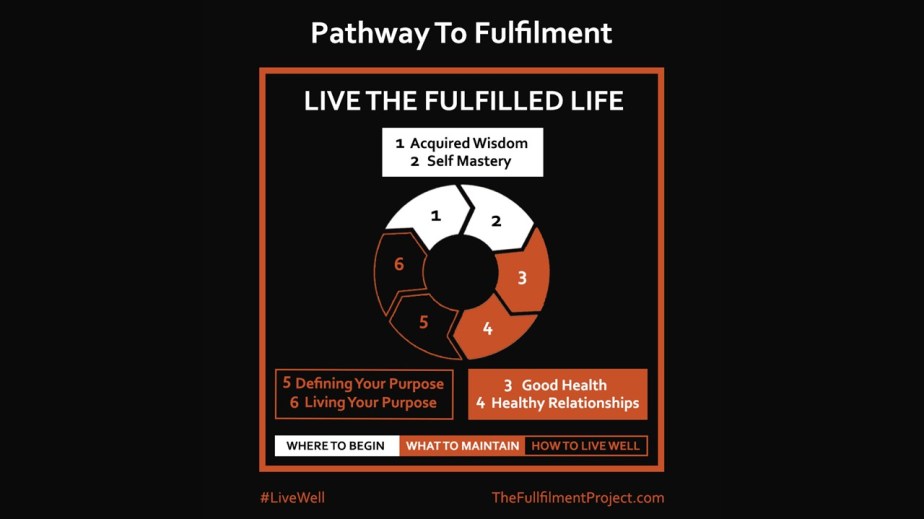
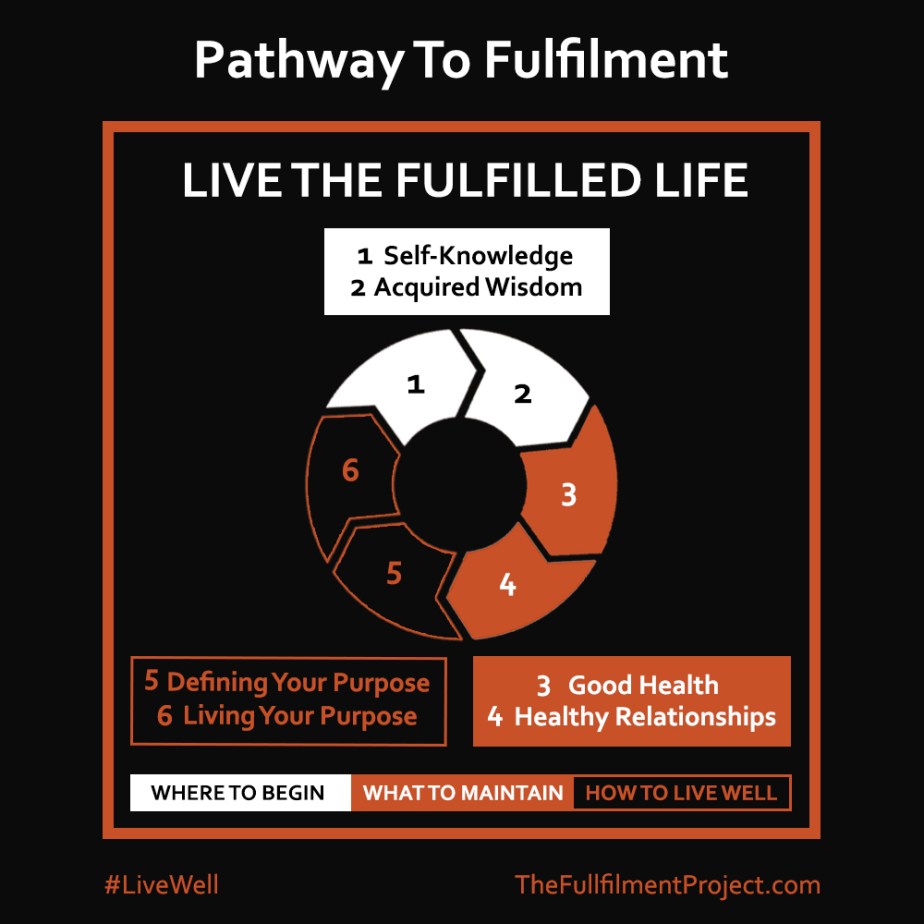
I have reflected on the first two steps to the existing Pathway and have moved Acquired Wisdom to Step 1, as I feel that wisdom gives us a strong foundation from which to build. I have replaced Self Knowledge with Self Mastery and moved it to Step 2, as self knowledge is a useful mental exercise, whereas self mastery is an actionable way of being, which is built on both wisdom and self knowledge. This, I feel, is a more effective part of the journey, as self mastery is required in order to have a life well lived. The six steps  are now Acquired Wisdom, Self Mastery, Good Health, Healthy Relationships, Defining Your Purpose and Living Your Purpose.

The six steps of the Pathway To Fulfilment are divided into Where To Begin, What To Maintain and How To Live Well. Now that I have an outline of a process that I believe will bring about fulfilment in ones life, I aim to add in the detail of the activities and actions you will follow within each step of the journey towards fulfilment and a life well lived. Watch this space and the Facebook Group Community for up and coming updates.

WHERE TO BEGIN

Step 1: Acquired Wisdom

We acquire the wisdom of others from a variety of sources, spiritual and secular. Wisdom challenges us and enlightens us. Often this is achieved by extensive reading, but, with the internet, a lot of this same wisdom can also be obtained through videos, audio books and pod-casts, however you learn best. This wisdom will feed into what you already know about yourself, it will influence how you see yourself and how you choose to live; helping towards self mastery.

There is a lot of wisdom out there to acquire, and it can sometimes be hard to distinguish wisdom from well sounding ignorance, so to simplify things for you I have broken down the wisdom I have found into ten Principles Of A Life Well Lived that will help you navigate the world skilfully. They are what I consider to be the essential wisdom to acquire. I will delve into each principle and explore how it will enhance your life. I have divided the principles into those that relate to Self and those that relate to Others. The principles related to Self are Growth, Equanimity, Fortitude, Seeking and Self Competition, and those related to Others are Stewardship, Servant-hood, Reciprocity, Joy Making and Connection. I will be sharing more detail on these moving forward.

Step 2: Self Mastery

The process of self mastery begins with getting to know yourself more substantially than you may have before; figuring out what really makes you tick, what you believe and don’t believe, what you think is true and false, what you think is ethical and not ethical, etc. It includes figuring out your beliefs and your ethics. Also, what happiness and success look like to you, personally, because our happiness and success are relative to our values, which are very personal to each of us. Our happiness and our success will not bring about fulfilment if they are not aligned with our values.  Self mastery begins with broad and deep self-knowledge and then in order to gain and maintain mastery of yourself you will need to cultivate both body and mind, the tools for which will come from the ten Principles Of A Life Well Lived.

This will primarily be mastery of your thoughts, which is the same whether you are embarking on self-development or a journey of faith. Our mind and body are in a sort of synergy, which means our thoughts effect the chemistry our brains create in our bodies, which in turn creates sickness or wellness. Wellness, being the optimal state to be in. Also, that if we fine tune our body through exercise, through practices such as Yoga, and if we cultivate strong Qi (Chi) in our energy system, through practices like Tai Chi and Qigong, our physical well-being will flourish and allow our mental mastery and well-being to develop too. Self Mastery is both physical and mental, which leads me to Step 3: Good Health.

WHAT TO MAINTAIN

Step 3: Good Health

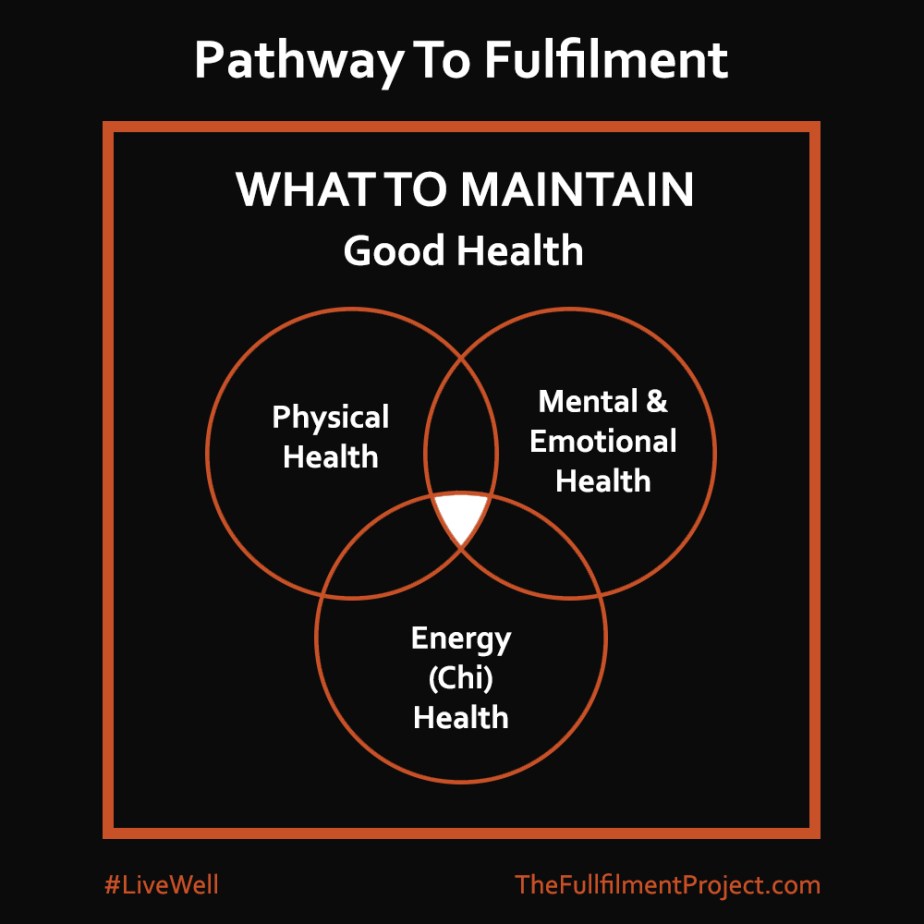
Your health should be of great concern, because good health is essential for your well-being and having an active, fulfilling life. I have included the usual physical health and mental and emotional health, and I have also included energy health; all of which could be thought of as a triad of good health. Good physical health includes diet and exercise. Good mental and emotional health includes mastering your emotions and balancing your thoughts. Good energy health includes mastering the Qi (Chi) that flows through your energy system, like blood through your bloodstream, as detailed in Traditional Chinese Medicine. To have good health you need to work on all three of these areas.

Step 4: Healthy Relationships

In this step you look at your relationships, and identify those relationships that are good for you and those that are not, and those that are a mixture of the two, that need work to become good. You should continuously work towards all of your relationships being healthy ones; meaning that they bring you happiness rather than stress, they uplift you rather than bring you down, and they are aligned with your values and ethics. These relationships are in circles of community, which are relationships with your self, your partner, your family, your friends, your colleagues and your acquaintances, and they are all interconnected.

HOW TO LIVE WELL

Step 5: Defining Your Purpose

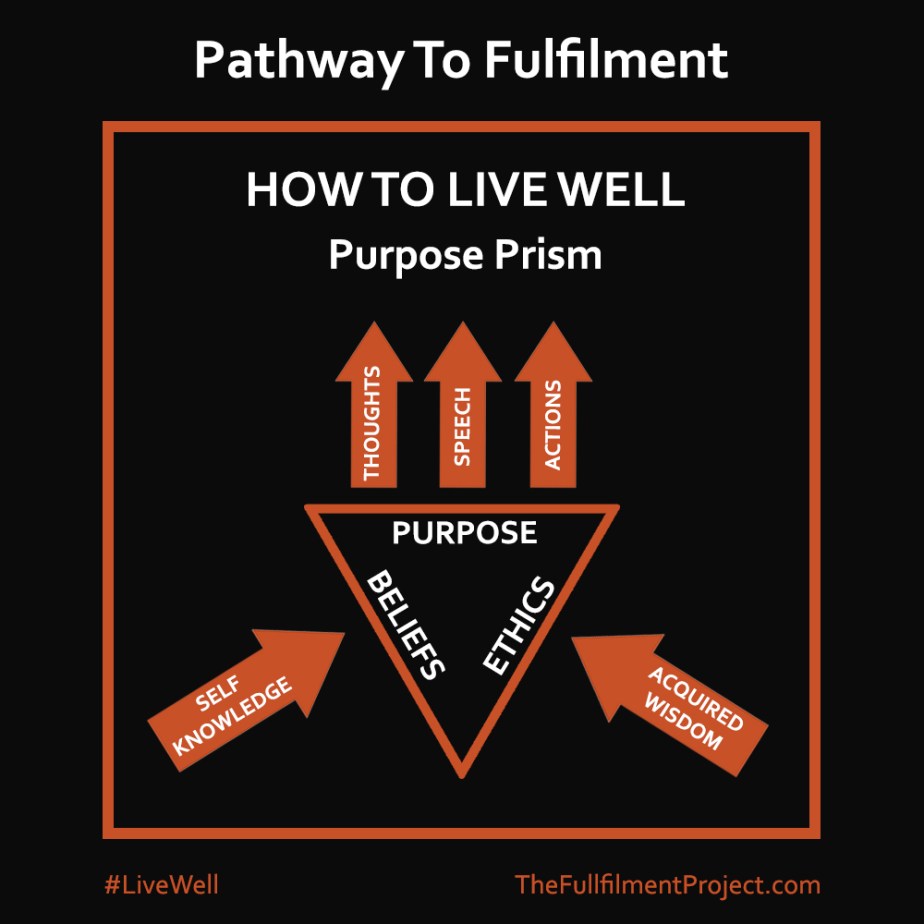
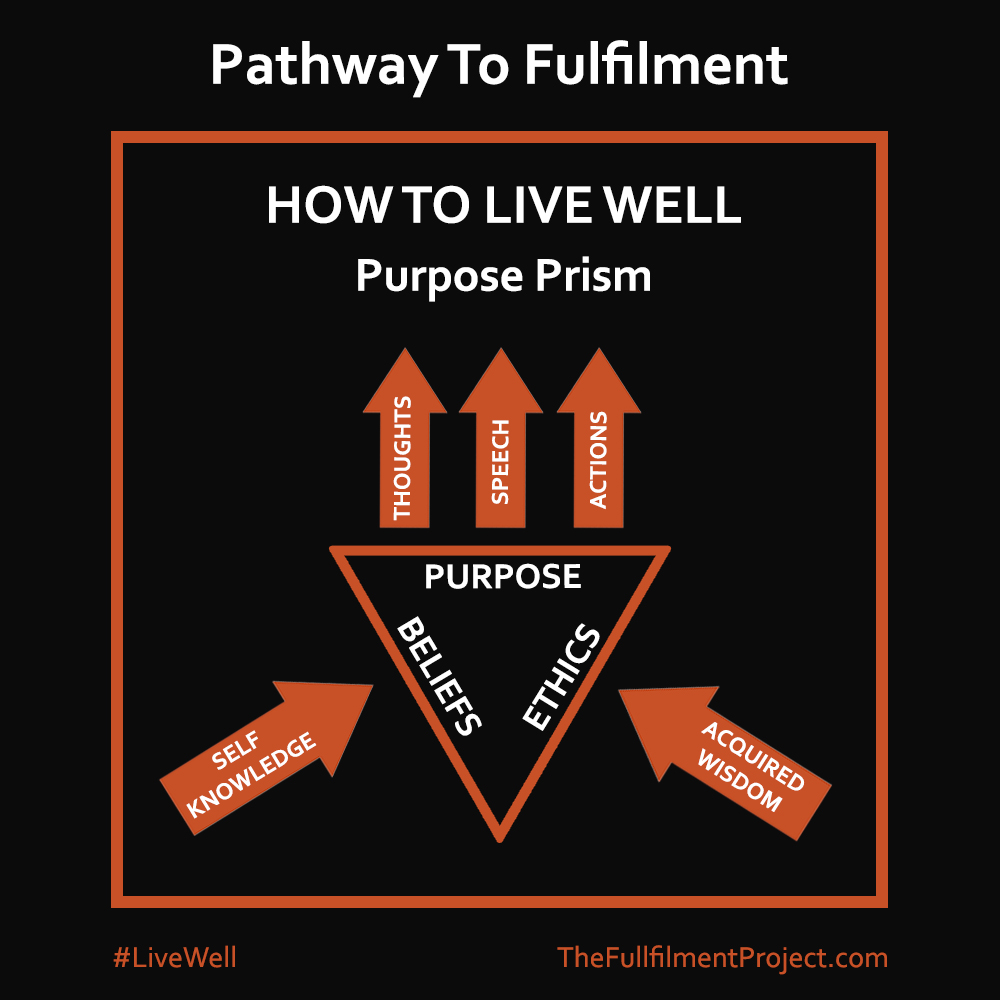
After working your way through this journey so far, you will have a solid foundation for how to start living your life better. From this new understanding of yourself, your defined beliefs and ethics form part of what I call your Purpose Prism, the third piece of this prism being your purpose. You will go through a process of building on your beliefs and your ethics, weaving in Acquired Wisdom and Principles Of A Life Well Lived, and all you have learned from steps 2, 3 and 4 and define your personal purpose. This prism is the filter through which you will see and experience the world, and it will influence your thoughts, speech and actions, making them wiser in nature. Your purpose comes from a vision of a better world that you want to help create.

Step 6: Living Your Purpose

You will then be set to start applying your beliefs, ethics and purpose to your life, to find your best way to live them out in your thoughts, speech and actions; to act on your vision of a better world through everything that you do. This is living your life on purpose. All of this work will mean that both happiness and success become personal, and therefore fulfilling, all three of which are bi-products of a life well lived. When the garden of our lives is tended to properly, these things blossom, but if we focus on achieving them without tending to the important things in our lives then these things will not blossom. Your happiness, success and fulfilment along your journey then feed back into your acquired wisdom, self mastery, health, relationships and your beliefs, ethics and purpose, and on it goes, because this journey is a life long endeavour. Follow the Path To Fulfilment and live well my friends.

Launching The Pathway To Fulfilment

I have done some work on what I have so far called the Fullfilment Framework and renamed it the Pathway To Fulfilment, a more linear and simpler journey. My intention is to create a process by which people can start to live well, and therefore have fulfilment. This is not a life hack or magical cure for what ails you. It is a deeply personal journey of self-discovery, of life balancing and purpose finding. There are four steps of this process which are foundational to a life well lived, they are Self-Knowledge, Acquired Wisdom, Good Health and Healthy Relationships.

The Principles Of A Life Well Lived have been folded into the Acquired Wisdom. I have separated these foundational steps and the other steps of the Pathway To Fulfilment, six steps in total, into Where To Begin, What To Maintain and How To Live Well. Now that I have an outline of a process that I believe will bring about fulfilment in ones life, I aim to add in the detail of the activities and actions you will follow within each step of the journey towards fulfilment and a life well lived. Watch this space and the Facebook Group Community and on Instagram for up and coming updates. This new Pathway To Fullfilment can also be found on the page on this website of the same name.

WHERE TO BEGIN

Step 1: Self-Knowledge

The process begins with getting to know yourself more substantially than you may have before; figuring out what really makes you tick, what you believe and don’t believe, what you think is true and false, what you think is ethical and not ethical, etc. Also, what happiness and success look like to you, personally. It is broad and deep self-knowledge. This is your starting point.

Step 2: Acquired Wisdom

You acquire the wisdom of others, from a variety of sources, spiritual and secular; wisdom that will challenge you and enlighten you, as wisdom should. Often this is achieved by extensive reading, but, with the internet, a lot of this same wisdom can also be obtained through videos, audio books and pod-casts, however you learn best. This wisdom will feed into your self-knowledge, and influence how you see yourself and how you choose to live.

Connected to Acquired Wisdom are ten principles that I believe generate fulfilment, because they are wise principles that will help you navigate the world skilfully and live your life well. I have divided them into those that relate to Yourself and those that relate to Others. The principles related to Self are Growth, Equanimity, Fortitude, Seeking and Self-Competition, and those related to Others are Stewardship, Servant-hood, Reciprocity, Joy Making and Connection. I will be sharing more detail on these moving forward.

WHAT TO MAINTAIN

Step 3: Good Health

Your health should be of great concern, because good health is essential for your well-being and having an active, fulfilling life. I have included the usual physical health and mental and emotional health, and also energy health; all of which could be thought of as a triad of good health. Good physical health includes diet and exercise. Good mental and emotional health includes mastering your emotions and balancing your thoughts. Good energy health includes mastering the Chi (Qi) that flows through your energy system, like blood through your bloodstream, detailed in Traditional Chinese Medicine. To have good health you need to work on all three of these areas.

Step 4: Healthy Relationships

You look at your relationships, and identify those relationships that are good for you and those that are not, and those that are a mixture of the two, that need work to become good. You should continuously work towards all of your relationships being healthy ones; meaning that they bring you happiness rather than stress, they uplift you rather than bring you down. These relationships are in circles of community, which are relationships with yourself, your partner, your family, your friends, your colleagues and your acquaintances, and all are interconnected.

HOW TO LIVE WELL

Step 5: Defining Your Purpose

After working your way through this journey so far, you will have a solid foundation for how to start living your life better. From this knew understanding of yourself, your defined beliefs and ethics form part of what I call your Purpose Prism, the third piece of this prism being your purpose. You will go through a process of building on your beliefs and your ethics, weaving in Acquired Wisdom and Principles Of A Life Well Lived, and define your personal purpose. This prism is the filter through which you will see and experience the world, and it will influence your thoughts, speech and actions, making them wiser in nature. Your purpose comes from a vision of a better world that you want to help create.

Step 6: Living Your Purpose

You will then be set to start applying your beliefs, ethics and purpose to your life, to find your best way to live them out in your thoughts, speech and actions, to act on your vision of a better world through everything that you do. This is living your life on purpose. All of this work will mean that both happiness and success become personal, and therefore fulfilling, all three of which are bi-products of a life well lived. They then feed back into your self-knowledge, acquired wisdom, health, relationships and your beliefs, ethics and purpose, and on it goes, because this journey is a life long endeavour. Follow the path to fulfilment and live well my friends.

Brexit: Them and Us

“Not one of us can rest, be happy, be at home, be at peace with ourselves, until we end hatred and division.”

– John Lewis

Them and Us

We have officially left the EU and have become an island unto ourselves. Times they are a changing, as the song goes, and it is important to reflect on the consequences of this change. There are two other growing parallel changes in the world as we move forward into the 21st century. Over the past few years, there has been a resurgence of nationalism is America and in countries across Europe, including the United Kingdom. Our departure from the EU has elevated the idea of ‘Britain First’ from the small conversations of the few into a more national conversation. You may have voted to remain or to leave the EU, you may now wish you had voted differently. Either way, we must be careful not to fall into the trap of thinking we are above or better than the countries of Europe, just because we say we are.

There has also been a rise in those who wish to protect our planet from the global, environmental crisis, which is becoming a movement that spans the world. This is being led by our youth, the ones who will be living in the world to come. They are trying to save their future, as the adults of the world appear to be trying to save their own national and personal priorities. Our strengths are always evident when we come together to achieve great things. Our weaknesses are evident when we separate into factions and try to take care only of our own.

Tribes

There is something inside human beings that pushes us towards trying to belong to a group. Wanting to belong to a group is a drive that is part of our evolution. In caveman times, it was safer to be in a group of people who would look out for our wellbeing; that would keep watch while we slept and would catch food so that everyone in the group could eat. Being part of a group, or a tribe, is a very human thing to do, and most of the time there is nothing wrong with this.

We support football teams, we belong to congregations, we are identified by the country in which we were born, the religion we follow, the ethnic roots we have. It is normal and adds to the variety of our communities and gives the individual, whether child or adult, a sense of not only safety, but also an understanding of themselves. However, what we need to be careful of is other people hijacking our drive to belong to a group, by setting us against people who belong to other groups. This is when we have real division, which then breads conflict. This happens in many places in the different areas of our lives; in the workplace, in schools, in social groups and in families.

Conflict On Demand

This is where division comes from, the dividing up of them and us. It happens with small groups of people and with countries, it happens with religions and with ethnicities, it happens between popular people and those who are not popular. We are fed conflict as entertainment, whether it is in the Big Brother house or characters in a soap opera, there is a pervasive message in modern culture that conflict between individuals or groups of people is entertaining.

If you think about the plays of Shakespeare, blockbuster films and programs on TV, there is very little that does not have a strong element of conflict. It would seem that there is a human desire to experience conflict, but when this spills out into our lives and we argue with other people, when we try to dominate other people or we create division between other people, this is when our actions and words bring conflict into the world.

The tensions and conflicts around the world, pose complex issues steeped in a human history of conflict across both national and religious lines, including the Crusades, the World Wars and the so-called War on Terror. What we need is exceptional leadership to guide us out of the darkness into the light. But that leaves people like you and me with a problem, what can we do to stem the flow towards division and conflict.

What Can We Do?

Well, what we do and what we say shapes the world we live in. Through our interactions we co-create our relationships, which in turn creates our society, which in turn creates our nations and our cultures. How we choose to live our lives will influence everything else, even if just a little.

What we need is a harmony revolution, because the only sensible way to counteract division in our own lives is to bring people together in harmony. By harmony I mean, to use a metaphor, the bringing together of very different instruments into an orchestra to create beautiful music. When we come together as human beings and we share what makes us unique, then we can collaborate, cooperate, and co-create. We can make the world a better place to be.

Often the best way to stop others trying to create an argument with us, or fight with us, on an individual level, is to not participate in the conflict, because then it fizzles out. If a fire has no fuel it will go out. A conflict needs two participating sides, if one side comes to the situation with peace, compassion and forgiveness, then healing can take place, because every attempt to create conflict does wound the other person, but if they do not retaliate then healing and harmony is possible. And when this happens, both sides are healed.

Those who are the angriest are the ones who suffer the most, because to be angry is to suffer. The best way to respond to anger is with compassion, because they are suffering, and compassion can extinguish anger. Nelson Mandela taught the world that forgiveness can free the soul and can break the cycle of fear and violence that can seem inescapable. There are inspirations in our global culture that lead us towards the light of freedom, forgiveness, compassion and love.

Healing Ourselves First

The words of the 1991 song by Micheal Jackson, Heal the World come to mind, “Heal The World, Make It A Better Place, For You And For Me, And The Entire Human Race.” And I believe that we can heal the world, one human interaction at a time, but we must start with ourselves. If we heal the divisions within ourselves; the prejudices and the grudges, we are more able to heal the divisions between ourselves and those in our lives.

I am not in any way negating the realities of the challenging daily lives in which we live. I am not assuming a totally peaceful Utopian ideal world is at our fingers tips either, but if each of us, in our own way, considers small ways in which we can connect more with our friends and families, neighbours and work colleagues on a more human level, this would be a great start. Taking the time, when possible, to make perhaps a bit more of an effort in ways that you may already be doing, to chat and ask after each other’s wellbeing, share a story or a joke. Our children and others will see this and perhaps change their own behaviour for the better.

Even though it seems such a small thing to do, there is evidence of efforts of this kind having a genuinely positive effect on those doing this and on those around them. So, I ask of you, in your own way, to have a think about what you can do, and what you may have thought about doing, along these lines, but have not done yet, because for one reason or another you just haven’t. Make that call to that friend or relative, knock on that door. Lift your head and give a sign of greeting and even stop for a quick chat with that neighbour or colleague at work. Connect with your eyes, words and smiles. Chances are the world will start smiling back at you a lot more often too.
5 Actions To Make 2020 The Best Year Yet

“Don’t mistake activity with achievement.”

― John Wooden

Figuring Out Your Beliefs and Values

This might seem a little too hippy for you to think about doing, but our beliefs and values are the prism through which we experience and act in the world. They are the reasons we do what we do and how we do it. If we believe it is wrong to steal we won’t, if we believe it is right to be generous then we will be.

Our beliefs are what we believe to be right and how we believe the world, and the universe, works. It is not just religious beliefs, which do also matter, but also beliefs about right and wrong, our morals and how people should behave. We also have beliefs about ourselves and how we allow ourselves to be treated. If we believe we are not worthy of respect, we will let people walk all over us, but if we believe we are worthy of respect, then we will expect it, or perhaps demand it.

Figuring out our values and beliefs sets the parameters for our lives. It gives us tools to navigate the world, to make good choices and will impact how our coming year and the rest of our lives will work out. If we don’t clearly define our beliefs and values we are kind of hitting and hoping with how we live our lives, which is certainly not a recipe for a successful, happy and fulfilling life.

Reviewing Your Priorities

Once we have our values and beliefs clarified we can set our priorities for the year ahead and look at how we are spending our time. If we look at our day or week we can see what percentage of our time we spend working, with friends, with family, engaging in hobbies, keeping fit, attending our place of worship, working on our goals etc.

Often we get stressed out because our life is out of balance. We sometimes spend too much time working or doing things for other people and not enough time for ourselves. Conversely, it is also not good to spend too much time doing personal activities and neglecting our loved ones or our jobs.

Finding a balance is a personal thing and therefore reviewing all the areas in our lives and thinking about what we care about is important. It may take a bit of time but it will mean your level of happiness, satisfaction and fulfilment in life will grow exponentially.

Removing The Bad Relationships

We all have relationships with other people, that is obvious, but the quality of those relationships matters. If someone in your life brings you down, makes you feel small, disrespects you on a regular basis or is just not good for you then you have two options.

The first option is to try and mend the relationship, to confront them on how they are treating you and stand up for your own wellbeing. All relationships should be built on equality and respect. They should include kindness, encouragement and generosity, if they do not then odds are they are having a detrimental effect on your wellbeing.

The second option is to cut them out of your life. If they are having a significantly negative impact on your life and confronting them on it either did not work or is not an option then they are not worth having in your life. Your life is wonderful opportunity to reach your full potential, to experience joy, success and fulfilment. No one has the right to get in the way of this and it your responsibility to manage your relationships, no one can do it for you.

Cultivating The Positive Relationships

On the flip side, we all have relationships in our lives that are very positive. People who give us love, encouragement, support and their time. These are the people we should be building our relationships. It can be easy to take these people for granted and assume that they will always be our friends and partner without any effort to cultivate these relationships.

However, if we do not spend time with these people, ask after their wellbeing, support them when they need us, and be a good friend or partner then we will grow apart and friends become acquaintances and partners move out of our lives.

it is also important to maintain and cultivate our relationships with workmates. These are people we spend a significant amount of time with and in order for the companies we work for, the team we work with and for us to thrive we need to build strong relationships with trust, loyalty and collaboration. All of these come from spending time with each other, face to face. Human being are social animals and we only trust people we know. We cannot do this over social media or by video conferencing, etc.

Reverse Engineer Your Dreams

We all have something we want to achieve, something big that lingers in the back of our minds, but seems too big to be able to get done. We usually tell ourselves that we will get around to working on this goal but life always get in the way. The reason we are not working towards this goal, whatever it might be, is that we are not prioritising it, we are not allocating time for it.

This might be because we have a mega busy lifestyle or it might be because the goal seems too big and we don’t think we will ever achieve, so we never start it. The first reason can be solved by breaking the goal into very small chunks and find time to slot these in during our day. For example, if you take public transport this is a perfect opportunity to read up on the goal in question or write assignments, notes, plans, etc.

The second reason is a lack of self belief. Depending on how deep this is you might just need encouragement from others or you might need something like Cognitive Behaviour Therapy if the issue is based on underlying bad experiences. If the latter is true there is no harm in seeking professional help to improve your well-being and quality of life, it can really help and is private.

Also, for the first reason asking someone who has a positive impact on your life to be an accountability partner can really help. Someone who knows your goal and who can check in with you on a regular basis to see how you are getting on and to give you encouragement and tips.

All of this is good, but you also don’t want the journey to your goal to take too long, so you need to speed up the process. To do this I recommend finding someone that you admire that has achieved the goal that you are seeking to achieve and study how they got there. Then you can reverse engineer the steps they took and take the same steps.

Some of the steps might not be applicable to you, or be things that are not available to you, but it will give you a road map. It will take some creative thinking and persistence. Once you have a plan it is important to set daily, weekly and monthly goals. Have a check list for time-frames like 3 months, 6 months, 1 year and 5 years. Take a course, read books, listen to podcasts, whatever it takes, you can do it. Have faith in yourself and go for it. We regret what we do not do more that the things that we do.

When you are at the end of your life in a nursing home don’t let this goal be a regret you wish you had tried to achieve. Good luck my friends, you can do great things with effort and persistence.

Something to think about

The limits we have in our lives are often created by ourselves, based on what we think the world expects of us. These limits are flexible barriers that can be changed or even removed. You are in charge of your reality.