Empowering Yourself

The idea of karma is something that often divides people, though many in the western world don’t spend the time to consider its implications, as they are more familiar with the monotheistic religions. I personally do believe in karma and I was thinking about it recently and I had a couple of insights that are relevant for everybody.

My understanding of karma is twofold, my present circumstances are a result of my past actions and my response to my current circumstances will result in my future circumstances.

If you find yourself in a good situation, you could think to yourself ‘I earned this.’ If you find yourself in a bad situation, you could think to yourself ‘I earned this.’ Owning your current situation based on your past actions is powerful. Thinking this way about bad situations could be seen as a negative thinking pattern, but not if you apply the second insight.

After considering your current situation, ask yourself ‘what do I do now to make things better?’ This will mean that you respond to the situation rather than reacting to it. You are asking yourself to put together a plan of action, you are empowering yourself to own whatever situation you find yourself in and move forward. This opportunity is always available, no matter what your present circumstances are.

The Fullfilment Framework Remastered

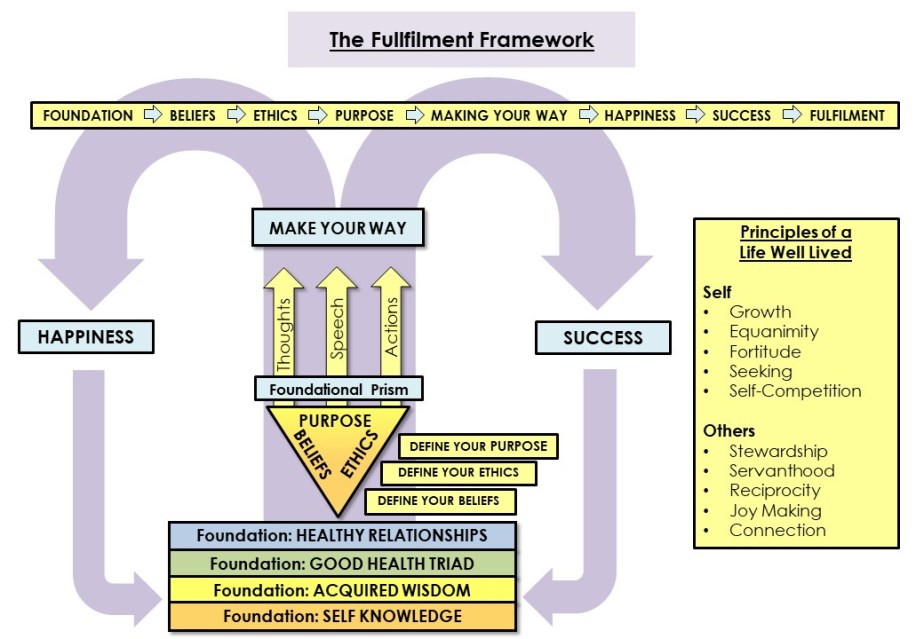
I have reworked my Fullfilment Framework, so it has a better journey towards fulfilment. This is a brief summary of the journey, which I will expand on later on this blog. This summary can be found on the Pathway To Fulfilment page.

Where To Begin

The Fullfilment Framework is a pathway to fulfilment. It is a deeply personal journey of self-discovery, of life balancing and purpose finding. The structure of the Fullfilment Framework begins with getting to know yourself more substantially than you may have before; figuring out what really makes you tick, what you believe and don’t believe, what you think is true and false, what you think is ethical and not ethical. Also, what happiness and success look like to you, personally. It is broad and deep self-knowledge. This is your starting place, the first level of the Foundation of the Fullfilment Framework. Next, you look at the wisdom of others, from a variety of sources; wisdom that will challenge you and enlighten you, as wisdom should. This wisdom will feed into your self-knowledge, and influence how you see yourself and how you should live.

Next, you look at Principles of a Life Well Lived, which are divided into those that relate to Yourself and those that relate to Others. The principles are; Self: Growth, Equanimity, Fortitude, Seeking, Self-Competition, and Others: Stewardship, Servanthood, Reciprocity, Joy Making, Connection. These are very much connected to Acquired Wisdom, because they are wise principles that I believe will help you navigate the world skilfully and live your life well.

What To Maintain

Next, you look at your health, which has three areas of concern in this framework. We have physical health, we have mental and emotional health and we have energy health; all of which make the Good Health Triad. Good physical health includes diet and exercise. Good mental and emotional health includes mastering our emotions and balancing our thoughts. Good energy health includes mastering the Chi (Qi) that flows through our energy system, like nerve signals through our nervous system. To have good health we need to work on all three of these areas.

Next, you look at your relationships, and identify those relationships that are good for you and those that are not, and those that are a mixture of the two, that need work to become good. You work towards all of your relationships being healthy ones; meaning that they bring us happiness rather than stress, they uplift us rather than bringing us down. These relationships are in circles of community, and these circles are relationships with yourself, your family, your friends, your colleagues, your acquaintances, and all are connected.

How To Live Well

After working your way through this journey so far, you will have a solid foundation for how to start living your life better. From this new understanding of yourself, your defined beliefs and ethics form part of what I call your Foundational Prism, the third piece of this prism being your purpose. You will go through a process of building on your beliefs and your ethics, weaving in acquire wisdom and the principles of a life well lived, and define your personal purpose, which completes the Foundational Prism. This prism is the filter through which you will see and experience the world, and it will influence your thoughts, speech and actions, making them wiser in nature. Your purpose is a vision of a better world that you want to help create.

You will then be set to start applying your foundation, principles and purpose to your life, to find your best way to live them out in your thoughts, speech and actions, to act on your vision of a better world through everything that you do. This is living your life on purpose. All of this work will mean that both happiness and success become personal, and therefore fulfilling, all three of which are bi-products of a life well lived, and they feed back into your Foundation and your beliefs, ethics and purpose, and on it goes, because this journey is a life long endeavour. Follow the path to fulfilment and live well my friends.

Always strive to be inspired and inspiring.

#LiveWell

Book Recommendation: Managing Oneself by Peter F. Drucker

Source of book cover image: Medium.com

Book can be bought here

Content of book can be read here

Why Read This Book

This is a small book full of deep wisdom around how we function in the workplace, what kind of person we are and what kind of place we should work in. Whether you are young or old, starting your career or further along, this little book can help you both live and work well.

Contents

  • What Are My Strengths?
  • How Do I Perform?
  • What Are My Values?
  • Where Do I Belong?
  • What Should I Contribute?
  • Responsibility for Relationships
  • The Second Half of Your Life
  • About The Author
  • Also By This Author

Summary

This book delves into questions around how we work and questions that we often do not consider when we are choosing where we work and the kind of job we choose to do. Questions like what our values are usually get left out of career conversations. The book goes on to discuss the contributions we make to the workplace and each other, as our relationships matter, and are things we are responsible for growing and maintaining. The book ends with a discussion on the second half of life, and what secondary work we begin in our later years that we are passionate about, whether this be Chair of the church council or Fund Raiser for a charity.

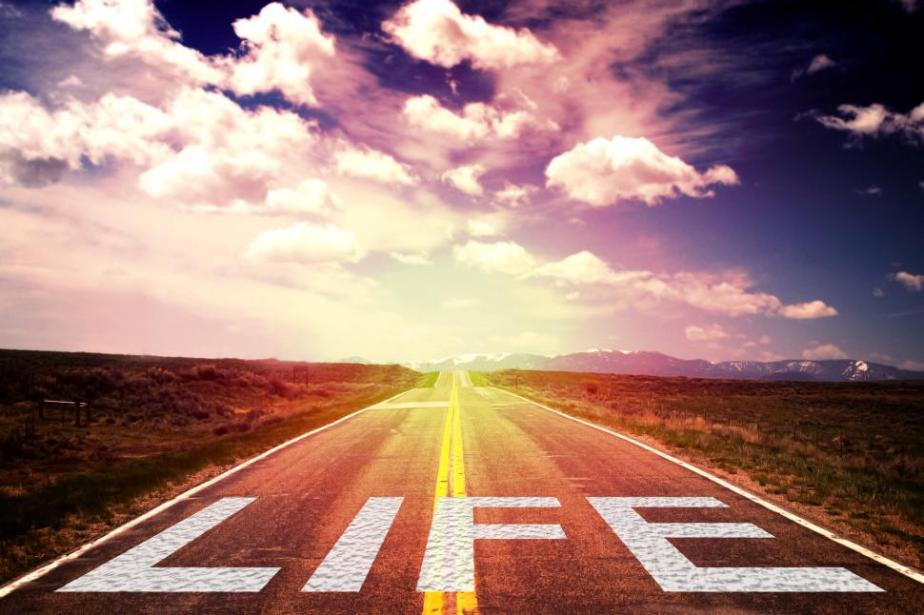
Our Life Long Journey-What Path Should We Follow?

“Your life is a journey. Your attitude is the guide.”
PJ Ferguson

Caught In a Pandemic

Today we are globally in difficult times with the Coronavirus pandemic, but different countries are handling it differently; some better than others, as these are unprecedented events. America seems to be falling into division and chaos, and in the UK there seems to be confusing advice on what we can and cannot do, leading to anxiety in some and other taking advantage and not following sensible advice to keep us. Other countries have done better and worse, depending on your point of view. It can seem that the future is uncertain and full of difficulty, but we cannot necessarily tell what the future will hold, as it has yet to happen.

Whatever our future holds, let us follow the wise words of those who came before us, who led with compassion and love, those who shone a light of hope in difficult times, like the prophets of our many religions and people like Martin Luther King and Nelson Mandela; leaders who helped us move towards a better way of living. Let us always have hope for the best, and as we make our way into the future, many things will come and go, and we will move past this pandemic, hopefully learning collectively and individually how to live a more balanced life. As we have slowed down and been confined indoors it has been an opportunity to pause and reflect on how we want to live. As many have said, when things go back to normal, it will be a new normal. It is up to us how this new normal will look for us, how our beliefs and ideas about life will influence our lives moving forward.

Our Journeys

As we move forward, we will all have different experiences and different journeys that we each take everyday. Before the Pandemic, there were both every day and religious journeys that we would take, those that work had a journey that they took to get to their job each day; whether by car, bus or train. Many are now working from home, including myself. Others who don’t work will have things that they did and places that they went to regularly, which have also changed.

Whatever we do with each day there are habits that we form, and familiar routines that we go through, as we go to familiar places. These journeys always seem to take less time and are comforting in some way, perhaps due to their familiarity, and the fact that they form part of the fabric of our lives and are connected sometimes to our habits and routines, like walking the dog or going to the pub on a Friday night. These journeys can be down the road, or to another town or city, or even to another country. Whatever the journey, and whatever the destination, there is always a reason for the journey, a purpose for going.

The Events In Life

Many of us have significant events that happen to us on the many journeys that we take, occasionally it is an event which we feel we are lucky to walk away from, a car crash, an illness, a decision which might of ended badly if we had made a different choice, all of these can be life changing, they can make us reassess our lives and our priorities. Sometimes these events are something a little less extreme, like meeting someone and falling in love, having a baby, getting the job you wanted, or just coming to a realisation that causes a change in direction in our lives. Everyday any of these things can happen, life is changing all the time, and our interactions with others are often what cause these changes.

We Go Through Life Together

The journey that we each take through life is one that we share with our friends, and our family, and the things that we do are witnessed by our children. Even though we spend our efforts passing on wisdom and knowledge that we have discovered in the course of our lives, we also pass on examples of how to behave through our actions, we are role models for our children and the actions that we take, and the path through life that we choose, can be copied. The path we take can become the path that our children take, so it would be best to live in a way that we want our children to live, to live up to the wise lesson that we try to instill in them.

We are never alone in the life we lead, there are always people with which we interact; people at work, people on the bus, people in a congregation, friends and family. We live very interconnected lives, and in doing so we learn from each other everyday, we always know more than we did the day before, we are always learning through our experiences, our education, our everyday interactions.

Putting Things Into Perspective

In a way this is how mankind has evolved over the centuries, our interactions have manifested in a collaboration of ideas and knowledge, that has given us the development of human beings from early man to our current level of intelligence and development. This trend will continue, and the paths that we all take will inform the wider community, and the human race as a whole. We are all part of a greater society, and our actions are like drops of water in a lake, the ripples spread out along the water’s surface, eventually having a far-reaching effect on the rest of our world.

We are all parts of a whole and we all have individual lives to lead as well. It is a paradox of sorts. We all want to do what is best for ourselves, yet we also want to do what is best for others too. So how then should we live our lives? What paths should we take on our journey from birth to death? That is something we all have to work out for ourselves, though I do advise looking into the teachings of the many prophets, spiritual leaders, and wise sages that have contributed to the pool of spiritual knowledge that can be found in any of the holy texts and scriptures that every culture has.

Every culture has this knowledge because each of them have had someone who has understood it and documented it, and because this knowledge is not restricted to any one culture, it is a universal wisdom which is part of the universe, and is there to be discovered by anyone who has the ability to see it and understand it. So, think about what path you want to make through life, and how you want to live, then take that first step and keep walking.

Something to think about…

Sometimes life gives us a challenge that can be an opportunity. What challenges do you have currently that could be an opportunity?
Self Knowledge: Limiting Beliefs

“Happiness has to do with your mindset, not with outside circumstance.”
― Steve Marabol

Our Beliefs

One of the key things to figure out when we are aiming to get a deep knowledge and understanding of ourselves is our beliefs. Often our beliefs are subconscious, yet they will dictate our thoughts, speech and actions repeatedly. Our beliefs play a major role in our thinking and how we react to people and situations and how we handle stressful times; do we find the positive or do we crumble? There are beliefs that we have which are very beneficial, but there are also limiting beliefs that get in the way of us progressing and being happy in life. 

Strategies To Change Our Beliefs

It is important to figure out what our limiting beliefs are, so we can replace them with beliefs that will help us to thrive. There are techniques employed by Performance Coaches that get deep into our psyche and make constructive changes. For example, Emotional Freedom Technique (EFT) and Neuro-linguistic Programming (NLP). There is also Byron Katie’s The Work, which is on my list of things to research.


It can also be beneficial to keep a journal, to write about the good and the bad each day, what we plan to do with the day and what we have learned at the end of each day. To write down our thoughts and feelings, so we can become familiar with our thought patterns, to figure out the limiting beliefs from the empowering ones.


For example,  I have limiting beliefs around failure, which can lead me to assume I will fail, that in turn can become a self-fulfilling prophecy. That is unless the thoughts are spotted and corrected when they pop up. If corrected enough these thoughts stop showing up as much, and can even disappear all together. This something I am working on at the moment.


We are capable of the things we believe we can do, with hard work and many hours of practice, if we believe big. It is no different with changing our mental habits, it takes time to remove limiting beliefs at their root. Some are more deeply rooted than others. I would begin by writing a journal to get a sense of your thought processes, and to watch how you react to good and bad situations. It is also important to observe what we consider to be good and bad as well.

Fixed and Growth Mindset

Some see challenge as a prompt to try harder, where as some will think “why does this always happen to me?” The latter is from a fixed mindset, where things are fixed and not flexible; things are the way they are and we can do nothing to change them, or we are the way we are and there is nothing we can do the change ourselves. This is, of course, not true; our brains are very capable of change, they are changing all the time.

Developing a flexible growth mindset that sees adversity as an obstacle that can be navigated is a lot more beneficial. A fixed mindset will be full of limiting beliefs that create barriers where there are opportunities. For example, if our role at work begins to change, like suddenly having to work from home during a global pandemic, you can think about all the issues that you might face, or you can think about the new skills you will learn working remotely, and all the job opportunities this will open up for you in the future in other job roles.

Owning Our Own Thinking

If we are going to work at our best, live at our best and be happier and more successful, it begins with figuring out our limiting beliefs and replacing them with ones which fill our lives with potential, but as the title of Byron Katie’s website suggests, we have to do the work, no one will do it for us. So, take ownership of your own life’s journey and remold your thinking towards happiness and success, and you will start to live better and your level of fulfilment will rise to levels you may never have felt before.

Something To Think About…

What are the goals that you hope to achieve in life and what are the barriers you put in place that prevent you from starting on these goals? What are the beliefs behind the barriers? What beliefs would put you in a better position to achieve your goals, that you could replace the limiting beliefs with?

Having a generous spirit

“You often say, ‘I would give, but only to the deserving.’ The trees in your orchard say not so, nor the flocks in your pasture. They give that they may live, for to withhold is to perish.”

– Kahlil Gibran, The Prophet


Christmas Spirit

Christmas is always a time for giving. Whether it be the cultural act of gathering and giving presents or the big push by advertising companies to get people to buy their products as Christmas gifts, there is no getting away from it at this time of year. It is a time when we put a lot of thought into the gifts we buy for our loved ones, because we want our gift to make them happy, to make them smile when they open it. The good feeling is a shared experience; they feel good when they get something they want and we feel good to see them so happy.

It is not the gift itself that makes us happy, as such, it is largely the act of giving and receiving that brings out our happy. So why is it that we are not as generous, generally, throughout the rest of the year. Obviously we cannot afford to be buying presents for people all year round. However, if the real meaning of generosity is in the act of giving, then we can choose how we are generous in ways that do not cost any money at all. They do however cost time and energy, two things that we all have.


Generosity is a Mindset

At any time we can give someone a smile, we can actually listen to someone, we can ask how someone’s day is going and care about the answer, we can help someone carry their bags up some stairs, we can hold the lift doors open so someone who needs the lift doesn’t have to wait for the next lift to be available, we can complement someone, we could wish someone good day, we could give our time to help someone with something that we are skilled at and they are not. There are countless things we could do to give our time, our energy and our words.


“Imagine if we could spread a little

happiness just by being nice to other people.”


As we gather together this Christmas and become more generous, loving and sharing let us begin to imagine what the world would be like if we treated everyone with the same love and respect as we do our own loved ones. Imagine if we could spread a little happiness just by being nice to other people. Imagine how happier you will be as a result of so much giving. We feel good when we give, so let us bring the Christmas spirit into our hearts and let it linger there beyond the New Year and on for the rest of the year.


Give more smiles, wish more people well, and if you are someone who prays, pray for everyone we encounter who is going through difficulty, even those we do not get along with. To be angry, jealous, frustrated or sad is to suffer, so let us spread a little love and start a generous revolution. Our world is shaped by how we interact in it, so let us shape our world to be a kinder, more loving place that we all want to be a part of.


Something to reflection on:

The way we perceive the world is our reality. Our actions in the world help to build someone else’s perception of the world. Positive thoughts, words and actions can change the world for others and ourselves.